

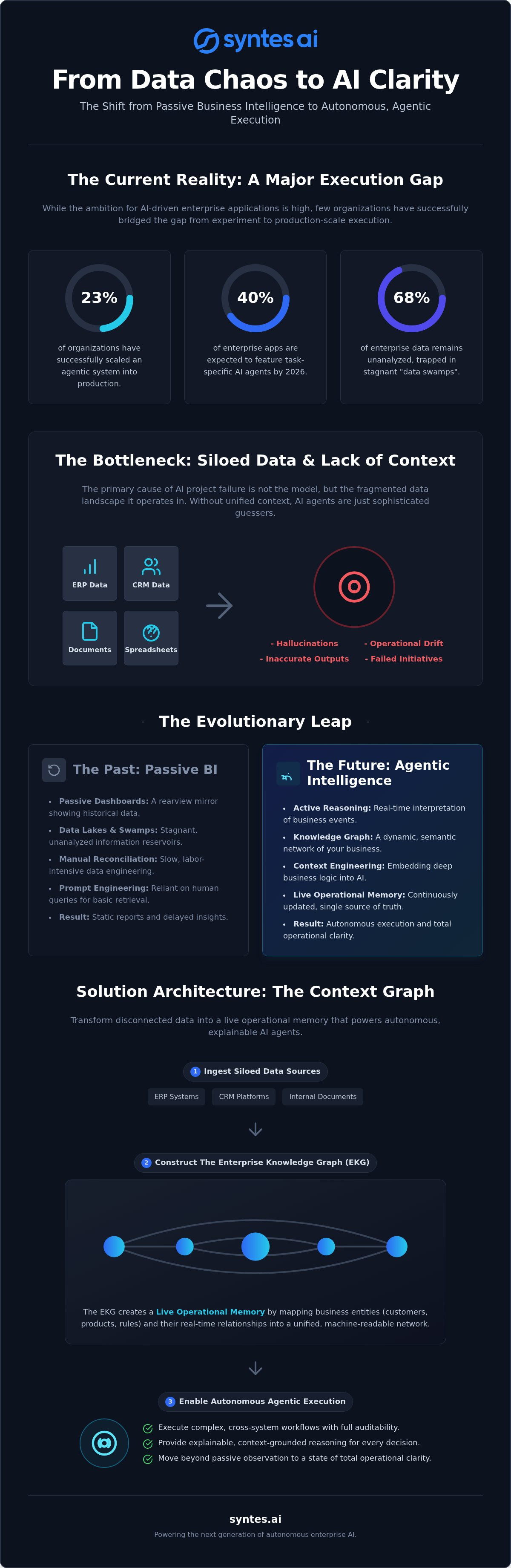
The era of the experimental chatbot is over; it’s time for the era of execution. While 40% of enterprise applications are expected to feature task-specific AI agents by the end of 2026, the current reality is stark. Only 23% of organizations have successfully scaled an agentic system into production. The bottleneck isn’t the model logic; it’s the absence of a robust knowledge graph for operational intelligence. You’ve seen high-priced AI initiatives stall because they can’t bridge the gap between legacy ERP silos and disconnected CRM data. Without a unified context, your agents are merely sophisticated guessers prone to hallucinations and operational drift.
You need more than a simple retrieval system. You need a live operational memory that understands your specific business rules in real time. This article demonstrates how to transform disconnected data into a Context Graph that powers autonomous, explainable AI agents. We’ll examine the critical shift from passive prompt engineering to active Context Engineering. You’ll learn how to build a governed architecture where agents don’t just answer questions. They execute complex, cross-system workflows with auditable reasoning. We’re moving beyond the black box toward a state of total operational clarity.
Key Takeaways
- Abandon the limitations of passive dashboards and transition to active intelligence capable of real-time operational reasoning.
- Architect a knowledge graph for operational intelligence to transform static data silos into a dynamic, semantic network of business entities.
- Evolve beyond standard RAG through Context Engineering, ensuring AI agents possess the deep business logic required for complex decision-making.
- Empower autonomous agents to execute cross-system workflows with total auditability and governed enterprise memory.
- Utilize a live operational memory to capture real-time business events, creating a continuously updated foundation for agentic execution.
Beyond the Dashboard: Why Traditional Business Intelligence is Obsolete
Traditional Business Intelligence (BI) has failed the modern enterprise. For decades, organizations poured millions into data lakes, hoping that massive storage would spontaneously generate operational clarity. It didn’t. According to IBM, 68% of enterprise data remains unanalyzed. These lakes have become data swamps; expensive, stagnant reservoirs of information that serve as a historical record rather than a strategic asset. Static dashboards are essentially rearview mirrors. They show you where you’ve been, but they’re useless for navigating the immediate complexities of a real-time global operation.
The fundamental flaw lies in the nature of passive intelligence. Historical reporting tells you that a supply chain disruption occurred last Tuesday. It doesn’t tell you how to resolve the resulting inventory imbalance across three different continents today. We’re witnessing a necessary pivot from historical reporting to real-time reasoning. This shift requires a knowledge graph for operational intelligence; a system that doesn’t just store data points but understands the complex relationships between them. It provides the semantic framework necessary for AI to interpret business events as they happen, moving the enterprise from a state of observation to a state of performance.
The High Cost of Data Fragmentation
Siloed ERP and CRM systems are the primary inhibitors of enterprise agility. When your customer data lives in one system and your logistics data in another, your AI agents operate in a vacuum. This fragmentation is the root cause of the hallucination problem in production environments. Large Language Models don’t hallucinate because they’re creative; they hallucinate because they lack the proprietary enterprise logic and relationships to ground their outputs. Disconnected documents and spreadsheets only exacerbate this context gap.
Manual data engineering for BI is no longer a scalable strategy for 2026. The labor-intensive process of reconciling disconnected data sources is too slow for the speed of agentic execution. Enterprises can’t wait for a weekly batch update to make a decision that needs to happen in milliseconds. The high operational cost of manual reconciliation is a tax on innovation that most companies can no longer afford to pay.
From Data Points to Interconnected Knowledge
True operational intelligence demands a transition from isolated database records to relationship-based intelligence. This requires a Knowledge Graph that serves as a unified context layer. By representing customers, products, and business rules as a dynamic web of nodes and edges, you create a machine-readable map of your entire operation. This architecture connects structured data from your databases with unstructured data from your internal documents, creating a single source of truth for your AI systems.
It transforms static data warehouses into a Live Operational Memory. For most organizations, solving enterprise data silos is the mandatory first step toward deploying autonomous agents that can actually execute. Without this interconnected foundation, your AI is just a faster way to make the same uninformed decisions. You don’t need more data; you need a more intelligent way to connect what you already have.
Architecting the Enterprise Knowledge Graph: Converting Silos into Semantic Intelligence
Architecting a knowledge graph for operational intelligence isn’t a mere data engineering task; it’s a strategic reconstruction of enterprise reality. An Enterprise Knowledge Graph (EKG) functions as a semantic network of business entities. It maps the DNA of your organization. Every customer, product, and business rule exists as a node. The relationships between them are the edges. This creates a dynamic web that mirrors actual operations rather than just recording them. Knowledge graphs are unique because they reveal semantic intelligence hidden within siloed data. They provide a shared language where AI agents and human operators finally speak the same dialect.
A static graph is a dead graph. To power agentic AI, your EKG must evolve in real-time with business events. This live operational context ensures that when a supply chain node shifts, the ripple effects are immediately visible to the agents responsible for execution. You aren’t just building a map; you’re building a nervous system.
Components of a Modern Context Graph
The backbone of a sophisticated graph lies in its ontologies and taxonomies. These frameworks define the enterprise-wide business semantics, establishing the “is-a” and “part-of” relationships that prevent AI confusion. Modern architectures utilize hybrid graph databases to manage complex, multi-dimensional relationships that would paralyze a standard relational system. By integrating business rules and policies directly into the graph structure, you embed governance into the data itself. This ensures that every automated action remains within the bounds of corporate compliance and operational logic.
Knowledge Graph vs. Traditional Databases
Traditional databases rely on rigid, schema-first tables. They break when complexity increases or when new data types emerge. In contrast, knowledge graphs utilize a flexible, schema-on-read nature that adapts to the messy reality of enterprise data. Graphs excel at multi-hop reasoning and complex operational pathfinding. If you need to determine how a regional power outage affects specific high-priority contracts across three different subsidiaries, a graph finds the connection instantly. This semantic data layer for enterprise is the new standard for organizations that value speed and accuracy. To see this architecture in action, you can book a demo to explore how we unify these disparate threads into a single execution layer.
Context Engineering: The Evolution of Knowledge Graphs for AI Reliability
Standard Retrieval-Augmented Generation (RAG) is a blunt instrument. It relies on vector similarity to find information, essentially guessing what’s relevant based on word patterns. For a knowledge graph for operational intelligence, similarity isn’t enough. You need causality. Context Engineering is the emerging enterprise discipline of building and governing the specific business context that AI agents require to function reliably. It moves beyond simple text retrieval to provide a structured, machine-readable map of how your business actually operates. While RAG might find a document about a product, Context Engineering explains how that product relates to a specific customer’s contract, current inventory levels, and regional shipping regulations.
This approach prioritizes operational relationship intelligence. It maps the “why” behind data connections, allowing agents to understand the implications of a data point rather than just its existence. Using graphs to prevent AI hallucination in reporting is the only path toward deterministic truth. By grounding AI responses in a verified semantic network, you eliminate the creative guesswork that plagues consumer-grade models. Your agents stop being chatbots and start being reliable executors of business logic.
The Syntes AI Context Engineering Framework
We approach context through a rigorous three-step process designed for the scale of global enterprise. First, we Connect. This involves integrating disparate structured data from ERPs with unstructured data from internal wikis and PDFs. Second, we Understand. Our platform automatically discovers entities, hierarchies, and business semantics to build a coherent map. Finally, we Contextualize. We create a live, continuously evolving model of the business that reflects real-time changes. This framework ensures that your AI agents aren’t just intelligent; they’re informed by the most current operational reality.
Explainable AI and Semantic Governance
Trust in AI is built on transparency. Knowledge graphs provide an auditable reasoning path for every decision an agent makes. If an agent denies a credit extension or reroutes a shipment, you can trace the exact semantic nodes and business rules that led to that outcome. This level of explainability is mandatory for regulated industries. Furthermore, we apply security, permissions, and compliance at the semantic level. This means your AI governance isn’t an afterthought; it’s baked into the very fabric of your data. Incorporating Human-in-the-Loop systems ensures that human expertise continues to refine the graph, maintaining integrity and trust as the system scales.
Operationalizing Intelligence: From Passive Insights to Agentic Execution
Observation is no longer a competitive advantage. In a market moving at machine speed, viewing a dashboard is a passive act that costs time you don’t have. We’re witnessing the rise of Agentic BI. This shift represents the transition from simply interpreting historical data to deploying autonomous agents that act on it. A knowledge graph for operational intelligence serves as the cognitive architecture for this evolution. It provides the necessary enterprise memory that allows agents to execute complex business processes safely and effectively. Without this grounded context, an agent is just a script running in the dark. With it, the agent becomes a strategic executor.
The true power of this architecture lies in cross-system integration. Modern enterprises are fractured across legacy ERPs, CRMs, and supply chain management tools. These are disconnected silos that prevent holistic action. A knowledge graph bridges these gaps, serving as the brain for workflow automation. It doesn’t just store information; it governs the logic of execution. By mapping the relationships between a customer’s contract in the CRM and inventory levels in the ERP, the graph enables agents to perform multi-step workflows that were previously manual and error-prone.
Steps to Deploy Agentic Operational Intelligence
- Step 1: Unify fragmented data. Ingest structured and unstructured sources into a governed semantic layer. This creates the foundational knowledge graph for operational intelligence that agents will use for grounding.
- Step 2: Define Action Spaces. Establish clear boundaries for AI agents. These action spaces are based on graph-validated business rules, ensuring every automated task remains compliant and logical.
- Step 3: Implement GraphRAG. Deploy advanced reasoning capabilities. This allows for multi-step execution where the agent can traverse the graph to find non-obvious solutions to operational hurdles.
Real-World Use Cases for Agentic Knowledge Graphs
In the supply chain, autonomous inventory rebalancing is now a reality. Agents use live operational context to reroute shipments before a stockout occurs, factoring in real-time weather and logistics data. In financial services, the graph enables explainable fraud detection. Agents don’t just flag a transaction; they provide a traceable path of reasoning based on deep relationship intelligence. Retailers are also leveraging this to create personalized customer journeys. By understanding the deep connections between past purchases, current browsing behavior, and loyalty status, agents can execute hyper-targeted interventions that drive immediate revenue.
The Syntes AI Context Graph: Building a Live Operational Memory
The Syntes AI Platform represents the definitive evolution in systemic integration. It is not a passive library. It is a specialized solution combining Enterprise Knowledge Graphs with a high-performance agentic AI framework to achieve total operational clarity. This architecture functions as a Live Operational Memory. It doesn’t just store data; it captures real-time business events and transforms them into actionable context. By utilizing two-way connectors, we ensure a seamless data flow across the enterprise AI infrastructure, allowing for a shared context layer where human experts and AI agents collaborate with unprecedented precision.
Context Graph vs. Static Knowledge Graph
Traditional repositories focus on creating “Golden Records.” They treat the knowledge graph for operational intelligence as a static map for human analysts to study. This approach is insufficient for the speed of 2026. The Syntes Context Graph is a living execution environment. It handles the messy reality of both structured ERP data and unstructured internal assets with equal dexterity. While competitors offer data persistence, we offer Operational Relationship Intelligence. This means our platform understands the “why” behind every connection, ensuring your agents operate with a deep, governed understanding of your business logic rather than just a list of facts.
Getting Started with Syntes AI
Transitioning from legacy BI to an agentic intelligence layer doesn’t require a total system overhaul. It begins with the strategic adoption of Context Engineering. We provide the tools to bridge the gap between your current data silos and a unified execution layer. Through the use of No-Code AI Apps, we democratize graph access across your entire organization. This allows non-technical stakeholders to leverage the power of the graph without deep architectural knowledge. The next evolution of your AI strategy starts here. It moves you away from passive observation and toward a state of informed, automated performance. You possess the data; we provide the sophisticated tools to bring order and execution to it.
The Mandate for Agentic Execution
The era of passive reporting is over. Enterprises that continue to rely on historical dashboards will find themselves outpaced by competitors who have embraced active, automated reasoning. By architecting a knowledge graph for operational intelligence, you move beyond the structural limitations of fragmented data silos. You create a live operational memory that empowers autonomous agents to execute complex, cross-system workflows with total precision. Syntes AI stands as the leader in Context Engineering, providing the sophisticated framework required to transform raw data into a governed, machine-readable semantic layer.
Trusted by global enterprise leaders, our platform ensures that your AI strategy is built on explainable AI reasoning rather than black-box guesswork. The transition from observation to performance is no longer optional; it’s the new standard for systemic integration. You’ve identified the flaws in traditional BI. Now, it’s time to deploy the solution that brings order to the messy reality of large-scale operations.
The path to total operational clarity is clear. Take the first step toward a future where your data doesn’t just sit in a stagnant lake; it acts as the governing brain for your entire enterprise.
Frequently Asked Questions
What is a knowledge graph for operational intelligence?
A knowledge graph for operational intelligence is a dynamic semantic network that unifies structured and unstructured data into a live operational memory. Unlike static repositories, it captures real-time business events and the intricate relationships between entities like customers, inventory, and business rules. It provides the high-fidelity context required for AI agents to reason and execute tasks. This architecture transforms fragmented silos into a single, machine-readable truth that powers immediate decision-making across the enterprise.
How does a knowledge graph improve AI accuracy in the enterprise?
Knowledge graphs improve accuracy by providing deterministic grounding for Large Language Models. Most AI errors occur because models lack specific enterprise context and business logic. By mapping proprietary relationships and rules in a graph structure, you provide a verified source of truth. This allows AI systems to move beyond pattern matching to relationship-based intelligence. The result is a system that understands how a specific contract relates to a logistics delay, ensuring precise outcomes.
What is the difference between a knowledge graph and a semantic layer?
A semantic layer provides a standardized glossary of business terms for human and machine consumption. A knowledge graph extends this by populating those definitions with actual, interconnected data and real-time relationships. While a semantic layer defines what a customer is, the graph shows exactly how that customer interacts with products, support tickets, and legal policies. It’s the difference between a dictionary and a living, breathing map of your entire operation.
Can a knowledge graph help prevent AI hallucinations?
Yes, knowledge graphs are the most effective tool to prevent AI hallucinations in production environments. Hallucinations usually stem from a lack of grounded data or the inability to reconcile conflicting information across silos. By enforcing business rules and verified relationships within the graph, you create a deterministic truth layer. AI agents query this layer to validate their reasoning before generating output, ensuring every response is anchored in auditable enterprise facts rather than probabilistic guesses.
How do you build an enterprise knowledge graph for BI?
Building an enterprise knowledge graph starts with the Connect phase, where you integrate disparate sources like ERPs and CRMs. Next, the Understand phase uses automated discovery to identify entities, hierarchies, and business semantics. Finally, you Contextualize by building a live model that reflects real-time operational events. This process requires a hybrid graph database and a robust governance framework to ensure data integrity and security across the semantic layer.
What is GraphRAG and why does it matter for business intelligence?
GraphRAG is an advanced retrieval technique that combines graph structures with Retrieval-Augmented Generation. It matters for business intelligence because it enables multi-hop reasoning that standard vector searches can’t achieve. If you need to know how a regional supplier’s bankruptcy impacts your production schedule across three subsidiaries, GraphRAG traverses the connections to find the answer. It provides the deep, relational insights necessary for complex operational pathfinding and long-term strategic planning.
How do AI agents use knowledge graphs to execute tasks?
AI agents use knowledge graphs as a governed action space and live memory. The graph provides the business rules and constraints that tell the agent what actions are permissible. When an agent needs to execute a cross-system workflow, it traverses the graph to understand the dependencies between systems like your CRM and supply chain tools. This ensures the agent acts with a full understanding of the business context, preventing unauthorized or illogical operations.
Is a knowledge graph better than a traditional data warehouse for BI?
A knowledge graph isn’t a direct replacement for a data warehouse, but it’s the superior foundation for a knowledge graph for operational intelligence. Data warehouses excel at historical reporting and batch processing. However, they struggle with the complex, multi-dimensional relationships required for agentic AI. Graphs offer a flexible, schema-on-read architecture that adapts to changing business needs faster than rigid tables. For organizations prioritizing execution and real-time reasoning, the graph provides the necessary agility and connectivity.