
A successful AI pilot can still fail in production. The practical answer to how to move from a PoC to production AI is to treat the transition as an operational readiness programme, not simply a model handoff. The timeline depends on data quality, integration complexity, security requirements, and testing scope.
A working proof of concept may seem close to deployment, but a pilot demonstrates feasibility, not dependable performance in real workflows. Production requires evidence that the system can handle representative inputs, connect safely to enterprise data and applications, meet business requirements, and remain monitored and governed after launch.
This guide explains how a provider assesses readiness, validates data, designs AI and retrieval-augmented generation (RAG) architecture, and establishes monitoring, governance, and guardrails. You’ll see what separates a promising experiment from an operational system, which risks need attention before deployment, and how to make a grounded decision about the next step.
Key Takeaways
- Distinguish a promising pilot from a production-ready system by assessing reliability, operational ownership, and business value.
- Evaluate whether enterprise data is reliable, representative, and available enough to support real workflows at scale.
- Design AI and RAG architecture around secure data access, system integration, performance, and cost control.
- Establish monitoring, governance, and guardrails before deployment, then keep oversight active as the system evolves.
- Identify where an Enterprise Knowledge Graph, Context Engineering, or cross-system integration can address obstacles to production readiness.
How Does a Provider Establish Monitoring, Governance, and Guardrails?
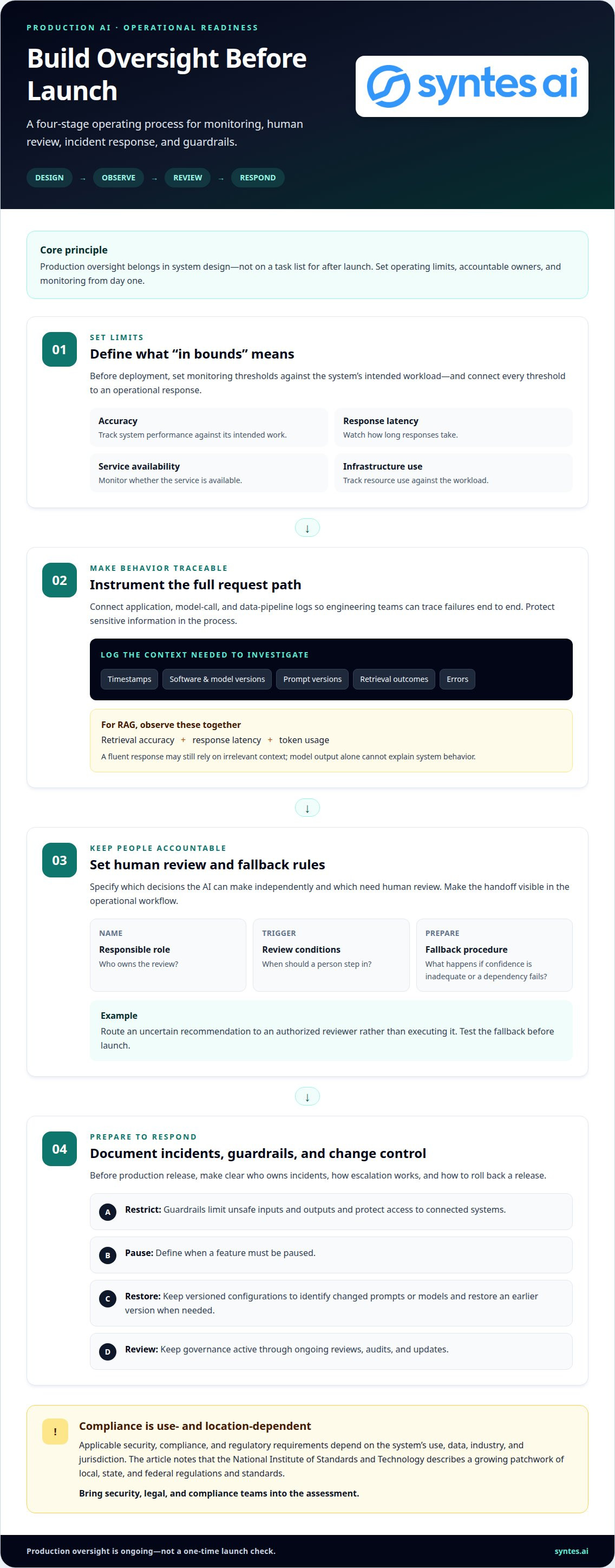
Production oversight should be part of system design, not a task postponed until launch. The transition requires defined operating limits, accountable owners, and monitoring from day one.
-
How Providers Configure Production Monitoring
Set monitoring thresholds before deployment, then connect each threshold to an operational response. Track accuracy, response latency, service availability, and infrastructure use against the system’s intended workload. The cost of moving an AI proof of concept into production depends on scope, data readiness, integrations, security, and ongoing monitoring; pricing is provided after a quote request. Avoid treating a successful test as evidence that production costs or performance will stay constant.
-
How Providers Set Up Logging and Observability
Instrument the application, model calls, and data pipeline so engineering teams can trace failures across the full request path. Logs should record timestamps, software and model versions, prompt versions, retrieval outcomes, and errors while protecting sensitive information. For a RAG workflow, monitor retrieval accuracy, response latency, and token usage together. A fluent response may still rely on irrelevant context, so model output alone cannot explain system behavior.
-
How Providers Plan Safety and Human Oversight
Define which decisions the AI system can make independently and which require human review. Oversight plans should name the responsible role, the conditions that trigger review, and the fallback procedure when confidence is inadequate or a dependency fails. For example, an uncertain recommendation can be routed to an authorized reviewer rather than executed. Test the fallback before launch and make the handoff visible in the operational workflow.
-
How Providers Prepare Incident Response and Guardrails
Document incident ownership, escalation paths, and rollback steps before production release. Guardrails should restrict unsafe inputs and outputs, protect access to connected systems, and define when a feature must be paused. Keep versioned configurations so teams can identify a changed prompt or model and restore an earlier version when needed. Governance also requires ongoing reviews, audits, and updates. The National Institute of Standards and Technology describes AI regulation as a growing patchwork of local, state, and federal regulations and standards.
Production readiness checks for reliability and security
In the United States, applicable security, compliance, and regulatory requirements depend on the system’s use, data, industry, and jurisdiction. The National Institute of Standards and Technology describes a growing patchwork of local, state, and federal regulations and standards, so providers assess relevant obligations with security, legal, and compliance teams. A provider’s plan for how to move from PoC to production AI should account for these requirements early.
-
How Providers Assess Organizational and Technical Readiness
Assign an owner to every production responsibility before deployment, including model management, data pipelines, incident handling, and software updates. Then map dependencies between teams and systems. A project is not operationally ready if nobody owns a failed integration or approves a model change.
Set acceptance criteria for both business value and system behavior. For example, define the response quality, latency, and reliability required under representative workloads. Confirm engineering teams can maintain code and configuration after launch, rather than relying on one contributor’s knowledge. These decisions clarify how to move from PoC to production AI as an accountable operational change.
-
How Providers Check Deployment and Environment Readiness
Compare the test environment with the intended production environment, including access controls, connected services, deployment pipelines, and recovery procedures. Test credentials may allow access that production permissions restrict. Verify that the deployment process records software and model versions, and confirm teams can reverse a release that causes failures.
Run evaluation queries through the actual deployment pipeline after each release. Assess response quality and latency, then investigate changes before exposing an update to users. Include failure scenarios such as unavailable dependencies or malformed inputs. This establishes whether production handles real operating conditions, not just a successful demonstration.
-
How Providers Verify Data Quality and Readiness
Trace the data required for each AI task to its source, owner, and update process. Assess whether operational data is reliable, representative, and continuously available. For example, a recommendation system may produce inconsistent results if a key business field is stale or missing across connected records.
Test the pipeline with representative inputs and check how it handles incomplete, duplicated, or outdated records. Confirm that access permissions match the data’s sensitivity and intended use. Data readiness means more than a clean sample: the production workflow must consistently receive relevant information and preserve its meaning as systems change.
-
How Providers Review Security and Compliance Requirements
Bring security, legal, and compliance teams into validation before deployment. Map the data the system processes, who can access it, and where outputs go. Assess obligations that apply to the use case and jurisdictions, rather than treating a general AI policy as a complete compliance review.
Test controls against realistic risks, including unauthorized access, prompt injection, and exposure of sensitive information. Review audit logging and retention practices against organizational policy. A readiness checklist should record each control, its owner, supporting evidence, and unresolved risk. For a focused review of these decisions, book a readiness discussion.
Production architecture for AI and RAG services
Design the production architecture around data boundaries, system responsibilities, and operating constraints. For RAG, connect enterprise context to the model without directly exposing raw source data.
-
How Providers Review Production Architecture and Integration
Map each request from the user interface through the application and AI services. One production pattern separates a user interface, a .NET API, a Python AI service, a vector database, and an LLM provider. Each component needs a defined responsibility, access boundary, and failure path. This separation lets teams update one service without rebuilding the entire application.
For RAG, retrieve only relevant passages and pass controlled context to the model. Avoid sending raw data directly to an LLM. The architecture should define how documents enter the index, how permissions affect retrieval, and how updated records replace stale context. A vector database should be designed to scale to millions of vectors as the corpus grows.
Trace integrations across systems before selecting the final design. PwC reported in September 2026 that 52% cited integration complexity as the most common reason technology investments fell short of expectations. Treat each connection as an explicit dependency: identify its data format, access method, failure behavior, and owner. That makes integration risk visible before deployment.
-
How Providers Conduct Technical Architecture Reviews
Review the architecture against measurable performance, security, and cost requirements. Test the complete request path, including retrieval, model response, and downstream actions. For example, measure whether a delayed source system also delays the user response, then decide whether the service needs a timeout or fallback. Evaluate the design under expected workload patterns, not just isolated queries.
Keep prompts outside application code and version them independently. This lets engineering teams update instructions, compare evaluation results, and restore an earlier version without changing unrelated software. Track model and prompt versions with each deployment so any change in response quality has a traceable cause.
Finally, compare the design with the organization’s data boundaries and operating model. Confirm that access controls apply during retrieval, not only at the user interface. Document component owners, dependencies, and update paths so the architecture remains maintainable as models, data sources, and business workflows change.
How Does a Provider Validate Data Quality Before Scaling?
Before production, assess whether operational data is reliable, representative, and continuously available. Privacy and governance checks include role-based access, prompt-injection protections, audit logs, and safeguards for sensitive information.
-
How Providers Assess Data Quality and Enterprise Context
Profile the records that support each business task, then test completeness, consistency, freshness, and relevance. For example, a forecasting application may produce misleading outputs if regional sales records use different product identifiers. A provider maps those fields to business meaning, checks how missing values affect outputs, and evaluates representative records rather than relying on a polished sample.
Test whether the information reflects enterprise-specific processes, terminology, and exceptions. A model may confuse an internal abbreviation with a common phrase unless its context is clear. PwC’s 2026 Digital Trends in Operations research found nearly nine in ten respondents said poor data quality affected progress toward value from digital initiatives.
-
How Providers Integrate Data and Unstructured Sources
Trace how structured records and unstructured content reach the AI application. Examine source systems, extraction steps, document formats, and update frequency. For a RAG workflow, test whether a retrieved passage preserves the document’s meaning and relevant metadata. A technically successful import is not enough if tables, headings, or access labels disappear during processing.
Design ETL or ELT pipelines to detect failed transfers, stale records, and schema changes. Validate outputs after each transformation and compare them with their source. For example, if an updated policy document enters a retrieval index, confirm outdated versions no longer influence answers. Document data owners and pipeline dependencies so scaling does not obscure accountability.
- Test pipeline behavior as data volume, user demand, and model complexity change. A small sample may conceal bottlenecks in transformation, indexing, or retrieval. Measure how processing delays affect application responses and determine which pipeline components can scale independently. Test incremental updates too, so new records become available without unnecessarily rebuilding every dataset.
Validate real inputs, including incomplete records and unexpected formats. Compare results across relevant data subsets to expose uneven performance, then trace errors to the source, transformation, or model context. This helps isolate whether a quality issue requires data correction, pipeline changes, or a revised retrieval strategy before broader use.
- Apply governance controls throughout ingestion and use. Role-based permissions should restrict which records users and AI services can access; audit logs should capture relevant access and processing events. Providers also test safeguards against prompt injection and check that sensitive data is handled according to organizational privacy policies.
Connect data lineage, access decisions, and quality findings to the application’s operating process. Assign owners for source changes and pipeline failures, and retest affected outputs after updates. This gives teams a practical basis for scaling across users and models while preserving traceability and controlled access.
Differences between AI pilots and production systems
A pilot proves feasibility; production proves an AI system can deliver reliably in real workflows. The difference is operational evidence, not a more convincing demonstration.
- Distinguish a proof of concept from a minimum viable product. A proof of concept tests whether an idea can work; an MVP is the smallest product version intended for real users. Neither label establishes production readiness on its own. A pilot may rely on curated inputs, manual oversight, or limited integrations, while production must support repeatable work across actual users, data, and connected systems.
Gartner’s September 2026 analysis of AI strategy and organizational readiness reports that 59% of AI pilots fail to reach production. Treat that figure as a warning against equating a successful experiment with an operational capability. Identify what remains untested: real inputs, system dependencies, ownership, governance, and sustained business value.
- Test failure consequences, not just average accuracy. A pilot scoring 70% accuracy can still create substantial production risk; that example also means a 30% failure rate in production. The business impact depends on the task. An incorrect internal summary differs from a mistaken output that triggers an operational action.
Have the delivery team classify errors by severity and workflow impact. Check whether users can detect and correct them, whether the system can abstain, and what happens when retrieval provides weak context. Set acceptance criteria around the consequences of errors, not a single aggregate score that hides critical failure types.
- Measure production outcomes beyond model accuracy. Track system reliability, response times, operational costs, and user adoption alongside answer quality. For example, accurate outputs delivered too slowly may disrupt a time-sensitive workflow. A technically stable system may still fail if employees bypass it or repeat work manually.
Connect each measure to the intended business process and review results under representative usage. Compare model responses with the actual task outcome, such as whether a support agent resolves a case using retrieved information. This distinguishes useful intelligence from plausible text that adds no operational value.
- Require evidence across the complete AI system before scaling. Evaluate retrieval, integrations, access controls, human review, and governance as parts of one workflow. A model can perform well in isolation while production retrieval returns outdated documents or a downstream application rejects its response.
Make the scale decision using these combined results. Proceed when the system meets agreed quality and operational thresholds, owners can manage changes, and failures have defined handling paths. If evidence reveals a weakness, narrow the use case or address the underlying issue before expanding users or automating more consequential actions.
Syntes AI
Syntes AI helps organizations address the connected data, context, and integration challenges that can stall AI projects before production. Its Enterprise Knowledge Graph and Context Engineering support structured, actionable enterprise context, while Cross-System Integrations connect AI capabilities with existing software environments. The Syntes Agentic Platform enables businesses to deploy and manage AI agents for operational tasks.
Turn to Syntes AI when a promising proof of concept needs a stronger foundation in enterprise data and connected workflows. The next step depends on where readiness gaps remain, whether in data context, system integration, or governed agent deployment.
Contact Syntes AI to discuss your production goals.
Make the Next AI Decision Operational
The next step isn’t to expand a pilot simply because it works in a controlled setting. Decide what operational capability the organization needs, which workflows should change, and what evidence will justify each stage of expansion. A clear plan for how to move AI from a PoC into production connects those decisions to accountable ownership and measurable business outcomes.
Keep the initial production scope focused. Use evidence from real workflows to decide whether to refine the system, extend it to another process, or pause expansion. This discipline makes deployment a deliberate business decision rather than an open-ended experiment.
When enterprise context and connected systems are central to your rollout, Syntes AI’s Context Engineering Platform can help you plan the right path forward.
Build with purpose, learn from production, and let evidence shape what comes next.
Frequently Asked Questions
How long does productising a PoC take?
For most mid-market companies, moving a proof of concept into production takes 4 to 12 weeks. Teams deciding how to move from PoC to production AI should account for data access, integration complexity, security needs, and acceptance criteria. A provider can estimate the work after mapping dependencies and open decisions. A prototype requiring major workflow changes needs more preparation than one with a clear operational path.
How Common Is AI Pilot Purgatory?
It remains a significant execution challenge. PwC’s September 2026 research on the AI execution gap found that 34% of respondents said their organizations were scaling AI implementation across the enterprise, while 27% said AI was fully embedded across business units. The gap between experimentation and broad integration shows why projects need accountable owners, operational plans, and evidence of business value before expansion.
How Can a Provider Build for MLOps and LLMOps From Day One?
Build MLOps and LLMOps into the delivery workflow, rather than treating operations as a later handoff. Version models, prompts, and evaluation datasets; automate repeatable tests; and record changes with each release. For example, if an updated model changes classification behavior, the team can compare evaluation results with the previous version and decide whether to proceed or revert.
How Can a Provider Define Success Metrics Before Scaling?
Start with the business outcome, then set measurable acceptance criteria for the workflow. For a document-processing project, metrics could include the share of cases completed without correction and the time employees spend resolving exceptions. Establish a baseline before deployment, assign an owner to each measure, and define review points. This ties success to operational impact, not just favorable model outputs.
How Can a Provider Integrate AI With Existing Systems and Data Pipelines?
Map how data and actions move between the AI application and existing systems, then define interfaces and failure handling. For example, check an AI-generated update against the destination system’s required fields before submission. Integration testing should cover permissions, changing data formats, and unavailable dependencies, so a failure in one service doesn’t silently disrupt the wider workflow.
How Can a Provider Help Secure Stakeholder and Executive Buy-In?
Make the decision concrete by identifying the business problem, accountable sponsor, affected teams, and evidence needed to justify investment. A practical proposal can show how a specific workflow changes, where human decisions remain, and which operational measure will indicate value. Addressing these points early helps executives assess the initiative as a governed business change, not merely a technology demonstration.
How Can a Provider Manage LLM Costs During the Transition?
A provider tracks token usage by workflow and relates it to task completion, not just request volume. Forecast usage from representative workloads, then set budgets and alerts around operating needs. The team can examine whether long prompts or repeated requests drive consumption and test changes against response quality. This makes cost control an explicit design decision before wider adoption.
What are the stages for moving an AI proof of concept to production?
A practical answer to how to move from PoC to production AI is to treat the work as staged decision-making. A 90-day roadmap begins with 30 days to validate the use case, business problem, data readiness, and stakeholder alignment. Days 31-60 prepare the solution for production; days 61-90 focus on deployment and scaling. Each stage should provide evidence for the next commitment.