

AI value comes from choosing fewer initiatives with clearer strategic fit, not from automating every possible task. The practical answer to how to manage a portfolio of AI projects is to rank opportunities by expected business value, delivery readiness, resource demand, and exposure to cost, trust, ethics, and privacy risks. Then fund, monitor, and adjust the portfolio against evidence, not enthusiasm.
AI can accelerate project work, but automation alone does not make an initiative worth pursuing. Leaders need a consistent view of what each project should improve, what it requires, and how its results will be evaluated.
This article explains how to prioritize AI initiatives, balance portfolio capacity, and give the PMO meaningful oversight. It also covers where AI automation can improve portfolio decisions, and why data quality, human review, governance, and safeguards remain essential to protecting value.
Key Takeaways
- Prioritize initiatives by strategic fit, expected value, delivery readiness, and risk, then align funding and specialist capacity with those choices.
- Give the PMO consistent data on objectives, resources, progress, outcomes, and governance so AI recommendations can be reviewed by accountable people.
- Assess data quality, privacy, trust, ethical impact, and operating costs alongside potential benefits, with safeguards for technical and reputational risks.
- Use AI insights to strengthen portfolio reviews and forecasting, but keep human judgment in decisions about priorities, exceptions, and value realization.
- Automate repeatable project tasks where useful, then track progress and deviations to determine whether automation is improving delivery.
Resource optimization and capacity planning
Portfolio planning connects AI initiatives to strategic objectives, available capacity, and expected value. To manage a portfolio of AI projects effectively, make those trade-offs visible before teams commit scarce resources.
Allocating Resources and Forecasting
Resource allocation and forecasting match each project’s budget, staffing, data, and computing needs to its expected work. This matters because promising use cases can stall when essential skills or infrastructure are committed elsewhere.
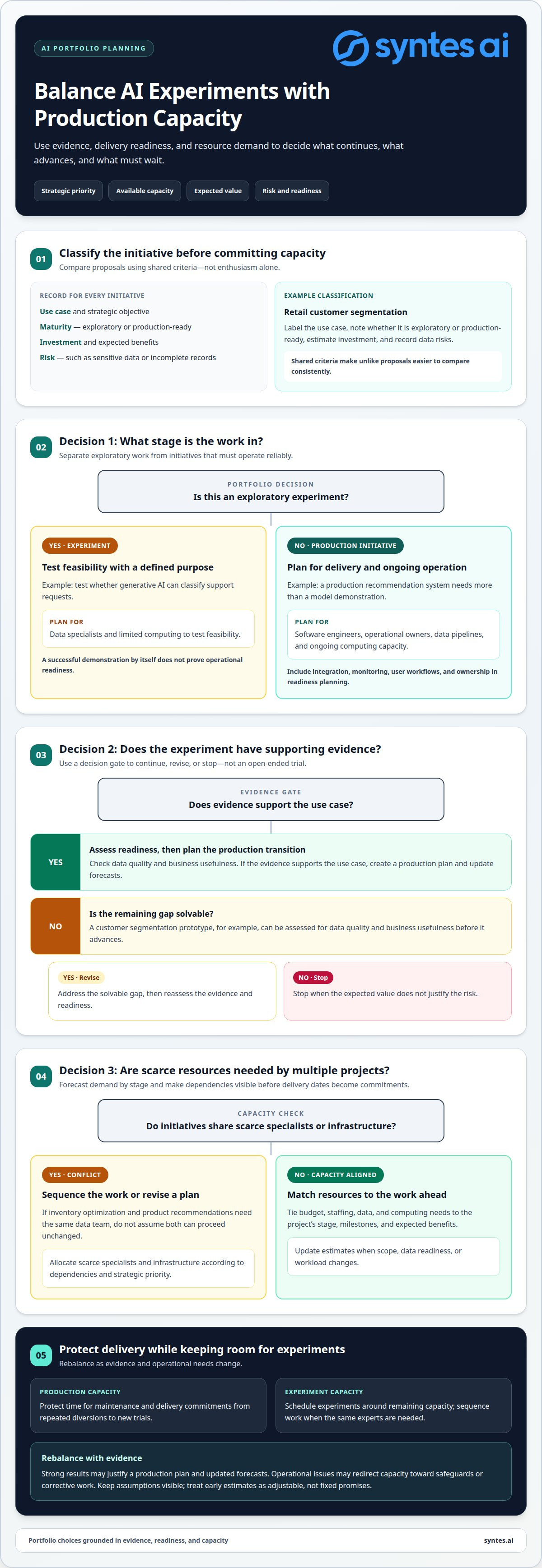
Categorize initiatives by use case, maturity, investment, and risk. For example, classify retail customer segmentation as an operational use case, then record whether it is exploratory or production-ready. Estimate the investment and note risks such as sensitive data or incomplete source records. Shared criteria let decision-makers compare proposals consistently.
Forecast demand at each project stage. A generative AI experiment may need data specialists and limited computing to test feasibility. A production recommendation system may require software engineers, operational owners, data pipelines, and ongoing computing capacity. Record these needs alongside milestones and expected benefits.
Allocate scarce specialists and infrastructure according to dependencies and strategic priority. If inventory optimization and product recommendations need the same data team, sequence the work or revise one plan. Forecasting reveals this conflict before delivery dates become commitments. Update estimates when scope, data readiness, or workload changes.
Keep assumptions visible. A project with uncertain data access may warrant a smaller initial commitment than one with an established pipeline. Tie each capacity request to its use case and next decision point instead of treating early estimates as fixed promises.
Balancing Experiments and Production Projects
A balanced portfolio funds exploratory work while protecting capacity for mature AI projects. Experiments create options, while production systems bring ongoing delivery and operational risks.
Separate experiments from production initiatives by maturity and purpose. An experiment might test whether generative AI can classify support requests. A production project must also address integration, monitoring, user workflows, and ownership. A successful demonstration alone does not establish operational readiness.
Set a decision gate for each experiment: continue when evidence supports the use case, revise when a solvable gap remains, or stop when the value does not justify the risk. For example, a customer segmentation prototype can advance once its data quality and business usefulness have been assessed.
Protect production capacity from repeated diversions to new trials. Reserve specialist time for maintenance and delivery commitments, then schedule experiments around remaining capacity. If both workstreams need the same software or data experts, sequence them rather than assuming both can proceed unchanged.
When deciding how to manage a portfolio of AI projects, shift the balance as evidence changes. Strong results may justify a production plan and updated forecasts; operational issues may redirect capacity toward safeguards or corrective work. Base trade-offs on evidence, not novelty alone.
Data PMOs Need Before Adopting AI in Portfolio Management
Before AI informs portfolio decisions, the PMO needs reliable records, defined approval boundaries, and named human owners. In the United States, requirements depend on the data, sector, use case, and jurisdictions involved. Map applicable privacy, sector-specific, and contractual obligations before approving each initiative.
Build a governance-ready portfolio record
Give every initiative a record linking its business objective to its data, decision rights, and delivery status. Include the accountable business owner, intended users, data sources, access permissions, expected outputs, and known limitations. For a retail forecasting project, for example, distinguish sales data from customer-level information and identify who can approve its use.
This structure helps the PMO compare initiatives and trace how recommendations affect portfolio decisions. It also makes reports more useful: leaders can see whether an AI recommendation reflects current project data, an outdated assumption, or an incomplete record. Log changes to scope, data, and ownership so later reviews have a clear basis.
Set approval boundaries for AI agents
AI agents can summarize status, identify dependencies, and recommend resource changes, but those outputs should not become approvals by default. Gartner’s governance research states that AI agents cannot be accountable entities, so PMO staff should review AI-generated recommendations. Gartner’s report “Strengthen AI Governance to Manage Agentic AI Risks” was dated 8 July 2026.
Define which actions an agent may prepare and which require a person’s decision. For example, an agent may flag a delayed project, while a portfolio leader approves a schedule change or funding shift. Assign an owner to review the recommendation, document the rationale, and record the final decision. This boundary preserves useful automation without transferring accountability to software.
Apply governance across the portfolio
A global retail company initially struggled to align AI initiatives with strategic objectives and maintain transparency and governance. Portfolio management helped improve the coherence, transparency, and governance of its initiatives. The example shows why PMOs need a shared view across use cases, not isolated project reports.
For retail initiatives such as customer segmentation, product recommendations, and inventory optimization, a shared record can show objectives, data dependencies, owners, risks, and approval status. This helps decision-makers spot duplicated work or conflicting assumptions before initiatives scale. It also supports consistent reviews as projects move from testing to operational use.
Make review boundaries explicit in each portfolio report: who evaluates AI-generated insights, who approves consequential changes, and what evidence supports the decision. A consistent AI governance discussion can help clarify how connected portfolio context supports those reviews.
AI limitations in PPM, including data quality, trust, cost, ethics, and privacy
AI can sharpen portfolio decisions, but weak data and hidden risks can undermine strategic value. Treat data quality, trust, operating cost, ethics, and privacy as decision criteria, not issues to postpone until deployment.
Data quality sets a ceiling on useful analysis. Gartner’s planning assumption projects that by 2028, PMOs with AI-ready data foundations will have 70% higher AI accuracy than peers using low-quality data. In practice, inconsistent project names, stale status fields, or missing dependencies can produce recommendations that misrepresent the portfolio. Before using AI insights, establish clear definitions for key fields and identify who maintains them.
Trust depends on whether decision-makers can interpret an output and understand its basis. For example, a system might flag a delivery delay because its data shows unresolved dependencies. If the PMO cannot trace that signal to current project records, leaders have little basis for action. Preserve the source data, assumptions, and rationale behind significant recommendations, then compare them with actual project conditions.
Costs extend beyond model access. A portfolio assessment should include computing, data preparation, software integration, monitoring, and specialist effort. AI projects may require data scientists, ethicists, and end users, so staffing is part of the investment. Compare ongoing inputs with measurable benefits, such as time saved or improved quality. Reassess when usage or maintenance demands change.
Privacy needs attention because AI projects often use extensive, sometimes sensitive, data. Map which project records contain personal or confidential information, who can access them, and how data moves between systems. For example, a workforce-planning initiative should distinguish aggregated capacity information from employee-level records. Limit data use to what the project needs, and involve relevant privacy and security reviewers in governance.
Ethical review should examine how a system’s outputs affect people and business decisions. A prioritization model trained on past delivery outcomes, for instance, could reproduce patterns in those records instead of reflecting current strategic priorities. Involve ethicists and end users when defining evaluation criteria, then assess recommendations for uneven effects, misleading assumptions, and outcomes that conflict with intended use.
Risk management should cover technical, operational, ethical, and reputational exposure. A failed integration can disrupt a workflow; an inaccurate recommendation can distort funding choices; a privacy incident can damage trust. For each initiative, define a monitoring approach, escalation owner, and contingency plan before reliance grows. Include safeguards that pause or limit use when data quality deteriorates or outputs fall outside approved boundaries.
These controls make trade-offs visible without treating AI as either a universal solution or an automatic threat. A PMO can compare expected value with data readiness, operating demands, stakeholder trust, and potential harm. If an initiative has unreliable data or risks without workable safeguards, adjust its scope or sequence before committing more resources. That discipline protects value across the portfolio.
AI-assisted portfolio prioritization and value-based funding
Scale an AI project when evidence supports its objectives, feasibility, and delivery readiness. Pause it when a specific gap needs resolution; cancel it when expected value no longer justifies its risks or resource demands. A clear decision rule keeps funding tied to portfolio outcomes rather than momentum.
AI can improve portfolio intelligence by surfacing dependencies, patterns, and changes across project records. Its recommendations should inform, not replace, portfolio judgment. For example, a system might flag two initiatives competing for the same data team. The PMO can then assess whether sequencing, narrower scope, or a capacity shift best supports enterprise objectives.
Forecasting should represent uncertainty rather than reduce every plan to one estimate. Gartner recommends that PMOs replace single-point estimates with probabilistic forecasting, embed AI insights in portfolio reviews, and align risk metrics with enterprise value realization. This approach shows decision-makers possible outcomes and connects risk discussions to the value each initiative is expected to create.
Fund projects based on evidence as they progress. Record time invested, time saved, quality improvements, and tangible benefits. For example, a workflow automation initiative could compare staff time before and after deployment while tracking output quality. This helps reviewers distinguish realized value from activity, technical completion, or optimistic projections.
Use portfolio reviews to decide whether funding should continue, change, or stop. Evaluate each initiative against its objectives, document outcomes, and capture lessons for future work. If a system improves quality but requires more operational effort than expected, revise its value assessment and resourcing plan. If results support expansion and risks remain manageable, consider scaling with an updated forecast.
Gartner’s report “How to Use AI to Improve Portfolio Risk Management and Protect Value” was dated 30 June 2026. Gartner’s “AI Use-Case Assessment for Program and Portfolio Management Processes” was dated 17 July 2026. These assessments reinforce the value of connecting use-case evaluation and risk management to portfolio decisions, rather than judging models in isolation.
When deciding how to manage a portfolio of AI projects, keep a concise record of each decision: objective, evidence, assumptions, risks, forecast, and funding rationale. This explains why an initiative advanced, changed direction, or ended. It also gives future teams a stronger basis for evaluating proposals and improving portfolio decisions.
AI automation in project management
AI automation changes project management by shifting repetitive analysis from manual updates to connected workflows. Gartner forecasts that artificial intelligence will drive 80% of project management tasks by 2030. The strategic question is not whether a task can be automated, but whether automating it improves portfolio decisions and delivery outcomes.
Start with work that has clear inputs and reviewable outputs. For example, an AI system can consolidate project status from software records, identify overdue dependencies, and prepare a portfolio summary. Project managers can spend less time assembling updates and more time resolving the blockers they reveal. Automation is useful when source data is current and teams can trace alerts to underlying project information.
Predictive systems can also help teams anticipate delivery challenges. AI-powered predictive systems increased project completion predictability by 30%. Treat this as a reason to evaluate forecasting use cases, not as a promise that every project will become more predictable. Forecast quality depends on relevant project history, consistent progress data, and whether teams respond to signals early enough to change outcomes.
Connect automation to a decision process. When a system flags a dependency, route the alert to the owner responsible for resolving it. When it detects a schedule deviation, show the affected milestones and assumptions for review. A project manager should remain responsible for interpreting complex exceptions, such as a delay caused by changing scope rather than poor execution. Make the next action clear in the workflow.
Measure results at both task and portfolio levels. Track whether automated reporting reduces manual consolidation, whether teams address flagged deviations, and whether forecasts improve planning decisions. Record failures too, such as duplicate alerts or outdated records. These signals show where workflow logic or source data needs adjustment, instead of prompting teams to automate an unreliable process.
Financial results need the same discipline. 93% of companies investing in AI for project management report a positive return on investment. That figure is not a substitute for portfolio-level evaluation: compare each initiative’s operating effort and benefits against its stated objectives. A workflow that saves time but creates extra review work may need redesign before expansion.
Keep automation proportional to risk. Use it to assemble information, surface patterns, and coordinate repeatable actions; retain human approval for consequential changes to scope, funding, or commitments. Review performance as project conditions change. Effective portfolio management connects automated signals to accountable owners, timely intervention, and measured outcomes.
Syntes AI
Syntes AI is a natural next step when portfolio decisions rely on information scattered across enterprise systems. Its Enterprise Knowledge Graph structures complex data into an actionable format, while Cross-System Integrations connect AI capabilities with existing software. Context Engineering helps provide relevant context for AI applications, and the Syntes Agentic Platform enables organizations to deploy and manage AI agents for operational tasks.
These capabilities are relevant when fragmented data makes dependencies hard to understand, initiatives difficult to compare, or AI workflows challenging to operationalize. They support the underlying data and integration environment; portfolio leaders still set priorities, assess value, and retain decision accountability.
Contact Syntes AI to discuss your portfolio context and integration needs.
Make Portfolio Decisions a Continuous Advantage
Managing a portfolio of AI projects means building a decision system that adapts as business priorities and evidence change. Treat the portfolio as an operating model, not a static inventory. Every investment should generate learning that improves the next decision, whether that means refining selection criteria, changing an initiative’s direction, or redirecting capacity.
Make that learning visible. Keep a clear record of why a project advanced, what changed its trajectory, and which assumptions proved useful. Over time, these decisions help leaders distinguish repeatable value from isolated wins. They also make it easier to respond to changing business conditions without losing sight of strategic intent.
The next step is to connect portfolio priorities with the enterprise data and AI capabilities needed to act on them. A focused discussion can clarify where that alignment matters most.
Build with intent, learn from every decision, and keep your AI portfolio focused on durable business value.
Frequently Asked Questions
What is AI-powered strategic portfolio management, and why does it matter for C-level leaders?
AI-powered strategic portfolio management uses AI to help leaders interpret portfolio information and assess choices across initiatives. For C-level executives, its value lies in connecting investment decisions with enterprise priorities, rather than reviewing projects as isolated delivery plans. For example, leaders can examine how a proposed initiative affects dependencies, operating capacity, and strategic objectives before approving a portfolio change. Human decision-makers remain accountable for those choices.
How do AI strategic portfolio management platforms differ from traditional PPM tools?
Traditional project portfolio management tools typically organize project records, schedules, budgets, and status updates. AI-enabled platforms can add capabilities such as summarizing information, identifying patterns across records, or generating forecasts from available data. Some may also support agentic workflows, where software prepares or carries out defined operational tasks. The distinction is not simply “AI versus no AI”; it is whether intelligence is connected to useful data and governed decision processes.
What metrics should executives track to measure the success of AI-powered strategic portfolio management?
Measure whether portfolio decisions improve, not just whether teams use an AI feature. Useful measures include forecast accuracy over time, time spent preparing reviews, capacity devoted to priority work, and whether funded initiatives achieve their stated outcomes. Pair these with data-quality indicators and the number of recommendations requiring correction. A shorter review cycle matters most when leaders still receive reliable evidence for sound investment decisions.
What are the biggest challenges when implementing AI in strategic portfolio management, and how can they be mitigated?
Common challenges include inconsistent portfolio records, unclear decision ownership, weak user trust, privacy exposure, and operating demands that exceed expected value. Mitigate them by limiting an initial deployment to a defined workflow, documenting what information it can use, and assigning a human owner to review outputs. Record incorrect recommendations and their causes. This turns implementation issues into specific changes to data, workflow design, or approval boundaries.
What practical steps should a PMO or strategy office take to get started with AI-powered strategic portfolio management?
Start with a decision process that causes recurring friction, such as preparing a dependency review or identifying incomplete project updates. Define the intended outcome, the source records it depends on, and who remains responsible for acting. Test whether AI can improve the workflow without changing approval authority. Then review errors, user feedback, and operational effort before extending the approach to another portfolio process.
What is an AI project portfolio, and how is it different from a traditional project portfolio?
An AI project portfolio is the coordinated set of AI initiatives an organization evaluates, funds, and oversees. Like a traditional portfolio, it includes projects competing for investment and capacity. Its distinguishing feature is added uncertainty around data suitability, model behavior, evaluation, and ongoing operation. A conventional software upgrade may have familiar requirements; an AI initiative may need new evidence about output quality and how results affect decisions.
How do you prioritize AI projects by business value, feasibility, risk, and strategic fit?
Assess every proposal against the same criteria, then discuss trade-offs instead of relying on one attractive benefit. A useful comparison considers the business outcome, evidence that the use case is feasible, data access, delivery dependencies, operating effort, and potential harm. For example, an initiative with strong projected value but unresolved data access may need a feasibility phase before full funding. Document why it ranks above or below alternatives.
What frameworks can organizations use to evaluate and rank AI project proposals?
Organizations can combine a weighted evaluation scorecard with stage-gate reviews and portfolio balancing. The scorecard compares proposals using agreed criteria, such as strategic fit, expected value, feasibility, and risk. Stage gates tie further investment to evidence gathered during development. Portfolio balancing then considers whether the overall set has appropriate risk and maturity profiles. These methods work best when criteria and decision rationales are recorded consistently.