

AI risk often enters through ordinary text, not just structured databases. To understand how to handle sensitive data in AI models, control what reaches prompts and training datasets. Names, email addresses, phone numbers, financial records, customer IDs, and confidential documents can all expose information. Filter, redact, or mask sensitive fields before they reach a model, then inspect the prompts and data that actually move through the system.
That’s the core challenge: unstructured content is spread across files, tickets, logs, and other systems, where sensitive details can be difficult to classify and easy to overlook. Effective safeguards must follow data from ingestion through training and inference while preserving the context AI needs to produce useful results. This article explains where exposure occurs and how to reduce it through data minimization, access controls, and sanitization. It also covers what to consider when using sensitive information in model training, offering a practical framework for protecting data without treating every AI use case alike.
Key Takeaways
- Map sensitive information across files, tickets, logs, and other unstructured sources before AI workflows can use it.
- Align access with each user’s role, the task’s purpose, and the AI agent’s permissions to limit unnecessary data exposure.
- Track dataset lineage and transformations so training data can be assessed, governed, and reviewed over time.
- Limit data use to what each AI task needs, and assess whether de-identified information could still be linked back to a person.
- When safeguards must work across enterprise systems, an AI Data Platform and connected knowledge infrastructure can help make data context more actionable.
What Types of Sensitive Data Are Most Commonly Exposed Through Enterprise GenAI Tools?
Enterprise AI exposure often begins with ordinary text: a customer email, support ticket, or internal document. Names, email addresses, phone numbers, financial records, and customer IDs can pass through prompts, retrieval, and generated responses.
PII in Prompts and Retrieval
Retrieval-augmented generation (RAG) brings information from connected sources into a prompt so a model can answer with relevant context. If a retrieved document contains a customer’s email address or financial record, that information may reach the model even when the user never typed it. Before indexing or retrieval, classify content and filter, redact, or mask sensitive fields. Then inspect the prompts that actually reach the model, including retrieved passages, rather than relying only on the original user request.
Prompt Storage and Retrieval Risks
Prompt storage creates exposure when requests, retrieved passages, or generated responses remain accessible beyond their intended use. A support prompt containing a customer ID, for example, may also appear in an application log or a later retrieval result. Map where prompts and responses are stored, who can retrieve them, and how long each copy remains available. Apply encryption to AI training datasets, inference requests, model outputs, and system logs at rest, in transit, and during processing, using AES-256 or equivalent.
Inspection must cover both sides of inference. Scan incoming prompts and RAG context for names, contact details, customer IDs, and financial information; inspect generated responses for values that should not be disclosed. OWASP’s 2025 Top 10 for LLM Applications identifies sensitive information disclosure as a core risk. Mindgard’s 2025 research found that nearly a third of enterprise employees admitted entering internal documents or emails into AI tools. That makes review of real prompts essential, not just policy language.
In the United States, relevant protections can include the Health Insurance Portability and Accountability Act (HIPAA) and Gramm-Leach-Bliley Act (GLBA), depending on the data and organization. California’s California Privacy Protection Act (CPPA) is also relevant; organizations subject to the European Union’s GDPR must account for that regulation.
After exposure, restrict access to the affected AI workflow, preserve relevant prompts and logs, and identify the data and systems involved. Assess potential disclosure, contain further retrieval or reuse, and route the incident through the organization’s privacy, security, and legal response processes.
For example, if a RAG answer includes a customer’s phone number, trace the response to its source document and retrieval path. Remove or mask the value at the source, address any stored copies, and test whether another prompt can retrieve it. Record the affected dataset, transformation, and approval status so the same sensitive value does not re-enter an AI workflow unnoticed.
Role-, purpose-, and agent-based access policies
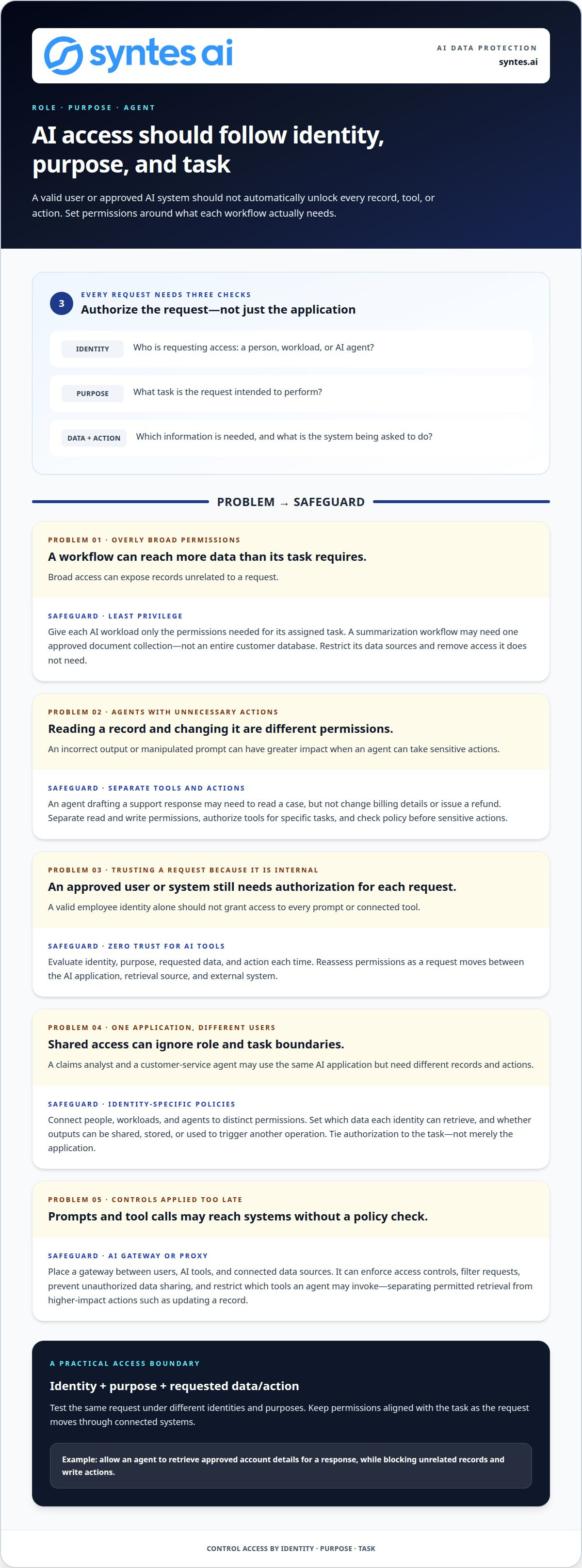
AI access controls should bind each request to an identity, a defined purpose, and the required permissions. This prevents a valid user prompt from unlocking data the user cannot access elsewhere.
Least-Privilege AI Workloads
Least-privilege access gives an AI workload only the permissions needed for its assigned task. Broad permissions can expose records unrelated to a request. For example, a summarization workflow may need access to one approved document collection, not an entire customer database. Assign permissions to the workload identity, restrict its data sources, and remove access the task does not require.
Agent and Tool Access Controls
Agent and tool controls define which actions an AI agent can perform through connected applications. An agent that drafts a support response may need to read a case, but not change billing details or issue a refund. Separate read and write permissions, authorize tools for specific tasks, and require an explicit policy check before sensitive actions. This limits the impact of an incorrect output or manipulated prompt.
Zero Trust for AI Tools
Zero Trust treats every request as requiring authorization, even when it comes from an approved user or internal AI system. Evaluate each request using identity, purpose, requested data, and action. A valid employee identity alone should not grant access to every prompt or connected tool. Reassess permissions as the request moves between an AI application, retrieval source, and external system.
Identity management connects people, workloads, and agents to distinct permissions. For example, a claims analyst and a customer-service agent may use the same AI application but require different records and actions. Policies should determine which data each identity can retrieve and whether the output can be shared, stored, or used to trigger another operation. Tie authorization to the task, not merely the application.
An AI gateway or proxy can enforce access controls, filter requests, and prevent unauthorized data sharing. Place it between users, AI tools, and connected data sources so policies apply before prompts reach a model. A gateway can also restrict which tools an agent may invoke, helping separate permitted retrieval from higher-impact actions such as updating a record.
For example, define a workflow policy that allows an agent to retrieve approved account details for a response, while blocking unrelated records and write actions. Then test the same request under different identities and purposes. A structured access design can make these boundaries clearer across connected systems. Discuss AI access architecture for enterprise workflows.
Sensitive-data exposure during AI model training
Training data can expose sensitive information before a model reaches runtime. Exposure can also occur during analysis, labeling, deployment, and use of third-party services.
Exposure Across AI Pipelines and Workflows
Exposure across an AI pipeline occurs when sensitive data moves through preparation, training, evaluation, deployment, or inference without consistent protection. Each transfer creates another place where data or interim outputs may be accessed. For example, a labeling team may create working files beside source records. Map the pipeline’s data stores and transfers, including temporary analysis and labeling locations, to identify where controls must apply.
Review training data before assembling it. Filter personal information, record source lineage, and preserve the transformation code and approval status for each dataset version. If a dataset is de-identified, assess residual re-identification risk before reuse. These steps give risk management a clear record of what entered training, how it changed, and which approved version reached the model.
Preventing Model Memorization and Disclosure
Preventing memorization means reducing sensitive examples in training data and testing whether a model can reproduce them. A 2021 study demonstrated that training data extraction from large language models can recover individual examples containing names, phone numbers, and email addresses. Filter PII before fine-tuning, then test model outputs for unexpected disclosure. De-identification alone is not enough; assess whether remaining details can still be linked to a person.
For example, a training record with a job title, location, and unusual event may identify someone even without a name. Review combinations of fields, not just direct identifiers. When tests reveal sensitive output, trace it to its dataset version and transformation history, then address the source data and reassess the model. This links prevention to evidence instead of relying on a single sanitization pass.
Controls Across Training and Use
For on-premises training, confidential computing can help protect data and models from malicious insiders and unauthorized personnel from other organizations. In federated learning, confidential computing can protect a global model during aggregation from unauthorized access or modification. These controls address different exposure points. Match each control to where data is stored, processed, and combined, rather than treating model training as one isolated event.
Risks of Public AI Tools
Entering sensitive information into public AI tools can move it beyond an organization’s direct control. As a security precaution, organizations using AI that is not fully on-premises should assume their data may become public. This applies to prompts, uploaded documents, and data processed by third-party models. Restrict sensitive inputs, and assess vendor data handling, access, and processing arrangements before using them in a workflow.
A practical response is to keep raw confidential records out of public prompts and use approved, filtered data instead. If a third-party model supports a business workflow, include the vendor and connected services in the data-flow map. Trace which information reaches each service and apply controls before transmission. This makes vendor exposure part of the training and runtime risk assessment, not an afterthought.
Data minimization and purpose limitation
Data minimization means giving an AI workflow only the information needed for its defined task. Purpose limitation keeps that information tied to the reason it was collected and approved. Together, they reduce unnecessary exposure across enterprise AI infrastructure, from ingestion and storage to retrieval and model use.
Article 5 of the European Union’s General Data Protection Regulation (GDPR) requires personal data to be processed lawfully, fairly, transparently, and with data minimization. For AI teams, that principle has practical consequences: a model generating a delivery update may need an order status, but not a customer’s full payment history. The workflow should receive the smallest relevant set of fields, not an entire record because it is easier to connect.
Define purpose at the use-case level. “Improve customer service” is too broad to guide data access or retention. A more operational purpose might be drafting responses to delivery-status questions using order status and approved service details. That distinction helps teams decide which sources are appropriate, which attributes are unnecessary, and whether a later use falls outside the original purpose. It also clarifies how to handle sensitive data in AI models: tie permitted inputs to a specific business task.
Apply minimization at multiple points, not just in the prompt. Before ingestion, exclude fields the task does not require. During retrieval, constrain results to relevant records and attributes. At inference, remove unrelated details from context. For storage, retain only the prompt or output information required for the workflow’s defined purpose. Each step narrows what can be exposed downstream.
Data detection supports these decisions, but classification alone doesn’t minimize data. A scan may identify names, account details, or sensitive fields; the workflow still needs rules for excluding, masking, or transforming them. For example, a service-summary task may use a customer’s region and issue category while omitting direct identifiers. Teams deciding how to handle sensitive data in AI models should also assess whether transformed details could reveal identity when combined.
Purpose limitation matters when AI assets are reused. A dataset approved for one model task should not automatically feed another task or training process. Record the approved purpose and data lineage with each dataset version, then assess proposed changes before reuse. This makes decisions about how to handle sensitive data in AI models an explicit governance matter, rather than allowing new uses to emerge through infrastructure connections alone.
Before deployment, align the task, data fields, access policy, and retention approach. If the model’s output requires only a category, don’t provide the underlying narrative by default. If a workflow changes from summarizing records to making recommendations, reassess the necessary inputs and their purpose. This discipline helps teams advance AI while limiting data collection, exposure, and storage to what the work requires.
Sensitive data controls for unstructured content
Unstructured content hides sensitive values in prose, attachments, and operational records. A support ticket may combine a customer name, email address, account identifier, and confidential complaint in one paragraph. Unlike a database column, that information has no consistent field boundary. Strong governance must discover and classify content across files, logs, tickets, tables, and embeddings before downstream AI jobs consume newly ingested assets.
Start by identifying the content sources connected to each AI workflow. Classify names, email addresses, phone numbers, financial records, and customer IDs before indexing or retrieval. For example, a service platform may ingest a ticket alongside an attached invoice, while a log records the customer’s account ID. Treat each source and embedded representation as an asset, then apply handling rules before making it available to AI. This is a practical foundation for handling sensitive data in AI models when information arrives as text, files, and mixed-format records.
Classify data early enough to stop newly ingested content from reaching downstream jobs unreviewed. Connect detection to ingestion and retrieval policies so a sensitive file can be restricted, filtered, or routed for review before a model uses it. A shared folder, for instance, may contain both approved product documentation and confidential personnel records. Set access and processing rules by content category, not just by storage location.
Automated sanitization can help, but it may work only in some cases. Unstructured data is less predictable and harder to monitor than structured data because sensitive details can appear in unexpected wording, scanned documents, or mixed-content files. A detector might identify an email address but miss a customer ID embedded in a sentence. Combine automated discovery with targeted review of high-risk sources and representative samples.
Anonymization also needs recurring tests. Check whether sensitive information remains protected and whether AI-generated results retain the quality required for the task. For example, mask names in support conversations, then assess whether the model can still categorize the issue and summarize its resolution. Re-identification risk can persist when indirect details appear together, so evaluate combined fields, not merely direct identifiers. This is a core consideration in handling sensitive data in AI models across unstructured sources.
Make governance operational with clear ownership, classification outcomes, and records of data movement. When a new source enters an AI platform, identify its content type, apply relevant detection and access rules, and test the sanitized material before broader use. Reassess controls when source formats or downstream jobs change. This helps prevent confidential content from becoming an invisible part of datasets simply because it arrived in an unstructured format.
Syntes AI: AI Data Platform
Syntes AI helps organizations connect sensitive-data controls to the systems and context that enterprise AI depends on. Its AI Data Platform and Enterprise Knowledge Graph structure complex data for actionable use, while Cross-System Integrations connect AI capabilities across existing software environments. The Syntes Agentic Platform supports the deployment and management of operational agents.
This is a relevant next step when sensitive information is distributed across systems, making it difficult to govern consistently or provide appropriate context to AI workflows. The focus is not simply on adding a model. It is on connecting data, context, and operational processes so AI can work within an enterprise environment.
Contact Syntes AI to discuss your enterprise AI needs.
Make Data Governance Part of AI’s Evolution
AI use will change as teams connect new sources, automate tasks, and adapt models to emerging business needs. Treat governance as an operating capability that evolves alongside those decisions, not as a one-time approval. Assign clear ownership for data access, model changes, and review of new use cases. Make each change traceable so teams can understand how information moves and who is accountable.
A durable approach to handling sensitive data in AI models depends on keeping safeguards aligned with real workflows. As AI expands across an enterprise, revisit whether each use still has the right purpose, context, and access boundaries. This discipline helps organizations advance AI while making deliberate choices about sensitive information.
Build with clarity, and let responsible data practices support what comes next.
Frequently Asked Questions
How Do You Handle PII in AI Pipelines?
Handle PII by controlling its movement through every stage, from source systems to model outputs. For a claims workflow, define which fields the model needs, then prevent unrelated identifiers from entering its context. Include temporary files, evaluation datasets, and monitoring records in the data map. Assign owners to review new sources and workflow changes so a newly connected system doesn’t bypass existing handling rules.
How Is DLP for GenAI Different From Traditional Data Loss Prevention?
DLP for GenAI must account for information placed in prompts, retrieved as context, and returned in generated output. Traditional controls may focus on files or outbound messages, while an AI workflow can move data between connected sources and tools during one interaction. For example, a prompt may contain no PII, but retrieved context may add it. Extend detection and policy enforcement across the full request and response path.
How do you design a safe PII pipeline?
Design a safe PII pipeline by defining permitted data, processing steps, and access boundaries before connecting sources. For a customer-support workflow, specify which case fields can be used, which roles may retrieve them, and where intermediate results can persist. Test with representative records, including messy text and attachments. Track transformations and approvals, then reassess them when a source, model, or business purpose changes.
How should lineage prove compliance?
Lineage should provide a traceable record of where data originated, how it was transformed, and which approved dataset or model used it. For a model review, connect the dataset version to its source systems, transformation logic, approval status, and relevant workflow. Keep access records and material changes alongside that history. This creates evidence for internal review and helps teams investigate a specific output without relying on memory.
How should you handle PII before it reaches LLMs?
Before sending PII to an LLM, determine whether the task can work with fewer fields or transformed values. For example, a product-return question may need an order status, not a full customer profile. Apply filtering or masking before assembling the request, including to retrieved passages and attached content. Then inspect the actual request payload, because the final context can differ from what the user initially entered.
How should your team govern embeddings?
Govern embeddings as derived data, not harmless technical artifacts. Record which source content produced each embedding set, who can query it, and which AI workflows may use the results. For example, a vector index built from personnel files should not automatically serve a general knowledge assistant. Apply access restrictions to both the index and retrieval results, and include re-indexing or removal when source content changes.
What Does Sensitive Data Protection in AI Mean?
Protecting sensitive data in AI means managing information across model inputs, connected sources, training materials, outputs, and operational records. It combines data-handling rules with access controls, testing, and governance. For example, a workflow that summarizes contracts must account for both the source documents and the summaries it generates. The goal is to support the intended AI task while limiting access and use to the information it requires.
What Makes Sensitive Data Uniquely Risky in AI Systems?
AI systems can copy sensitive details across connected workflows and surface them in contexts users may not expect. A document may be indexed, retrieved for a later prompt, and reflected in an answer or evaluation record. The risk therefore extends beyond the original file. Review how information travels between sources, models, and tools, and test whether a user can retrieve data outside their intended task or permissions.