

Large technology projects rarely fail for lack of ambition. They lose control when risks, dependencies, and system integrations emerge too late. To understand how to de-risk large technology projects, start risk management at project inception and continue through completion: define the context, identify and assess risks, plan responses, and monitor changing conditions.
It makes sense to focus first on scope, budget, and schedule. But these plans are only as reliable as the assumptions behind them, especially when a project must connect systems, data, teams, and business processes. Early risk reviews should involve people who understand those dependencies. Assess likelihood and impact, assign clear owners, and account for the risk that remains after existing controls.
This article explains how governance and contingency planning keep decisions actionable, how realistic budgets, resources, and timelines ease execution pressure, and why integration dependencies need attention from discovery onward. You’ll learn how to identify risks early and structure the oversight, plans, and cross-system considerations that help large technology initiatives stay aligned with business needs.
Key Takeaways
- Start risk management during discovery and keep it active through delivery, so emerging threats can be assessed and addressed before they disrupt execution.
- Give each risk a clear owner, priority, and response plan, then make risk status part of regular governance and reporting.
- Build budgets and timelines around the work, available resources, task dependencies, and agreed processes for handling changes.
- Bring affected teams and system dependencies into planning early; integration gaps can create operational risks beyond the project team.
- Use connected data and context to improve visibility across complex environments, and consider Syntes AI’s Enterprise Knowledge Graph and Cross-System Integrations where they address that need.
Early risk identification and mitigation planning
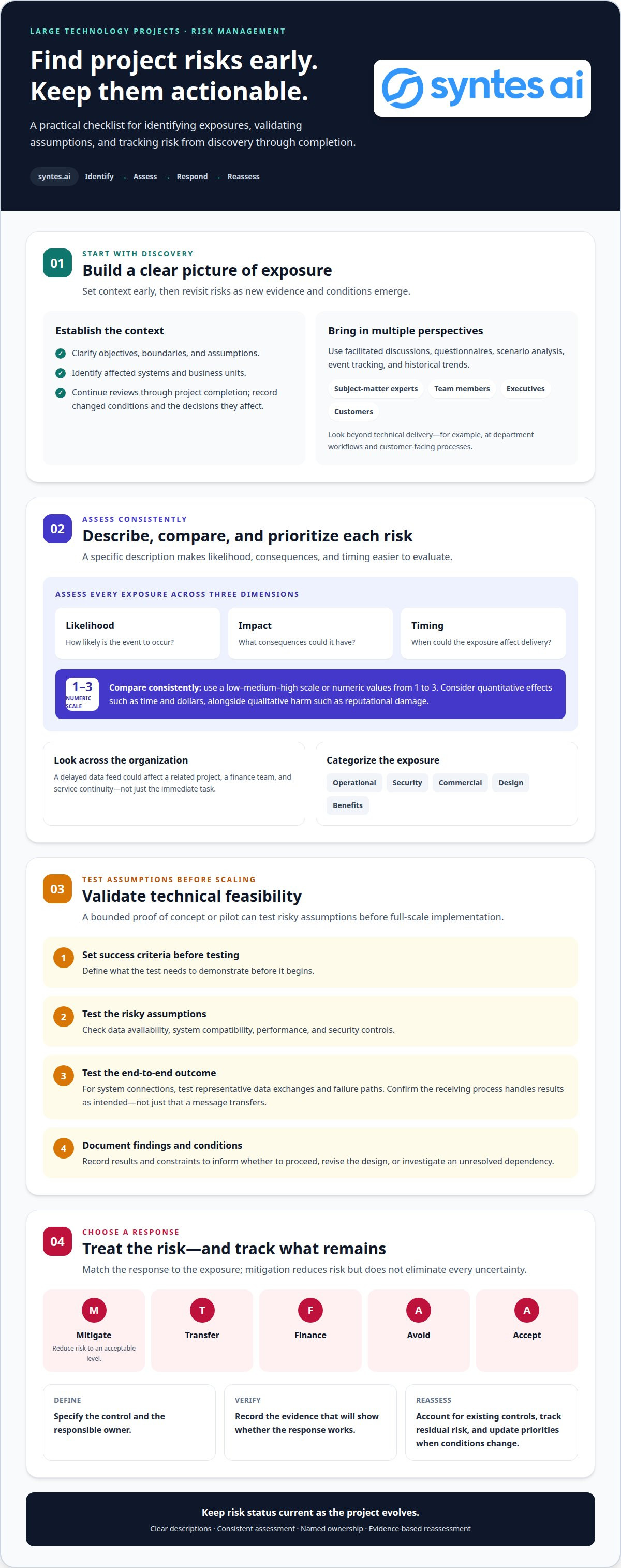
Start risk management during discovery and continue through completion. Learning how to de-risk large technology projects begins with identifying exposures before they constrain delivery.
Risk Identification and Impact Analysis
Risk identification records events that could affect project objectives; impact analysis evaluates their likelihood and consequences. Use facilitated discussions, questionnaires, scenario analysis, event tracking, and historical trends. Include subject-matter experts, team members, executives, and customers. Their perspectives can reveal effects beyond technical delivery, such as disruption to a department’s workflow or a customer-facing process.
Describe each risk specifically, then assess probability, impact, and timing. A low-medium-high scale or numeric values from 1 to 3 can help teams compare exposures consistently. Consider quantitative effects, such as time and dollars, alongside qualitative harm, such as reputational damage. Account for existing controls too, since residual risk remains after those controls are considered.
Technical Feasibility Validation
Technical feasibility validation tests whether proposed architecture, data, and integrations can support required outcomes before full-scale implementation. This matters because unresolved assumptions can become costly constraints as delivery expands. A bounded proof of concept or pilot can test the riskiest assumptions, including data availability, system compatibility, performance, and security controls.
Set success criteria before testing, then document results, constraints, and conditions for proceeding. For example, a team connecting a workflow to enterprise systems can test representative data exchanges and failure paths. Confirm that the receiving process handles results as intended, not just that a message transfers successfully. These findings help determine whether to proceed, revise the design, or investigate an unresolved dependency.
Start Risk Reviews at Project Inception
Establish context by clarifying objectives, boundaries, assumptions, and affected systems or business units. Revisit risks as delivery evolves, since new evidence can invalidate earlier assessments. A discovery review may identify an access constraint; a later integration test may reveal a different operational consequence. Keep assessments current by recording changed conditions and the decisions they affect.
Analyze Exposure Across the Organization
Consider potential effects beyond the immediate task. A delayed data feed could affect a related project, a finance team, and service continuity. Categorize exposures by operational, security, commercial, design, or benefit considerations. Then prioritize them by likelihood, impact, and expected timing. This clarifies dependencies and helps leaders distinguish decisions needed now from risks that require ongoing observation.
Choose a Treatment and Track Residual Risk
Choose a response that fits the exposure: mitigate, transfer, finance, avoid, or accept it. Mitigation reduces risk to an acceptable level rather than eliminating every uncertainty. Specify the control, responsible owner, and evidence that will show whether it works. Reassess residual risk after applying controls, and update priorities when assumptions or conditions change. This is how to de-risk large technology projects without treating every uncertainty as equally urgent.
Project governance and contingency planning
Define scope through agreed requirements, deliverables, boundaries, and exclusions. Assess each requested change for its justification and added time or cost before approval. Track project health through metrics, risk reviews, status reports, and stakeholder feedback. Treat blocked decisions or deteriorating dependencies as early warning signs.
Incident Response and Contingency Plans
An incident response and contingency plan assigns responsibilities and defines actions to contain disruption, mitigate harm, and restore critical work. Teams need agreed decisions before a risk becomes an incident. Assign an owner to each material risk, document the response, and make escalation paths clear to team members and executives.
For example, if a system integration disrupts a business process, a containment plan can identify who pauses the affected workflow and who coordinates recovery. A contingency plan also records how the project will proceed if a key dependency remains unavailable. Include employee training, response procedures, reporting measures, and periodic plan testing.
Governance gives these plans operational force. Set policies for risk reporting, define decision authority, and include project risks in regular status reports or meeting agendas. Where appropriate, connect monitoring to existing internal audit, GRC, performance measurement, independent verification and validation, and stakeholder feedback processes.
Scope Definition and Change Control
Scope definition establishes the approved requirements, deliverables, design, schedule, budget, and test plans that guide execution. It matters because ambiguous boundaries make additional requests difficult to assess. Have the project team agree to and sign these baseline documents, including clear exclusions and assumptions that shape delivery.
When a stakeholder requests a new feature, document the change and require a reason before approval. Assess its effects on cost, schedule, dependencies, and testing, then record the decision. This makes trade-offs visible and prevents a series of individually small requests from quietly changing the project’s commitments.
Project Health and Early Warning Signs
Project health monitoring compares actual progress with approved plans and uses risk information to guide action. It matters because a missed milestone may signal a dependency failure, unresolved decision, or resource constraint. Review performance measures alongside stakeholder feedback and open risks, rather than relying on a single status label.
For instance, repeated delays in a design approval can threaten dependent build and testing tasks. Record the blocker, its owner, affected milestones, and required decision in the status report. Escalate when the responsible team cannot resolve it within its authority. Clear reporting turns emerging pressure into a decision while options remain open.
Test the risk-management plan periodically and update it when project conditions change. A contingency that no longer matches the delivery architecture can leave teams without a usable response. For projects where AI oversight is central, explore AI governance for project oversight as part of the governance design.
Risks from large digital project investments, teams, and timelines
Large investments magnify the effects of weak requirements, unavailable expertise, and optimistic schedules. Breaking delivery into evidence-based phases helps leaders uncover constraints before committing further resources.
Technology Risks in Enterprise Risk Management
Enterprise risk management connects technology exposures to strategic, financial, operational, compliance, and knowledge-management risks across the organization. A project can meet a technical milestone while still creating wider business exposure.
For example, a delayed data migration may affect reporting, customer operations, and a related project. Assess impacts across business units, not just within the delivery team. Leadership can then compare technology risks with other organizational priorities and decide which exposures need action, monitoring, or acceptance. This brings technology decisions into enterprise oversight rather than leaving them as isolated project updates.
Cost Overruns and Project Failures
The Standish Group’s 2015 Chaos report found that 66 percent of software projects ended in partial or total failure. Its analysis covered 50,000 software projects worldwide, and fewer than one in three projects produced successful outcomes. Deloitte estimates that 70% of digital transformation projects are considered failures. These figures describe project failure, not a U.S.-specific cost-overrun rate.
Cost pressure often grows when requirements change, dependencies slip, or estimates overlook the people doing the work. Build estimates from task-level input, compare them with actual results from past projects, and use three-point estimating to represent uncertainty. Digital transformation failure can mean a schedule overrun, a budget overrun, or failure to deliver the original aims. Track each dimension separately to see where intervention is needed.
Prototyping and Piloting Approaches
Prototyping and piloting test a defined assumption on a limited scale before broader investment. This lets teams learn whether a design supports real requirements before expanding work across systems and business units.
Choose a representative workflow, define observable acceptance criteria, and test the riskiest technical or operational assumption first. For example, a pilot can test whether a proposed data exchange supports the intended business process. Capture defects, user feedback, and unresolved dependencies, then use the findings to revise scope, sequencing, or estimates. Treat each phase gate as an evidence-based decision, not an automatic expansion point.
Vendor, Cybersecurity, Privacy, and Regulatory Risks
These risks arise when external dependencies, data handling, security controls, or compliance needs threaten project delivery or business operations. They matter because a vendor delay or unresolved data concern can affect multiple teams and connected systems.
Map vendor responsibilities to project dependencies, document service assumptions, and identify how a supplier issue affects milestones. Assess cybersecurity and privacy exposures alongside operational and compliance impacts. Assign owners to open questions, include them in project reporting, and escalate decisions that exceed team authority. For regulated work, involve relevant internal specialists early so requirements shape architecture and testing instead of arriving as late-stage changes.
Budget, resource, and dependency planning
Choose a fixed-price contract when requirements and deliverables are stable; consider time-and-materials when discovery may change the work. In either case, align payment terms, change approval, and budget oversight with the project’s uncertainty.
Discovery should turn approved outcomes into a detailed plan of tasks, owners, required skills, and dependencies. Map which work must finish before another task can start. For example, data migration may depend on source-system access, while user acceptance testing depends on a working interface and prepared test data. A dependency map makes sequencing visible before teams commit to milestones.
Build the budget from the work, not a headline estimate. Ask the people doing each task to estimate the effort, then compare assumptions with actual results from past projects. Separate planned work from contingency allowances and identify who can approve their use. If a vendor deliverable, data cleanup, or internal review is excluded, make that boundary clear in the plan.
Resource plans must account for operational responsibilities as well as project assignments. A subject-matter expert who supports daily operations may not be available for every workshop or test cycle. Name the required roles, confirm when their input is needed, and identify backup coverage for critical knowledge. Cross-training and clear role definitions reduce disruption if team members leave or become unavailable.
Dependencies also cross organizational boundaries. A new ecommerce channel, for example, may require finance to handle revenue processes, even if finance does not build the platform. Include indirectly affected teams during discovery, then map their decisions, data, and handoffs to project tasks. This reveals resource demands that a technology-only plan can miss.
Set budget allocation and extension rules during discovery. Define which workstreams receive funding, how approved changes affect estimates, and who decides whether to extend the schedule or adjust scope. When a dependency slips, assess its effect on connected tasks before moving the finish date. A change log should link each request to its rationale, resource impact, and approval.
Use milestone forecasts to compare planned effort with actual progress. If a data-quality task takes longer than estimated, recalculate downstream testing and deployment dependencies instead of preserving an outdated schedule. Keep assumptions visible, including the availability of internal specialists, vendor inputs, and system access. This gives sponsors a basis for reallocating resources or revising the sequence before pressure compounds.
A useful planning review follows work from discovery through delivery: task owners validate estimates, project leaders map dependencies, finance confirms allocations, and sponsors agree on extension decisions. Record unresolved assumptions as planning risks with owners and review points. This makes the budget, staffing plan, and schedule connected management tools rather than separate documents that drift apart.
Technology projects and system integrations
System integration risk sits at the boundaries between applications, data, and business processes. A project can deliver a functioning new platform yet still disrupt operations if information arrives late, changes meaning, or fails to reach the next system. Map these connections during discovery, then keep them visible through deployment and completion.
Start with an integration inventory. For each connected system, record its business purpose, data exchanged, owner, dependency, and downstream users. Trace a transaction from its source through every transformation to its destination. For example, follow a customer update from a sales platform into a billing workflow, noting where validation, approval, or manual handling occurs. This exposes fragile handoffs a system-by-system checklist can miss.
Next, clarify the meaning and authority of shared data. Two applications may use different labels for the same concept or handle updates differently. Define which system owns each important record, how duplicate or conflicting values are handled, and which downstream process depends on the result. A customer record that differs between sales and billing can create operational rework even when both integrations technically succeed.
Plan integration work as a dependency chain, not an isolated technical workstream. Identify prerequisites such as access, data preparation, interface decisions, and business approvals. Connect each dependency to the implementation tasks it can block. If a source system changes its data structure, assess the impact on mappings, validation, reporting, and user workflows before continuing dependent work.
Test complete business transactions across connected systems. Validate expected data, rejected inputs, duplicate submissions, interrupted exchanges, and recovery behavior. A successful message transfer is not enough if the receiving process applies the wrong business meaning. Include users who understand the workflow, and schedule test points before cutover so teams can correct defects while options remain open.
Finally, plan deployment around connected-system impacts. Sequence cutover activities, define how teams will recognize an incomplete transfer, and establish a rollback or recovery approach suited to the workflow. Reassess the integration map whenever scope or architecture changes. This keeps technical decisions tied to operational consequences instead of treating connectivity as a final implementation detail.
Syntes AI
Syntes AI helps organizations address project risk where fragmented data, operational context, and system dependencies complicate delivery. Its Enterprise Knowledge Graph structures complex enterprise data, while Cross-System Integrations connect AI capabilities with existing software environments. Context Engineering helps establish relevant context across those systems, and the Syntes Agentic Platform enables businesses to deploy and manage AI agents for operational tasks.
Consider Syntes AI when project planning exposes disconnected information or integration challenges that affect execution. These offerings can help create a more coherent foundation for enterprise technology initiatives, with the approach shaped around the systems and business context involved.
Contact Syntes AI to discuss the technology and integration challenges affecting your project.
Turn project insight into your next decision
The next step is to turn project insight into a decision framework leaders can use as conditions change. Identify which assumptions need evidence, which trade-offs need executive direction, and how technology decisions connect to operating priorities. That is the practical core of how to de-risk large technology projects: make dependencies visible early enough to preserve meaningful choices.
Where fragmented enterprise data and disconnected systems complicate execution, Syntes AI’s Enterprise Knowledge Graph, Syntes Agentic Platform, and Cross-System Integrations can support a more connected technology environment. Its live Context Graph connects structured data, documents, and relationships, while bi-directional connectors operate across existing stacks with no rip-and-replace.
Use your next planning discussion to clarify the decisions, dependencies, and context that matter most to delivery. Contact Syntes AI to discuss how its Context Engineering Platform can support your enterprise AI and integration requirements.
Build the next phase on clear decisions and connected execution.
Frequently Asked Questions
Need help de-risking your project?
Yes. Syntes AI can help when project risk stems from fragmented enterprise knowledge or AI initiatives that must work across existing systems. Its Context Engineering focuses on building and maintaining business context so AI systems can reason accurately and execute actions safely. A useful starting discussion covers the project’s intended outcome, the decisions it must support, and the information or workflows blocking delivery. Bring those details to a conversation with Syntes AI.
What are the main causes of failure in large technology projects?
Common causes include incomplete requirements, weak sponsor or user engagement, ineffective leadership, underestimated effort, and dependencies discovered late. A practical warning sign appears when delivery teams interpret the same requirement differently. Testing then uncovers mismatched workflows rather than isolated defects. Large projects are also vulnerable when indirectly affected groups, such as finance teams supporting a new sales channel, enter planning only after design decisions are fixed.
How do you assess and prioritize risks in a large technology project?
Describe each risk as an event, its trigger, and its consequence, then assess likelihood and impact. Consider timing too, so an urgent exposure isn’t obscured by a more severe but distant one. For example, a delayed data extract may have limited impact now but threaten reconciliation later. Revisit its priority when the trigger appears or a related assumption changes, keeping the risk register useful for decisions.
What governance, oversight, and escalation processes reduce project risk?
Define who can approve scope, release contingency resources, pause deployment, and accept remaining exposure. Give each decision a clear escalation route so teams know where unresolved issues go and what evidence leaders need. A useful status update identifies the decision required, its operational consequence, and when it matters. This structure helps executives focus on actionable exceptions instead of reviewing activity without clear ownership.
What contingency, rollback, and change-management plans should a large technology project have?
Document the conditions that trigger a pause, who authorizes rollback, and which stable process or system becomes the fallback. Include steps for reconciling data created during a partial deployment, validating restored operations, and deciding when work can restart. For changes, record the request, rationale, affected workflows, and approval. A change to a data field, for example, should prompt a review of dependent reports and integrations before release.
What are typical cost overruns and failure rates for large technology projects in the United States?
The Standish Group found that 66 percent of software projects ended in partial or total failure, and Deloitte estimates that 70% of digital transformation projects are considered failures.