

A retry is not a recovery plan. How AI agents handle exceptions depends on detecting what failed, checking whether the output is usable, and choosing a bounded recovery path, such as a fallback or retry. When the situation is ambiguous or the action carries significant risk, the agent should stop and escalate to a person rather than guess.
It’s reasonable to expect an agent to recover from routine errors without derailing a workflow. But recovery needs controls: repeated attempts can compound errors, and a technically successful response can still contain unusable output.
This article explains how agents detect failures, use fallbacks, constrain tools, manage timeouts, and decide when human review is needed. Validation, retry limits, checkpoints, and clear escalation details help contain an exception while preserving useful work for the next step.
Key Takeaways
- Escalate ambiguous or high-risk exceptions with a clear summary, relevant logs, and the agent’s partial results so a person can make an informed decision.
- Use output-quality checks and circuit breakers to stop malformed or degraded results from moving into downstream workflows.
- Constrain tools with validation rules, limited permissions, and approval gates for actions that could cause significant impact.
- Use fallbacks and checkpoints to preserve completed work and resume from the point of failure instead of restarting an entire workflow.
- Set timeouts according to task complexity, then define what the agent should return or do when execution exceeds its limit.
1. Human escalation for ambiguous exceptions
Agents should escalate when evidence supports several plausible diagnoses, not force a single answer. A practical rule combines confidence, error patterns, and business impact. For example, queue a decision when at least two escalation reasons apply. Another example escalates below 0.7 confidence when at least one additional reason exists. These thresholds illustrate a decision pattern, not a universal setting.
Confidence alone cannot authorize high-risk actions. An agent proposing a production database migration at 95% confidence should still stop for human approval. Destructive operations also require approval regardless of confidence. The control belongs before execution, where a human can review the proposed action and prevent the agent from turning an ambiguous interpretation into an irreversible change.
Escalation must include enough context to support a decision. Send a concise issue summary, relevant logs and data, and possible courses of action. Preserve the agent’s reasoning chain, confidence score, and partial results. This helps the reviewer see what the system observed, which assumptions shaped its diagnosis, and what work can safely continue downstream.
Tool and SDK design should support both human developers and AI agents. Syntes AI returns structured error fields for predictable handling alongside a detailed message explaining the failure. A machine can route a known error type; an agent can use the explanation to reassess its next step. Neither format should obscure the original failure or relevant context.
A strong handoff also distinguishes the failed action from completed work. Record which operations succeeded, which remain pending, and whether a downstream process has already received a result. For example, if an agent cannot determine whether a record update completed, pause dependent actions and include that uncertainty in the escalation message. This helps prevent duplicate or conflicting changes.
Human review should change the system’s next move, not merely acknowledge an alert. A manager can adjust the ranking of proposed diagnoses and resolution plans, then approve, reject, or redirect the selected action. Keep that decision attached to the exception record so the agent can resume from a defined state instead of repeating the same uncertain reasoning.
Use a clear escalation path: detect ambiguity, pause affected actions, assemble evidence, and route the case to an authorized reviewer. Keep the circuit closed while a high-risk decision awaits approval. Resume only after recording the decision and its scope. This makes human intervention an operational control, rather than a last-minute message after an error spreads.
When an action awaits review, the system must pause safely. For high-risk operations, stop and escalate to a human regardless of confidence; confidence alone does not override the need for intervention. A decision can be queued when at least two escalation reasons apply. More broadly, escalation protocols can use error severity, confidence in the proposed solution, or business rules to determine when intervention is required. Thresholds should reflect confidence levels, error patterns, and business impact rather than simple failure counts. SDKs should also support human developers’ preference for structured data and familiar exception handling, while allowing agents to use detailed text descriptions.
2. Circuit breakers for detecting output-quality failures
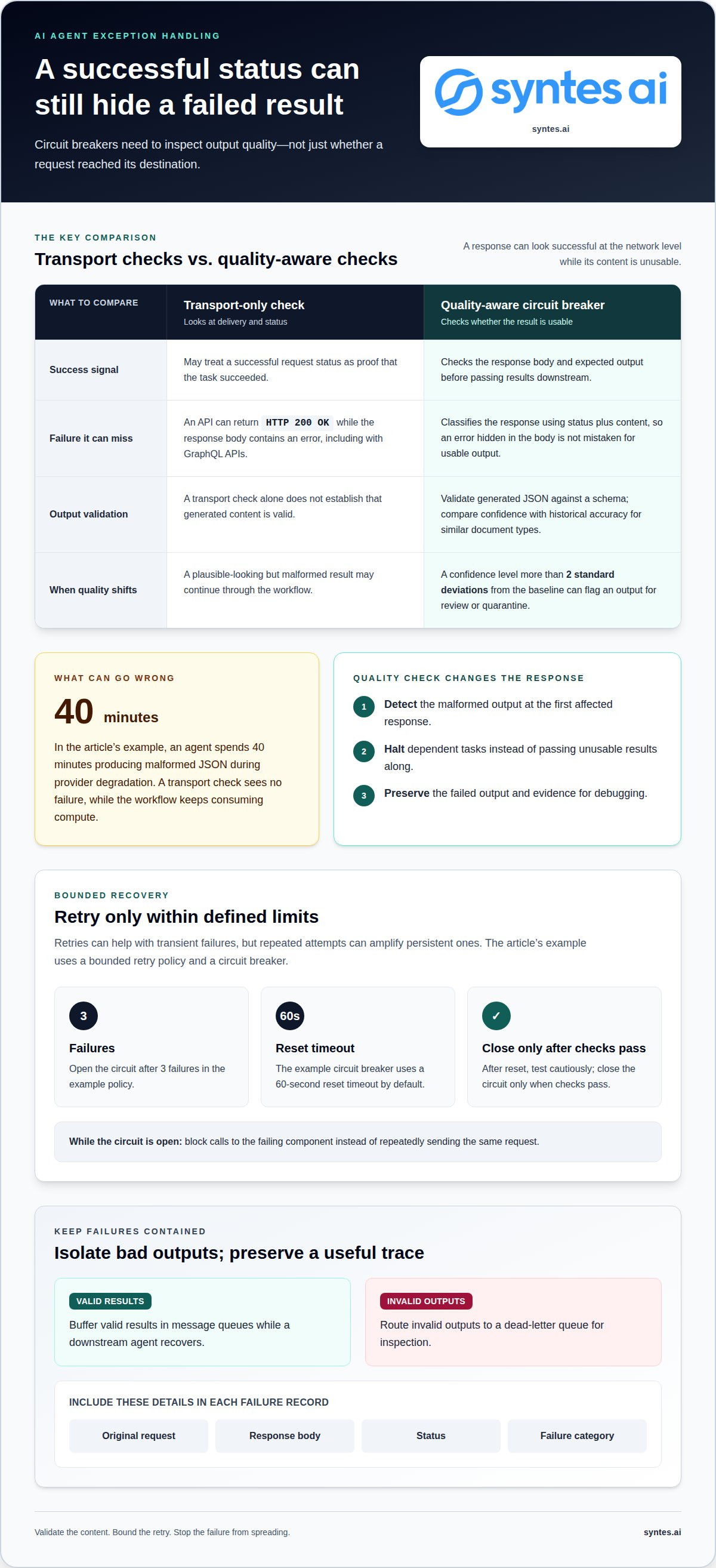
AI agents detect and classify exceptions by checking each stage against its expected status and output contract. Understanding how AI agents handle exceptions starts with distinguishing transport failures, tool errors, and invalid results, such as malformed JSON returned after a successful request. This classification shows whether a workflow should retry, quarantine a result, or stop processing. A response’s status alone cannot establish that its content is usable.
Tool and API failures require both status checks and response inspection. Some APIs return HTTP 200 OK while placing an error in the response body, including GraphQL APIs. An agent that reads only the status may classify that response as successful and pass bad data downstream. Preserve the response body and error details so the agent can identify the failure and correct its input when appropriate.
Quality-aware circuit breakers monitor outputs, not just network availability. Validate generated JSON against a schema, then compare confidence with historical accuracy for similar document types. A confidence level more than two standard deviations from that baseline can flag an output for review or quarantine. This catches plausible-looking failures that ordinary transport checks miss.
Consider an agent that spends 40 minutes producing malformed JSON during model-provider degradation. Its transport check sees no failure, so the workflow keeps consuming compute while creating unusable results. Output validation would detect the defect at the first affected response. The system could then record the failed output, halt dependent tasks, and preserve evidence for debugging.
Retries help with transient failures, but repeated attempts can amplify persistent ones. Set a bounded retry policy for recoverable errors, then open the circuit after 3 failures. The example circuit breaker uses a 60-second reset timeout by default. During that interval, block calls to the failing component instead of sending the same request repeatedly. After reset, test cautiously and close the circuit only when checks pass.
Message queues can isolate failed work from healthy workflows. Buffer valid results while a downstream agent recovers, and route invalid outputs to a dead-letter queue for inspection. Include the original request, response body, status, and failure category in each record. This gives debugging teams a reproducible trace without letting malformed content circulate as a valid result.
Measure failures at each agent handoff, including output validity and processing latency. A circuit breaker can pause downstream processing when either exceeds its normal range. In one example, safeguards caught quality degradation within three calls instead of six hours. This is central to how AI agents handle exceptions across production workflows: validate each result, classify the failure, and retry only when its type supports recovery.
3. Designing constrained tools to prevent errors
Exception handling differs by framework: some tools raise exceptions, while others return errors as values. A handler-based design can route failures and successful results through separate functions. These patterns affect how an agent receives failure details, but neither removes the need to document which calls can fail. Clear contracts help agents and developers choose the right response.
Build validation into each tool boundary, before an action reaches a downstream system. An API’s HTTP 422 response can identify missing required fields; HTTP 400 can report that first and last names are missing. These details help an agent correct an input instead of repeating an invalid request. A tool should preserve the response body, not expose only a generic status.
Status codes alone can mislead. Some APIs return HTTP 200 OK while the response body contains an error, including GraphQL APIs. Parse both the status and body, then classify the result before accepting it. For an agent that updates a customer record, this distinction prevents an error response from being treated as a completed function result.
Keep tool errors visible and actionable. A Python tool can return an error value that a ReAct agent uses to revise its input. Include the relevant message and, when useful for debugging, a traceback or suggested correction. However, bugs inside the tool may require raising exceptions rather than asking the agent to repair an internal defect.
Separate error handling from success handling when a function supports both paths. Require callers to provide an error handler and a success handler, so a failure cannot silently become a normal result. In a streaming middleware example, Go replaces a response-stream error with a fallback message. Keep that fallback distinct from verified success, or downstream steps may act on false data.
Prevent unsafe actions with narrow tool permissions, input validation, and explicit limits. For example, a validation gate can block a delete request exceeding 10 records. The Infocomm Media Development Authority (IMDA) recommends limiting agent autonomy and access to tools and data. For consequential actions, require a separate approval gate before execution.
Common failure modes include missing fields, misleading HTTP 200 responses, swallowed exceptions, and fallback messages misread as successful results. Test each path with known inputs: a valid request, an HTTP 400 error, an HTTP 422 response, and HTTP 200 containing an error body. Confirm logs retain the request, response, error category, and resulting action. Health checks with known document samples can track processing time, confidence, and output formats.
For systems spanning multiple tools, reviewing agent workflow controls can help connect validation and error handling across execution paths.
4. Graceful degradation and fallback strategies
Graceful degradation keeps a workflow useful when a dependency fails, without pretending the failed step succeeded. Middleware can centralize retries, error handling, and fallback behavior. For example, if document classification becomes unavailable, preserve incoming records and pause classification. Intake can continue without sending incomplete classifications downstream.
Resource isolation limits how far an exception can spread. Separate an agent’s working state from downstream tasks so one stalled operation doesn’t block unrelated processing. A message queue can hold completed results while the failed agent recovers. This creates a controlled boundary between an unavailable component and workflows that can still proceed.
Checkpointing makes recovery precise. Capture agent state before API calls, at agent handoffs, and after major processing sections. A lightweight JSON snapshot in Redis can preserve that state, with expiration matched to workflow duration. For a large document batch, checkpoint each section with extracted data, confidence scores, and cross-references.
That checkpoint changes the recovery path. If an agent fails on document 47 of a 50-document batch, it can resume at document 47 rather than restart at document 1. The system should restore the saved context, identify the unfinished work, and continue from that boundary. Completed documents remain available instead of being processed again.
A graceful fallback response should state what the agent completed and what remains unavailable. For example, return a partial report that clearly marks classification as pending, rather than presenting an incomplete result as final. Keep the response in the expected schema so downstream tools can distinguish partial output from completed output.
Fallbacks need limits. If a substitute source cannot provide the fields required by the schema, stop that branch and preserve the last valid checkpoint. Then route the missing information for escalation or later recovery. This prevents a fallback from filling gaps with unsupported values or triggering actions based on incomplete context.
For agents that share learned knowledge, coordinated checkpointing can preserve a consistent processing state. Agents in a processing chain reach a shared checkpoint before the next stage advances. If one agent fails, the system can restore aligned states rather than combine new results with stale context from another agent.
Implement recovery as an explicit sequence: isolate the failing dependency, preserve valid state, select a fallback, validate its schema, then resume or escalate. A fallback should reduce disruption, not hide the exception. Keeping the original error beside the checkpoint also gives operators a concrete record for diagnosing why the primary path failed.
Set an explicit recovery policy for each interaction, using middleware to apply error handling, retry logic, and graceful degradation. That makes the response to a failed operation deliberate rather than dependent on an individual agent’s behavior. Together, these controls make recovery bounded and predictable. They preserve valid progress, expose unresolved issues, and prevent a retry or fallback from being mistaken for proof that the original operation succeeded.
5. Catching timeouts during agent execution
AI agents manage timeouts, rate limits, and network errors by classifying each interruption before retrying. They stop work that exceeds its execution limit, preserve completed state, and resume only when the failure can be retried safely. A timeout does not prove an operation failed: the request may have reached its destination before the response was lost.
Set task timeouts according to document complexity, not an arbitrary duration. A short, structured record and a lengthy document analysis have different processing demands. Monitoring should capture execution time, intermediate inputs and outputs, and API error responses. These details help distinguish slow work from a stalled dependency and show where the timeout occurred.
Define the timeout response in the framework’s middleware. In a C# example, a TimeoutException returns, “Sorry, the request timed out. Please try again later.” Other exceptions receive a generic error message. This gives the caller a clear status without presenting an incomplete result as successful.
Network failures and rate limits need distinct handling. A temporary connection interruption may allow a bounded retry, while a rate-limit response signals that the agent should pause rather than immediately resend the same request. Preserve the response details and retry only when the error indicates a recoverable condition. If the outcome remains uncertain, check the operation’s state before resubmitting.
That check matters for actions that change external data. Suppose an agent submits a record update, then times out before receiving confirmation. Repeating the update blindly could duplicate an operation or overwrite newer information. Record the request identifier and last confirmed step, then determine whether the first call completed before continuing.
Timeout controls should also bound an agent’s own reasoning loop. One example sets a maximum of 15 agent cycles. A cycle limit catches an agent that keeps reasoning without reaching a useful result, while a task timeout limits elapsed execution. Use both controls where appropriate, and route repeated stalls for escalation rather than allowing unbounded attempts.
After a timeout, preserve the last valid checkpoint and clearly mark unfinished work. A resumed run should load that state, identify the incomplete operation, and avoid replaying confirmed steps. Monitoring can compare expected and actual execution paths, helping teams correct framework settings or the dependency causing repeated delays.
Test timeout behavior with a delayed response, a dropped connection, and a rate-limit response. Confirm that each case records its status, stops or retries as designed, and returns an accurate message. Also verify that completed work remains intact and unresolved outcomes reach the right review path.
Syntes AI
Syntes AI helps organizations design AI agents that operate across complex systems with clearer context and controlled execution. When exception handling spans disconnected data, tools, and workflows, an Enterprise Knowledge Graph can structure information for more actionable use. Context Engineering and Cross-System Integrations help align that context with the systems agents need to use.
Turn to Syntes AI when moving from isolated agent experiments toward operational workflows that require coordinated data and system access. The Syntes Agentic Platform supports deploying and managing AI agents for operational tasks, while connected enterprise information helps teams shape how those agents interpret exceptions and continue their work.
Contact Syntes AI to discuss your agent workflows and exception-handling needs.
Make exception handling part of your operating model
The real test of how AI agents handle exceptions is whether operational controls support sound decisions when systems behave unpredictably. Treat recovery design as part of the architecture, not a patch applied after deployment. This gives teams a clearer basis for deciding where agents can act, where they must pause, and how people stay accountable for consequential decisions.
As agent workflows expand across enterprise systems, exception policies should evolve with them. Revisit assumptions about tool access, output acceptance, and escalation as workflows change. A control that fits a contained task may not fit a process with broader downstream effects. Align boundaries with the work, and keep ownership of them clear.
The next step is to connect these operational requirements to the systems and information your agents need to use. A deliberate architecture turns exception handling from an isolated technical concern into a foundation for dependable execution.
Build with intent, and give your agents a disciplined path forward.
Frequently Asked Questions
How do AI agents recover from errors and retry failed actions?
Agents should distinguish a transient fault from invalid input or an uncertain side effect before retrying. A validation error needs corrected input, not the same call again; a temporary connection failure may justify a controlled retry. For operations that could create duplicate records, use an idempotency key when supported and verify the destination state before resubmission. Keep attempt history tied to the task to help distinguish tool failures from agent errors.
When should an AI agent ask a human for help?
An agent should ask for help when source records conflict, a business rule doesn’t resolve the conflict, or the next step would commit a consequential change. For example, if two systems show different contract terms, it should hold the affected decision rather than choose silently. Present the competing evidence and decision scope, then record the reviewer’s selected rule so the same case doesn’t return as an unresolved exception.