

Fluent answers aren’t necessarily reliable. Grounding LLMs on enterprise data means connecting a language model’s responses to relevant, trusted business information, so it can use current facts and context rather than relying only on patterns learned during training. The goal is not simply to generate an answer, but to make it relevant to the organization and supported by its information.
That distinction matters when employees ask about company policies, customers, products, or operations. Enterprise AI needs more than plausible responses: it needs access to accurate content, a clear understanding of relationships among business entities, and boundaries that keep information relevant to the user and task.
This article explains what AI grounding means, how retrieval and trusted enterprise content shape LLM responses, and how entity-based data products can make business context more precise. It also explores how grounding can move enterprise AI beyond isolated answers toward systems that connect information across business environments and support informed action.
Key Takeaways
- See how retrieval-augmented generation brings relevant enterprise information into a model’s response at query time.
- Learn why entity relationships and well-governed knowledge bases help make business context more precise and current.
- Understand when fine-tuning changes a model’s behavior and when retrieval is better suited to supplying up-to-date facts.
- Explore how source quality, access controls, and answer validation shape trust in enterprise AI.
- Identify how connected data foundations can move AI beyond isolated responses toward useful, context-aware work.
How does LLM grounding contribute to the evolution of AI in companies?
Retrieval-augmented generation (RAG) connects a language model to relevant enterprise information while it prepares an answer. This allows a response to draw on company records, not just patterns learned during training.
Retrieval-Augmented Generation Pipelines
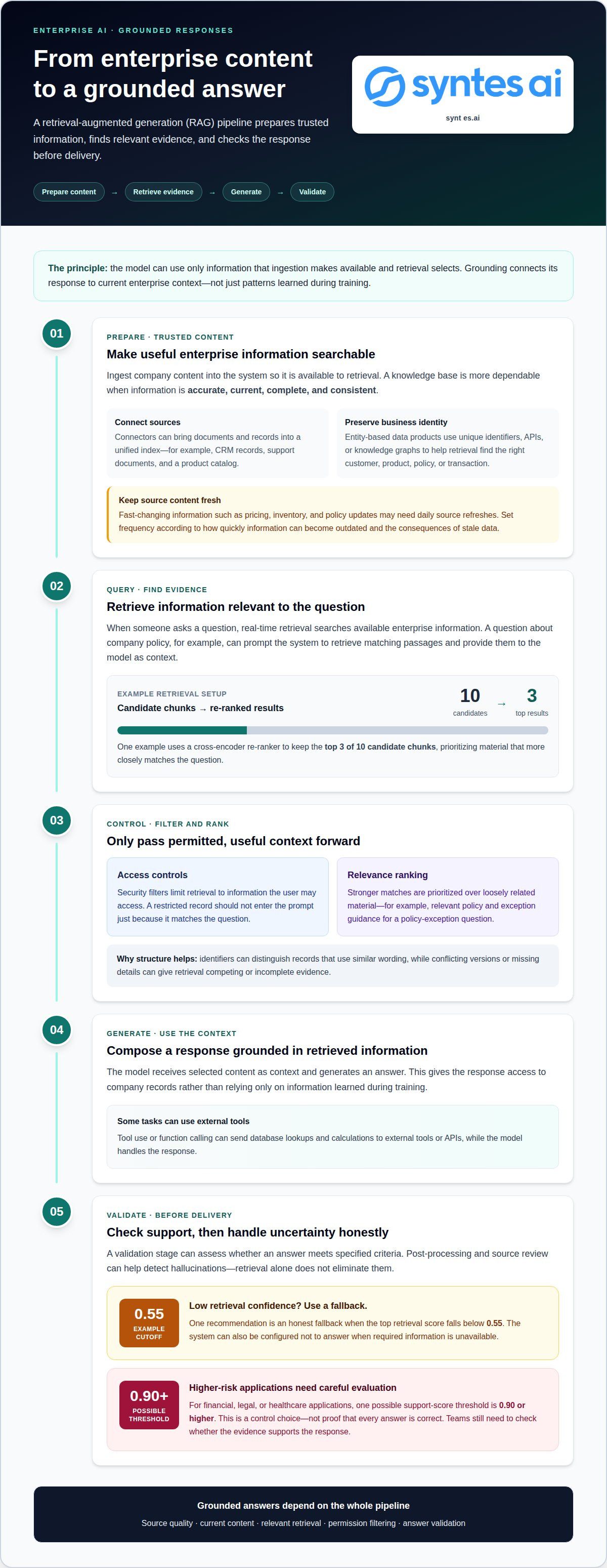
RAG is a pipeline that ingests enterprise content, retrieves material relevant to a question, and supplies it to the model to generate an answer. The sequence matters: a model can use only information that ingestion makes available and retrieval selects.
For example, a question about company policy can prompt the system to retrieve matching passages and pass them to the model as context. A validation stage can then assess whether the answer meets specified criteria. Each stage has a distinct role: prepare content, find evidence, compose an answer, and assess the result.
Real-Time Retrieval and Relevance Ranking
Real-time retrieval searches available enterprise information when someone asks a question, helping responses reflect current records. Relevance ranking orders retrieved passages so the model receives the strongest matches before less useful material.
One example configuration returns 10 candidate chunks, then uses a cross-encoder re-ranker to keep the top 3 results. This narrows prompt context to material more closely related to the question. If a user asks for a policy exception, ranking should favor the relevant policy and exception guidance over loosely related documents.
Permissions also shape retrieval. Enterprise RAG systems can apply access controls and security filters to private data, limiting retrieval to information a user may access. For example, an employee should not receive a restricted record just because it matches their question. Permission filtering must determine which content enters the prompt.
There is no single typical price for enterprise RAG platforms and LLM APIs. Costs vary with factors such as model choice, usage, retrieval infrastructure, storage, and support. Pricing is set according to the specific case.
Retrieval can fail when content is missing, stale, poorly indexed, or only loosely related to a question. A low-confidence fallback is safer than a confident guess: one example recommendation is to return an honest fallback when the top retrieval score falls below 0.55. The system can also be configured not to answer when required information is unavailable.
Grounding connects enterprise AI to information sources and operational controls, rather than treating it as a standalone text generator. Tool use or function calling can send database lookups and calculations to external tools or APIs, while the model handles the response. Post-processing can check output against defined criteria, and reviewing sources can help detect hallucinations that retrieval alone does not eliminate.
That combination supports more accountable workflows: retrieve evidence, respect permissions, generate an answer, and validate it before delivery. For higher-risk financial, legal, or healthcare applications, one possible support-score threshold is 0.90 or higher. The threshold is a control choice, not proof that every answer is correct; teams still need to evaluate whether retrieved evidence supports the response.
How are entity-based data products used in LLM grounding?
Entity-based data products connect business concepts to precise records through unique identifiers, APIs, or knowledge graphs. This gives retrieval a structured way to find the right customer, product, policy, or transaction instead of relying on similar wording alone.
Knowledge Base Quality and Consistency
A reliable knowledge base depends on content that is accurate, current, complete, and consistent. Each quality dimension affects what an LLM can retrieve and how confidently it can use the result.
For example, records with different product names but the same identifier can be recognized as referring to the same product. Conflicting policy versions, by contrast, can give retrieval competing evidence. Completeness matters too: if a product record lacks its current status, a generated answer may miss a decisive detail. These issues affect application accuracy, even when the language model is capable.
Knowledge Management and Unified Indexes
Knowledge management organizes enterprise content so a unified index can make relevant sources searchable across systems. Connectors bring documents and records into the index, giving retrieval a consistent place to search.
A question about a customer account might depend on a CRM record, a support document, and a product catalog. A unified index can make those sources available to the retrieval pipeline without requiring the model to guess where each item lives. Clear document ownership also helps teams resolve conflicts and keep content consistent as systems change.
Continuous Updates to AI Knowledge
Continuous updates refresh indexed content as source systems change, keeping retrieved context aligned with operational information. Fast-changing content, such as pricing, inventory, and policy updates, may need daily source refreshes.
During deployment, set update frequency according to how quickly a source can become outdated and the consequences of using stale information. A frequently changing catalog needs a different refresh approach from a stable technical manual. If updates fail or arrive late, retrieval can return obsolete records even after the source has changed.
Answer Traceability and Data Risks
Traceability connects generated claims to supporting source material, helping users inspect the context behind an answer. Answers should include citations or supporting context, while access controls and security filters limit which private records retrieval can use.
Grounding does not eliminate privacy or security risks. Weak permission filtering can expose information to an unauthorized user, and incomplete or outdated sources can still produce misleading answers. A governed pipeline must preserve source permissions, identify the material used, and validate claims against it. Human review can remain important when an incorrect answer could have serious consequences.
Knowledge graphs add another layer by representing entities and their explicit relationships. An ontology can define concepts such as customer, contract, and account, then specify how those entities connect. Retrieval can use these relationships to assemble context instead of asking the model to infer joins from names or document proximity. For teams shaping this foundation, explore entity-based grounding approaches as part of the design discussion.
What is LLM grounding in the context of enterprise data?
Enterprise grounding supplies a language model with company information and context during inference, helping it answer questions about actual business conditions. The choice between retrieval and fine-tuning depends on whether the need is current facts, specialized behavior, or both.
Query-Time Grounding and Fine-Tuning
Query-time grounding retrieves relevant information as a question is asked, while fine-tuning adapts a pretrained model using task-relevant training data. This distinction matters because retrieved content can reflect changing records without retraining the model.
For example, a policy assistant can retrieve the current policy text each time someone asks a question. If the policy changes, the source content and retrieval index can be updated. Fine-tuning instead modifies model weights and parameters using new data. It can help a model follow a specialized format or handle recurring domain language, but updating factual knowledge may require another training process.
Domain-specific fine-tuning can expose a model to materials such as medical texts, legal documents, or technical manuals, shaping how it interprets terminology and performs a task. It does not automatically connect the model to the latest internal record. A reliable implementation separates model behavior from factual access: tuning influences how the model responds, while query-time retrieval supplies evidence for the answer.
These techniques solve different problems. Fine-tuning can help when a general model needs a consistent task pattern, such as converting service notes into a defined structure. Retrieval is more suitable when an answer depends on changing enterprise facts, such as a contract’s latest status. Fine-tuning can be expensive and may yield only slight improvements, so its value depends on the task and the quality of its training data.
RAG, Fine-Tuning, and Long-Context Models
RAG retrieves selected source material for a response; fine-tuning changes model behavior through training; long-context models accept more input within a prompt. Comparing these options helps teams choose based on the knowledge task, not on model capability alone.
Consider a question about a supplier agreement. RAG can retrieve the relevant passage, grounding the answer in that source. Fine-tuning may teach the model how to extract renewal terms, but it does not retrieve the current agreement. A long-context model can process a larger supplied document, but someone still needs to locate and provide the relevant document.
These methods can also be combined for enterprise knowledge. Fine-tuning can establish a response pattern, while RAG supplies current source material at query time. A long context can hold multiple retrieved passages when a question requires comparing them. Choose an approach by identifying whether the gap concerns specialized behavior, access to current facts, or reasoning across more supplied text.
Before implementation, test representative questions against each approach. A policy question that changes with new source documents tests retrieval. A repeated classification task tests whether tuning improves consistency. Comparing lengthy records tests context handling. The results show which technique supports the use case and where source quality, retrieval, or model behavior needs refinement. Organizations planning custom deployments can also partner with specialized software and AI consultancies like 4mation to architect and evaluate these complex integrations.
LLM grounding with trusted enterprise content
Trusted content gives generative AI a dependable basis for producing accurate responses. In practice, grounding combines source data with business context: a contract clause, its customer, its effective status, and the question being asked. Without those connections, a language model may retrieve a relevant phrase but misunderstand what it applies to. A grounded answer should reflect both the source and its relationship to the user’s request.
Chunking determines how documents enter the retrieval context. A useful chunk preserves a meaningful unit, such as a complete policy rule or a contract clause with its conditions. Semantically coherent chunks of roughly 200 to 500 tokens can improve verification precision. Fixed 512-token chunks can split sentences or paragraphs, separating a rule from an exception. The design must balance useful context against the model’s processing limits.
Source selection matters as much as chunk size. For an answer about a product warranty, the system should retrieve the applicable warranty document, not an unrelated sales description. Responses should include citations or supporting context so readers can trace claims to their sources. External information can supplement internal content when a question requires public facts, but the system must distinguish the sources clearly.
Analytical AI needs connected context, not isolated values. A question about declining sales may require a time period, region, product category, and agreed definition of “sales.” An ontology or knowledge graph can represent these relationships explicitly, helping the system connect a metric to its business meaning. This gives retrieval more than matching language: it provides a conceptual map for interpreting evidence.
Context also determines whether an answer is operationally useful. If an analyst asks what might happen after a delivery schedule changes, the system needs relationships among the schedule, orders, and expected outcomes. A causal model can help ground natural-language questions about interventions and counterfactuals. The answer then depends on relevant relationships and assumptions, rather than treating correlation as proof of cause.
Trusted enterprise content must remain intelligible as it moves through an AI pipeline. A generative AI application can preserve document identity, ownership, and source context during ingestion, then pass those details alongside retrieved passages. For example, a policy excerpt should retain its document title and section. This supports precise citations and helps reviewers distinguish authoritative material from a draft or superseded version.
Grounding is ultimately a data and context discipline, not simply a prompt technique. A current source can still be incomplete, and a precise passage can still be irrelevant to the user’s situation. Teams need to assess whether retrieved material answers the actual question, whether its business relationships are clear, and whether the response stays within the evidence. These checks make enterprise information usable for language models without confusing fluent generation with verified understanding.
Grounding LLMs with enterprise data
Reliable enterprise grounding starts with a semantic foundation, not a pile of documents. A model needs to know what business concepts mean, how they relate, and which source defines them. Give it a conceptual map before detailed records. An ontology can define entities such as customer, contract, and revenue, then describe their relationships independently of where data is stored.
That separation matters in large organizations, where the same concept can appear across finance, sales, and operations systems. Explicit ontology relationships let retrieval connect records without asking the model to guess how tables join. RDF and OWL are standards for representing knowledge in machine-interpretable form. Their role is structural: they make concepts and relationships explicit, so questions can be resolved against a defined business model.
Consider a demand forecasting table used to inform inventory planning. An illustrative forecast reports 98.4% completeness and traces its lineage to three upstream sources. Those details help an AI application assess what information contributed to the forecast and whether the dataset is sufficiently complete for the question. The forecast value alone is not enough; its coverage and source relationships help make the answer interpretable.
This is where entity resolution becomes critical. A customer name may differ across a CRM, a contract repository, and a support platform, even when each record describes the same organization. Matching those records to a unique business entity can help models assemble relevant context without conflating similar names. Permission filtering must still apply during retrieval, so users receive only information their access allows.
Data products can package business information with its meaning, quality, and lineage. For example, a demand forecast can connect its completeness measure to the upstream records used to produce it. This helps an AI application distinguish a well-supported forecast from a dataset with gaps or disconnected sources. It also lets teams trace what contributed to an answer, rather than treating the model’s response as an isolated output.
Platform architecture should connect semantic definitions to retrieval and execution. A query can resolve a business entity, retrieve relevant data, and pass its context to the language model. If the question concerns a metric, its definition and time period should accompany the value. If required context is absent, the system should avoid filling the gap with an unsupported factual claim.
The takeaway: grounding enterprise models depends on structured meaning, connected records, governed access, and traceable data lineage. Better prompts cannot fix ambiguous business definitions or disconnected source systems. Build the foundation around the relationships and rules that give enterprise facts their meaning.
Syntes AI: AI Data Platform
Syntes AI helps organizations build the data foundation needed to ground enterprise AI in relevant business context. Its AI Data Platform connects with an Enterprise Knowledge Graph and Cross-System Integrations, bringing complex data into a structured, actionable format. For AI agents that need to work across enterprise systems, the Syntes Agentic Platform supports deployment and management for operational tasks.
This approach is relevant when useful information is spread across systems, business concepts lack clear connections, or AI applications need context beyond isolated documents. The priority is connecting data, meaning, and workflows so models and agents can work with enterprise information in context. The right starting point depends on the organization’s data environment and the operational task it wants to support.
To discuss grounding enterprise AI in connected business data, contact Syntes AI.
Move from grounded answers to operational AI
The next challenge is turning grounded responses into dependable work across the organization. That means deciding which tasks AI should support, how people remain involved, and what evidence an automated action must use. Organizations navigating this shift often look to GenAI consulting firms like Navo Inc. to support synthetic workforce development and AI agent deployment. A strategy for grounding LLMs on enterprise data should connect trusted information to clearly defined workflows, not stop at better answers. Start with a business process where accurate context can inform a meaningful next step, then expand as the operating model matures.
Syntes AI offers an Enterprise Knowledge Graph to structure business data, Cross-System Integrations to connect enterprise environments, and the Syntes Agentic Platform to deploy and manage AI agents for operational tasks. Together, these capabilities support the shift from disconnected information to context-aware AI execution.
Build with purpose. The strongest foundation is one that makes enterprise knowledge useful in the decisions and workflows that matter.
Frequently Asked Questions
What is AI grounding?
AI grounding connects a model’s response to information beyond its pretrained knowledge. For example, a procurement assistant can use a current supplier record to answer a question about an active agreement. Grounding helps anchor responses in relevant evidence, but it does not make every answer correct automatically. The system still needs suitable sources, clear context, and checks to distinguish supported statements from unsupported ones.
What Are the Main Challenges in Implementing LLM Grounding?
The main challenges are fragmented information, inconsistent definitions, permissions, and retrieval quality. A policy assistant may find two versions of a rule and select the outdated one unless source ownership and version status are clear. Access rules must apply when content is retrieved, not only when it is stored. Teams need representative tests to discover when search misses relevant material or answers go beyond the evidence.
What are the LLM grounding techniques for reliable outputs?
Useful techniques include retrieval-augmented generation, knowledge graphs, tool calls, and answer verification. A finance assistant might retrieve a metric’s definition, call a database for its current value, then check that the response preserves the metric’s time period. Clear fallback behavior matters too: if the system lacks evidence, it should say so rather than invent a factual answer.
What are the best practices for ongoing grounding assurance?
Maintain assurance by testing real user questions, monitoring retrieval failures, and reviewing changes to important sources. For example, after a product policy is revised, test questions about its eligibility rules and exceptions. Track which source versions informed responses, and send ambiguous or high-impact cases for human review. User feedback can reveal missing content, unclear business terms, or questions the system should handle differently.
What does grounding LLMs on enterprise data mean?
Grounding LLMs on enterprise data means giving a model access to relevant organizational facts and context when it responds. This context can include records, document definitions, relationships, and business rules. For example, answering whether an order is delayed may require its status, delivery date, and the organization’s definition of “delayed.” Grounding makes those inputs available; it does not remove the need to assess the answer.
What are the main architectures for connecting LLMs to enterprise data?
Common architectures include retrieval pipelines, direct tool or API calls, and knowledge-graph-backed retrieval. A document assistant may search an index, while a reporting assistant may query a database through a controlled tool. A graph can represent relationships among entities spanning systems. Fine-tuning changes model behavior rather than connecting it to live records, so it serves a different purpose from retrieval or tool access.
How does retrieval-augmented generation (RAG) work with enterprise data?
RAG searches enterprise content for material relevant to a user’s question, then supplies selected passages to the language model as context. The model uses those passages to generate a response, which can include source references for review. For instance, a benefits assistant could retrieve the policy section relevant to an employee’s question. The answer depends on whether the index contains the right content and retrieval finds it.
How do you prepare and index enterprise data for LLM grounding?
Start by identifying authoritative sources and preserving useful metadata, such as document owner, version, subject, and access permissions. Remove or mark duplicate and superseded content so retrieval can distinguish current material. Divide documents into coherent sections, then index them for search. For records, retain identifiers and relationships. Finally, test representative questions against the index and refresh it when source content changes.