

The best enterprise AI vendor isn’t the one with the most impressive demo. Evaluating enterprise AI vendors means setting minimum thresholds for security architecture and data governance, then scoring candidates against weighted criteria; one framework assigns 25% to each of those two areas. A strong evaluation also tests pricing, risk controls, and technical fit against the work the system must actually perform.
It’s reasonable to focus on model capability and promised results. But those strengths matter only if data practices, contract terms, oversight, and integration work in your operating environment. A polished presentation cannot show how a system handles your data or fits your workflows.
This guide gives you a structured way to compare vendors: what to examine in data retention and training use, how to assess pricing and contract protections, which risk controls and technical questions matter, and how to apply weighted criteria to reach a defensible decision. You’ll leave with a clearer basis for distinguishing a compelling demonstration from a solution suited to enterprise operations.
Key Takeaways
- Assess data retention, training use, deletion, and third-party processing before approving access to enterprise data. GDPR penalties can reach 4% of global annual revenue, according to the European Union.
- Compare pricing by modeling expected usage and how costs change as volume grows, then examine the contract’s protections and exit terms.
- Evaluate risk controls through auditability, human oversight, output testing, and ongoing monitoring, not policy statements alone.
- Test integration with existing systems and real workflows; a polished demonstration can’t establish technical fit.
- Use weighted criteria and minimum acceptable thresholds to make trade-offs visible and support a defensible decision.
1. AI vendor data retention, training use, and deletion
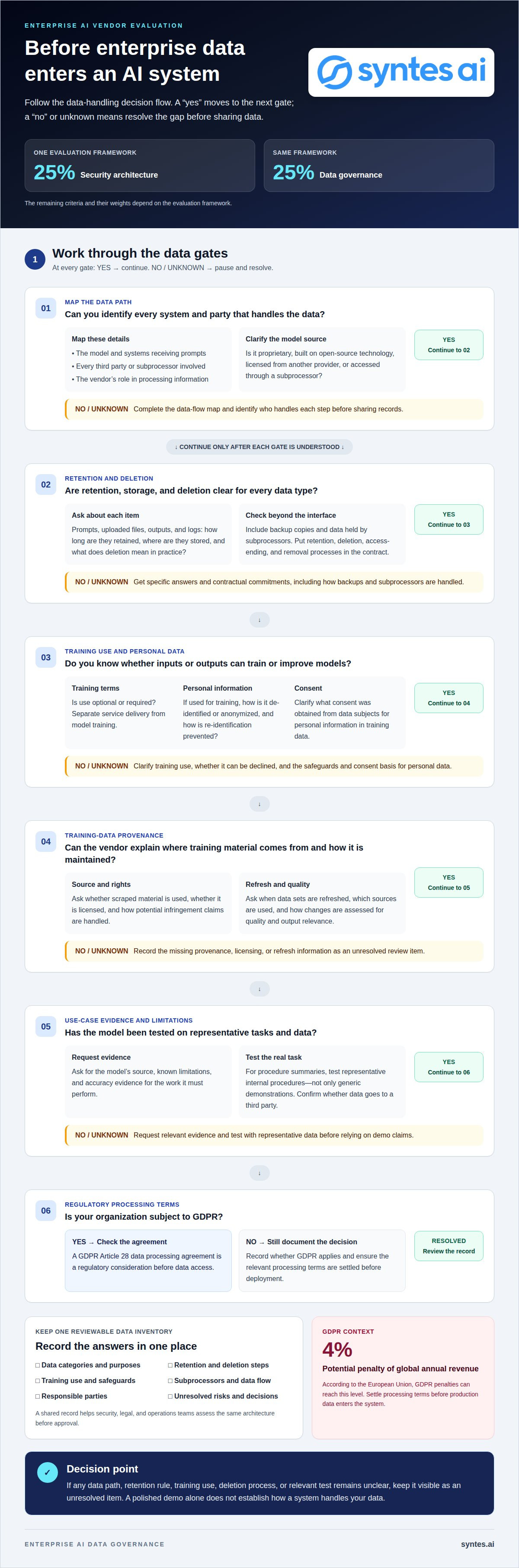
Start with a data-flow map before sharing internal records with an AI vendor. Identify the model, the systems that receive prompts, and every third party that processes information. Determine whether the model is proprietary, built on open-source technology, licensed from another provider, or accessed through a subprocessor. These distinctions reveal who may handle your data and which terms govern each step.
Next, establish what happens to prompts, uploaded files, outputs, and logs after a request. Ask how long each category is retained, where it is stored, and what deletion means in practice. A vendor should explain how it handles backup copies and data held by subprocessors, not just material visible in the user interface. Put retention and deletion commitments in the contract, with clear processes for ending access and removing data.
Separate service delivery from model training. Ask whether your inputs or outputs can be used to train or improve models, and whether that use is optional or required. If personal data may be used for training, ask how it is de-identified or anonymized and how the vendor works to prevent re-identification. Clarify what consent the vendor obtained from data subjects for personal information in training data. These answers help distinguish actual capabilities from broad privacy assurances.
Training data also raises questions about provenance and reliability. Ask whether the vendor uses scraped material, whether it has licensed that material, and how it responds to potential infringement claims. Request an explanation of how training data sets are refreshed and how changes are assessed for quality. A stale or poorly documented data set can affect output relevance. The refresh process should make the timing and data sources clear.
Test model claims against the data your use case requires. Ask for the model’s source, known limitations, and evidence of accuracy on relevant tasks. For example, assess a system that summarizes internal procedures using representative procedures, not just generic demonstrations. Confirm whether information is passed to a third party and whether the vendor can explain that party’s role in processing.
For organisations subject to GDPR, a GDPR Article 28 data processing agreement is a regulatory consideration before data access, according to the European Union. According to the European Union, GDPR penalties can reach 4% of global annual revenue. Treat these as reasons to settle processing terms before deployment, not after production data has entered the system.
Record the answers in a reviewable data inventory: data categories, purposes, retention, training use, subprocessors, deletion steps, and responsible parties. A clear record lets security, legal, and operations teams assess the same architecture and identify unresolved data-handling risks before approval.
2. AI pricing models and contract protections
Require the service-level agreement to define availability, incident response, error resolution, escalation paths, and support scope. It should also state which training and support services are included, how performance is measured, and what happens when agreed service levels are missed. These terms turn general promises into operational commitments.
AI software is generally offered through software-as-a-service models, but the billing unit can vary. A contract may use a subscription, usage-based charges, or credits, so compare the price mechanism rather than the headline figure. According to Zylo’s pricing analysis, 78% of IT leaders report unexpected charges on AI tools, while credit-based AI pricing models grew 126% year-over-year. Define billable activity, included usage, overage rates, and notification thresholds before deployment.
Build a total cost model around expected operating volume, then show how costs change if usage doubles. Include software fees, integration work, data preparation, support, training, and any services required to maintain the deployment. Model costs across three years, not just the initial contract. Organizations that prepared detailed three-year total cost of ownership models were 2.8 times more likely to remain within their original budgets.
Contract protections should address future changes as well as current pricing. Document how the vendor can revise rates, introduce new billing units, or change model access. Define notice periods, renewal terms, price-review mechanisms, and an exit process that covers data export and transition assistance. An internal cost owner can review usage against the agreed model and flag unexpected growth before renewal discussions.
Price also depends on performance. Test each model on representative business tasks, then measure accuracy, time saved, error correction, and human review effort. For example, a model that generates more drafts may still cost more overall if staff must repeatedly correct inaccurate outputs. Ask how the model reaches decisions, and assess how it handles biased or underrepresented inputs. A vendor should describe known limitations and how teams can report problematic outputs.
- Explainability: Require clear descriptions of model inputs, decision logic, and output limitations.
- Flexibility: Document available model options and the conditions for changing them.
- Portability: Define how the organization can export its data and operational records if the agreement ends.
- Support: Specify who handles incidents, how issues are escalated, and which response and resolution metrics apply.
These terms reduce lock-in by making cost, support, and exit conditions visible before commitment. A workflow and integration discussion can help clarify the operational requirements behind a pricing comparison.
3. AI-specific methodology and risk management
Use a formal framework to turn broad AI concerns into controls, owners, and review actions. The NIST AI Risk Management Framework and ISO/IEC 42001 are examples for mapping governance controls. Apply the chosen framework across the system lifecycle, from selecting a use case to monitoring live outputs. Assign an accountable leader to each risk, including data quality, harmful outputs, and operational failure.
Test model behavior before deployment using representative cases. Measure accuracy and review outputs for bias, missing perspectives, and unsupported claims. A system that performs well on common requests may still fail on underrepresented cases. Record the test set, expected responses, observed errors, and corrective action for each issue. Repeat testing after material model or workflow changes, so approval reflects current performance rather than an outdated snapshot.
Human oversight must be operational, not just a policy statement. Require an audit trail recording who submitted a question, what information the system retrieved, which model responded, and what action followed. Confirm that authorized users can review and override outputs before consequential decisions. For example, an AI recommendation in a customer workflow should have a defined escalation path when confidence is low or source information conflicts.
Build change management into the implementation plan. Identify who will use AI, which decisions they can delegate, and which actions still require human approval. Provide role-specific training and capture user feedback through a defined process. If employees cannot tell when to trust an output or how to report an error, adoption stalls and risks remain invisible. Track usage alongside workflow outcomes, not in place of them.
Pay-as-you-go pricing needs active cost controls. Set budget thresholds, assign an owner to monitor usage, and review consumption against expected workload. Track which teams, workflows, and model operations drive charges, and investigate sudden increases before they become routine. The evaluation should also show how costs respond to changing volumes, so leaders can connect resource use to business value.
Risk does not end at launch. Review vendor performance quarterly to detect model drift, recurring errors, and changes in operational fit. Reassess security and privacy posture 18 months into the contract, since the vendor’s controls may change during that period. Keep a record of findings, assigned owners, and remediation actions. This creates a repeatable governance cycle instead of relying on an initial approval.
- Define: Map each risk to a control, accountable owner, and review trigger.
- Test: Use representative cases to assess accuracy, bias, and failure handling.
- Monitor: Track usage, output quality, and drift through scheduled reviews.
- Escalate: Preserve human review and override paths for consequential actions.
4. Technical architecture and legacy system integration
Compare integration coverage, deployment requirements, customization options, and the ability to scale across users and data. Test the vendor’s technical fit against your actual systems, such as customer relationship management software, case management tools, and internal data platforms. A polished demonstration cannot establish how the product will perform in your environment.
Start with a system map. Identify where the AI solution must read information, where it must write results, and which workflows depend on those exchanges. Then document the required interfaces, identity controls, data formats, and failure paths. For example, if an AI assistant summarizes service cases, test whether it can retrieve the right case context and return its output to the workflow where staff act on it.
Integration is not a one-time connection. Compare how each product handles system changes, customized business logic, and monitoring after deployment. Ask the vendor to explain which components are configurable and which require custom work. A useful proof of concept exercises the full workflow, including permissions, handoffs, and error handling, rather than showing an isolated model response. An AI proof of concept can take 4-8 weeks, so define its technical scope and success measures before it begins.
Scalability requires more than a promise to support growth. Test how performance changes as users, data volume, and workflow complexity increase. Confirm how the architecture handles concurrent activity, data updates, and interruptions in connected systems. Technical integration and data architecture are the second-leading cause of project delays and cost overruns in enterprise AI implementations. Treat architecture review as a core evaluation step, not a final implementation detail.
Legacy environments make this assessment especially important. Professional services firms commonly use platforms that are 5-15 years old, so vendors must account for existing data structures and operational dependencies. Map the systems that must remain in place, then test how the AI product connects with them. Include customization needs in the design, and assess whether changes can be maintained without disrupting established workflows.
Set realistic deployment expectations. A realistic professional-services AI deployment timeline is 6-12 months, and implementation timelines are estimated to be underestimated by 2-4x. These figures make phased planning essential: define technical dependencies, data readiness, testing gates, and operational ownership before rollout. A proof of concept validates a bounded scenario; it does not replace planning for production deployment.
Portability deserves equal attention. Enterprises switching AI vendors after initial deployment typically spend 40 to 60 percent of the original implementation cost on remediation, re-architecture, and redeployment. Assess how data, workflow logic, and integrations can be transferred if the system changes. The goal is not to avoid commitment; it is to understand which architectural choices may make future change costly.
- Map: Trace data and actions across each connected system.
- Test: Exercise permissions, handoffs, failures, and realistic workload growth.
- Plan: Define dependencies, monitoring, and phased deployment gates.
- Assess: Identify customization requirements and the implications of switching platforms.
5. Weighted criteria for evaluating enterprise AI vendors
A weighted scorecard makes trade-offs visible instead of letting a polished demonstration dominate the decision. Score each criterion from 1 to 5, then multiply the score by its assigned weight. Agree on definitions before vendor presentations, so every evaluator applies the same standard. Set minimum acceptable scores for security architecture and data governance first. A vendor that misses either threshold should not advance because a high commercial score cannot compensate for a critical control gap.
Use a framework that reflects enterprise risk and implementation demands. One evaluation model assigns weights across six criteria, totaling 100%:
- Security architecture, 25%: Assess controls, system design, and the evidence supporting security claims.
- Data governance, 25%: Examine data handling, ownership, permitted uses, and governance responsibilities.
- Access control and auditability, 20%: Evaluate permissions and whether system actions can be traced.
- Compliance and regulatory readiness, 15%: Assess alignment with the requirements relevant to your organization.
- Commercial terms, 10%: Score pricing clarity, contract protections, and exit conditions.
- Governance and monitoring, 5%: Review ongoing oversight, issue handling, and performance review mechanisms.
For each score, record evidence, not impressions. A score of 1 might indicate a material gap; a score of 5 should require strong, relevant proof. Apply the same test to every vendor, such as requesting documented access controls or testing audit logs with a representative workflow. Keep evaluator notes beside the score so stakeholders can see why a candidate ranked higher.
Build the assessment around your use case. Ask vendors for case studies and model test results, then run a test set drawn from your organization’s actual cases. Compare outputs against agreed measures for accuracy and usefulness. A vendor’s broad performance claim cannot show how its system handles your terminology, edge cases, or workflow constraints. Ask what the product cannot do yet; clear limits help define deployment scope.
Keep commercial scoring separate from technical acceptance. A lower-cost offer should not override a failed security or data-governance threshold. Likewise, a high technical score should not obscure unclear contract terms, weak support commitments, or an impractical exit path. Calculate weighted totals only after mandatory thresholds are met, then compare the evidence behind close scores.
Before final approval, test whether the ranking depends too heavily on one criterion. Recalculate totals with modest changes to subjective weights and note whether the preferred vendor changes. If it does, identify the assumption driving that shift and resolve it with stakeholders. This sensitivity check helps distinguish a stable decision from one resting on a contested priority. Record the final rationale, accepted trade-offs, and accountable decision owner, so future reviews have a clear baseline.
Finally, assess whether each vendor can operate as a long-term partner. Review communication, support expectations, training, and the process for resolving errors. Ask how the vendor reports changes that may affect performance or governance. A defensible selection records the score, evidence, unresolved risks, and decision owner, giving leadership a clear basis for approval.
Syntes AI
Syntes AI helps enterprises turn evaluation findings into an operational AI foundation by connecting fragmented data, business context, and workflows. Its Enterprise Knowledge Graph and Context Engineering create a unified context layer, while the Syntes Agentic Platform enables governed agents to execute operational tasks. The live context graph connects structured data, documents, and relationships, giving agents business context for their work.
For organizations assessing integration fit, Syntes AI’s Cross-System Integrations use bi-directional connectors across existing systems, with no rip-and-replace. Teams can deploy in weeks, not months, without disrupting source systems. This approach fits when vendor selection reveals gaps in context, integration, or governed execution, rather than a need for an isolated AI tool.
Contact Syntes AI to discuss your enterprise AI needs.
Turn vendor evaluation into an operational decision
The decision is not complete when a vendor is selected. Lasting value comes from making that choice a foundation for how the organization learns to work with AI. Treat evaluating enterprise AI vendors as the beginning of a deliberate operating capability: teams should be able to explain why a use case matters, what boundaries apply, and how responsibility changes as systems take on new tasks.
Pursue a shared operating vision, not a collection of disconnected deployments. As teams gain experience, revisit which work should be automated, augmented, or remain human-led. Make the rationale clear to technical and business groups, so new initiatives inherit less ambiguity and build on organizational learning. A strong vendor relationship should strengthen your capacity to make these choices, rather than make strategy dependent on product demonstrations. The next stage is a considered model for how people and AI collaborate.
Move forward with clarity, letting each deliberate decision build a more capable organization.
Frequently Asked Questions
How Do You Evaluate an AI Vendor for Enterprise Deployment?
Begin with a defined business process and identify who owns its outcome. Then determine which decisions the system may support, which require human approval, and what evidence would justify expanding its role. As you evaluate enterprise AI vendors, compare their answers against the same operational scenario. Include the teams that will use, govern, and maintain the system, so deployment planning reflects real responsibilities rather than procurement assumptions.
What Are the Main Types of Enterprise AI Companies?
Enterprise AI companies generally focus on different layers of the technology stack. Some build or provide models; others offer business applications, data and context platforms, or tools for integrating and governing AI across workflows. These categories can overlap. Classify a vendor by the problem its product solves and its place in your architecture. For example, while specialized systems like REI Reply focus on niche marketing and contact center automation for real estate investors, horizontal platforms connect broader cross-departmental operations.
What are the criteria for evaluating AI adoption roadmap vendors?
Assess whether a vendor’s roadmap connects technical milestones to business ownership and adoption. Look for clear dependencies, decision points, training plans, and criteria for moving from a limited rollout to broader use. A useful roadmap identifies which teams need to change their workflows and how feedback will shape subsequent releases. It should also explain how the vendor communicates product changes, so your organization can plan for evolving capabilities.
What should organisations look for in AI platforms and AI tools to support ongoing vendor evaluation?
Choose tools that make product changes and operational outcomes reviewable over time. Useful evaluation records can connect a model or platform version to the workflow, test cases, approval decision, and observed issues. This helps teams distinguish a change in the vendor’s system from a change in source data or user behavior. Clear ownership of these records also makes recurring reviews more consistent across business units.
What’s the biggest mistake in AI vendor selection?
The biggest mistake is choosing a system before defining the decision or work it must improve. Without a precise use case, teams can mistake a convincing demonstration for evidence of operational value. For example, when assessing specialized enterprise solutions like closestrong.ai, organizations should verify how the platform operationalizes sales strategy across active deals rather than relying on generic text generation. Define intended users, workflow boundaries, and the consequences of errors before comparing vendor claims.
What criteria should enterprises use to evaluate AI vendors?
Use criteria that reflect both business value and your organization’s ability to operate the system. Alongside technical fit and governance, assess ownership, workflow impact, implementation dependencies, and how users will report problems. Separate mandatory conditions from preferences, then document the evidence behind each decision. This makes trade-offs explicit and prevents a strong presentation or attractive feature from outweighing a business-critical requirement.
How do enterprise AI vendors compare on capabilities, accuracy, and reliability?
Compare vendors using identical tasks, input conditions, and review standards. Examine more than average accuracy: note whether outputs remain useful across routine and unusual cases, whether errors can be identified, and how consistently results hold when inputs change. Record failure types as well as successful outputs. This reveals practical differences between vendors, such as one handling exceptions clearly while another produces answers that require extensive interpretation.
What are typical enterprise AI vendor pricing models and costs?
Common pricing structures include subscriptions, usage-based billing, and credit-based plans, with terms varying by product and contract. Total cost depends on more than the quoted software charge: implementation effort, data preparation, training, support, and ongoing administration can all affect the business case. Compare costs against expected use and business outcomes, and clarify how charges are calculated, what changes them, and which services are included.