
A knowledge graph can be built in-house and still fail to make enterprise AI trustworthy. That’s the distinction at the heart of the diy knowledge graph vs platform decision: assembling graph infrastructure isn’t the same as creating governed context that AI can use to reason and act. DIY gives teams control over the components, but also makes them responsible for integration, semantic modeling, governance, and ongoing maintenance.
That responsibility can be worthwhile when requirements are distinctive and the organization has the expertise to sustain the system. A platform, meanwhile, must do more than sit beside existing data: it needs to connect systems, reflect business semantics, and support governance without imposing a one-size-fits-all model. This article compares both approaches using practical business and technical criteria, clarifies what each takes to build, integrate, govern, and maintain, and explains how to distinguish a graph database from a broader enterprise AI operating layer. You’ll also see how Syntes AI’s Context Engineering framework spans Connect, Understand, Contextualize, Govern, and Execute, framing the decision around trusted AI execution, not just a feature checklist.
Key Takeaways
- Assess the diy knowledge graph vs platform choice against your workflows, internal expertise, and governance needs, not feature lists alone.
- Map your data sources, business entities, relationships, policies, and required actions before selecting an architecture.
- Decide who will own semantic modeling, integration, change management, governance, and ongoing maintenance.
- Distinguish graph storage from the wider context layer needed to support AI reasoning and operational use.
- Use the five Context Engineering pillars, Connect, Understand, Contextualize, Govern, and Execute, to assess how a platform can link enterprise context to governed AI activity.
DIY Knowledge Graph vs. Platform: What Are You Actually Choosing?
The diy knowledge graph vs platform decision is about who assembles and operates the context layer behind enterprise AI. A DIY knowledge graph is an organization-owned implementation built from selected technologies and services. An enterprise platform brings capabilities for connecting data, modeling relationships, applying governance, and making context available to AI applications into a more integrated environment.
A graph database can store and traverse relationships, but storage alone doesn’t define what a customer, asset, or transaction means across the business. Nor does it automatically provide the policies and interfaces AI systems need to use that information. A Knowledge graph represents entities and the relationships between them. The enterprise challenge is keeping that representation aligned with changing systems and business meaning.
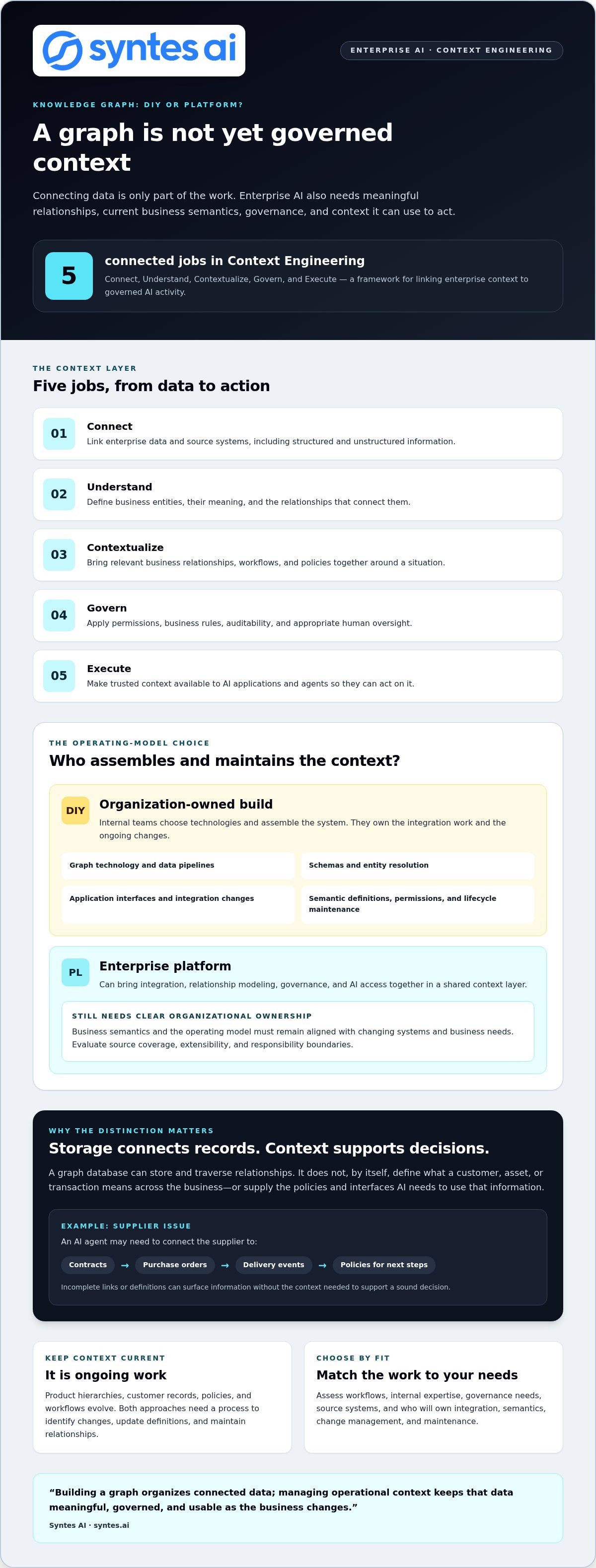
Quotable distinction: Building a graph organizes connected data; managing operational context keeps that data meaningful, governed, and usable as the business changes.
What does building a knowledge graph yourself involve?
DIY means selecting graph technology, designing data pipelines, defining schemas, resolving entities across sources, and building application interfaces. Teams also own integration changes, semantic definitions, permissions, and lifecycle maintenance. A prototype might show that selected data can be connected for one use case. A production system must maintain dependable context across workflows as sources, relationships, and business rules evolve.
What does an enterprise knowledge graph platform add?
A platform can bring data integration, relationship modeling, governance, and AI access together in a shared context layer across enterprise systems. Its value is not simply fewer components to assemble. It can connect structured and unstructured data to business entities and relationships, then make governed context available to applications and agents. The fit depends on how well its model aligns with the organization’s semantics and operating needs.
Syntes AI takes this broader approach through Context Engineering and a live Context Graph. It connects enterprise data, models relationships, applies governance, and enables AI agents and applications to act on trusted context. For a deeper look at how enterprise graphs move from connected information toward agentic intelligence, read The Executive Guide to Enterprise Knowledge Graphs.
How DIY Builds and Enterprise Platforms Manage Context Differently
The practical difference in the diy knowledge graph vs platform decision is how context is created, kept current, governed, and made useful to AI. A graph’s value depends on accurate entities and relationships, not on storing data in graph form alone. Stanford’s explanation of the subject-relationship-object structure helps clarify the foundation: a graph connects defined things through meaningful relationships, rather than simply collecting records in a structured database.
Operational context is linked business information that helps a system interpret a situation and determine how to act. For example, an AI agent handling a supplier issue may need to connect a supplier to contracts, purchase orders, delivery events, and the policies governing next steps. If those links or definitions are incomplete, retrieval may surface information without the context needed to support a sound decision.
Who owns integrations, semantics, and change?
In a DIY build, internal teams design and maintain connectors, data mappings, entity-resolution logic, and business definitions. They also respond when a source system changes a field, a business unit revises a term, or a relationship takes on new meaning. A platform can provide integration capabilities and a shared context layer across enterprise sources, but the organization still needs clear ownership of its semantics and operating model. Evaluate source coverage, extensibility, and responsibility boundaries against the systems in scope.
Context is not a one-time modeling task. Product hierarchies, customer records, policies, and workflows evolve. Both approaches need a process for identifying changes, updating definitions, and maintaining the relationships AI depends on. The difference is where that work sits: in organization-managed components or within a platform and the teams responsible for configuring and using it.
How do governance and agent execution change the comparison?
Governance needs to shape how context is accessed and used. Teams must account for permissions, business rules, auditability, and appropriate human oversight. A DIY architecture can implement these controls, but the organization must coordinate them across its components. A platform can bring context and governance capabilities into a shared environment, with fit determined by the organization’s requirements and implementation.
Agents need more than relevant passages. Before taking action, they need business context to establish what a record means, which relationships matter, and what rules apply. Syntes AI’s Context Engineering framework connects data, models entities and relationships, contextualizes them, applies governance, and enables agents and applications to act on trusted context. For a broader view of how agentic platforms connect context to action, explore the guide to Agentic AI Platforms. To see how this approach can relate to your workflows, explore a Syntes AI demonstration.
DIY Knowledge Graph vs. Platform: Compare the Trade-Offs
The right choice depends on more than technology preferences. A DIY build gives the organization direct control over architecture and implementation, but makes internal teams responsible for the full lifecycle. A platform can bring integration, modeling, governance, and AI access into a shared environment, but teams still need to assess its fit with their systems and business semantics. An enterprise knowledge graph must address entity resolution, access controls, and governance, not just connected data.
| Comparison dimension | DIY knowledge graph | Enterprise platform |
|---|---|---|
| Control | Teams select and manage the components and architecture. | Capabilities are integrated within a platform, with choices shaped by its design. |
| Customization | Supports bespoke modeling and specialized architecture when internal expertise is available. | Provides platform capabilities that need to align with business semantics and workflows. |
| Integration ownership | Internal teams build and maintain connectors, pipelines, and mappings. | Integration capabilities can connect sources; teams still assess source coverage and ownership boundaries. |
| Governance | The organization designs and coordinates controls across its components. | Governance can be part of a shared environment, subject to fit with organizational requirements. |
| Maintenance | Teams maintain infrastructure, mappings, definitions, and integrations over time. | The platform consolidates capabilities, while teams still manage context, configuration, and business rules. |
| AI readiness | AI access and execution depend on the components and controls the organization builds. | A platform may connect governed context to AI applications and workflows as part of its operating model. |
Separate the initial implementation from the work that follows. A prototype may establish that specific entities and relationships can support a use case. Production brings continuing responsibilities: adapting integrations as sources change, revising semantic definitions, maintaining governance, and keeping context relevant to dependent workflows. Neither approach removes this work. The decision determines how it is organized and owned.
When can a DIY knowledge graph be the better fit?
DIY can suit a narrow domain with specialized modeling needs, especially when architectural control is a priority and an experienced team can own the system from design through maintenance. For teams requiring extra operational support, working with an experienced technical partner like 4mation can help manage ongoing maintenance and system reliability. Make the full lifecycle explicit from the start. Include integration changes, governance, and sustained engineering ownership in the plan, not just the initial build.
When does a platform approach make more sense?
A platform merits consideration when context must span multiple systems, data types, or business functions, or support governed AI workflows. A shared layer can make enterprise relationships and rules reusable across applications. When preparing for AI agent deployment and synthetic workforce development, organizations often turn to specialized consultancies like Navo while evaluating architectural options alongside platforms like Syntes AI.
Rule of thumb: Choose according to the control you require, the operational capacity you can sustain, and the AI use you intend to support.
How to Decide: A Practical Enterprise Evaluation Framework
Start with the work AI must support, not a preferred graph database or vendor. A focused evaluation ties the architecture to real decisions, clarifies who will own the operating model, and makes the diy knowledge graph vs platform choice testable.
- 1. Start with a workflow. Identify a specific decision or task, who performs it, what information they need, and what action should follow. Clarify whether AI needs to retrieve information, reason across relationships, or support a governed action.
- 2. Inventory the context. Map the source systems and data types involved, including structured and unstructured information. Identify key business entities, how they relate, which policies govern them, and where definitions or records may differ across systems.
- 3. Score the requirements. Compare integration breadth, data handling, and relationship modeling. Assess permission handling, business rules, auditability, and human oversight. Rate each requirement by importance, then separate essential conditions from desirable capabilities.
- 4. Test organizational capacity. Name the owners for integrations, semantic modeling, governance, operations, and ongoing change. Consider whether those teams can maintain context as source systems and business rules evolve, and whether the approach supports reuse beyond the first workflow.
- 5. Define a bounded pilot. Choose a workflow with identifiable sources, relationships, and decision criteria. Evaluate decision quality, explainability, governance, and usefulness in the workflow. Set criteria before testing so the team can judge the operating model, not just whether a demo works.
Which requirements should the evaluation score?
Score both technical fit and operational responsibility. For example, a use case combining customer records, service policies, and case notes needs clear entity relationships and support for different data types. Assess whether the system can reflect required permissions, explain how context informed an answer, preserve human oversight, and distinguish information retrieval from agent actions that must follow business rules.
How can an enterprise test the operating model?
Use the pilot to examine change, not just a fixed snapshot. Update a source record or revise a business rule, then observe whether the resulting context and downstream reasoning remain appropriate. Track who makes the update, how it is governed, and what maintenance it requires. Before expanding, compare the effort to operate the approach with its potential for reuse across workflows.
The evaluation should end with a clear decision: which requirements are met, what responsibilities remain with internal teams, and whether the approach can support the intended AI use beyond the pilot.
How Syntes AI Connects Knowledge Graphs to Governed Enterprise Execution
The build-versus-platform decision comes down to what must happen after enterprise data is connected. Syntes AI combines Context Engineering, a live Context Graph, and governed AI in an integrated platform. The Context Graph is a live operational model and continuously evolving enterprise memory, linking business entities and relationships so AI agents and applications can work with contextualized information.
That breadth matters when the goal extends beyond retrieving a record. A workflow may need to relate information across systems, interpret business rules, and provide context for an agent or application to act. Syntes AI organizes this work through five framework pillars:
- Connect: Bring structured and unstructured enterprise information into the context process through cross-system integrations.
- Understand: Identify business entities and the relationships connecting information across sources.
- Contextualize: Apply business meaning to those connections and develop the live Context Graph as operational context.
- Govern: Govern the context used for AI reasoning, including relevant policies and permissions.
- Execute: Enable agents and applications to use trusted context in support of governed actions.
The sequence links data to action and makes context and governance part of the operating model, rather than treating the graph as an isolated storage layer. Platform fit depends on the organization’s requirements, existing architecture, semantics, and ownership model. The diy knowledge graph vs platform question is best resolved by testing those requirements against a real workflow, not by assuming a platform or in-house build is right for every enterprise.
What should buyers assess in a platform demonstration?
Use a representative workflow to follow context from source to action. Trace relevant systems and data, inspect how entities and relationships are modeled, then see how business rules and permissions inform the context available to an agent or application. Assess whether the reasoning can be explained and whether the proposed action fits the workflow’s governance needs.
A useful evaluation also makes operational fit visible. Consider how the approach aligns with current architecture, who owns semantic definitions and ongoing changes, and whether context can support enterprise priorities beyond the example shown. A demonstration should help decision-makers assess the operating model, not just the interface.
Choose the Context Model That Can Grow With Your AI
The diy knowledge graph vs platform decision isn’t about choosing technology in isolation. Start with the business workflow, then weigh the control and customization of an in-house build against the integration, governance, and ongoing ownership your organization can sustain. A sound choice accounts for both the initial implementation and the continuing work of keeping enterprise context accurate and useful.
For AI to move beyond retrieving information, it needs connected business relationships, explainable reasoning, and governance that carries through to agent actions. Syntes AI brings these elements together through a live Context Graph and a five-pillar Context Engineering Framework: Connect, Understand, Contextualize, Govern, and Execute. The right fit depends on your systems, business semantics, operating capacity, and intended AI use.
Make the next step practical: evaluate the approach against a representative workflow and the requirements your teams need to govern. With a clear view of those needs, you can build a stronger foundation for trusted AI execution.
Your enterprise context can become a foundation for more informed, governed action.
Frequently Asked Questions
Is it better to build a knowledge graph in-house or use a platform?
Neither approach is universally better. Choose based on the control you need and the capacity you can sustain. A DIY build can suit a focused use case when your team can own graph technology, integrations, semantic modeling, governance, and maintenance. A platform may fit better when context must connect multiple systems and support governed AI workflows. Evaluate the diy knowledge graph vs platform choice against a real business workflow and its ongoing requirements.
What is the difference between a knowledge graph and an enterprise AI platform?
A knowledge graph represents entities and their relationships, such as customers linked to orders, products, and policies. An enterprise AI platform can use a graph as part of a broader operating environment, connecting data, contextualizing business meaning, applying governance, and making trusted context available to AI applications or agents. A graph database alone doesn’t automatically provide those capabilities; their scope depends on the architecture or platform.
Can a company build a knowledge graph without a platform?
Yes. A company can assemble a graph using selected technologies and internal data pipelines, then develop its own schemas, entity resolution, and application interfaces. The organization remains responsible for keeping integrations, business definitions, permissions, and graph data current. A prototype for one use case differs from a production system supporting multiple workflows, which needs sustained technical and governance ownership.
How do you compare DIY knowledge graph and platform options?
Compare them against the same requirements: source-system coverage, structured and unstructured data handling, relationship modeling, customization, and integration ownership. Then assess governance, permissions, business rules, auditability, maintenance responsibilities, and how AI will use the context. Identify whether the workflow needs retrieval, explainable reasoning, or governed agent actions. Test the options with a bounded use case and include ongoing operations, not just the initial implementation.
Does a knowledge graph prevent AI hallucinations?
No. A knowledge graph can give an AI system structured relationships and business context to inform its responses, but it doesn’t guarantee that every answer will be correct. Results still depend on the graph’s accuracy and currency, how the AI uses it, and the surrounding governance and evaluation practices. For enterprise use, consider whether reasoning can be explained and whether people can review consequential outputs or actions.
What should an enterprise AI platform demonstration include?
A useful demonstration should follow a representative workflow from source data to decision or action. Examine how the platform connects relevant systems, models entities and relationships, and applies business rules and permissions. See how context informs an answer or agent action, and how reasoning can be explained. Also assess fit with existing architecture, ownership of ongoing changes, and the governance needed for the intended use case.