

What if the most future-proof data architecture isn’t a particular platform, but the ability to change without rebuilding everything around it? That’s the central challenge in designing future-proof data architecture: legacy systems and disconnected data make change costly, while rigid technology choices can limit what teams can do next. AI raises the stakes by exposing gaps in data context, governance, and operational readiness.
The answer isn’t to predict which technology stack will dominate. It’s to design around business capabilities, clear governance, and the capacity to evolve. This guide shows how to balance flexibility with operational needs, connect data across systems, and support trusted AI as requirements change.
You’ll learn a repeatable process for assessing current capabilities, choosing patterns that fit your needs, and reducing unnecessary dependence on any single platform. We’ll also explore how Context Engineering and a live Context Graph can maintain business context across changing systems, connecting enterprise information to governed AI reasoning and action.
Key Takeaways
- Approach designing future-proof data architecture as a repeatable process. Start with business capabilities and priority decisions rather than a predetermined technology stack.
- Assess principles such as loose coupling, interoperable interfaces, clear ownership, and shared definitions to make change manageable.
- Compare warehouses, lakehouses, fabrics, and meshes by their trade-offs, governance needs, and fit with your organization’s operating model.
- Map systems, data relationships, access rules, integration dependencies, and quality gaps to identify what must change before selecting or validating a design.
- Use Context Engineering’s Connect, Understand, Contextualize, Govern, and Execute pillars to maintain useful business context across evolving systems and AI workflows.
Designing Future-Proof Data Architecture Starts with Change, Not Technology
Business requirements change. New data sources appear, processes evolve, and AI introduces demands that existing systems may not have been designed to meet. The challenge is to support change without assuming anyone can predict every future requirement. Designing future-proof data architecture isn’t about selecting a stack that will never age. It’s about making change possible without repeatedly replacing foundational systems.
Future-proof data architecture is the governed capacity to adapt business context, data relationships, and system capabilities as needs change. This definition shifts attention from technology forecasts to durable design principles: clear ownership, interoperable interfaces, shared meaning, and controlled change. Platforms and tools may evolve; sound architecture makes those transitions manageable. A foundational overview of data architecture helps clarify its scope across data assets, structures, and the systems that support them.
What does future-proof mean for enterprise data architecture?
It means adaptable and governable, not fixed or immune to change. Suppose a sales process begins using a new external data source to improve account qualification. A resilient architecture can connect and govern that source, define how its fields relate to existing customer data, and make it useful in the relevant workflow without forcing a redesign of every downstream system. Adopting the newest platform alone doesn’t deliver resilience. The design must support change while preserving business meaning and oversight.
Why do data architecture decisions become difficult to reverse?
Reversibility declines when systems are tightly coupled, ownership is unclear, and teams use inconsistent definitions for core concepts such as customer, order, or eligibility. A change to one source can then trigger custom fixes across reporting, operations, and AI workflows. The problem isn’t simply that data is spread across systems. The relationships, rules, and responsibilities needed to interpret it may also be fragmented or undocumented.
That fragmentation limits what data can do. An analytics model may show a customer record without showing how it relates to a contract, support case, or operational decision. An AI system can retrieve information yet lack the governed context to reason about how those facts connect. Connected business relationships are central to an enterprise knowledge graph guide: a knowledge graph represents entities and their relationships so systems can work with context, not just isolated records. The architectural priority is to preserve those connections as underlying tools and requirements evolve.
The Design Principles That Make Data Architecture Adaptable and AI-Ready
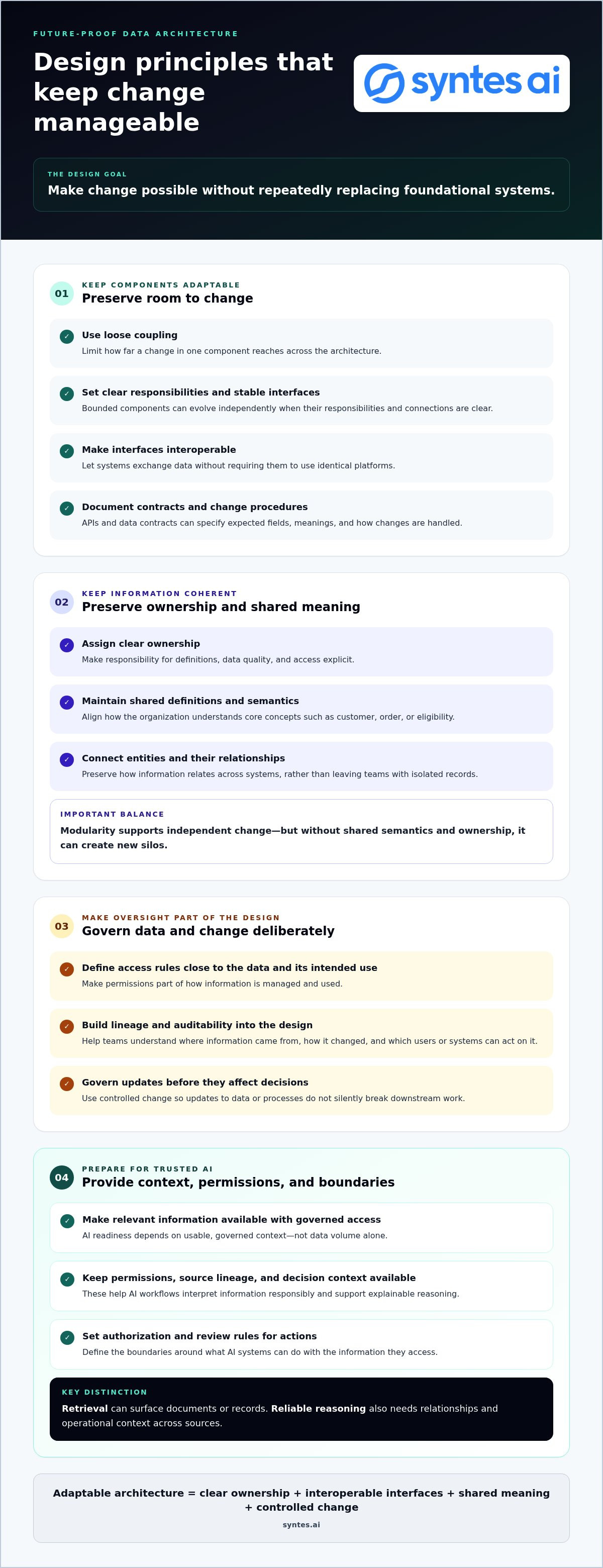
Adaptability comes from design choices that preserve options, not from adding layers of technology. Loose coupling limits how far a change in one component reaches. Interoperable interfaces let systems exchange data without requiring identical platforms. Explicit ownership clarifies who maintains definitions, quality, and access. Governed change ensures updates to data or processes don’t silently break downstream decisions.
How do modularity and interoperability preserve room to change?
Design bounded components around clear responsibilities, then connect them through stable interfaces. APIs and data contracts can define expected fields, meanings, and change procedures, helping teams make updates deliberately instead of surprising downstream users. Modularity alone, however, can create new silos. Assign owners and maintain shared semantics so components can change independently while contributing to a coherent enterprise view.
This principle applies to governance as much as integration. Define access rules close to the data and its intended use, and build lineage and auditability into the design. Those controls help teams understand where information came from, how it changed, and which users or systems can act on it. The future-proofing federal data discussion underscores why secure, scalable infrastructure matters when operations depend on reliable information.
How should an architecture support trusted AI?
AI needs governed access to relevant information, plus boundaries around what it can do with that information. A system should make permissions, source lineage, and decision context available to support explainable reasoning. Actions should follow defined authorization and review rules. Retrieval can surface documents or records, but reliable enterprise reasoning also depends on maintaining relationships and operational context across sources.
A semantic layer aligns data with business meaning, while a context layer can connect that meaning to the situation an AI workflow must interpret. Explore the semantic data layer guide for a closer look at how shared meaning supports agentic systems. For organizations assessing how context and governance fit into their architecture, a Syntes AI demo offers a way to explore these design considerations.
Compare Data Architecture Patterns by Their Trade-Offs, Not Their Labels
Architecture patterns describe different responsibilities, not competing answers to the same question. A warehouse organizes structured data for analytics. A lakehouse combines data-lake flexibility with data-management capabilities for analytics. A fabric focuses on connecting distributed data through integration and metadata. A mesh distributes data ownership across domain teams. Choose a pattern by matching its operating assumptions to your needs, not by declaring one universally superior.
Where do knowledge graphs and context layers fit?
Graphs represent entities and their relationships, such as how an account connects to contracts, transactions, and service events. A context layer can make those connections and their business meaning available across workflows without replacing source systems or every analytics platform. This distinction matters when designing future-proof data architecture: add connective context where it resolves fragmentation while preserving systems that continue to serve their purpose. For cross-system integration considerations, see the enterprise data silos guide.
A Practical Process for Designing and Validating Future-Proof Data Architecture
Start with the work the architecture must support, not a technology shortlist. Designing future-proof data architecture becomes practical when teams trace business decisions to the data, relationships, controls, and systems those decisions depend on. Use this sequence to establish a target state, deliver it incrementally, and test whether it can absorb change.
- Step 1: Identify priority capabilities and decisions. Select business workflows that depend on information crossing system boundaries, such as approving a transaction or resolving a service issue. Define the decision to be made, the information it requires, and what a useful outcome looks like.
- Step 2: Map the current information landscape. Inventory relevant systems, data owners, key entities and relationships, access rules, quality gaps, and integration dependencies. Trace how a critical data element moves from its source into the workflow, including transformations and handoffs.
- Step 3: Rank requirements by consequence. Prioritize needs according to operational importance, risk, and dependencies. A missing relationship or unclear permission that blocks a high-priority decision deserves attention before a novel capability with no immediate business dependency.
- Step 4: Design and deliver a bounded capability. Define the interfaces, shared meanings, ownership, governance controls, and data flows required for one priority workflow. Implement in increments, retaining useful existing systems and changing only the capabilities needed to close identified gaps.
- Step 5: Build operational controls into each phase. Assign accountable owners and establish how teams will monitor data quality, integration behavior, access, and lineage. Make those controls part of delivery and ongoing operation, not a final review after the architecture is already in use. For enterprise leaders aligning technical controls with executive governance, strategic IT consultancies such as Unisphere Solutions help connect system-level security with broader organizational risk appetite frameworks.
How can teams test whether a design can adapt?
Test the design against realistic changes before treating it as a target state. Introduce a new source, revise a business rule, or add a governed AI workflow to a representative process. For each scenario, check whether teams can update interfaces and definitions without hidden downstream breakage, and whether permissions, lineage, and the basis for a resulting decision remain understandable.
Record the findings. If a change depends on undocumented connections or obscures who owns a rule, revise the design before expanding it. Broader infrastructure choices also shape these decisions, as explored in this enterprise AI infrastructure guide.
When should architecture assumptions be revisited?
Set a decision checkpoint at meaningful business or technical changes, such as a new priority workflow, a shift in data ownership, or a change to an integration dependency. Reassess whether the architecture still supports the required decisions, controls, and operating responsibilities. This keeps the target state adaptable without turning every new technology into a reason to rebuild.
Use Context Engineering to Keep Enterprise Data Architecture Operational
Architecture connects systems and data. Context Engineering makes the business meaning and relationships across them usable, governable, and maintainable as processes evolve. This matters for AI because access to information alone doesn’t explain how a fact relates to a business decision or which actions are permitted. A live Context Graph represents connections among systems, documents, entities, rules, and events as an evolving operational model, while existing source systems continue to serve their established roles.
How does the Context Engineering Framework work?
The framework moves through five connected pillars:
- Connect: Integrate structured and unstructured information across relevant business systems.
- Understand: Identify entities, relationships, and business semantics so information can be interpreted in context.
- Contextualize: Model how data, rules, and events relate to operational workflows and decisions.
- Govern: Apply security, permissions, and auditability to the context and its use.
- Execute: Enable applications and AI agents to use trusted context for actions within defined governance boundaries.
Each pillar addresses a different architectural responsibility. Together, they connect enterprise information to AI reasoning and action without treating a context layer as a replacement for every data platform or operational system. For example, an agent may need to relate a business record to a policy and a recent event before recommending a next step. A governed context model can make those connections more visible and help people understand which information informed the reasoning. It doesn’t guarantee a correct outcome; permissions, data quality, business rules, and oversight still matter.
What should enterprise leaders do next?
Choose one meaningful workflow where decisions depend on information from multiple systems. Map the context it requires: key entities and relationships, relevant documents and rules, data owners, access boundaries, and the actions an application or agent may take. Then validate the design incrementally against existing systems and business rules. Check whether connections remain understandable as information changes, and whether governance applies throughout the workflow.
This focused assessment gives architecture teams a concrete basis for deciding where integration, context modeling, and governance need to evolve. It also keeps implementation tied to an operational outcome rather than an abstract platform target. To explore how Context Engineering could fit your architecture priorities and implementation context, book a Syntes AI demo.
Make Your Architecture Ready for What Comes Next
Designing future-proof data architecture isn’t about choosing a stack that never changes. It’s about building the capacity to adapt: start with business capabilities and priority workflows, select patterns according to their trade-offs, and validate each design against real changes in data, rules, and operations.
For enterprise AI, flexibility must work alongside governance. Syntes AI’s five-pillar Context Engineering Framework, Connect, Understand, Contextualize, Govern, and Execute, provides a method for building and maintaining business context. Its live Context Graph connects enterprise data and business relationships to support governed workflows and explainable reasoning, while existing systems continue to serve their roles.
Start with one meaningful workflow. Map the context it depends on, identify the controls it requires, and test how they hold up as needs evolve. A focused first step can turn architecture strategy into practical progress.
Build with change in mind, and your architecture can keep creating room for what comes next.
Frequently Asked Questions
What does future-proof data architecture mean?
Future-proof data architecture means an organization can adapt its data systems, connections, and governance as business needs evolve, without repeatedly replacing foundational systems. It doesn’t mean predicting every future technology or locking into a supposedly permanent stack. Instead, teams establish clear ownership, interoperable interfaces, shared business definitions, and controlled change processes. Those principles help new data sources, workflows, and AI capabilities fit into the architecture without sacrificing operational context or oversight.
How do you design a data architecture that can adapt to change?
Start with the business decisions and workflows that depend on reliable information, then map their systems, data relationships, owners, and access requirements. Design modular components with stable interfaces and shared definitions so changes can be managed without creating disconnected silos. Implement capabilities incrementally, and test changes such as adding a source or updating a business rule. Designing future-proof data architecture also means embedding governance, lineage, and observability into each phase.
Can legacy systems be part of a future-proof data architecture?
Yes. A future-proof architecture can preserve legacy systems that still support essential business processes while connecting their data to newer capabilities through governed interfaces or integrations. For example, a reporting workflow may continue to rely on an established operational system while a context layer connects its records to related documents or business rules. The key is to understand dependencies, assign ownership, and avoid embedding fragile assumptions that make future changes difficult.
Is a data mesh or data fabric better for enterprise architecture?
Neither is inherently better. A data mesh is an organizational approach that distributes data ownership across business domains, while a data fabric is a technology layer for connecting distributed data through integration and metadata. A mesh may fit organizations with teams able to own domain data products; a fabric may help coordinate access across complex systems. They can also work together when responsibilities, shared definitions, and governance are explicit.
What role does data governance play in future-proof architecture?
Data governance makes change accountable and controlled. It defines who owns data, how it can be accessed and used, which business rules apply, and how its movement and transformation can be traced. Embedding governance in architecture helps teams update sources and workflows while maintaining permissions, lineage, and auditability. For AI, these controls also help establish which information an application or agent may use and which actions require boundaries or review.
How does data architecture support enterprise AI agents?
Data architecture supports enterprise AI agents by connecting relevant information and its business meaning with governed access to systems and workflows. Agents need more than retrieved documents: they may need relationships among entities, current operational context, and applicable business rules to reason about a task. Clear permissions, traceable sources, and defined action boundaries help people understand how an agent reached a recommendation and control what it can execute.
What is the difference between a knowledge graph and a context graph?
A knowledge graph represents entities and the relationships among them, such as customers, products, and suppliers. A context graph applies graph-based relationships to operational business context, connecting information such as documents, rules, and events across systems to support reasoning and action. The terms can overlap, but a context graph emphasizes an evolving view of the business relevant to workflows and AI. Its value depends on governed, maintained connections, not the label alone.