

Technical debt in a data platform isn’t a cleanup list; it’s a portfolio of business risks. Dealing with technical debt in data platforms starts with recognizing how fragile pipelines, undocumented transformations, and hidden dependencies make routine changes risky. Some shortcuts can wait. Others threaten critical data products, slow delivery, or undermine trust in decisions.
Teams need to modernize without pausing feature delivery or compromising operational commitments to rebuild everything. The answer isn’t to fix every imperfection. It’s to identify debt with evidence, weigh its business and operational consequences, and direct effort where it reduces the most risk.
This guide explains how to uncover and assess debt, prioritize remediation by risk, impact, and effort, and reduce it without turning each fix into a costly rebuild. It also covers how clearer ownership, stronger governance, and deliberate architecture can prevent new debt. Syntes AI’s Context Engineering and live Context Graph connect enterprise data into operational context, complementing the work of assessing and prioritizing existing debt.
Key Takeaways
- Separate deliberate, time-bounded trade-offs from unmanaged debt that raises future change, operating, or reliability costs.
- Build an evidence-based debt inventory by tracing assets and dependencies, then reviewing failures, incidents, manual interventions, schema changes, and delivery delays.
- Choose whether to refactor, modernize, contain, or replace based on risk, business continuity, dependencies, team skills, and the ability to reverse course.
- Make dealing with technical debt in data platforms part of planned delivery: assign owners, define acceptance criteria, and set rollback conditions for each remediation task.
- Reduce recurring fragmentation with clear ownership, shared definitions, data contracts, lineage, and change controls, supported by governed, connected operational context.
What Technical Debt in Data Platforms Looks Like, and Why It Compounds
A data platform can keep producing outputs while becoming harder to change, operate, and trust. A brittle ingestion job or undocumented transformation may seem manageable on its own. But when other pipelines, reports, and teams depend on it, each change carries more uncertainty and requires more coordination.
Data platform technical debt is deferred engineering work that makes future changes, operations, or reliability harder and more costly. This builds on the broader idea of technical debt, but in a data platform, the liability often crosses system boundaries. A schema change at ingestion can break transformations, disrupt orchestration, and leave downstream consumers with incomplete or inconsistent data.
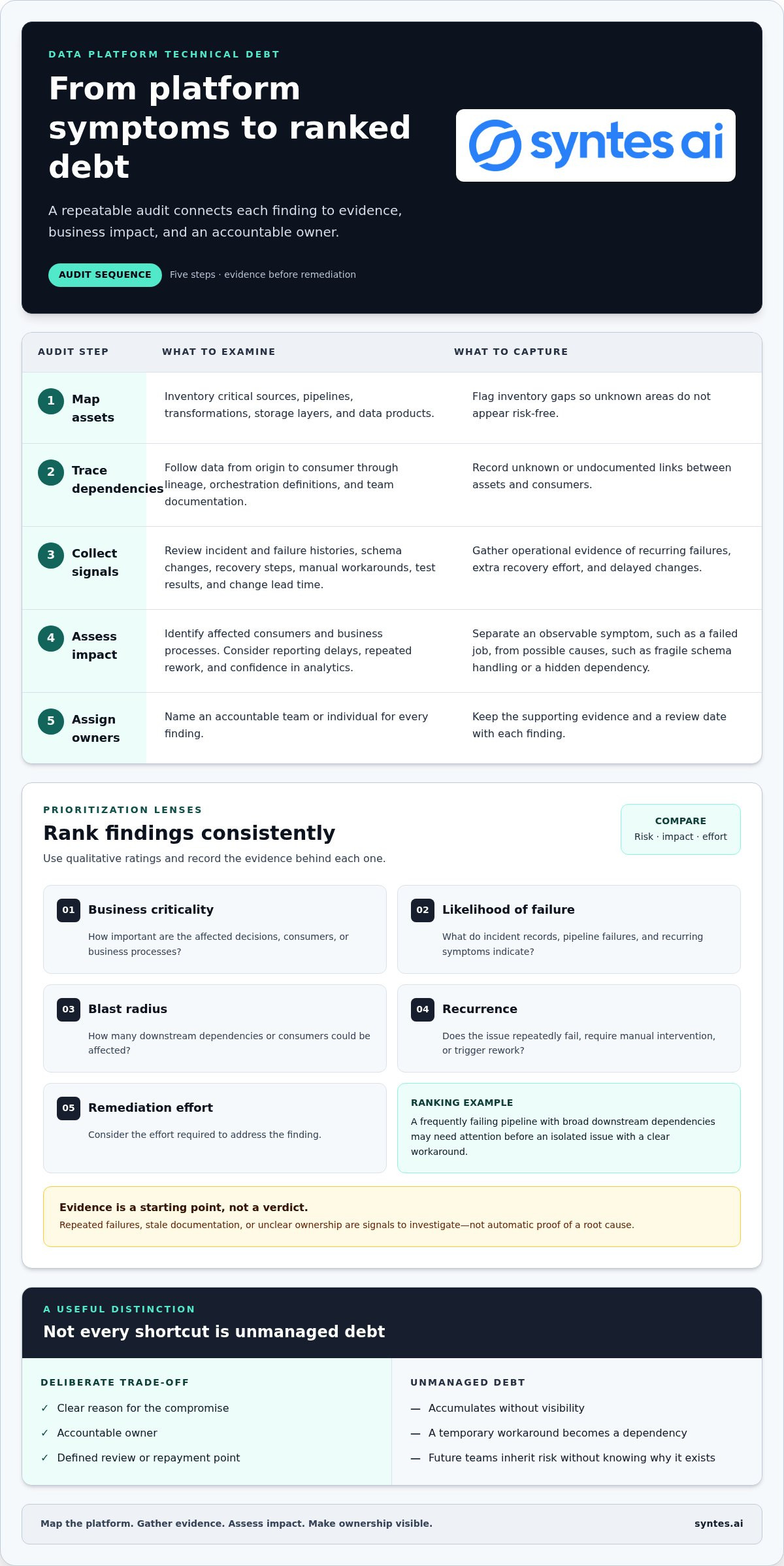
Not every shortcut is unmanaged debt. A deliberate trade-off has a clear reason, an accountable owner, and a defined point for review or repayment. Unmanaged debt accumulates without visibility: a temporary workaround becomes a dependency, and the next team inherits its risk without knowing why it exists. Dealing with technical debt in data platforms means distinguishing these cases before treating every compromise as equally urgent.
Which forms of technical debt appear in data platforms?
Look for brittle pipelines that fail when source formats shift, duplicated transformations that produce conflicting definitions, and schema drift that surprises consumers. Debt also hides in unclear ownership, weak observability, manual recovery steps, undocumented dependencies, and processing patterns that consume unnecessary time or resources.
Tool sprawl adds another maintenance burden. Teams may use different standards for naming, testing, lineage, or access, so a fix in one part of the platform can introduce work elsewhere. The result is more than a collection of local defects. Teams must repeatedly translate assumptions and rebuild connections just to keep data flowing.
How does data platform debt affect business operations?
Unreliable datasets delay reporting and force analysts to validate or reconcile outputs instead of using them. Repeated rework weakens confidence in analytics, especially when teams can’t explain why reports differ or whether a dataset is current.
During an incident or proposed change, opaque lineage makes it difficult to identify affected consumers, while unclear ownership slows investigation and approval. Assess these effects using organization-specific evidence, such as incident histories, repeated manual interventions, reporting delays, and time spent tracing dependencies. When diagnosing recurring failures, automated root cause analysis platforms like ZANALYSE can help teams parse logs and incident timelines into structured reports. Debt matters most where it obstructs critical decisions or makes routine change unpredictable.
Repairing individual pipelines helps, but it won’t prevent fragmentation from returning if shared definitions, ownership, and cross-system context remain unclear. Treat debt as a platform-wide operational concern, not just a list of isolated code defects.
How to Find and Measure Data Platform Technical Debt
A useful audit connects each symptom to affected assets, operational evidence, and accountable owners. That gives teams a basis for ranking risks instead of debating which issue feels most urgent. Before choosing a fix, establish a defensible picture of the debt. Martin Fowler’s overview of what is technical debt offers a foundation; the steps below apply that idea across data workflows.
Teams can detect platform debt in incident records, pipeline failures, schema changes, manual interventions, and the lead time required to make changes. Use those sources in a repeatable audit:
- Map assets. Inventory critical sources, pipelines, transformations, storage layers, and data products. Flag gaps in the inventory so unknown areas don’t appear risk-free.
- Trace dependencies. Follow data from origin to consumer using lineage, orchestration definitions, and team documentation. Record unknown or undocumented links.
- Collect signals. Review incident and failure histories, schema changes, recovery steps, manual workarounds, test results, and change lead time.
- Assess impact. Identify affected consumers and business processes. Separate an observable symptom, such as a failed job, from possible causes, such as fragile schema handling or a hidden dependency.
- Assign owners. Name an accountable team or individual for each finding, and record the supporting evidence and a review date.
What signals reveal hidden pipeline and data-model debt?
Look for repeated failures, growing recovery effort, stale documentation, and dependencies that only one team understands. Compare transformations across teams to find duplicated logic or conflicting definitions of the same metric. Then inspect lineage, schema-change handling, test coverage, and ownership records. Treat these signals as candidates for investigation, not automatic proof of a root cause.
How should teams score and rank debt items?
Use consistent qualitative ratings for business criticality, likelihood of failure, blast radius, recurrence, and remediation effort. A frequently failing pipeline with broad downstream dependencies may need earlier attention than an isolated issue with a clear workaround. Record the evidence behind each rating, affected consumers, accountable owner, and next review date.
Keep symptoms and causes distinct. A rise in manual reruns is evidence; inadequate retry logic remains a hypothesis until code review or production behavior supports it. Mark estimates accordingly, then update them as new evidence emerges. This keeps an unverified diagnosis from driving expensive remediation.
When an audit exposes recurring gaps in lineage or cross-system context, Syntes AI’s Context Engineering and live Context Graph can make relationships across enterprise data more visible. This connected operational context complements debt assessment; it doesn’t replace it. See how governed operational context works as part of a broader platform strategy.
Which Technical Debt Response Fits: Refactor, Modernize, or Replace?
There’s no universal remedy for platform debt. Choose the smallest intervention that addresses the root cause without exposing critical workloads to unnecessary disruption. A localized defect may call for a targeted refactor. Debt spread across dependencies, operations, or governance may justify broader modernization. In some cases, containment is the prudent option while teams build a safer path forward.
Compare options against operational risk, dependency complexity, continuity requirements, available skills, and reversibility. Estimate effort and business impact using your organization’s workloads and constraints. Consider both the current burden and the transition risk of making a change.
| Response | Suitable conditions | Trade-offs and signals to reconsider |
|---|---|---|
| Targeted refactor | Debt is localized, interfaces are understood, and workloads can remain operational during changes. | Limits the scope of change, but repeated patches or recurring failures may signal a deeper architectural cause. |
| Modernization | Core platform components or practices constrain multiple workflows, and dependencies can be migrated in controlled stages. | Can address systemic limitations, but requires sequencing, compatibility planning, validation, and skills the team can sustain. |
| Containment | Immediate change carries more risk than the current workaround, or a safer intervention depends on future prerequisites. | Preserves continuity in the near term, but needs explicit ownership and review so temporary controls don’t become permanent blind spots. |
| Replacement | Existing components cannot meet important operational needs, and dependencies can be transitioned with a defined migration path. | Creates a chance to resolve systemic constraints, but adds transition debt through parallel operation, migration, and compatibility work. |
When is incremental refactoring the safer choice?
Refactor when the defect has a clear boundary and teams understand the interfaces around it. Make a small change, add or strengthen tests, validate downstream behavior, and define a rollback plan before release. This keeps the blast radius manageable while preserving service continuity. If each patch exposes another dependency or the same failure keeps returning, reassess the architecture instead of extending the patch cycle.
When should teams consider modernization or replacement?
Consider broader change when constraints recur across pipelines, dependencies, operations, or governance rather than within one isolated component. Before committing, define the migration path, compatibility strategy, validation approach, and accountable service owner. Replacement isn’t a clean slate: parallel systems, data movement, and consumer transitions create their own obligations. Include that transition debt in the assessment.
For teams dealing with technical debt in data platforms, the right choice reduces verified risk while preserving critical business operations. Revisit the decision when evidence changes, such as a wider dependency scope, recurring incidents, or a revised continuity requirement.
How to Pay Down Data Platform Debt Without Disrupting Delivery
Debt repayment stalls when it sits outside the work teams are already planning. Convert prioritized findings into a time-boxed backlog, then give each item an owner, a clear outcome, acceptance criteria, and rollback conditions. “Improve pipeline reliability” is too broad to schedule. “Handle the agreed schema change without manual recovery and verify downstream outputs” gives the team a testable result.
Plan capacity for this work alongside feature delivery and operational commitments. The allocation should reflect your team’s risk priorities and delivery obligations, not an arbitrary cleanup quota. For cross-system dependencies, map affected teams and data consumers. The enterprise data silos guide explains how fragmentation can complicate coordinated change.
How can teams sequence remediation safely?
Start with high-impact items that are well understood and can be changed behind tested interfaces. Before rollout, coordinate platform, domain, security, and downstream consumer owners, especially when a data contract or access pattern will change. Stage the release: validate the change, reconcile outputs against expected results, monitor affected consumers, and keep rollback procedures ready.
Define success and failure signals before deployment. Acceptance criteria might cover output completeness, expected freshness, and successful execution without the manual intervention the fix was intended to remove. If validation fails, pause or roll back rather than allowing an uncertain change to spread through dependent workflows.
How should leaders protect repayment work from being deferred again?
Keep debt items visible alongside feature work and operational risks in the same planning process. Review them at agreed decision points, and bring them forward when evidence changes: recurring incidents, increasing recovery effort, longer change lead time, or expanding consumer impact. This ties prioritization to operational signals rather than a fixed number of cleanup tasks.
Track a baseline before work begins, then compare it with post-change evidence. Useful measures include failure recurrence, recovery effort, incident patterns, change lead time, and effects on data consumers. If symptoms persist, revisit the diagnosis; completing a task doesn’t prove the underlying debt has been reduced. A consistent cadence makes dealing with technical debt in data platforms part of delivery, not work that waits for a future pause.
Where fragmented context drives recurring integration work, governed, connected operational context is an architectural consideration alongside targeted remediation.
Prevent Recurring Debt with Governed Context and Clear Platform Ownership
A repaired pipeline can still sit inside a fragmented platform. If neighboring systems use different definitions, undocumented interfaces, or unclear ownership, the same integration burden returns in another form. Lasting prevention requires operating practices that connect technical change to shared business meaning. For a broader view of how relationships across enterprise data can be represented, see this enterprise knowledge graph guide.
What operating practices keep data debt from returning?
Assign both product and technical owners to critical datasets, interfaces, and transformations. Product ownership clarifies intended meaning and use; technical ownership covers implementation, reliability, and change. Make both responsibilities explicit in the documentation teams use to plan and operate the platform.
Build consistency into routine work:
- Use versioned data contracts to define expected structures and communicate changes to consumers.
- Maintain lineage so teams can trace data from source through transformation to downstream use.
- Apply quality checks and governed access appropriate to each dataset and use case.
- Review incidents and exceptions to identify where standards, ownership, or architecture need to change.
These controls turn recurring failures into feedback. If teams repeatedly need custom mappings or manual workarounds, investigate the shared definitions and interfaces behind them instead of patching each instance in isolation. Similar operational challenges with manual tracking arise in specialized engineering environments, where platforms like SOCWeld help teams digitize and manage welding documentation.
How can shared context support trusted enterprise AI?
Disconnected records rarely carry enough meaning on their own. A customer record, policy document, operational event, and business rule may refer to the same real-world situation, but separate systems can obscure those connections. A governed Context Graph links entities, structured and unstructured data, rules, relationships, and events in a shared layer, making the context behind information more visible.
Syntes AI’s Context Engineering Framework organizes this work through Connect, Understand, Contextualize, Govern, and Execute. The framework connects enterprise information and supports governed AI execution through a live operational context. A semantic data layer guide offers further context on architecture for shared meaning. Context Engineering complements debt assessment and prioritization; it doesn’t replace either.
For teams dealing with technical debt in data platforms, the enduring objective is clear: make ownership, meaning, dependencies, and change visible enough to prevent old fragmentation from resurfacing as new maintenance work.
Turn Data Platform Debt into a Managed Advantage
Dealing with technical debt in data platforms starts with evidence, not a blanket rebuild. Map where fragility affects critical workflows, distinguish symptoms from root causes, and prioritize fixes by business risk, dependencies, and effort. Then protect remediation with clear ownership, planned capacity, and measures that show whether reliability and changeability are improving.
Prevention matters just as much as repayment. Shared definitions, documented lineage, data contracts, and change controls help stop repaired pipelines from becoming isolated fixes in a fragmented environment. When teams need connected operational context, Syntes AI’s live Context Graph connects structured and unstructured enterprise data, while governed AI agents and explainable reasoning support trusted execution.
Technical debt doesn’t have to dictate the pace of innovation. With a clear view of risk and a disciplined path forward, your team can strengthen the platform while continuing to deliver for the business.
Frequently Asked Questions
What is technical debt in a data platform?
Technical debt in a data platform is deferred engineering work that makes future changes, operations, or reliability harder. Examples include brittle ingestion pipelines, duplicated transformations, undocumented dependencies, and weak schema-change handling. These shortcuts may keep data flowing today, but each new dependency or workaround can increase maintenance effort and make failures harder to diagnose. Dealing with technical debt in data platforms means identifying which liabilities threaten important workflows and addressing them deliberately.
How do you identify technical debt in data pipelines?
Review recurring pipeline failures, manual recovery steps, duplicated transformation logic, and changes that break downstream schemas. Trace lineage to see which consumers depend on affected data, and check whether ownership records and documentation are current. Incident histories and change records provide evidence of operational impact. Separate symptoms from causes: repeated reruns are a symptom, while fragile retry logic or an undocumented dependency may be a cause that needs validation.
How should a data team prioritize technical debt?
Rank each item by business criticality, likelihood of failure, potential blast radius, recurrence, and remediation effort. A recurring defect that affects a critical data product may take priority over an isolated issue with a safe workaround. Record the evidence behind the rating, affected consumers, proposed response, and accountable owner. Treat uncertain estimates as hypotheses, then revise them as incident patterns, production behavior, or dependency analysis provide stronger evidence.
Should we refactor or replace a legacy data platform?
Refactor when debt is localized, interfaces are understood, and changes can be tested without disrupting dependent workloads. Consider broader modernization when constraints recur across architecture, operations, or governance. Before replacing a platform, assess dependencies, business continuity, available skills, reversibility, and the migration path. Replacement brings transition risk of its own, including compatibility work and parallel operation. Compare organization-specific effort and impact rather than assuming a rebuild is inherently safer or more effective.
How can organizations reduce technical debt without slowing delivery?
Break remediation into incremental, time-boxed work with named owners and measurable acceptance criteria. Plan capacity alongside feature commitments, and make changes behind tested interfaces where possible. Use staged rollout, monitor affected data products, and define rollback plans before release. Compare operational outcomes before and after each fix, including failures, recovery effort, change lead time, and consumer impact. This keeps debt work connected to delivery while limiting the risk of broad, unvalidated change.
Can data contracts prevent technical debt?
Data contracts can reduce avoidable integration problems by defining dataset ownership, schemas, compatibility expectations, and how changes are communicated. Versioned contracts help producers and consumers coordinate updates instead of discovering breaking changes through failed jobs or inconsistent outputs. Pair contracts with documented lineage, quality checks, and change controls so teams can understand downstream effects. Contracts don’t eliminate every form of debt, but they make important assumptions explicit and easier to maintain.
How does technical debt affect enterprise AI projects?
Fragmented data, unclear semantics, weak lineage, and inconsistent business rules make it harder for AI systems to work from reliable enterprise context. A model or agent may encounter conflicting records or miss the relationships that explain what information means. Integration and governance connect data with relevant rules and relationships while making access and reasoning more controlled. Syntes AI uses a live Context Graph and governed AI agents with explainable reasoning to support trusted enterprise AI.