
What if the fastest way to combine two companies’ data is not to migrate it all at once? In data integration for mergers and acquisitions, speed matters. But moving unfamiliar data before its meaning, quality, and access rules are understood can create unreliable reporting and operational risk. Disparate systems and conflicting definitions make that pressure harder to manage.
The answer isn’t to pause integration. It’s to stage it around deal priorities, protect business continuity, and establish clear ownership and lineage as systems connect. That gives teams a practical way to make data traceable and useful across legacy and acquired company environments without discarding the context that explains what it means.
This guide shows how to build an integration plan, from assessing data and setting priorities to aligning definitions, governance, and access. You’ll also learn how a shared context layer can complement system connections by preserving relationships among business entities, documents, rules, and events. The goal is a governed foundation for dependable reporting, analytics, workflows, and future AI initiatives.
Key Takeaways
- Shape data integration for mergers and acquisitions around deal priorities, accountable owners, and decisions at each stage of the lifecycle.
- Choose between migration, coexistence, direct connections, and integration platforms by weighing urgency, complexity, sensitivity, reversibility, and the future operating model.
- Set clear stewardship, shared definitions, quality rules, access controls, and lineage expectations so teams can trust combined data beyond migration.
- Use a shared context layer to preserve relationships and business meaning across connected systems, documents, rules, and operational events.
- Build toward reporting, analytics, workflows, and governed AI by ensuring connected data has reliable context and authorized access.
Why Data Integration for Mergers and Acquisitions Starts With Business Context
Connecting two systems is not the same as integrating two businesses. Effective data integration for mergers and acquisitions aligns records and applications with the definitions, relationships, ownership, and access rules people need to use information reliably. A technically successful transfer can still produce misleading reports if the combined organization treats different meanings as equivalent.
Migration moves data; post-merger data integration makes it usable across the combined organization, whether it has moved, remains in place, or continues to flow between systems. The broader concept of data integration brings information from different sources together for consistent use. In an M&A setting, business context determines what should connect and why.
What does data integration mean in an M&A context?
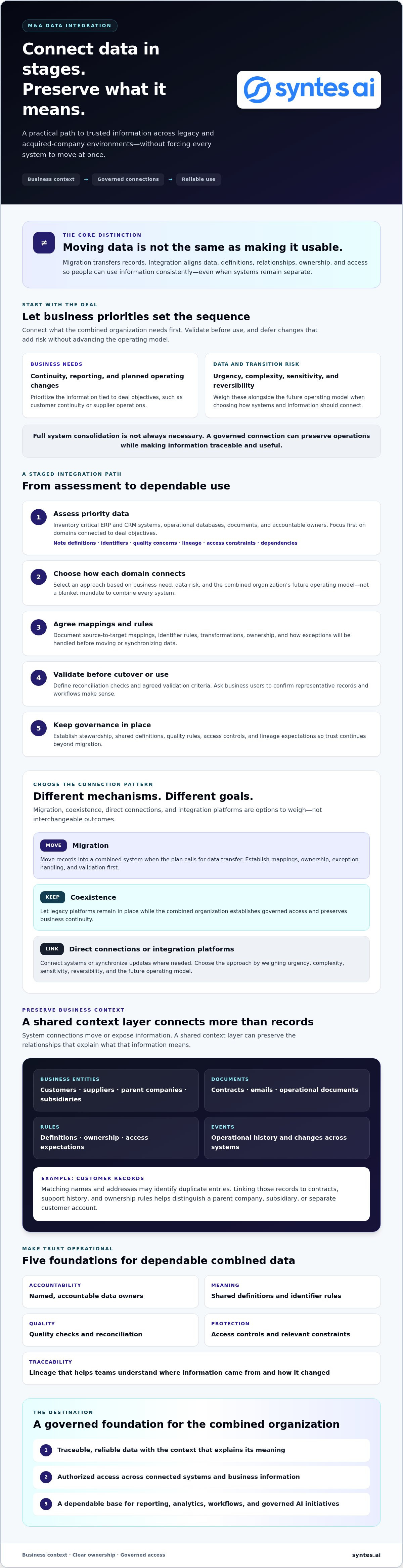
Integration may involve migrating records into a combined system, synchronizing updates between legacy platforms, transforming fields into agreed formats, or providing governed access while systems remain separate. These are different mechanisms, not interchangeable goals. The right mix depends on what the deal requires and how the combined organization will operate.
Consider a customer record. Matching names and addresses may reveal two entries for the same organization, but not whether one is a parent company, a subsidiary, or a separate customer account. Linking the record to contracts, support history, and ownership rules gives teams more context for decisions. A shared context layer, such as a Context Graph representing relationships among entities, documents, business rules, and events, can complement system connections by preserving those relationships.
Why do data silos persist after a deal closes?
Different identifiers can make the same supplier appear to be several entities. Duplicate customer records can fragment service history. Conflicting definitions, such as what counts as an active account, can distort combined reporting. Meanwhile, relevant context may remain in disconnected contracts, emails, or operational documents, making decisions harder to trace and explain.
These problems persist when teams prioritize moving data before establishing shared definitions, accountable owners, and access expectations. Let the deal rationale and target operating model set the sequence: identify which information must support continuity, reporting, or a planned operating change, then decide how it should connect and who may use it. Full system consolidation isn’t always necessary. A governed connection between systems may preserve operations while giving teams reliable, traceable information.
How to Integrate Data Across the M&A Lifecycle
Build the integration plan around decisions the deal must support, not a blanket mandate to combine every system. Integration sequencing should follow deal priorities and data risk: connect what the combined business needs first, validate it before use, and defer changes that add risk without advancing the operating model. Strategic investment offices such as Seraphis Group often highlight that clarifying these overarching priorities early in the deal lifecycle helps organizations focus post-merger technical resources where they create the most value.
This makes data integration for mergers and acquisitions a coordinated business program. Legal, security, business, and technology stakeholders need shared checkpoints. Legal teams identify relevant agreements and access constraints; security teams assess exposure and appropriate controls; business leaders rank continuity and synergy needs; technology teams map sources, dependencies, and transition options. PwC’s discussion of successful M&A integrations also underscores the importance of aligning integration with operating-model decisions.
What should teams assess before and during diligence?
Start with a targeted inventory of critical ERP and CRM systems, operational databases, documents, and accountable data owners. Prioritize the domains tied to deal objectives, such as customer continuity or supplier operations, rather than trying to catalog every asset at once. For tech leaders evaluating strategic transactions, discover AGC Partners to see how specialized technology investment banking supports SaaS and AI dealmaking from discovery through close. For each priority domain, record definitions, identifiers, quality concerns, lineage, access constraints, and dependencies that could affect business operations.
How should teams plan migration, validation, and cutover?
Before moving or synchronizing data, document source-to-target mappings, identifier rules, transformations, ownership, and how exceptions will be handled. Define reconciliation checks, then ask business users to confirm that representative records and workflows make sense. Base cutover on agreed validation criteria, not a date alone. Record rollback or coexistence options that fit the transition plan.
A practical lifecycle sequence gives each phase a decision, an owner, and a deliverable:
- Diligence and discovery: Business and technology leads identify priority domains and dependencies. Deliverable: a scoped inventory with owners, risks, and open questions.
- Pre-close planning: Legal, security, business, and technology stakeholders review relevant constraints and agree on target-state priorities. Deliverable: an integration sequence, access plan, and source-to-target mapping backlog.
- Close and transition: Data owners and technology teams execute approved migration, synchronization, or coexistence plans. Deliverable: reconciliation results, exception records, and documented cutover decisions.
- Post-close monitoring: Operational owners review data quality, access, lineage, and unresolved exceptions against business needs. Deliverable: a tracked issue log and decisions for the next integration wave.
Keep the plan adaptive. If a critical dependency or data-quality issue emerges, pause the affected transition and reassess its sequence instead of forcing a risky cutover. Where teams need to preserve relationships among systems, records, documents, and business rules, a governed context layer can complement core integration. Teams assessing this approach can explore governed enterprise context as part of their planning.
Which M&A Data Integration Approach Fits the Combined Organization?
There’s no universal architecture for data integration for mergers and acquisitions. Choose an approach by weighing business urgency, system complexity, data sensitivity, reversibility, and the target operating model. A rapid migration may simplify a priority workflow, while keeping systems separate can protect continuity when consolidation isn’t yet practical. The decision should follow the intended operating model, not a preference for one technical pattern.
Use this comparison to frame the choice. Approaches can be combined. For example, a platform may support staged coexistence before selected data is migrated.
| Approach | Best fit | Advantages | Trade-offs and questions to validate |
|---|---|---|---|
| Rapid migration | A limited, well-understood domain needs to move quickly. | Can reduce the number of systems teams use for that domain. | Is data quality understood? Can users validate mappings and exceptions before cutover? What is the fallback if critical records fail validation? |
| Staged coexistence | Both organizations need their systems during a transition. | Supports continuity while integration proceeds in manageable stages. | Which system owns each record? How are updates synchronized, duplicates resolved, and mismatches reconciled? What triggers a future migration decision? |
| Point-to-point connections | A small number of defined systems need to exchange data. | Direct connections can address specific operational needs. | Will the number of connections become difficult to change or govern? Who monitors failures and maintains shared definitions? |
| Middleware or integration platform | Multiple systems need coordinated exchange and transformation. | Can provide a common layer for managing data flows across applications. | Does it fit the operating model and governance needs? Who owns mappings, access controls, and exception handling? |
When is staged coexistence preferable to immediate consolidation?
Coexistence can make sense when a system supports a critical workflow, a migration depends on unresolved data questions, or the combined organization hasn’t settled its long-term platform choices. It still needs explicit controls: define authoritative sources by data domain, specify synchronization direction and frequency, identify duplicate-handling rules, and reconcile exceptions. Set review points so parallel operation remains a deliberate transition rather than an unowned permanent state.
What does a context layer add beyond pipelines and connectors?
Pipelines and connectors move or expose data. They don’t necessarily establish what a record means across organizations. A Knowledge Graph can represent how entities relate to documents, business rules, and operational events, giving connected information shared meaning without automatically replacing source systems. For a deeper explanation, see this guide to the enterprise knowledge graph.
How to Govern Data Quality, Lineage, and Access After the Deal
A completed migration is not proof of trusted data. Records can arrive in the new environment with conflicting definitions, incomplete history, or access that no longer reflects business responsibilities. For data integration for mergers and acquisitions to support reliable decisions, governance must continue after systems connect, with named owners and documented rules.
Use this checklist to make governance part of daily operations:
- Stewardship: Assign a business owner and data steward for each priority domain. Make clear who can resolve definition disputes and approve changes.
- Shared definitions: Record agreed meanings for key fields, entities, and statuses. Note where legacy definitions differ and which one applies to each use.
- Quality rules: Specify validation and matching criteria, how exceptions are handled, and who reviews recurring errors.
- Lineage: Track where data originated, how it was transformed, where it flows, and who owns each step.
- Access: Document who can view or change data, for what purpose, and which accountable security stakeholders validate those permissions.
- Auditability: Retain governance decisions, approvals, exceptions, and relevant change history so teams can explain how data is managed.
How can teams maintain trusted master and reference data?
For shared entities such as customers or products, identify authoritative sources and decision owners before combining records. Business stakeholders should agree on matching criteria, which source takes precedence when records conflict, and how exceptions reach a steward. Don’t erase unresolved differences by forcing a single value. Document the conflict, assign an owner, and track the decision through resolution. A knowledge graph for master data management can help represent relationships among entities and their business context.
How should teams preserve lineage, permissions, and auditability?
Carry lineage and access expectations through each transformation and connection, not just into the destination system. Record the source, transformation, destination, ownership, and relevant decision history. Security stakeholders should validate inherited permissions against current responsibilities. Access from a legacy environment shouldn’t automatically remain appropriate after roles change. Review permissions as systems, ownership, and operating responsibilities evolve.
When teams can’t yet reconcile definitions or ownership, maintain a visible decision log with the issue, accountable owner, interim handling, and review status. This makes uncertainty manageable rather than invisible and helps analytics and operational users understand data limitations.
Build Post-Merger Operational Intelligence on Integrated Data
Integration creates value when teams can use connected, validated data in daily operations. Combined reporting can draw on consistent definitions; search can surface relevant records and documents across systems; analytics can connect activity across the organization; and workflows can act on information with clear ownership. The goal of data integration for mergers and acquisitions isn’t simply to make data accessible. It’s to make it meaningful and governed enough to inform decisions.
How can integrated context support trusted AI initiatives?
Enterprise AI depends on both structured data, such as account records, and unstructured information, such as contracts and operating documents. A Context Graph can represent how entities relate to business rules, documents, and operational events, giving systems more context for interpreting information. That context can support explainable reasoning, but it doesn’t guarantee correct outputs. AI agents also need authorized access, defined boundaries, and human oversight appropriate to the decision.
What should executives evaluate in an integration platform?
Assess whether an approach fits the organization’s actual sources, controls, and operating model. Ask how it connects structured and unstructured data, applies governance, tracks lineage, explains reasoning, and protects access. Test how it represents changing relationships, such as a customer moving between business units, and how owners can review exceptions. For a wider view of integration challenges, explore solving enterprise data silos.
Syntes AI provides enterprise data integration, Context Engineering, and governed AI capabilities. Its connectors support structured and unstructured data across business systems, while its Context Graph represents relationships among entities, documents, business rules, and operational events. These capabilities can complement core system integration by preserving business meaning across connected information. Evaluate them against your requirements rather than assuming a context layer replaces source systems or resolves every data conflict.
- Connectivity: Which priority sources can the platform connect?
- Governance and lineage: Can teams trace data flows, decisions, and ownership?
- Explainability and security: Can users understand how information informs outputs, and is access governed?
- Operational fit: Can the approach accommodate the combined organization’s workflows and evolving relationships?
What is the next step for an M&A integration team?
Choose one high-priority business domain. Map its source systems, owners, key relationships, access expectations, and current data issues. Agree on measurable objectives and governance responsibilities before expanding the scope. A focused initiative gives executives a concrete basis to assess architecture, validate business value, and decide what to integrate next.
Turn Integration Into a Stronger Operating Foundation
Successful post-merger integration is more than moving records into shared systems. It aligns data with deal priorities, preserves business meaning across connected sources, and assigns clear responsibility for quality, lineage, and access. A staged approach lets teams protect operations while building toward dependable reporting, analytics, and workflow decisions.
That’s the strategic value of data integration for mergers and acquisitions: creating a governed foundation the combined organization can use and extend. Syntes AI provides enterprise data integration across structured and unstructured sources, alongside a live Context Graph designed to represent enterprise relationships and operational context. Its governance and explainable AI capabilities can help teams establish context for future AI initiatives, without treating automation as a substitute for accountable decisions.
Start by selecting a priority business domain. Map its systems and owners, assess the architecture, and agree on success measures and governance before expanding the effort. A focused first step can give your team a clearer path from deal execution to lasting operational intelligence.
With clear priorities and governed context, your combined organization can move forward with greater confidence.
Frequently Asked Questions
What is data integration in a merger or acquisition?
Data integration in a merger or acquisition aligns information, systems, definitions, ownership, and access so teams can use data across both organizations. It may involve moving records, synchronizing systems, or connecting information while applications remain separate. The objective is reliable use, not simply technical connectivity. For example, combining customer records also requires understanding whether they represent the same account, related entities, or distinct business relationships.
How do you integrate data after an acquisition?
Begin by identifying the business decisions and workflows that need support, then inventory the relevant systems, data owners, definitions, and dependencies. Map fields and identifiers, agree on transformations and access, and decide whether to migrate, synchronize, or connect the data in place. Validate key records with business users, document exceptions, and monitor quality and lineage after launch. Assign owners to make ongoing decisions and resolve conflicts.
What are the biggest data integration challenges in M&A?
Common challenges include incompatible identifiers, duplicate records, inconsistent definitions, unknown data quality, unclear ownership, and access rules that differ between organizations. Important information may also sit in documents or other unstructured sources rather than application databases. These issues can undermine combined reporting, disrupt customer or supplier workflows, and make decisions harder to trace. Prioritizing critical data domains helps teams address the most consequential gaps first.
Should companies migrate data immediately after an acquisition?
Not necessarily. Immediate migration may be appropriate for well-understood data that supports an urgent operating need, but rushing before teams assess quality, dependencies, and access can introduce avoidable risk. In other cases, connected systems can operate in parallel while the organization validates its future design. Set clear ownership, synchronization and reconciliation rules, and review points so coexistence remains controlled and migration decisions are based on evidence.
How can companies maintain data quality during a merger?
Define quality rules before transforming or combining records. Agree on formats, matching criteria, duplicate handling, and how to flag incomplete or conflicting values. Reconcile source and destination records, test representative workflows with business users, and route exceptions to named stewards for resolution. Keep a record of unresolved issues and their owners. Continue monitoring after cutover, since quality can change as systems, definitions, and responsibilities evolve.
What is the difference between data migration and data integration in M&A?
Data migration transfers data from one system or environment to another. Data integration is broader: it makes information usable across systems by connecting or moving it, aligning definitions, preserving relationships, and governing ownership and access. A company can integrate data while leaving source systems in place through synchronization or managed access. Migration may be one step in an integration plan, but it doesn’t establish shared meaning or trust on its own.
How can an enterprise knowledge graph help with M&A data integration?
An enterprise knowledge graph can represent connections among business entities, documents, rules, and operational events across data sources. This relationship layer can help teams interpret information that would otherwise remain disconnected, while source systems continue to operate. Syntes AI’s Enterprise Knowledge Graph is designed to unify complex enterprise data, and its Context Graph represents relationships and operational context. Governance and explainable reasoning support responsible use, but don’t guarantee every conclusion is correct.