
Legacy system maintenance is not just a support-line item; it can consume capacity that would otherwise fund change. The average enterprise spends 57 percent of its IT budget supporting business operations, though that figure includes more than legacy systems alone. The cost of maintaining legacy systems depends on the people, infrastructure, licenses, security work, integrations, and downtime required to keep them running.
It’s reasonable to keep a system that remains reliable and supports essential work. But a low visible maintenance bill can hide growing technical debt, fragile integrations, and delays that constrain new initiatives. This article explains the direct and hidden costs of maintaining legacy systems, how ongoing upkeep compounds them, and how to weigh those costs against modernization or replacement. The decision is not simply whether a system is old; it’s whether its total cost and operational limits still make sense for the business.
Key Takeaways
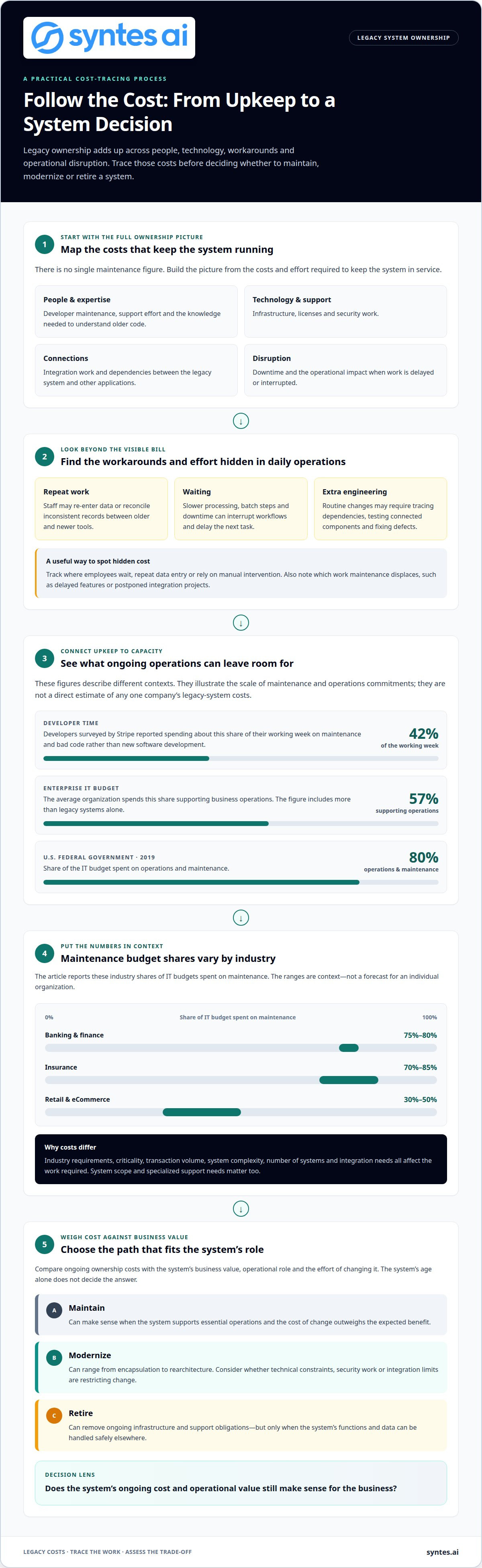
- Build a fuller ownership picture by accounting for labor, infrastructure, licensing, integrations, and the operational impact of downtime.
- Trace technical debt to the work it creates: maintenance and workarounds can divert engineering capacity from improvements and new capabilities.
- Compare ongoing operating costs with modernization options, accounting for transition effort and the system’s role in business operations.
- Use security exposure, supportability, integration limits, and business impact to judge when keeping a system running no longer makes sense.
- Cross-system integrations and a structured view of enterprise data can help connect existing environments to new capabilities.
Legacy Systems Cost: How Much Does It Really Cost to Maintain Legacy Software?
There is no single maintenance figure: ownership costs combine technology, labor, integration, and operational disruption. The cost of maintaining legacy systems also varies by industry and organization size, because criticality, transaction volume, and system complexity change the work required.
Developer Productivity Losses
Developer productivity losses occur when engineers spend time maintaining existing software instead of building or improving capabilities. Developers surveyed by Stripe reported spending about 42% of their working week on maintenance and bad code rather than new software development. That time has a direct opportunity cost: fewer engineering hours remain for product changes, automation, and innovation.
Outdated code can make routine changes harder to assess and implement. A small modification may require developers to trace dependencies, test connected components, and fix defects before releasing anything new. The effort isn’t limited to visible problems. Teams also need to preserve knowledge of how older systems behave, especially when documentation is incomplete or expertise is concentrated among a few employees.
For decision-makers, the useful measure is not just the maintenance budget. Track which work maintenance displaces, such as delayed features or postponed integration projects. This distinction shows whether ongoing support protects business operations or absorbs capacity that could deliver more value elsewhere.
Operational Inefficiencies
Operational inefficiencies are the extra time and effort required to complete work through systems that no longer support current processes well. Older systems can process information more slowly and experience more frequent downtime, interrupting workflows and reducing employee productivity.
These costs can remain hidden in departmental time rather than appearing on an IT invoice. Map where employees wait, repeat data entry, or rely on manual intervention. This helps distinguish routine operating effort from avoidable friction caused by system limitations. It can also reveal where failures or delays may affect customer-facing work.
Productivity and Innovation Impacts
Legacy-system productivity and innovation impacts arise when technical constraints slow both daily execution and strategic change. In 2019, the U.S. federal government spent 80% of its IT budget on operations and maintenance. That example shows how operational commitments can dominate available resources, leaving less room for modernization and innovation.
At an enterprise level, the average organization spends 57 percent of its IT budget supporting business operations. This figure includes more than legacy systems, but it illustrates the competition for technology capacity. When teams must prioritize stability and upkeep, new initiatives may move more slowly, even when business priorities demand faster change.
Integration limitations can deepen the problem. If an older system cannot readily exchange data with current applications, employees may lack timely information for decisions. The resulting delays affect productivity and restrict opportunities to improve workflows. In some environments, outdated components also complicate security work, requiring teams to address vulnerabilities while preserving essential services.
Costs by Industry and Organization Size
Maintenance costs vary with sector requirements, the number and complexity of systems, and how much the organization depends on them. Banking and finance organizations typically spend 75%-80% of their IT budget on maintenance; insurance organizations spend 70%-85%, while retail and eCommerce spend 30%-50%.
These differences reflect distinct operational demands, not a universal price per system. A business supporting critical transactions may need more extensive maintenance and continuity work than one using legacy software for a narrower function. Organization size matters through system scope, user numbers, integrations, and specialized support needs. Larger environments can involve more dependencies, while even a smaller organization may face substantial costs if one system underpins essential operations.
Use industry budget shares as context, not as a forecast for an individual organization. A clearer estimate combines staff effort, support and infrastructure expenses, integration work, and disruption. This breakdown shows which systems consume the most resources and whether their operational value justifies the ongoing commitment.
Modernization costs versus legacy system ownership costs
Decide whether to retain, modernize, or retire each system by comparing its ongoing cost with its business value.
Retiring, Modernizing, or Maintaining Systems
These options describe whether an organization keeps a system as-is, changes its platform or architecture, or removes it from service. Each path creates different costs, risks, and operational demands.
Modernization can range from encapsulation to rearchitecture.
Retirement can remove ongoing infrastructure and support obligations, but only when the system’s functions and data can be handled safely elsewhere. Maintaining it may remain sensible if it supports essential operations and change costs outweigh the expected benefit. Partial upgrades can address specific inefficiencies without replacing the entire structure.
Risks of Unsupported Software
Unsupported software is a system without ongoing vendor support, which can leave organizations with greater responsibility for reliability and security. This risk matters most when the application holds sensitive information or supports critical operations.
Outdated systems may lack current security features and patches, increasing exposure to vulnerabilities. A failure can also be harder to resolve when vendor assistance or specialist expertise is unavailable. These risks can extend beyond the application if connected systems depend on its data or operation.
Continuing to maintain unsupported software requires a clear view of dependencies, security needs, recovery requirements, and replacement options. Before changes begin, a transition plan should define timing, data migration, and operational risks.
Scope drives both the modernization estimate and the disruption involved. Moving a smaller system or using a lift-and-shift approach has an estimated return-on-investment window of 12-18 months. Partial refactoring or platform upgrades are estimated at 24-36 months, while complex core banking or ERP projects may take 36 months or more to reach that point.
Enterprise content management offers a concrete example of potential value. The example underscores why organizations should weigh future operating costs and inefficiencies alongside upfront investment, rather than treating the initial project estimate as the full decision.
For modernization decisions involving connected applications, explore cross-system integration options as part of the broader assessment.
Technical debt
Technical debt is the future effort created when organizations defer necessary changes to technology or code. It matters because upkeep can consume investment and limit the ability to adapt.
Legacy Technology and Technical Debt
Legacy technology can make technical debt a structural cost, not just a backlog of coding tasks. Estimates put legacy systems at 70%-80% of total technology spending in many organizations, while legacy technology makes up an average of 31% of an organization’s technology.
These figures describe different measures: spending and technology share. Together, they show why an older system can command disproportionate resources even when it represents only part of the environment. Around 80% of enterprises have not fully moved away from on-premises infrastructure, so older platforms may remain embedded in essential workflows.
Technical debt grows when teams repeatedly work around obsolete dependencies instead of addressing their causes. This work can preserve current operations, but it also makes later changes harder to estimate and deliver. The hidden cost is reduced flexibility: a planned improvement may require resolving dependencies before developers can implement it.
Engineering Time and Technical Debt
Technical debt consumes engineering time through maintenance, defect fixes, and workarounds that compete with new development. Teams may spend 20%-40% of engineering time maintaining and fixing old code, reducing capacity for product work and integration.
McKinsey found that 10% to 20% of budgets intended for new products are diverted to resolving technical debt. Gartner projected that companies would spend 40% of their IT budgets maintaining technical debt by 2025. These measures show how deferred work can turn into a recurring claim on future investment.
A useful assessment links debt to business impact. Identify systems that no longer serve current needs, then map their dependencies, change frequency, support requirements, and operational role. For example, if a routine application update requires repeated manual fixes across connected components, capture both the engineering effort and the delay to planned work.
Specialist support adds another pressure point. Finding people with skills for older technologies can become harder as those technologies age. Organizations should account for the effort required to retain expertise and transfer system knowledge, not just the hours spent on immediate repairs.
Use these findings to rank technical debt by consequence. Prioritize issues that repeatedly block changes, require scarce expertise, or threaten essential operations. This ranking helps distinguish manageable maintenance from accumulated debt that weakens the organization’s ability to deliver new capabilities.
Hardware, software, patching, and licensing expenses
Direct expenses include hardware, software support, renewals, repairs, and integration work. Separate recurring annual charges from project-based costs to see what the operating budget actually carries.
Hardware and Software Expenses
Hardware and software expenses cover the equipment and applications needed to keep a legacy environment operational. Aging infrastructure can require replacement parts and continued vendor support, in addition to normal digital operations.
Hardware used to support legacy systems typically requires refresh cycles every 3-5 years, so costs may arrive unevenly rather than as a smooth annual charge. Include backup components and scarce spare parts in the inventory; a single unavailable component can complicate repair planning.
Software creates its own obligations. Track each application’s renewal date, support status, and dependencies to distinguish necessary licenses from overlapping or underused software. A clear inventory also helps identify which business functions rely on each application.
Patching and Licensing Expenses
Patching and licensing expenses cover routine software upkeep and the fees required to retain access or vendor support. Both matter because a system can remain operational while its upkeep consumes substantial staff time and budget.
Three-quarters of IT teams managing legacy systems spend up to 25 hours a week on patch management. That work includes identifying updates, testing compatibility, scheduling changes, and resolving issues. Legacy applications may depend on older components, making a patch cycle more involved than applying an update to one isolated program.
Licensing can become more expensive when systems move into extended support. Legacy licensing and vendor fees can increase by 50%-100% in that situation. Include the applicable renewal and support terms in the ownership estimate, rather than treating the current fee as a permanent baseline.
Repair and Annual Support Costs
Repair and annual support costs cover vendor assistance, maintenance work, and fixes needed to restore or preserve system operation. They matter because recurring contracts and unexpected repairs affect different parts of the budget.
Direct maintenance expenses can also include hardware and software maintenance, support fees, and scarce spare parts. Record contract charges separately from repair events so repeated failures don’t disappear inside a broad operations line.
Integration adds another cost when older applications cannot exchange data cleanly with modern software. For example, connecting a legacy application to a newer digital platform may require custom data handling and repeated integration testing. Estimate each project separately, then include ongoing connection support in the system’s continuing ownership cost.
Evaluating whether to replace legacy systems
Replacement makes sense when a system’s operating burden, business risk, and limitations outweigh the cost and disruption of change. Compare the full current-state cost with a defined modernization or retirement scenario, rather than comparing annual support fees with a project estimate alone.
Start with a system-level assessment. Map its business functions, connected applications, data flows, support arrangements, and recovery needs. Then identify the workarounds and manual steps employees use because the system cannot meet current requirements. For example, repeated data re-entry between a legacy application and a modern platform signals integration friction and a potential source of errors.
Next, calculate hidden costs alongside direct expenditure. Include staff time spent maintaining the system, integration work, operational interruptions, and delayed initiatives. Treat the result as an illustration, not a benchmark; the relevant calculation is the cost attached to your own systems and workflows.
Security and continuity belong in the same comparison. Older systems may lack current security features and patches, while a failure can interrupt business-critical operations. Assess vulnerabilities, recovery requirements, data sensitivity, and business impact together. A system with a dependable recovery path may justify continued operation; one that repeatedly disrupts essential services demands a stronger case for modernization.
Compare alternatives against the same scope. Maintaining preserves the current structure but retains its constraints. Modernizing can target specific components or integration gaps. Replacing or retiring may remove dependencies, but requires planning for data migration, employee training, and operational transition. Forrester’s Total Economic Forum study found that retiring old legacy systems could reduce hardware and operational running costs by 65%. That potential saving must be weighed against transition effort and the functions the system supports.
Make the decision explicit: retain a system when it remains supportable and fit for its role; modernize when targeted changes address defined constraints; replace or retire it when risk, inefficiencies, or ownership burden undermine its value. Set measurable outcomes, such as reducing manual handoffs or improving access to operational data, and review progress after implementation. This gives enterprise leaders a basis for tracking whether the investment solves the original problem.
Syntes AI: Cross-System Integrations
Syntes AI provides Cross-System Integrations to connect enterprise software environments, helping organizations address data silos and fragmented workflows without treating every legacy application as an isolated problem. When systems must continue operating as modernization decisions take shape, integration can help make information more accessible across the existing stack.
An Enterprise Knowledge Graph structures complex data so relationships across systems can be represented in an actionable format. Context Engineering helps establish the context needed for enterprise AI applications, while the Syntes Agentic Platform enables organizations to deploy and manage AI agents for operational tasks. These offerings are relevant when disconnected data and systems obstruct coordinated work or make it difficult to apply AI within existing operations.
Contact Syntes AI to discuss how cross-system integration and connected enterprise data relate to your modernization priorities.
Turn the ownership decision into a path forward
The cost of maintaining legacy systems is useful only when it informs a decision. The next step is to turn the assessment into a direction: preserve what still serves the business, address constraints that block progress, and connect modernization work to operational priorities. This creates a clear basis for sequencing change without treating every legacy application as a replacement project.
Syntes AI offers Cross-System Integrations, an Enterprise Knowledge Graph, and the Syntes Agentic Platform. These offerings can support organizations working to connect enterprise software, structure complex data, and deploy AI agents for operational tasks. They are relevant when fragmented systems and data make it harder to coordinate work or apply enterprise AI across existing environments.
Use the next conversation to clarify which systems, data relationships, and workflows matter most to your modernization plans. A focused discussion can bring those priorities into view.
Build from a clearer understanding of your systems and move forward with purpose.
Frequently Asked Questions
Cost trend comparison: Maintain or modernize?
Maintaining a system costs less upfront, while modernization shifts spending toward a defined change program and future operations. Compare both paths across the same planning horizon. For example, an application with recurring manual workarounds may appear inexpensive in the IT ledger yet delay customer or employee workflows. Include that operational effect alongside support, infrastructure, transition, and training requirements before deciding.
So, what can you do about your legacy technology?
Classify each system by business purpose, data handled, dependencies, and current support needs. Then document which teams use it and what happens if it becomes unavailable. This may reveal that two applications have different priorities, even if both use outdated technology. Preserve systems that remain fit for purpose, target specific constraints where possible, and plan retirement when their business function can be handled elsewhere.
What exactly counts as a “legacy system”?
Gartner defines a legacy system as an information system that may use outdated technologies but remains critical to day-to-day operations. Age alone doesn’t determine whether a system is legacy. An older transaction application that still supports essential business processes but creates difficulties when teams connect it with newer applications is one example. Both its operational role and technical limits matter.
What is the Real Issue with Legacy Systems?
The central issue is a growing mismatch between what the business needs and what its systems can support. A platform may still run, yet make it difficult to trace how information moves between applications or adapt processes as requirements change. For example, teams relying on separate records may struggle to establish a shared view of a customer or transaction across departments.
When does modernization become cheaper than maintenance?
Modernization becomes financially preferable when the accumulated cost of support, workarounds, and operational disruption exceeds the investment and transition effort. Compare expected costs over the same time horizon, including any period when old and new systems may operate together. A recurring custom fix is a useful signal to examine: if it keeps returning, its cumulative burden may outweigh a targeted redesign.
Which Systems Should You Replace?
Prioritize systems whose limitations create material business risk or repeatedly obstruct essential work. An application that handles a critical process, lacks current security patches, and depends on scarce expertise deserves closer review than a stable tool with limited connections. Replacement isn’t automatic: a system with a narrow role and manageable support needs may remain viable while higher-impact dependencies receive attention first.
What is the average annual cost of maintaining legacy systems in the United States?
There isn’t one annual figure that describes every U.S. organization or system. Treat that range as a planning reference for support and maintenance, not as a complete ownership estimate for a particular application or enterprise environment.
What percentage of IT budgets do organizations spend maintaining legacy systems?
The share varies by sector and by how heavily an organization depends on older systems. Legacy-heavy companies spend about 75%-85% on maintenance. An enterprise-wide figure needs careful interpretation: the average enterprise spends 57 percent of its IT budget supporting business operations, which includes more than legacy maintenance. These measures describe different budget categories, so they shouldn’t be treated as interchangeable.