
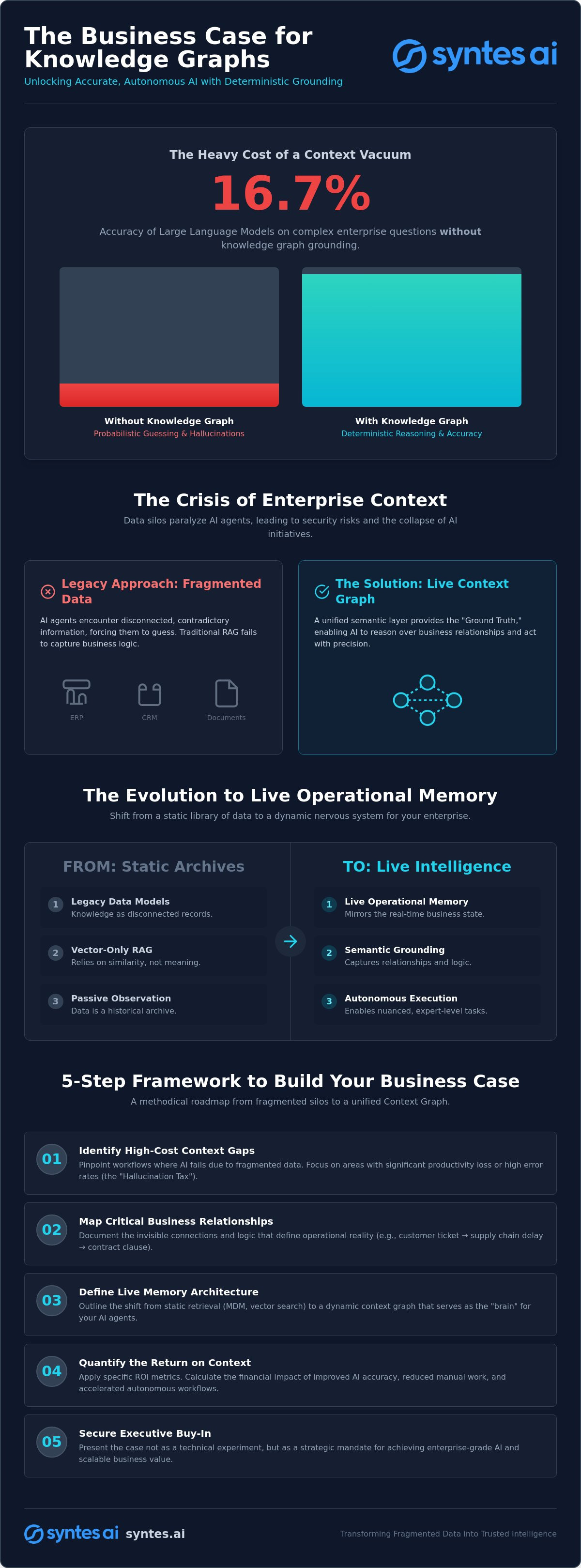
LLMs answering complex enterprise questions without knowledge graph grounding achieve a mere 16.7% accuracy. This is the heavy cost of operating in a context vacuum. You have likely witnessed the pattern where promising AI pilots stall because they lack the deterministic grounding needed to navigate fragmented data silos. Building a business case for knowledge graph implementation is no longer a luxury for the R&D department; it is a strategic mandate for any leader who expects Agentic AI to deliver actual business value. Companies like SoTechnology support this transition by providing AI-enabled digital solutions that help organizations grow and create significant impact.
You recognize the gravity of the data quality gap, yet quantifying the return on context remains a persistent challenge. This guide provides a clear roadmap to secure approval for your Context Engineering initiative by focusing on high-impact outcomes rather than theoretical experiments. You’ll learn to apply specific ROI metrics for Agentic AI and discover how a live Context Graph transforms passive observation into active, governed performance. We will outline the exact steps to transition your enterprise from fragmented data to a unified, intelligent infrastructure. To help navigate the strategic complexities of this transition at the executive level, you can discover TechAxis Advisors for expert alignment of technology and business goals.
Key Takeaways
- Recognize that deterministic grounding is the only path to enterprise-grade AI accuracy.
- Transition from legacy data models to Live Operational Memory for autonomous agent execution.
- Master the strategic framework for building a business case for knowledge graph adoption to secure executive buy-in.
- Quantify the impact of eliminating the “Hallucination Tax” on your bottom line.
- Follow a methodical 5-step roadmap to move from fragmented silos to a unified Context Graph.
The Crisis of Enterprise Context: Why AI Fails Without a Knowledge Graph
The era of AI experimentation has ended. We’ve entered the era of operational execution. For the modern enterprise, the primary obstacle to scaling autonomous agents isn’t a lack of compute or model capability. It’s a lack of context. Current research indicates that the enterprise knowledge graph market will grow to nearly $10B by 2032, a shift fueled by the realization that Large Language Models (LLMs) are effectively blind without a structured semantic anchor. A knowledge graph is no longer just a technical asset; it’s the definitive “Ground Truth” for enterprise intelligence. It serves as the cognitive map that allows AI to move from passive prediction to active reasoning.
Large Language Models cannot reason over isolated data silos. This fundamental limitation creates the “Context Gap.” When an AI agent attempts to execute a workflow, it often encounters fragmented and contradictory information scattered across the organization. Without a unified layer, the agent defaults to probabilistic guessing. This results in hallucinations, security vulnerabilities, and the eventual collapse of AI pilots. Transitioning the narrative from simple “data retrieval” to “operational reasoning” is the first step in building a business case for knowledge graph integration. You don’t just store data. You encode the logic of your business.
The Failure of First-Wave RAG
Traditional Retrieval-Augmented Generation (RAG) has reached its ceiling. Most first-wave implementations rely solely on vector-only search, which identifies text chunks based on mathematical similarity rather than actual meaning. Research shows that LLMs answering enterprise questions without knowledge graph grounding achieve only 16.7% accuracy on complex queries. This approach fails to capture the complex relationships and hierarchies that define business logic. If your AI cannot distinguish between a primary stakeholder and a secondary contact because they appear in the same document, it cannot be trusted with autonomous tasks. Semantic grounding is the only definitive cure for AI hallucinations.
Data Silos as a Strategic Liability
Disconnected ERP, CRM, and legacy document stores do more than just slow down human employees. They paralyze AI agents. Solving enterprise data silos is not a peripheral IT project; it’s a strategic necessity for survival. When data is trapped in silos, AI agents lack the “Live Operational Memory” required to make informed decisions. The efficiency drag caused by manual data reconciliation is immense, often costing enterprises millions in lost productivity. When building a business case for knowledge graph technology, the focus must remain on the high cost of this fragmentation. You cannot scale intelligence on a foundation of broken context.
From Static Graphs to Live Operational Memory: The Evolution of Context
Is your data infrastructure a library or a nervous system? Most enterprises treat knowledge as a static asset, a collection of records stored in disparate silos. They are wrong. In the high-stakes environment of 2026, a legacy knowledge graph acts as an encyclopedia. It is useful for reference but insufficient for action. The shift toward Agentic AI requires a transition to Live Operational Memory. This is the core of building a business case for knowledge graph adoption: moving from passive archives to active, evolving intelligence that mirrors the real-time state of your business.
Context Engineering is the discipline that maintains this memory. It ensures that as market conditions shift, supply chains fluctuate, and customer behaviors evolve, your AI agents possess the immediate context required for accurate execution. This isn’t theoretical. A recent Total Economic Impact™ assessment highlights that graph technology provides a quantifiable lift by enabling deeper reasoning over complex datasets. While traditional Master Data Management (MDM) focuses on the “what” of a data point, a Context Graph focuses on the “how” and “why.” It captures the relationships that define operational reality.
Operational Relationship Intelligence
Map the invisible. Traditional data stacks struggle to connect a customer’s recent support ticket with a pending supply chain delay and a specific contract clause. Relationship-based intelligence identifies these links automatically. By treating relationships as first-class citizens, the Live Context Graph enables agents to perform with a level of nuance previously reserved for human experts. It transforms passive observation into automated performance. If you are ready to see how this architecture functions in a live environment, you can experience the Context Graph platform in action.
The Architecture of a Semantic Layer
A semantic data layer for enterprise serves as the bridge between raw data and agentic reasoning. It unifies structured ERP tables with unstructured PDF contracts into a single, coherent memory. This layer doesn’t just store information; it encodes business rules. It provides a transparent, explainable framework for AI decision-making. When an agent executes a task, the graph provides a traceable path of logic. This transparency is essential for governance. It ensures that every automated action is grounded in verified enterprise context rather than probabilistic guesswork.
Quantifying the ROI: Strategic Pillars of the Business Case
Securing executive approval for advanced data infrastructure requires a shift in dialogue. You must move from discussing technical nodes to defining operational outcomes. Building a business case for knowledge graph implementation hinges on four strategic pillars that redefine enterprise value: operational efficiency, risk mitigation, revenue acceleration, and global scalability. By providing the essential infrastructure for agentic ai platforms, a context graph becomes the engine for autonomous execution across your most complex systems.
The practical application of these networks is already being validated by initiatives like the Business Open Knowledge Network, which highlights how structured relationships drive business intelligence. For the modern enterprise, this translates to faster decision-making cycles. When your AI reasons over real-time operational context, you accelerate revenue by identifying market opportunities and supply chain optimizations that legacy systems simply cannot see. You aren’t just organizing data. You are weaponizing it.
Calculating the Cost of ‘Business as Usual’
Stop ignoring the “Hallucination Tax.” This is the tangible cost of unverified AI outputs, encompassing the human labor required to audit every LLM response and the legal liabilities in regulated sectors. Legacy search methods rely on probabilistic keyword matching. This drastically increases the time-to-insight compared to graph-based semantic search. Additionally, the labor costs associated with manual data mapping and cross-system integration represent a constant, silent drain on your engineering resources. Every hour spent reconciling data silos is an hour lost to innovation.
The Agentic AI Multiplier
Knowledge graphs act as a definitive performance multiplier for autonomous agents. By providing a pre-structured semantic layer, you significantly reduce the token cost and latency of every agentic interaction. Instead of forcing an LLM to process massive, unorganized text blocks, you provide precise, relational context. This allows for the ROI of autonomous agents to scale rapidly. You move beyond simple chatbots to governed agents capable of complex tasks like end-to-end supply chain orchestration. Building a business case for knowledge graph technology is ultimately about this transition. You stop paying for theoretical experiments and start investing in bottom-line results.
The 5-Step Framework for Your Knowledge Graph Business Case
The theoretical value of context is clear. Now, you must execute. Building a business case for knowledge graph integration requires a methodical shift from abstract data management to precise context engineering. This isn’t about mapping every data point in the company. It’s about strategic prioritization. You don’t need more data; you need more relevant connections. Follow this five-step framework to move from a pilot to a production-grade cognitive architecture.
- Step 1: Identify a High-Value Use Case. Focus on “context-rich” domains where hallucinations are fatal. Fraud detection, complex supply chain orchestration, or regulatory compliance are ideal candidates.
- Step 2: Map the Semantic Requirements. Define the entities and relationships that drive your specific business logic. What connections must the AI understand to act autonomously?
- Step 3: Define the Governance Framework. Establish how the AI reasoning will be audited. You must ensure every automated decision is traceable back to a verified node in the graph.
- Step 4: Pilot with GraphRAG. Proving accuracy gains is essential. Demonstrate how grounding an LLM in a graph structure outperforms standard vector-only RAG in complex reasoning tasks.
- Step 5: Scale to Infrastructure. Transition from a standalone project to a robust enterprise ai infrastructure that serves as your organization’s live operational memory.
Selecting the Right Pilot Project
Start small to win big. The most common failure in graph initiatives is the “Boil the Ocean” trap. Don’t try to map the entire enterprise on day one. Instead, select a specific operational domain characterized by high data complexity and high business value. Success in a single, high-stakes area provides the proof points needed for wider adoption. You must set measurable KPIs during this phase. Focus on metrics like accuracy lift, reduction in manual reconciliation time, and the speed of agentic execution. When building a business case for knowledge graph technology, these hard numbers are your strongest leverage.
Building the Governance and Security Layer
Trust is the currency of Agentic AI. Understanding how to prevent ai hallucination is a core requirement for any viable business case. By integrating business rules and regulatory compliance directly into the graph structure, you create a system that is governed by design. Your business case must explicitly address data privacy and agentic safety. A well-engineered context graph ensures that agents only access authorized data, providing a transparent audit trail for every automated decision. This level of control separates production-grade AI from experimental toys.
Syntes AI: Transforming Fragmented Data into Trusted Intelligence
Legacy vendors sell you a database. Syntes AI provides an execution platform. While graph databases are useful storage tools, they lack the native intelligence required to govern autonomous agents in a high-stakes environment. Leading enterprises choose Syntes because we provide a unified layer for Context Engineering and Agentic AI. We don’t just store nodes. We build a Live Operational Memory that unifies your entire cross-system architecture into an actionable Context Graph. This is the final, decisive component in building a business case for knowledge graph adoption: the transition from static infrastructure to measurable operational impact.
The Syntes AI Platform moves beyond the limitations of traditional data management by integrating disparate data streams into a single, semantic layer. It’s the difference between having a map and having a GPS that understands the terrain in real-time. By providing this cognitive foundation, we enable your organization to move from the business case phase to a full-scale enterprise AI transformation. You stop managing data silos and start orchestrating intelligence.
The Syntes Context Engineering Methodology
Trusted AI isn’t a result of chance. It’s a result of engineering. Our methodology follows a rigorous roadmap: Connect, Understand, Contextualize, Govern, and Execute. This framework ensures that every automated action is grounded in deterministic truth. Syntes AI automates the discovery of complex entities and hidden hierarchies, removing the manual labor that typically causes data projects to stall. This deterministic approach is central to building a business case for knowledge graph initiatives that prioritize governance over theoretical experimentation. We position your organization for long-term operational relationship intelligence, ensuring your AI remains accurate as your business logic evolves.
Getting Started with Syntes AI
Speed defines the leaders of the AI era. Most enterprises lose months in the “data preparation” phase, effectively paralyzing their AI ambitions before they begin. Syntes AI collapses this timeline. By initiating a Context Engineering workshop, your organization can identify high-impact use cases and map semantic requirements in days. This speed-to-value advantage is the core strength of the Syntes Agentic Platform. You have the strategic roadmap. Now, you need the platform capable of delivering on its promise. Stop building silos. Start engineering context.
The Strategic Mandate for Contextual Intelligence
The window for AI experimentation is closing. Enterprises that fail to ground their autonomous agents in a deterministic semantic layer will find themselves trapped in a cycle of hallucinations and failed pilots. You have seen how transitioning from static archives to Live Operational Memory provides the necessary infrastructure for Agentic AI. By following a structured 5-step framework, you move beyond technical theory into measurable ROI. Successfully building a business case for knowledge graph integration is the difference between a fragmented data stack and a unified, intelligent enterprise.
Syntes AI stands as the definitive partner for this transformation. As the winner of the Enterprise Intelligence Innovation Award 2025, we provide explainable AI reasoning for regulated industries and maintain Live Operational Memory for Fortune 500 supply chains. We don’t just organize your data; we architect your truth. Secure your competitive advantage by moving from passive observation to active, governed performance today.
Your journey toward total operational clarity begins with a single, strategic decision to prioritize context.
Frequently Asked Questions
What is the difference between a Knowledge Graph and a Context Graph?
A Knowledge Graph typically acts as a static repository of entities and relationships, serving as a structured encyclopedia for the business. In contrast, a Context Graph is a live, continuously evolving model of the business state. It functions as operational memory rather than a passive archive. This real-time relevance is essential for powering autonomous agents that must react to fluctuating market conditions and internal system changes instantly.
How long does it take to see ROI from a Knowledge Graph implementation?
Tangible returns typically manifest within three to six months for a focused pilot project. Initial value is measured through the reduction of human-in-the-loop requirements and the elimination of AI hallucinations in specific, high-stakes domains. As the implementation scales to enterprise-wide infrastructure, the ROI compounds. Strategic leaders prioritize building a business case for knowledge graph technology by targeting high-complexity use cases to ensure immediate speed-to-value.
Do we need to replace our existing Data Warehouse to build a Knowledge Graph?
You don’t need to replace your existing Data Warehouse or ERP systems. A Context Graph acts as a semantic layer that sits above your current infrastructure. It unifies structured data from warehouses with unstructured information from document stores. By connecting these disparate silos, it transforms passive data into a connected, actionable intelligence layer without requiring a “rip and replace” of your legacy investments.
Why is a Knowledge Graph better than standard RAG for preventing hallucinations?
Knowledge Graphs provide deterministic grounding, whereas standard RAG relies on probabilistic similarity. Vector search identifies text chunks that look similar but may lack logical connection. A graph structure maps the actual business rules and hierarchies. This ensures that AI agents reason over verified relationships. This architectural difference is why graph-grounded systems achieve significantly higher accuracy on complex enterprise queries than vector-only approaches.
What are the primary industries benefiting from Knowledge Graph business cases in 2026?
Regulated and high-complexity sectors lead the adoption in 2026. Supply chain orchestration, fraud detection in financial services, and clinical decision support in healthcare are primary beneficiaries. These industries require the explainable AI reasoning and strict governance that only a graph-based infrastructure provides. Organizations in these fields are aggressively building a business case for knowledge graph adoption to maintain a competitive edge in autonomous execution.
How does Agentic AI use a Knowledge Graph to execute tasks?
Agentic AI uses the graph as a cognitive map to navigate multi-step workflows. Instead of just generating text, the agent traverses the relationships within the graph to identify dependencies, verify permissions, and execute cross-system actions. This allows the agent to function with a level of nuance and accuracy that exceeds simple prompted models. The graph provides the Live Operational Memory required for autonomous, governed decision-making.
Is building a business case for a Knowledge Graph different for SMEs vs. Enterprises?
The core logic remains consistent, but the scale of complexity differs. Enterprises focus on unifying global data silos and managing thousands of intersecting business rules. SMEs typically leverage Knowledge Graphs to automate specific, context-heavy workflows with greater agility. While an enterprise business case emphasizes systemic risk mitigation and global efficiency, an SME case often centers on rapid scalability and reducing the labor costs of manual data reconciliation.