
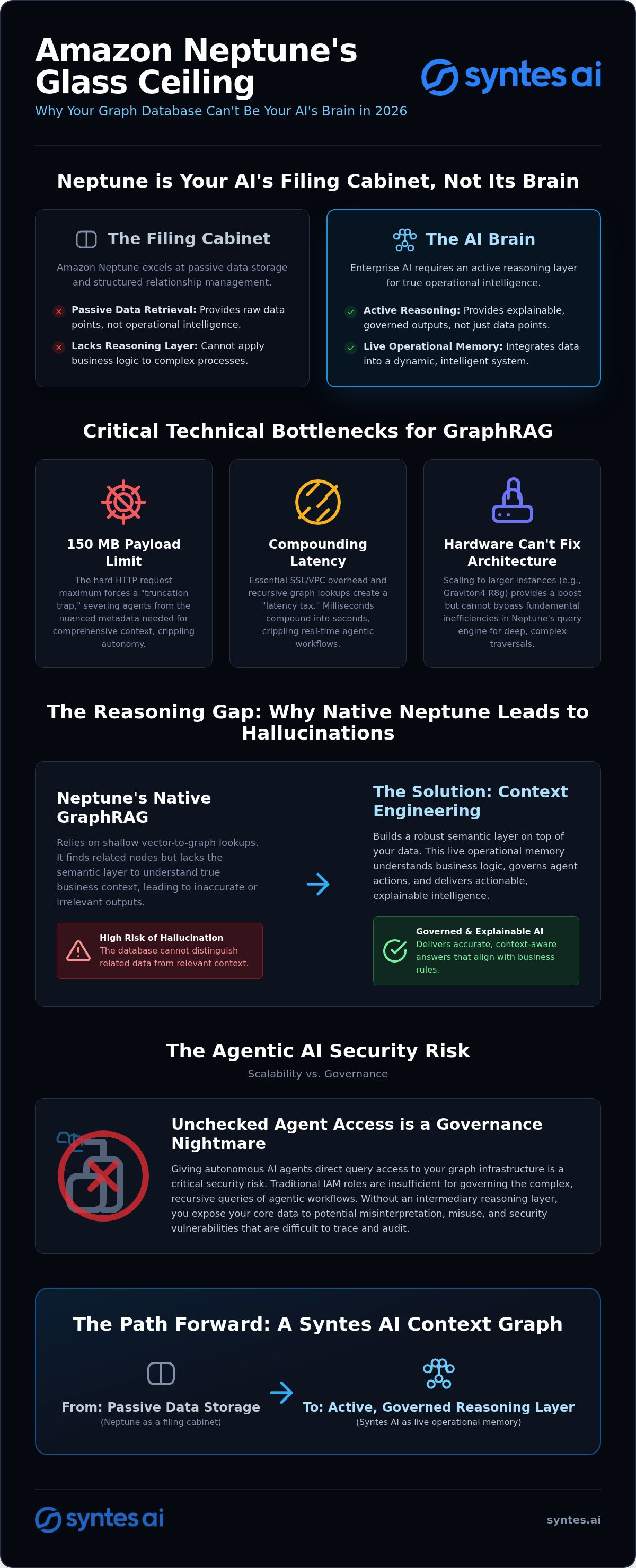
Your graph database is not your AI’s brain; it’s merely its filing cabinet. Amazon Neptune remains a formidable tool for managing structured relationships, yet the reality of 2026 reveals critical Amazon Neptune limitations for enterprise AI that many architects overlook until production latency spikes. You likely chose Neptune for its AWS native integration and proven scalability. That was a sound tactical decision. However, as you move toward agentic workflows, the gap between raw data retrieval and true operational intelligence becomes an expensive liability.
This review dismantles the technical ceilings of Neptune’s current engine, specifically addressing why memory-unbounded vertex enumeration and the friction between Analytics and Database engines hinder real-time GraphRAG. You’ll discover how to bridge these architectural gaps using Context Engineering to eliminate hallucinations. We provide a framework for distinguishing “Context” from “Data” and a strategic roadmap for implementing a Syntes AI Context Graph as your live operational memory. It’s time to transition from passive data storage to an active, governed reasoning layer that scales with your enterprise ambition.
Key Takeaways
- Identify the specific architectural ceilings, such as the 150 MB HTTP payload limit, that constrain high-volume GraphRAG operations in production environments.
- Analyze the primary Amazon Neptune limitations for enterprise AI to understand why raw graph databases struggle to provide explainable reasoning for complex business logic.
- Move beyond traditional IAM roles to address the governance risks inherent in giving autonomous agents direct query access to your graph infrastructure.
- Transition from passive data storage to active Context Engineering by deploying a Syntes AI Context Graph as a live operational memory.
Understanding Amazon Neptune’s Role in the 2026 AI Landscape
Amazon Neptune is a purpose-built, fully managed graph database engine designed to store and navigate highly connected datasets. As a core component of the AWS ecosystem, Amazon Neptune supports popular graph models like Property Graph and W3C’s RDF, offering the high-availability and scalability required for global identity resolution and fraud detection. It excels at managing billions of relationships with millisecond latency for traditional transactional queries. However, the shift from static identity graphs to dynamic, AI-driven Knowledge Graphs has exposed fundamental Amazon Neptune limitations for enterprise AI. While it remains a robust storage layer, it often fails as an intelligence layer. Storage is no longer the bottleneck; reasoning is.
Neptune Database vs. Neptune Analytics: A Forced Dichotomy
By 2026, AWS finalized the bifurcation of its graph offering into two distinct engines: Neptune Database and Neptune Analytics. This was a strategic move to address separate OLTP and OLAP workloads, yet it introduced significant friction for real-time AI. To perform complex GraphRAG, data must often be synchronized or moved between these environments. This synchronization isn’t instantaneous. It creates a “latency tax” that compromises the responsiveness of agentic workflows. Enterprises find themselves managing dual infrastructures, separate pricing models, and distinct scaling protocols just to achieve the performance a single, unified intelligence layer should provide. This architectural split forces a trade-off between the consistency of a database and the speed of an analytics engine.
The Standard Pitch for GraphRAG on AWS
The marketing narrative suggests that integrating Neptune with Amazon Bedrock Knowledge Bases solves the retrieval problem. It doesn’t. Native GraphRAG on Neptune typically relies on simple vector-to-graph lookups that lack a robust semantic layer. Without Context Engineering, these retrievals remain shallow. They provide raw data but fail to deliver actionable meaning. In the high-stakes environment of 2026 enterprise operations, simple retrieval frequently leads to hallucinations because the database cannot distinguish between related nodes and relevant business context. This gap highlights the primary Amazon Neptune limitations for enterprise AI: it lacks the native reasoning capabilities required to govern autonomous agents effectively. Simple retrieval is failing the accuracy requirements of modern enterprises that demand explainable, governed outputs rather than mere data points.
Is a graph database alone enough for Agentic AI? The answer is a definitive no. While Neptune provides the “memory” of relationships, it lacks the “operational logic” to apply those relationships to complex business processes. For enterprises to scale, they must look beyond the database toward a platform that integrates structured and unstructured data into a live, reasoning memory.
Technical Bottlenecks: Payload Limits and Latency in GraphRAG
Operationalizing AI at scale requires more than just a place to store nodes and edges. It demands high-throughput, low-latency execution that remains stable under the weight of massive context windows. Amazon Neptune, while reliable for standard transactional tasks, introduces structural friction when tasked with the heavy lifting of 2026-era GraphRAG. These Amazon Neptune limitations for enterprise AI aren’t just minor inconveniences; they are hard technical ceilings that disrupt the flow of real-time intelligence.
One of the most significant hurdles is the mandatory overhead of SSL and VPC requirements. While essential for security, these layers add cumulative latency to every agentic request. When an AI agent must perform multiple recursive lookups to verify a fact, these milliseconds compound into seconds. Scaling instance sizes to Graviton4 R8g units provides a price-performance boost for write queries, but hardware alone cannot bypass the fundamental architectural constraints of Neptune’s query execution engine. Throwing more memory at a db.r5.large instance won’t fix a query that is structurally inefficient for deep traversal.
The Payload Problem in Large Context Windows
The current 150 MB HTTP request payload maximum represents a severe bottleneck for modern data ingestion. In an era where AI agents must process thousands of unstructured documents to build a comprehensive context, this limit forces engineers into a “truncation trap.” To stay within the buffer, systems often discard the very metadata that provides nuance to the graph. Payload limits are the hidden killer of agentic autonomy because they sever the connection between an agent’s reasoning and the full breadth of its operational data. This restriction makes it nearly impossible to feed large, multi-modal context sets directly into the graph engine without significant preprocessing and data loss.
Latency and the “N+1” Query Problem in Graphs
Graph traversal naturally suffers from exponential complexity. In Neptune, deep traversals, moving beyond three or four hops, frequently result in latency spikes that break real-time workflows. The implementation of vertex enumeration and counting in Neptune Analytics is not memory-bounded, which often triggers out-of-memory (OOM) exceptions when queries attempt to scan large graph segments. This lack of predictable performance makes it difficult to maintain a live operational memory. If your agents are waiting seconds for a response, they aren’t autonomous; they’re stalled. To see how a truly unified intelligence layer handles these complexities, you can book a demo of a platform designed for context-heavy execution. High-performance enterprise knowledge graphs must prioritize reasoning speed over simple storage, a shift that Neptune’s legacy architecture hasn’t fully realized.
The Reasoning Gap: Why Native Neptune Lacks Enterprise Context
Storing relationships is a simple task. Interpreting them with the precision required for global enterprise operations is where the architectural vacuum becomes apparent. While Amazon Neptune provides a robust environment for graph data, its native reasoning capabilities are confined to basic RDFS-level inference. This level of logic’s insufficient for the multi-layered, conditional business rules that define a modern organization. It can identify that a specific node is an instance of a class, but it can’t navigate the nuanced hierarchies of a global supply chain or a complex regulatory framework. This is one of the most critical Amazon Neptune limitations for enterprise AI; it remains a passive storage engine in a world that demands active, automated performance.
The “Black Box” problem further complicates this gap. Neptune returns results based on query matches, yet it offers no inherent mechanism to explain the logic behind those results. The “reasoning” is often offloaded to a Large Language Model (LLM) that interprets the retrieved data. This separation creates a dangerous disconnect. Without a dedicated semantic layer, you’re effectively asking an LLM to guess the context of your data. To bridge this divide, architects must move toward Context Engineering. This discipline transforms raw data into a structured reasoning framework, ensuring that AI agents operate from a position of informed intelligence rather than mere observation.
From Data Nodes to Business Meaning
Raw nodes and edges don’t equal context. They’re merely mathematical representations of relationships. Neptune’s architecture relies on static schemas that struggle to adapt to the “live” shifts of a high-velocity business environment. When operational realities change, a static graph database requires manual updates and schema migrations. This rigidity limits the flexibility of AI agents. They become tethered to an outdated model of the business. True operational intelligence requires a system that evolves in real-time, integrating structured and unstructured data into a cohesive, active memory.
The Hallucination Risk of Ungoverned Graphs
Ungoverned graphs are breeding grounds for hallucinations. When an AI agent performs shallow retrieval from a Neptune database, it often extracts related but irrelevant information. The LLM then synthesizes these fragments into a confident, yet entirely incorrect, answer. This is an unacceptable risk for enterprise environments that demand deterministic truth. A graph’s only as smart as the context it understands. Addressing these Amazon Neptune limitations for enterprise AI requires more than a database; you need a platform that enforces accuracy through systemic integration and governed reasoning.
Scalability vs. Governance: The Agentic AI Security Risk
Giving an autonomous agent direct query access to your graph database is an invitation to systemic failure. While AWS emphasizes IAM roles and VPC isolation, these tools govern data access, not agent behavior. They ensure an agent can read a node; they do nothing to ensure the agent should act upon it. This distinction represents one of the most overlooked Amazon Neptune limitations for enterprise AI. If your agent infers a relationship that triggers a high-value transaction or a sensitive supply chain shift, you need more than a firewall. You need a governance framework that understands intent. Architecting for secure enterprise AI requires moving beyond simple permissions into the territory of active, governed reasoning.
Governing Agent Actions, Not Just Access
Data security is not behavioral governance. Traditional IAM policies are static. They cannot account for the dynamic, recursive logic of an AI agent navigating a graph. Agents require a Live Operational Memory to interpret rules, policies, and ethical constraints in real-time. Without this layer, an agent might execute an unauthorized action simply because the graph showed a valid path between two entities. This risk is compounded in Neptune, where the database remains indifferent to the consequences of the queries it satisfies. You can’t secure an agent by locking the data; you must govern the logic.
Auditability and Explainable AI (XAI)
Enterprise compliance is non-negotiable. It requires a transparent, immutable trace of AI reasoning. Neptune provides query logs, but it lacks native “Reasoning Logs” that explain why an agent chose a specific path. This transparency gap makes it nearly impossible to satisfy audit requirements for explainable AI. Maintaining Human-in-the-Loop systems in Neptune is difficult because the database doesn’t provide a native interface for real-time intervention during multi-step reasoning. Building a unified context layer is the only way to ensure your agentic workflows are audit-ready. It transforms the black box of graph retrieval into a documented sequence of informed decisions, providing the clarity required for governed execution.
Beyond the Database: Transitioning to a Live Context Graph
A database is a vault. It secures your data, yet it remains fundamentally passive. To overcome the structural Amazon Neptune limitations for enterprise AI, you must transition from a storage-first mindset to a context-first architecture. The Syntes AI Platform provides the intelligence layer that Neptune lacks. It transforms static nodes into a Syntes AI Context Graph, serving as a live operational memory that evolves with every business decision. This isn’t a repository; it’s a reasoning engine. While Neptune focuses on the “where” of data storage, Syntes AI focuses on the “how” of data execution.
We define this evolution through the Five Pillars of Context Engineering:
- Connect: Unify siloed data streams across the entire enterprise ecosystem.
- Understand: Transform raw, unstructured data into structured semantic meaning.
- Contextualize: Align information with specific, real-time operational business logic.
- Govern: Enforce deterministic truth and ethical constraints at the reasoning layer.
- Execute: Empower agents to perform high-stakes actions with absolute certainty.
Modern Enterprise Knowledge Graphs must be live. A static graph is a legacy graph. In the high-velocity environment of 2026, waiting for manual schema updates or batch processing is an operational failure. You need a system that learns, adapts, and responds with the speed of your business.
Architecting for Agentic Intelligence
Stop searching. Start executing. The shift from “Search” to “Action” defines the next era of enterprise technology. Syntes AI bridges the critical gap between Large Language Models and proprietary backend systems, ensuring that your agents operate with full situational awareness. The ROI of a unified context layer is clear: it eliminates the latency and inaccuracy inherent in fragmented graph databases. You gain a single source of truth that powers both reasoning and performance. By moving the intelligence out of the database and into a governed platform, you bypass the Amazon Neptune limitations for enterprise AI that stall production workflows.
The Future of Operational Relationship Intelligence
The next evolution of AI is relationship-based. Document retrieval is a solved problem; understanding the intricate, shifting connections between those documents is the new frontier. Prepare your enterprise AI infrastructure for 2027 and beyond by investing in relationship intelligence. Transform your data into trusted, actionable intelligence. The era of the passive database is over. The era of the live context graph has begun. It’s time to build a system that doesn’t just remember your business, but understands it.
Transitioning from Static Storage to Agentic Intelligence
The roadmap for 2026 demands a fundamental shift in how enterprises perceive graph architecture. You’ve seen that Amazon Neptune serves as a powerful repository for relationship data, yet it cannot function as the autonomous brain your AI agents require. Relying on legacy structures exposes your operations to significant Amazon Neptune limitations for enterprise AI, ranging from technical payload bottlenecks to critical reasoning gaps. Static storage is no longer a competitive advantage; it’s a technical debt that slows execution.
Syntes AI transforms fragmented data into trusted operational intelligence. Our platform provides the live context required for governed AI agents to execute safely across your proprietary systems. By implementing a Syntes AI Context Graph, you move beyond passive observation and into a state of total operational clarity. The future of enterprise intelligence isn’t found in a static database; it’s built through active Context Engineering. It’s time to build a system that doesn’t just remember your business, but understands it.
You’re now equipped to define the next era of your enterprise intelligence with absolute certainty and speed.
Frequently Asked Questions
What are the main Amazon Neptune limitations for enterprise AI in 2026?
The primary Amazon Neptune limitations for enterprise AI in 2026 center on architectural rigidity and the 150 MB HTTP payload ceiling. These constraints prevent the ingestion of large unstructured context windows required for sophisticated agentic reasoning. Additionally, Neptune lacks a native semantic reasoning layer, forcing architects to offload logic to LLMs. This separation creates a reasoning gap where the database provides raw data but lacks the operational intelligence to govern autonomous agent actions effectively.
Can Amazon Neptune handle real-time GraphRAG for thousands of users?
Scaling to thousands of users is technically possible within the AWS ecosystem, yet performance often degrades during deep graph traversals. Neptune’s latency spikes exponentially beyond three hops, which is a common requirement for complex GraphRAG. While Graviton4 instances improve price-performance, the mandatory SSL and VPC overhead adds cumulative delay. For high-concurrency environments, relying solely on Neptune often results in stalled agents and inconsistent response times across global enterprise workflows.
How does Neptune Analytics differ from Neptune Database for AI agents?
Neptune Database is optimized for high-volume transactional updates, while Neptune Analytics serves as an in-memory engine for complex graph algorithms. For AI agents, this forced dichotomy creates a latency tax. Moving data between these engines for real-time reasoning introduces synchronization delays. Agents require a unified, live operational memory, not a fragmented architecture that separates current transactions from the deep analytical context needed for accurate, real-time decision-making.
What is the maximum payload limit for Amazon Neptune queries?
The maximum HTTP request payload limit for Amazon Neptune is 150 MB. This is a hard technical ceiling that frequently disrupts AI data platform workflows. When agents attempt to process massive sets of unstructured documents or complex metadata, they hit this buffer, leading to the truncation trap. Critical business context is lost during ingestion, forcing engineers to implement expensive preprocessing layers that compromise the integrity and depth of the enterprise knowledge graph.
Why do AI agents hallucinate when using standard graph databases?
Hallucinations occur because standard graph databases provide raw nodes without a semantic reasoning layer. They offer relatedness rather than relevance. When an agent performs shallow retrieval, it extracts data fragments that the LLM then synthesizes into a confident but incorrect answer. Without Context Engineering to enforce deterministic truth, the agent lacks the governed operational logic to distinguish between a valid relationship and a correct business fact.
Is Neo4j better than Amazon Neptune for enterprise AI grounding?
Neo4j and Amazon Neptune are both robust storage engines, yet neither natively solves the reasoning gap for autonomous agents. While Neo4j offers strong native graph algorithms, it still functions as a passive repository. The choice between them is secondary to the implementation of an intelligence layer. Enterprises require a platform that builds a live operational memory over these databases, transforming raw storage into a governed framework for agentic execution and trusted intelligence.
How can I implement governance for my AI agents on AWS?
Implementing governance requires moving beyond standard AWS IAM roles, which only control data access. You must govern agent behavior and intent. This involves creating a unified context layer that provides reasoning logs for every decision an agent makes. By integrating a Syntes AI Context Graph, you establish an audit-ready framework. This ensures that agents follow business rules and ethical policies while providing the transparency required for enterprise compliance and human-in-the-loop intervention.
What is the benefit of a Context Graph over a standard Knowledge Graph?
A standard Knowledge Graph is often a static representation of facts. In contrast, a Syntes AI Context Graph is a live, continuously evolving operational memory. It integrates structured data with real-time events and unstructured documents. This active model allows AI systems to understand the current state of the business, not just its historical record. Context Graphs enable the trusted AI reasoning needed for agents to perform complex, multi-step workflows with absolute accuracy.