
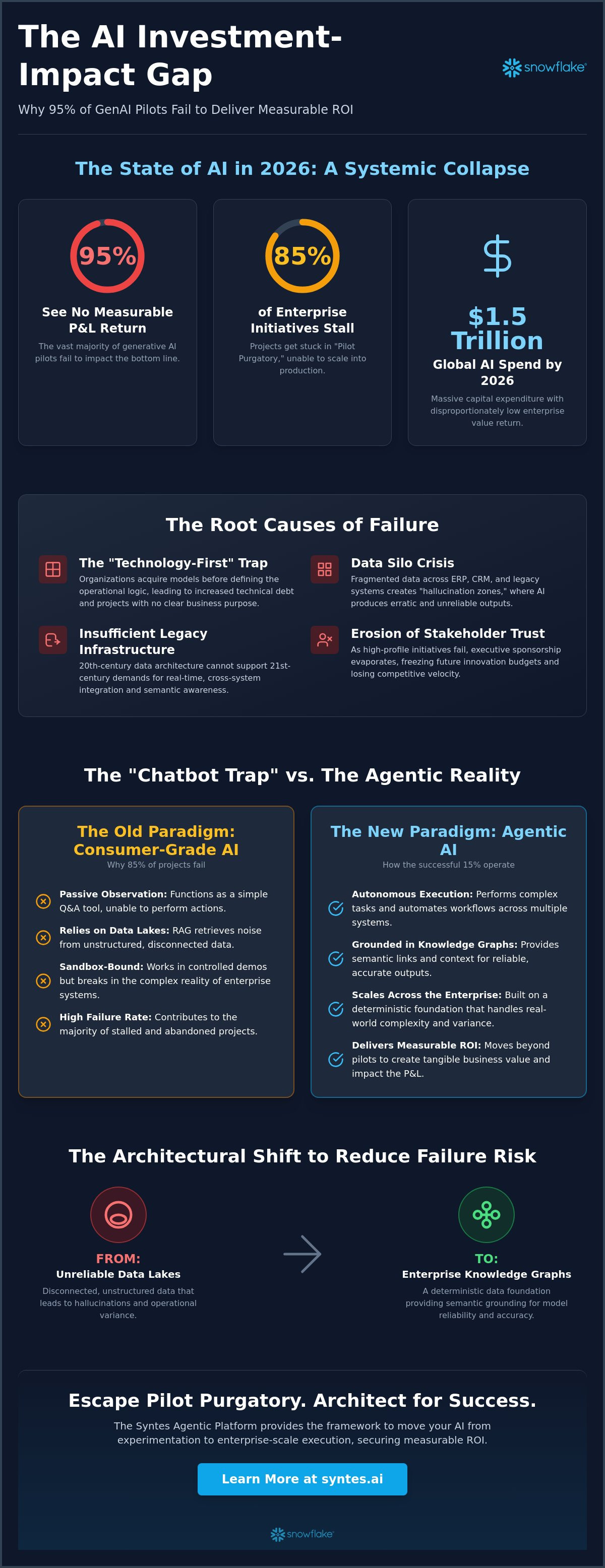
95% of organizations see no measurable P&L return from their generative AI pilots. This isn’t a minor setback; it’s a systemic collapse of the current implementation paradigm. The latest ai project failure statistics 2026 reveal that 85% of enterprise initiatives have stalled, leaving boards questioning the massive capital expenditure that has yet to impact the bottom line. You’ve likely felt the pressure of executive sponsorship waning as promising pilots fail to transition into production. It’s frustrating to watch data fragmentation across legacy systems paralyze your most ambitious models and limit their operational intelligence.
We provide the definitive 2026 data on why these initiatives fail and outline the architectural shift required to move from pilot purgatory to measurable ROI. You’ll discover a clear framework to avoid the 80% failure bracket by prioritizing robust infrastructure and semantic grounding over shiny, disconnected models. We’ll explore how a deterministic data foundation and cross-system integration turn passive observation into active, automated performance that scales across the global enterprise.
Key Takeaways
- Identify the structural flaws in the $1.5 trillion global AI spend and why legacy data foundations are insufficient for 21st-century operational demands.
- Analyze the latest ai project failure statistics 2026 to recognize the “Technology-First” trap that prevents 95% of GenAI pilots from reaching production.
- Differentiate between passive, consumer-grade chatbots and the autonomous execution capabilities of enterprise-grade Agentic AI.
- Transition from unreliable data lakes to deterministic Enterprise Knowledge Graphs to provide the semantic grounding required for model reliability.
- Implement a framework for operational intelligence using the Syntes Agentic Platform to move beyond pilot purgatory and secure measurable ROI.
The State of AI in 2026: Quantifying the $1.5 Trillion Investment-Impact Gap
Capital is flowing. Results are not. This is the defining paradox of the current fiscal year. We call it the Investment-Impact Gap. It’s the chasm between the aggressive capital allocation seen in boardrooms and the stagnant productivity metrics on the factory floor and in the back office. Gartner projections indicate that global AI spend will reach a staggering $1.5 trillion by the end of 2026. Yet, this massive infusion of liquidity hasn’t translated into a proportional rise in enterprise value. Instead, it has highlighted a systemic inability to move from theoretical experimentation to hard-coded operational reality.
The data is unforgiving. According to the RAND Corporation, AI projects fail at twice the rate of traditional IT initiatives. This isn’t a statistical anomaly; it’s a fundamental warning. When we analyze the ai project failure statistics 2026, we see an industry struggling with its own success. S&P Global recently reported that 42% of firms abandoned their primary AI initiatives between 2025 and 2026 because they simply couldn’t prove a path to ROI. The honeymoon phase of “buying the future” has ended. We’ve entered an era where every dollar spent on various applications of artificial intelligence must be justified by a measurable impact on the P&L.
The 2026 Failure Benchmark: From LLMs to Agents
Complexity has a cost. As enterprises transitioned from simple Large Language Models (LLMs) to autonomous agentic workflows, the failure rate climbed from 70% to 85%. Simple chatbots were easy to deploy but hard to scale. Complex agents, designed to execute tasks across multiple systems, introduce layers of variance that legacy architectures can’t handle. This has created a “Pilot Purgatory” where 95% of GenAI initiatives currently stall. They work in a controlled sandbox but break the moment they encounter the messy, fragmented reality of enterprise data.
Economic Consequences of AI Project Attrition
Failed projects leave scars. Beyond the direct capital loss, there’s the toxic growth of “shadow AI,” where departments deploy unmanaged, fragmented models to solve immediate problems. This creates a security nightmare and further fragments the data environment. More critically, these failures erode stakeholder trust. When a flagship initiative fails to deliver, executive sponsorship evaporates, and future innovation budgets are frozen. For the Fortune 500, the cost of these stalls isn’t just a line item; it’s a loss of competitive velocity that may take years to recover.
The Root Causes of Failure: Why 95% of GenAI Pilots Fail to Impact the P&L
The model is a commodity. The workflow is the moat. Most organizations fall into the “Technology-First” trap, acquiring high-performance models before they’ve defined the operational logic those models are supposed to execute. This backward approach is a primary driver behind the sobering ai project failure statistics 2026. When you treat AI as a plug-and-play solution rather than a systemic overhaul, you’re not innovating; you’re just increasing your technical debt. Success requires a ruthless focus on specific, high-value automation targets rather than attempting to “solve everything” in a single, unmanageable sprint.
Modern data demands more than just cleanliness. “Cleaning data” is a 20th-century solution for a 21st-century problem. In the era of agentic reasoning, data must be more than accurate; it must be semantically linked and contextually aware. Legacy infrastructure simply isn’t built to support real-time cross-system integration. Recent industry reports suggest that nearly 90% of AI Projects Still Fail because they lack a deterministic link between raw data and actionable decision-making. Without this grounding, even the most sophisticated models succumb to hallucinations and operational variance.
The Data Silo Crisis: Fragmented Intelligence
Hallucinations are rarely a model problem. They’re a data problem. When AI agents attempt to navigate disconnected ERP, CRM, and legacy systems, they encounter “hallucination zones” where the lack of a unified truth leads to erratic outputs. Retrieval-Augmented Generation (RAG) was supposed to fix this, but without a robust semantic layer, it often just retrieves more noise. This is why forward-thinking enterprises are abandoning flat data lakes. They’re moving toward structured graphs that provide the connectivity required for reliable, autonomous performance. To bridge this gap, leaders are shifting toward Enterprise Knowledge Graphs to provide the necessary semantic grounding.
The Capability Transfer Gap
Don’t rent your intelligence. Relying exclusively on external consultants for AI orchestration creates a “dependency trap” that almost always ends in long-term failure. The most successful firms internalize these capabilities within the first 90 days. They follow a 10/20/70 budget model: 10% on the technology, 20% on the data foundation, and 70% on the people and processes required to sustain it. If you aren’t building a culture of internal ownership, your AI initiatives will remain expensive experiments rather than core business drivers. You need a partner that empowers your team with tools like the Syntes Agentic Platform to ensure the knowledge remains within your walls.
The “Chatbot Trap” vs. Agentic Reality: Why Consumer-Grade AI Fails the Enterprise
Conversational fluency is not operational intelligence. Most organizations mistake the ability to generate text for the ability to execute business logic. This fundamental misunderstanding is a primary driver behind the current ai project failure statistics 2026. Consumer-grade LLMs are designed for creative assistance and general inquiry; they aren’t built to navigate the fragmented, high-stakes environments of a global enterprise. They operate on probabilistic guesses. They lack the deterministic guardrails required for enterprise-grade security and cross-system integration. When a statistical model hallucinates a shipping date or a pricing tier, the result isn’t just a minor error; it’s a systemic failure that can paralyze a supply chain.
Statistical models fail because they don’t understand your business. They predict the next likely word, not the next correct business action. This is the hallucination problem. In a deterministic business environment, close enough is never good enough. Learning how to prevent ai hallucination is no longer an academic exercise; it’s a requirement for any initiative that intends to move beyond a slide deck and into production. Without a bridge between statistical probability and verified business facts, your AI will remain a liability rather than an asset.
Passive Observation vs. Active Performance
Insight without action is just overhead. In 2024, summarization was the primary value proposition; in 2026, it’s a commodity that provides zero competitive advantage. Enterprise leaders now demand that AI “do” rather than just “say.” We’ve seen hundreds of agentic initiatives stall in procurement and supply chain because the models were isolated. They could identify a bottleneck but lacked the system access or the semantic grounding to resolve it. If your AI cannot interact with your ERP or execute a cross-system workflow, it’s nothing more than an expensive search engine. True performance requires autonomous execution that respects your existing operational constraints.
Architecting for Deterministic Truth
How do you move from “maybe” to “yes”? You build for certainty. The shift from probabilistic answers to deterministic business actions is what separates the 15% success bracket from the failing majority. Enterprise agents require a semantic data layer to function reliably. This layer acts as a translator, turning messy, fragmented data into a structured world model that the AI can actually understand. It ensures that every automated action is rooted in a single, verified truth. By providing this grounding, you eliminate the variance that causes 80% of project stalls and ensure your AI remains reliable in even the most high-stakes operational environments.
Reducing Failure Risk: Building a Deterministic Data Foundation
Data lakes have become data graveyards. They store vast amounts of raw information but lack the relational context required for autonomous machine reasoning. This structural deficiency is the silent killer behind the ai project failure statistics 2026 we see today. If your data is flat, your AI is blind. Moving from passive storage to an Enterprise Knowledge Graph isn’t an optional upgrade; it’s the fundamental price of entry for operational ROI in a post-pilot world.
Cross-system integration acts as the nervous system of the modern enterprise. It connects disparate silos into a single, actionable intelligence layer. Without this connectivity, agents are paralyzed. They can’t execute across platforms because they can’t “see” the relationship between a customer record in a CRM and an order status in an ERP. By implementing a “Knowledge-First” strategy, you provide the semantic grounding that eliminates the variance causing 80% of project stalls. You replace probabilistic guesses with deterministic execution.
The Role of the Knowledge Graph in AI Success
How do you provide a “Ground Truth” for an autonomous agent? You build a map of your business logic. An enterprise knowledge graph does exactly this by mapping the complex relationships between entities. Unlike traditional databases, graphs provide the semantic grounding that statistical models lack. This structure prevents model drift and eliminates the hallucinations that plague 2026 implementations. It turns raw, fragmented information into a single, actionable intelligence layer that models can actually use to drive performance.
A Roadmap for 2026 AI Readiness
- Step 1: Audit your cross-system connectivity to identify the data silos that are currently starving your models of critical operational context.
- Step 2: Deploy a semantic data layer to provide model grounding, ensuring every output is rooted in verified business facts.
- Step 3: Orchestrate agentic workflows on top of this validated graph to transition from passive observation to active, automated performance.
Stop managing pilots and start architecting outcomes. You can secure your operational future when you deploy the Syntes Agentic Platform to bridge the gap between your data and your execution.
Syntes AI: Architecting the 15% Success Bracket with Agentic Knowledge Graphs
Execution is the only metric that matters. While the ai project failure statistics 2026 paint a grim picture of industry-wide stagnation, they also define the specific architectural requirements for success. The Syntes Agentic Platform exists to bridge the Investment-Impact Gap by shifting the focus from model experimentation to operational execution. We don’t just provide another layer of intelligence; we provide the deterministic grounding that models require to function in the real world. Our Knowledge Graph infrastructure serves as the cognitive anchor for your AI, ensuring every automated decision is rooted in the verified logic of your specific business environment.
Success in 2026 requires a fundamental pivot toward robust enterprise ai infrastructure. Most initiatives fail because they prioritize the “shiny” model over the “messy” reality of system integration. Syntes reverses this hierarchy. We prioritize connectivity and semantic grounding, creating a stable foundation where autonomous agents can thrive without the risk of hallucination or operational drift. This approach transforms AI from a speculative R&D expense into a core driver of measurable P&L impact.
Unifying Complex Data for Actionable Intelligence
Silos are the enemy of autonomy. The power of Syntes Cross-System Integrations lies in the ability to connect legacy stacks and modern cloud environments into a unified, actionable intelligence layer. We move your organization from fragmented data silos to agentic intelligence in under 90 days. Syntes AI delivers a 3x higher success rate than internal builds by providing the deterministic semantic grounding that home-grown models lack. By mapping the complex relationships within your data, we ensure that your agents possess the context necessary to execute high-stakes workflows across the entire global enterprise.
Beyond Chatbots: Deploying True Autonomous Agents
Stop talking and start doing. The Syntes Agentic Platform is engineered to manage complex business automation that goes far beyond the capabilities of consumer-grade chatbots. We provide the security, governance, and reliability required at the enterprise scale, allowing you to deploy agents that actually interact with your core systems. These aren’t passive observers; they’re active participants in your operational workflows. When you align your technology with the reality of your data, you move beyond the 85% failure bracket and into a state of total operational clarity. It’s time to stop the cycle of pilot stalls and start delivering results. Deploy your agentic infrastructure with Syntes AI today.
Secure Your Operational Future in the Age of Agentic Intelligence
The current ai project failure statistics 2026 represent a necessary market correction. The era of speculative experimentation has ended. You’ve seen how the “Chatbot Trap” and fragmented data silos drain capital without delivering measurable P&L impact. Success now belongs to the leaders who prioritize semantic grounding and cross-system integration over isolated model performance. Execution is the only differentiator that remains. It’s time to move beyond the limitations of statistical probability.
You don’t have to remain in the 85% failure bracket. By leveraging enterprise-grade Knowledge Graph infrastructure and our 90-day capability transfer model, your organization can deploy agents with the deterministic grounding required for zero-hallucination results. It’s time to bridge the impact gap and achieve total operational clarity. Architect your success with the Syntes Agentic Platform and turn your data into a decisive competitive advantage. The transition from passive observation to active, automated performance is no longer a vision; it’s a reality you can command today.
Frequently Asked Questions
What is the current AI project failure rate in 2026?
The current enterprise AI failure rate stands at 85%. This figure represents a significant escalation from previous years as organizations attempt to move from simple language models to complex, autonomous agents. While 48% of projects reach production, the vast majority fail to deliver measurable business value or sustain executive sponsorship beyond the initial pilot phase. It’s a systemic collapse of the “experiment-first” implementation paradigm.
Why do 85% of enterprise AI initiatives fail to reach production?
Initiatives stall primarily due to the “Technology-First” trap. Companies often acquire sophisticated models before defining the operational workflows those models must execute. This misalignment, combined with fragmented data across legacy systems, creates an environment where AI cannot reliably perform. Without a deterministic foundation, these projects remain stuck in “pilot purgatory” and never achieve the scalability required for production environments or measurable P&L impact.
How does a Knowledge Graph improve the success rate of AI projects?
An Enterprise Knowledge Graph provides the semantic grounding that statistical models lack. It maps complex relationships between disparate data points, creating a “Ground Truth” that prevents model drift and hallucination. By providing this structured context, the graph ensures that AI agents make decisions based on verified business logic rather than probabilistic guesses. This directly addresses the root causes identified in ai project failure statistics 2026, moving projects from theory to execution.
What is the difference between GenAI pilots and Agentic AI production?
GenAI pilots focus on passive observation, such as summarization or content generation, while Agentic AI production emphasizes active, autonomous execution. Pilots typically operate in isolated sandboxes with low risk. Production-grade Agentic AI requires deep system integration and the ability to perform complex tasks across multiple platforms, such as procurement or supply chain management, while maintaining strict security and governance standards at scale.
How can companies avoid the “consulting dependency trap” in AI?
Organizations avoid this trap by internalizing AI orchestration capabilities within the first 90 days of an initiative. Relying exclusively on external partners for core logic creates a brittle infrastructure that collapses once the consultants depart. Success requires a commitment to building internal expertise and using platforms that empower your existing team to manage, audit, and scale agentic workflows without constant, expensive external intervention.
What is the 10/20/70 model for AI resource allocation?
The 10/20/70 model dictates that 10% of resources should go to the AI model, 20% to the data foundation, and 70% to people and process transformation. Most failing projects invert this ratio by overspending on “shiny” models while ignoring the systemic changes required for adoption. Reallocating focus toward operational workflows and staff literacy ensures that the technology actually integrates into the business’s daily rhythm.
Can legacy systems be integrated into modern Agentic AI platforms?
Yes, legacy systems are essential components of a successful agentic architecture. Modern platforms use Cross-System Integrations to connect disconnected ERPs and CRMs into a unified intelligence layer. By wrapping these legacy stacks in a semantic data layer, you allow AI agents to access and act upon historical data without requiring a total system overhaul. This connectivity serves as the “nervous system” that drives real-time operational intelligence.
How do you measure the ROI of an Enterprise AI platform?
ROI is measured by direct P&L impact and measurable gains in operational efficiency. Instead of tracking “engagement” or “chat volume,” focus on hard metrics like reduced cycle times, lower error rates in automated workflows, and the successful transition of pilots into production. True ROI manifests when AI agents autonomously resolve complex business problems that previously required manual intervention, thereby freeing human capital for higher-value strategic tasks.