
Your “Golden Record” is a dead end. In an era of autonomous agents, a static database is a strategic liability. Traditional systems fail to provide the deep context required for modern intelligence. Research indicates that Large Language Models answering complex enterprise questions without grounding achieve a dismal 16.7% accuracy. To bridge this gap, forward-thinking organizations are pivoting to a knowledge graph for master data management. This shift transforms passive records into a living, semantic nervous system that fuels operational clarity.
You’ve likely realized that manual data modeling across disparate systems is a recipe for exhaustion and error. It’s time to evolve these rigid silos into dynamic, agent-ready intelligence. This article outlines how to architect a foundation using an Enterprise Knowledge Graph and the Syntes Agentic Platform. We’ll explore how to establish a reliable ground truth that eliminates AI hallucinations while slashing time-to-insight for your most complex enterprise queries.
The “Golden Record” is an artifact of a simpler era. It represents a flat, two-dimensional view of business reality that no longer serves the high-velocity demands of the modern enterprise. Traditional Master Data Management (MDM) focuses on deduplication and standardization within rigid relational tables. This approach creates a library of isolated facts rather than a functional map of business logic. A knowledge graph for master data management represents the necessary evolution. It replaces the static record with a semantic network of interconnected business entities, allowing for a fluid representation of information.
While legacy systems prioritize the “Golden Record,” they often ignore the relationships that give that record its actual utility. A semantic entity is dynamic. It exists within a web of context; connecting products to suppliers, customers to purchase intents, and assets to operational risks. The relational schemas of the past have become a “Rigidity Trap.” Every change in business logic requires a corresponding, high-cost change in the underlying SQL structure. This leads to an unsustainable reliance on manual data stewardship. It’s a systemic flaw that drains resources and stifles innovation across the entire stack.
A single row in a database cannot capture the nuance of real-world business. It lacks the connectivity required to explain how entities interact across organizational silos. When context is missing, AI reliability plummets. Decision-making becomes a reactive exercise based on fragmented snapshots rather than a proactive strategy driven by a clear understanding of What is a Knowledge Graph? and its capacity to map complex relationships. We’re witnessing a mandatory transition. Passive data storage is dead. Active operational intelligence is the new standard for the competitive enterprise.
AI agents fail when they encounter traditional, siloed data structures. They cannot navigate foreign key relationships with the speed or accuracy needed for autonomous task execution. Without a unified semantic layer, agents lack the “ground truth” necessary to operate without constant human intervention. At Syntes AI, we recognize that data is only as valuable as its ability to be executed upon. The Syntes Agentic Platform leverages an Enterprise Knowledge Graph to turn master data into a high-fidelity roadmap for automation. If your MDM doesn’t speak the language of relationships, it isn’t just outdated; it’s a bottleneck for your entire AI strategy.
The relational join is an architectural anchor. It drags down performance as data volume and relationship complexity increase, leading to the late-night query failures that haunt enterprise IT departments. Transitioning to a knowledge graph for master data management replaces these brittle connections with high-performance graph traversals. This isn’t just a technical upgrade; it’s a clarity revolution. By navigating multi-hop relationships with millisecond latency, organizations can query deep business hierarchies that would crash a traditional SQL database. The focus shifts from managing tables to managing meaning.
Ontologies serve as the blueprint for this new reality. Unlike a rigid database schema, an ontology defines enterprise-wide business logic in a way that both humans and machines can interpret. It provides the semantic precision required to align disparate departments under a single, coherent truth. Organizations can look to the Enterprise Knowledge Graph Foundation for principles on building these resilient frameworks. Within this architecture, entity resolution becomes a graph-native mechanism. It doesn’t just match records; it uses the web of surrounding connections to verify identity with a level of certainty that isolated records can’t match.
This architecture excels at unification. It ingests structured SQL data, semi-structured JSON files, and even insights extracted from unstructured documents into a single, interconnected fabric. This creates a holistic view of the enterprise that is impossible to achieve through traditional silos. It’s the difference between seeing a list of transactions and understanding the entire lifecycle of a customer relationship.
In a graph-based system, entities like “Customer” or “Product” are represented as nodes. Their business interactions, such as “Purchased” or “Supplied By,” are represented as edges. Properties allow for the storage of rich metadata on both nodes and edges without requiring a schema overhaul. Edges represent real-time business events, capturing the pulse of the enterprise as it happens. This flexibility ensures the data model evolves at the speed of the business, not at the speed of an IT ticket cycle.
Building these models manually is an exercise in futility. Modern enterprises leverage AI to map source system schemas directly to a central ontology, drastically reducing the communication gap between domain experts and data engineers. This process is further enhanced by an enterprise data catalog with knowledge graph, which activates metadata to make it accessible for agentic workflows. By automating the heavy lifting of model generation, you free your team to focus on high-value strategic execution. To see this in action, explore how the Syntes Agentic Platform streamlines the transition to a semantic foundation.
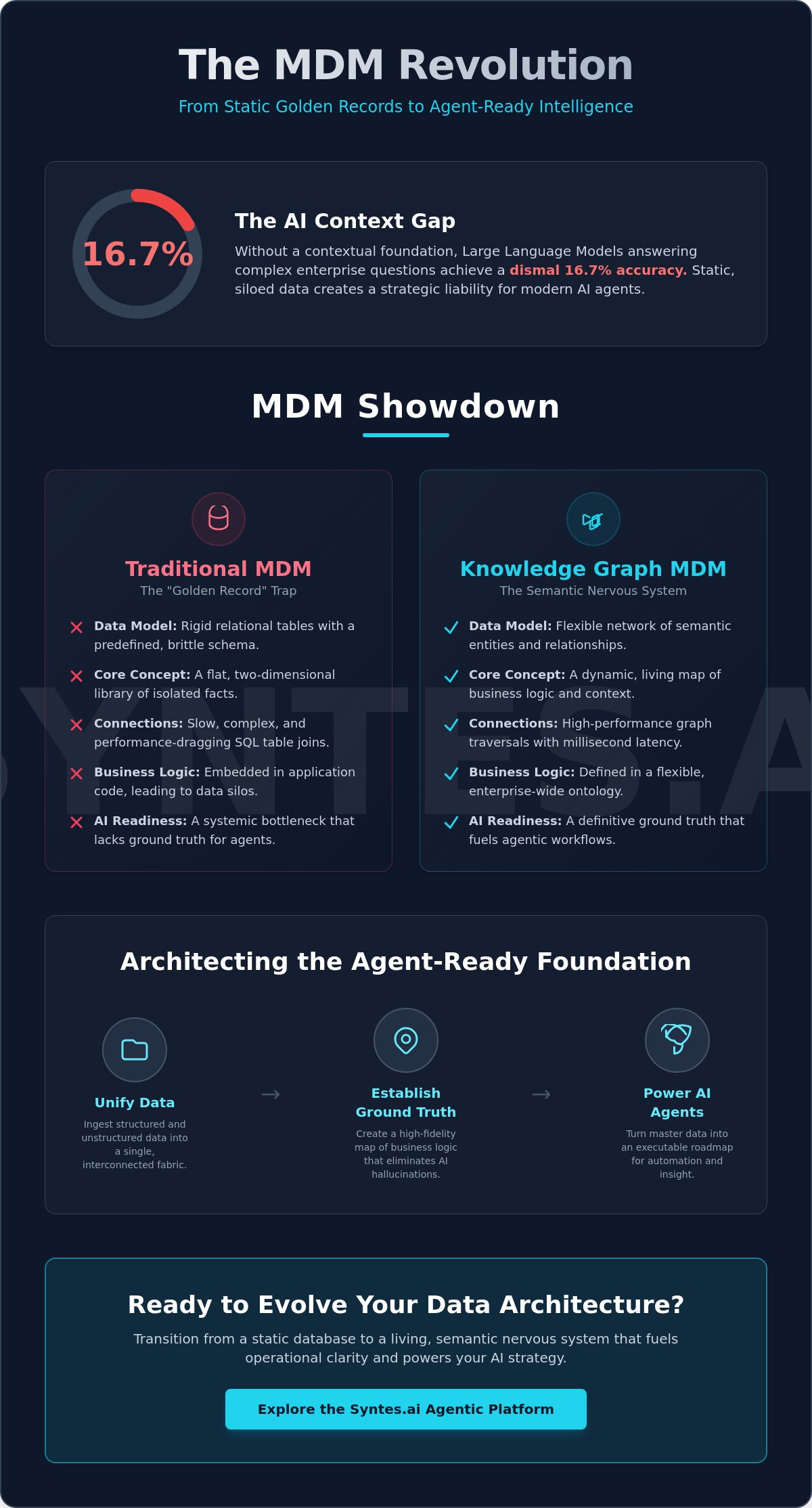
Traditional Master Data Management is a reactive cleanup operation. It functions as a digital archive, attempting to reconcile historical records into a singular “Golden Record” that remains stubbornly static. This approach is fundamentally incompatible with the speed of modern business. A knowledge graph for master data management, by contrast, creates a proactive intelligence layer. It doesn’t just store data; it understands the semantic intent behind it. While relational MDM relies on rigid SQL schemas that break under the slightest structural change, graph-driven systems utilize an evolvable model. This flexibility is anchored in the W3C RDF Standard, allowing enterprises to ingest and link data without the operational inertia of constant schema migrations.
The difference in relationship handling is equally stark. Relational databases treat connections as secondary foreign keys; simple pointers that lack inherent meaning. In a knowledge graph, relationships are first-class citizens. They carry semantic weight and context, enabling sophisticated pathfinding that keyword-based search can’t replicate. This is the foundation of AI readiness. Vector-only databases are prone to hallucinations because they lack structural grounding. Graph-grounded Retrieval-Augmented Generation (RAG) provides the logical constraints necessary for enterprise-grade AI. Research from May 2026 confirms that while LLMs achieve only 16.7% accuracy on complex queries in isolation, grounding them with a knowledge graph pushes that accuracy to 54.2%.
Relational systems suffer from the “Deep Join” problem. As you query across multiple tables to find complex connections, performance degrades exponentially. Knowledge graphs solve this through index-free adjacency. Traversing millions of connections takes milliseconds. You stop managing isolated data points and start managing living business concepts. This shift allows the enterprise to move from passive observation to active, automated performance. It’s the difference between a spreadsheet and a nervous system.
The myth that graph technology cannot scale to enterprise volumes is dead. With the release of Neo4j 2026.05.0 and TigerGraph 4.1.4 in May 2026, the market now possesses platforms capable of handling petabyte-scale analytical reasoning and real-time operational queries simultaneously. Achieving this level of performance often requires understanding the synergy of data fabric vs knowledge graph architectures. When these frameworks work in tandem, they enable real-time synchronization across global enterprise software stacks, ensuring that your master data is always current, connected, and ready for execution.
Transitioning to a semantic architecture is not a simple technical migration. It’s a strategic pivot. Organizations must stop viewing data as a series of disconnected tables and start treating it as a unified business asset. The roadmap to a knowledge graph for master data management begins with the identification of high-impact domains. Don’t attempt to boil the ocean. Target high-value areas like Customer 360 or complex supply chain logistics where relationship visibility offers an immediate competitive advantage. Once the domain is set, the focus shifts to defining a core ontology that mirrors business reality rather than legacy IT constraints. This is followed by the integration of disparate data sources through semantic middleware, the establishment of graph-based governance, and finally, the grounding of agentic AI workflows in this newly established ground truth.
Your ontology is the strategic blueprint for enterprise intelligence. It must prioritize business outcomes over technical limitations. By focusing on how entities interact in the real world, you create a framework for semantic grounding. This grounding is the only reliable defense against AI hallucinations; it provides the structural constraints that keep autonomous systems on track. Think of the ontology as a definitive dictionary for your AI agents. It ensures that every autonomous task is executed with a precise understanding of the relationships between products, customers, and operational processes. Without this clarity, your AI strategy is built on sand.
Legacy ERPs and CRMs are often the biggest hurdles to operational agility. They’re built on siloed architectures that resist connectivity. To overcome this, you must establish real-time data flows between these systems and your semantic layer. This ensures that your knowledge graph isn’t just a snapshot of the past, but a real-time reflection of the present. At Syntes AI, we specialize in high-performance Cross-System Integrations that bridge the gap between fragmented legacy environments and the modern semantic stack. We transform passive data into active intelligence, allowing your enterprise to move at the speed of thought. If you’re ready to eliminate the friction of siloed data, the Syntes Agentic Platform provides the necessary infrastructure to scale your vision.
Master Data Management is no longer a passive storage concern. It’s the high-octane fuel for autonomous enterprise performance. While legacy vendors treat data as a collection of isolated facts, Syntes AI recognizes that information is only valuable when it’s actionable. By architecting a knowledge graph for master data management, we provide the semantic fidelity required for high-stakes decision-making. Our platform moves beyond the limitations of simple data observation. It establishes a definitive ground truth that allows AI agents to navigate complex business logic with total certainty. This isn’t just a technical upgrade; it’s a fundamental shift toward industrial-strength automation.
Scalable AI requires more than just raw compute power. It demands an infrastructure that understands the nuance of your specific operations. The Syntes Agentic Platform is built on a native Enterprise Knowledge Graph, ensuring that every autonomous workflow is grounded in reality. We eliminate the systemic flaws of siloed data environments, replacing them with a unified intelligence layer. This transition from passive records to active semantic entities is the only path to sustainable operational clarity. Without this foundation, your AI strategy remains a series of disconnected experiments rather than a cohesive execution engine.
Deploy agents that actually understand your business. Most AI tools fail because they lack the context of your unique organizational logic. We solve this by integrating your master data directly into our agentic framework. This deep semantic integration eliminates hallucinations at the source. You don’t need another consumer-grade chatbot. You need industrial-strength automation that can execute tasks across your entire software stack. By leveraging our Cross-System Integrations, you ensure that your agents have real-time access to the data they need to perform with precision.
The enterprise knowledge graph is the last data migration you’ll ever need. It’s a living system that learns and evolves alongside your business. As new data sources emerge or business logic shifts, the graph adapts without the need for high-cost schema overhauls. This resilience ensures that your investment in data remains relevant for decades, not just until the next software update. Stop managing records and start mastering intelligence. Explore the Syntes Agentic Platform today to see how we transform static data into autonomous operational power.
The window for reactive data management is closing. Static “Golden Records” no longer suffice in a market defined by autonomous execution and real-time intelligence. You’ve seen how a knowledge graph for master data management transforms fragmented silos into a unified, semantic nervous system. This architecture doesn’t just store information; it provides the structural grounding necessary to eliminate AI hallucinations and fuel complex decision-making. It’s the difference between a passive archive and an active operational asset. Organizations that fail to make this shift will remain trapped in the manual labor of data reconciliation while their competitors achieve total operational clarity.
Syntes AI provides the definitive path forward. Our Syntes Agentic Platform is the first infrastructure specifically engineered for autonomous enterprise operations. We bridge the gap between legacy tech stacks and modern AI through deep cross-system integration and rigorous semantic precision. Don’t let rigid schemas anchor your strategic vision. Unify your enterprise data with the Syntes Agentic Platform and turn your master data into a competitive engine. The future of the enterprise is connected, contextual, and ready for action. Your evolution begins now.
A data catalog is a passive inventory of metadata; a knowledge graph for master data management is an active semantic network. While catalogs focus on discovery and location, knowledge graphs focus on meaning and connectivity. They transform isolated data points into a living business model. This architecture allows for real-time operational execution rather than simple observation. It’s the difference between a library index and a functioning brain.
A knowledge graph doesn’t just replace legacy MDM; it evolves it into a dynamic intelligence layer. Traditional systems are often limited by rigid SQL schemas that cannot adapt to changing business logic. By transitioning to a graph-based foundation, you eliminate the “Rigidity Trap” of relational tables. This move positions your master data as a primary orchestration layer for autonomous workflows. It’s a necessary step for any enterprise pursuing agentic AI at scale.
Accuracy improves through structural grounding and logical constraints. Research from May 2026 shows that grounding LLMs with a knowledge graph increases accuracy from 16.7% to 54.2% for complex queries. By providing a definitive “ground truth,” knowledge graphs prevent the hallucinations common in vector-only systems. AI agents gain the ability to navigate deep business hierarchies with millisecond latency. They stop guessing and start executing with precision.
The primary hurdles are ontology design and the ingestion of fragmented legacy data. Engineering teams must shift from table-centric thinking to relationship-centric modeling. This requires a sophisticated understanding of business logic rather than just database administration. Syntes AI addresses these challenges through automated model generation and high-performance cross-system integrations. Success depends on prioritizing business outcomes over technical constraints during the initial architecture phase.
Entity resolution in a graph environment utilizes the surrounding web of connections to verify identity. Instead of relying on simple string matching within a single row, the system analyzes the “neighborhood” of a node. It examines related products, addresses, and transactions to ensure a high-fidelity match. This graph-native approach provides a level of certainty that isolated relational records simply cannot match. It turns entity resolution into a proactive verification process.
Knowledge graphs are fully compatible with SQL-based legacy systems through semantic middleware. You don’t need to rip and replace your existing ERPs or CRMs. Instead, you utilize cross-system integrations to map source data into a central enterprise ontology. This allows you to maintain your legacy investments while gaining the benefits of a modern semantic layer. It’s a non-disruptive way to upgrade your enterprise intelligence without data loss.
A semantic layer reduces costs by eliminating the “n-squared” integration problem. Traditional point-to-point integrations grow exponentially in cost and complexity as you add new systems. By connecting every source to a single, central ontology, you simplify the architecture. This reduces the manual effort required for data modeling and maintenance. You stop building brittle bridges and start building a unified data fabric that scales with your business needs.
ROI is realized through slashed time-to-insight and the enabling of autonomous operational execution. Organizations see a massive reduction in the manual labor required for data stewardship and model maintenance. More importantly, it provides the foundation for the Syntes Agentic Platform, allowing for automation that was previously impossible. You aren’t just saving money on IT; you’re unlocking new levels of operational agility and long-term revenue potential.
DataRobot has been instrumental as we work through our generative and predictive AI use cases. With DataRobot’s LLM operations (LLMOps) capabilities and out-of-the-box LLM performance monitoring, we’re equipped to implement cutting-edge generative AI techniques into our business while monitoring for toxicity, truthfulness and cost.

Frederique De Letter
Senior Director Business Insights & Analytics, Keller Williams

A complete AI lifecycle platform is invaluable in optimizing the effectiveness and efficiency of our growing data science team. The DataRobot AI Platform provides full flexibility to integrate within our current ecosystem, including pulling data directly from Microsoft Azure to save time and reduce risk, and providing insights through Microsoft Power BI. This flexibility drew us to DataRobot, and we look forward to leveraging the integration with Azure OpenAI to continue to drive innovation.

Craig Civil
Director of Data Science & AI
The generative AI space is changing quickly, and the flexibility, safety and security of DataRobot helps us stay on the cutting edge with a HIPAA-compliant environment we trust to uphold critical health data protection standards. We’re harnessing innovation for real-world applications, giving us the ability to transform patient care and improve operations and efficiency with confidence

Rosalia Tungaraza
Ph.D, AVP, Artificial Intelligence, Baptist Health

DataRobot is an indispensable partner helping us maintain our reputation both internally and externally by deploying, monitoring, and governing generative AI responsibly and effectively.

Tom Thomas
Vice President of Data & Analytics, FordDirect
