
What if an AI agent’s biggest failure isn’t its model, but the business context it never received? Enterprise information is fragmented across systems, documents, and teams, so even capable AI can miss the rules, relationships, and changing facts that shape a reliable answer. Enterprise AI context management addresses this gap: retrieving relevant material is not the same as understanding how it connects.
It brings structured and unstructured information into a governed, evolving view of the business, giving AI systems context to reason and act. The goal isn’t simply to give AI more data. It’s to make that data relevant, current, and accountable.
This article explains the core components of context management and how it differs from RAG and a knowledge graph. You’ll also learn what governed, current context AI agents need and which practical criteria can help you evaluate an enterprise approach. The shift is from isolated answers to connected business understanding.
Key Takeaways
- Learn why business context is more than raw data, a prompt, or a retrieved document.
- See how the five-stage context engineering lifecycle moves information toward governed, useful action.
- Understand how enterprise ai context management works alongside RAG, knowledge graphs, and data integration.
- Use a bounded workflow to identify the systems, rules, relationships, and owners your AI needs.
- Explore how Syntes AI’s five Context Engineering pillars address distinct enterprise context needs.
What Is Enterprise AI Context Management, and Why Does It Matter?
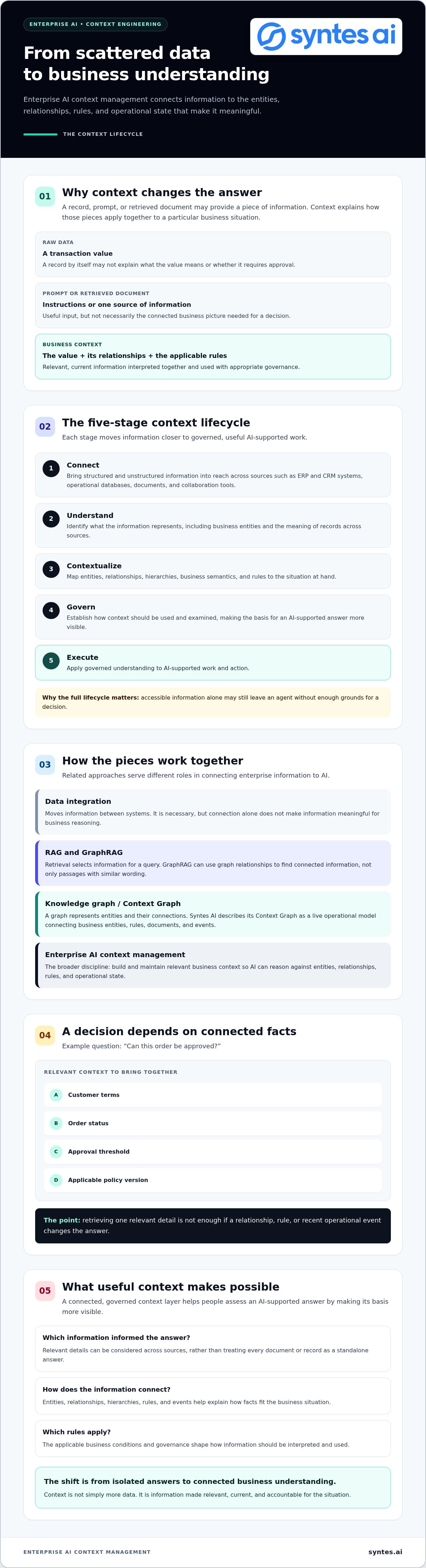
Enterprise AI context management is the discipline of building and maintaining relevant business context so AI can reason against an organization’s entities, relationships, rules, and operational state. It’s not simply collecting more data. Information must be interpreted together, under the right conditions, and with appropriate governance.
Raw data is a record that may not explain its business meaning. A prompt gives an AI system instructions for a particular interaction; a retrieved document supplies one source of information. Context connects these pieces and establishes how they apply to a specific situation. The broader idea of Context management involves applications sharing and synchronizing information about a subject. In an enterprise, that subject might be a customer, supplier, product, project, or transaction, with relevant policies and activity considered alongside it.
What counts as enterprise context?
Business context includes the entities an organization works with and the connections among them. A customer may belong to an account, have open transactions, and be covered by particular service terms. A supplier may be linked to contracts, delivery events, and internal approval rules. Documents and databases hold parts of this picture; hierarchies, business rules, and operational events help explain what those facts mean.
Context makes information situational. A transaction value alone doesn’t reveal whether it needs approval. The applicable threshold, account relationship, and current policy also matter. Context management brings these elements into a useful view rather than treating each record or document as a standalone answer.
Why do AI systems need business context?
The same question can require different answers depending on the business circumstances. For example, “Can this order be approved?” may depend on the customer’s terms, the order’s status, an approval threshold, and a policy version. If those facts are scattered across systems and documents, an AI system may retrieve one relevant detail but miss a condition that changes the decision.
Incomplete context can lead to responses that sound plausible but omit a relationship, rule, or recent operational event. A connected, governed context layer can make the basis for an AI-supported answer more visible: which information informed it, how that information relates to the situation, and which rules apply. This gives people a stronger basis to assess the response. Context management is therefore an ongoing enterprise discipline, not a one-time prompt-writing exercise.
How Enterprise AI Context Management Connects Data to Meaning
Connecting enterprise sources is necessary, but connection alone doesn’t make information useful to AI. Data integration moves information between systems; context engineering makes that information meaningful for business reasoning and action. Enterprise AI context management treats this as a continuing lifecycle: connect, understand, contextualize, govern, and execute.
From connected sources to a live Context Graph
An organization might draw information from ERP and CRM systems, operational databases, documents, and collaboration tools. Those sources can describe the same customer or project in different ways. A coherent context model links the entities and records, then represents their relationships through hierarchies, business semantics, rules, and events.
Syntes AI describes its Context Graph as a live operational model connecting business entities, rules, documents, and events. Rather than treating each source as a separate answer, a context graph provides a unified layer for representing how information fits together. The specific sources and connections depend on the enterprise environment. Connecting them does not, by itself, resolve inconsistent definitions or determine which policy applies.
How context management supports AI reasoning
At query time, GraphRAG can use a graph’s relationships to retrieve information connected to a question, not just passages that share similar wording. For example, a request about a project could draw on linked records, relevant documents, and associated rules. This connected retrieval can give a model a more useful evidence base for questions spanning multiple sources.
For teams assessing this approach, the key question is how connected information becomes governed context that can support execution. A closer look at Syntes AI’s Context Engineering approach can help clarify how those stages fit together.
Enterprise AI Context Management vs. RAG, Knowledge Graphs, and Data Integration
These terms describe different architectural roles, not competing choices. Retrieval-Augmented Generation (RAG) finds information for a model to use. A knowledge graph represents entities and relationships. Data integration connects systems and moves information. Enterprise AI context management coordinates these capabilities so AI can use business information with its meaning, rules, and relationships intact.
| Approach | Primary role | What it contributes |
|---|---|---|
| Data integration | Connect systems and data | Access to information across sources, without necessarily interpreting its business meaning. |
| RAG | Retrieve information for a query | Relevant documents or passages supplied to inform a model’s response. |
| Knowledge graph | Represent entities and relationships | A structured way to model how business objects connect. |
| Context management | Build and maintain usable business context | Relevant information, semantics, relationships, rules, and governance for AI reasoning and action. |
Context management and Retrieval-Augmented Generation
RAG retrieves material that may help answer a question, then provides it to the model as input. Its results depend on source data quality, retrieval design, and how the information is used. It can be effective for document-based questions, such as finding a clause in a contract.
Context management addresses a broader concern: whether the retrieved material reflects the right business entities, relationships, current rules, and permissions. Finding a contract clause may not be enough if the answer also depends on which supplier the contract covers or whether a later operational event changed the situation. RAG can operate within a context-management approach; it doesn’t replace the work of maintaining business meaning and governance.
Context management, knowledge graphs, and integration
A knowledge graph models entities and the relationships between them. It can connect facts otherwise spread across records and documents. But a graph alone doesn’t guarantee that those relationships are accurate, current, governed, or useful for a particular AI task. A Context Graph is one possible way to provide a unified context layer, not another name for every knowledge graph.
Likewise, connecting systems makes information accessible, not automatically understandable. Connected data alone doesn’t make AI context-aware; business meanings, relationships, applicable rules, and maintenance processes must also be established. Integration, graphs, and retrieval can work together in enterprise AI context management, with each component serving a distinct role.
How to Assess Enterprise AI Context Management Readiness
Assess readiness against a real business workflow, not an abstract goal such as “make AI smarter.” Choose a bounded process where a decision depends on information from multiple systems or changes as operational facts change. Define the decision the AI should support, who remains accountable, and what a correct, safe outcome looks like.
This starting point helps reveal whether enterprise AI context management can support the work with relevant, current, governed information. Disconnected sources can conceal conflicting definitions and missing relationships. A review of solving enterprise data silos can help frame that challenge.
Map the workflow and context it depends on
Trace the workflow from input to decision and identify the context needed at each step. Inventory the systems and information involved, assign an accountable owner to each source, and document how often its contents change and how updates reach the context used by AI.
- Decision: What question or action is the AI supporting, and where is human review required?
- Sources: Which systems, data types, documents, transactions, and operational events inform the decision?
- Meaning: Which entities, relationships, definitions, and business rules determine how the information should be interpreted?
- Ownership: Who is responsible for source quality, policy interpretation, and resolving conflicting information?
Check freshness and semantic consistency before expanding the workflow. A source may be accessible but stale; two systems may use the same term differently. Record these gaps rather than assuming integration will resolve them.
Set governance and evaluation criteria
Test representative workflow cases, including incomplete, conflicting, and changed information. Compare task-specific accuracy and safe execution with a documented baseline, and review whether the system follows access rules and escalates decisions at the right points. Define when a result is acceptable, when a person must intervene, and how issues will be investigated. This makes readiness an operational assessment rather than a broad claim that an AI system is “ready.”
How Syntes AI Applies Context Engineering to Enterprise AI
Once an organization has identified a workflow, its data dependencies, and its governance criteria, the next question is how to bring those elements into a coherent operating approach. Syntes AI applies Context Engineering through five pillars: Connect, Understand, Contextualize, Govern, and Execute. Together, they frame enterprise AI context management as an ongoing discipline, not a one-time data connection or prompt-writing exercise.
- Connect: Bring structured and unstructured enterprise information into reach through two-way connectors.
- Understand: Establish what the information represents across different sources.
- Contextualize: Relate business entities, rules, documents, and events so they can be considered together.
- Govern: Apply governance to the context used by AI systems and agents.
- Execute: Use that context to support AI agents and workflows in carrying out relevant tasks.
The sequence matters. Connecting a source provides access; it doesn’t automatically establish meaning, resolve conflicting information, or determine which rules apply. The later pillars address those needs by linking information to business context and governed use.
From fragmented enterprise data to operational memory
With two-way connectors, structured and unstructured information can contribute to a shared context layer. Syntes AI describes its Context Graph as a live operational model connecting business entities with rules, documents, and events. Graph technology represents how those elements relate, helping organize enterprise information as connected operational memory rather than isolated records.
That model can give AI systems a more coherent basis for interpreting a workflow, while keeping source information and its relationships within the broader context. For a deeper explanation of graph fundamentals and their enterprise role, read the executive guide to enterprise knowledge graphs.
Governed context for explainable AI agents
Agent execution raises the stakes: an agent needs relevant context, but it also needs boundaries. Governance should account for permissions, applicable business rules, review points, and expectations for traceability. Syntes AI’s framework places Govern before Execute, linking governed context to agent action rather than treating oversight as an afterthought.
When an agent’s reasoning can be considered alongside the evidence and relationships in its context layer, people have a clearer basis for reviewing its output. In mission-critical fields like healthcare, platforms like MayaMD show how combining deterministic logic with generative AI maintains necessary boundaries and operational context. The right approach depends on the workflow, sources, and controls your organization needs.
Build the Context Your AI Needs to Act
Trusted AI depends on more than connected systems or well-written prompts. Enterprise AI context management brings relevant business information, relationships, and rules together so AI can reason with a clearer view of the situation. RAG, data integration, and knowledge graphs each have distinct roles, but can work together within a governed context approach.
Syntes AI’s Context Engineering Framework spans Connect, Understand, Contextualize, Govern, and Execute. Its Context Graph is described as a live operational model connecting enterprise information. Together, these provide a framework to consider as you shape context for your workflows.
Frequently Asked Questions
What is enterprise AI context management?
Enterprise AI context management is the practice of building and maintaining the business information AI needs to reason about an organization’s operations. It brings relevant data, entities, relationships, documents, business rules, and operational events together so systems can interpret them in context. Unlike a prompt or an individual retrieved document, it’s an ongoing discipline for keeping that context useful, governed, and connected to real business workflows.
How is AI context management different from RAG?
RAG retrieves relevant information for a model to use when generating a response. Context management covers a broader role: organizing business meaning, relationships, rules, governance, and ongoing updates so retrieved material fits the situation. The approaches can work together. For example, RAG may retrieve a policy document, while a context layer helps relate it to the correct business entity and relevant operational facts.
What is an enterprise Context Graph?
An enterprise Context Graph is a context layer that represents relationships among business entities and information, such as customers, products, suppliers, documents, rules, and operational events. It helps AI reason across connected facts rather than treating each record as isolated. Syntes AI describes its Context Graph as a live operational model connecting enterprise information. Its value depends on the relevance, quality, and governance of the context it represents.
Can enterprise AI context management reduce hallucinations?
It can help reduce the risk of unsupported answers by grounding AI in relevant enterprise information and relationships. For instance, an answer informed by an applicable policy and its related business records may be better supported than one based on a loosely related document. Context management doesn’t eliminate hallucinations or guarantee accuracy. Results still depend on source quality, retrieval and model behavior, governance, and how outputs are evaluated.
How do you implement enterprise AI context management?
Start with a bounded workflow and identify the decisions AI should support. Map the systems, documents, entities, relationships, business rules, and events that inform those decisions, then assign owners and assess freshness, consistency, permissions, and provenance. Define human review and audit expectations before enabling agent execution. Test representative cases and compare task-specific accuracy and safe behavior against a documented baseline, then refine the context as the workflow changes.
Does enterprise AI context management replace data integration?
No. Data integration connects systems and makes information accessible across sources; context management builds on that access to organize meaning, relationships, rules, and governance for AI use. Integration remains important, but connection alone doesn’t ensure that data is interpreted correctly or kept relevant to a workflow. The two capabilities serve distinct roles and can work together as part of an enterprise AI architecture.
How does context management support AI agent governance?
Context management supports agent governance by helping define which information and business rules apply to a task, alongside permissions and review expectations. Governance can specify what an agent may access or do, when a person must approve an action, and what should be auditable. When an agent’s output can be examined against relevant sources and relationships, reviewers have a clearer basis for assessing its reasoning and actions.