

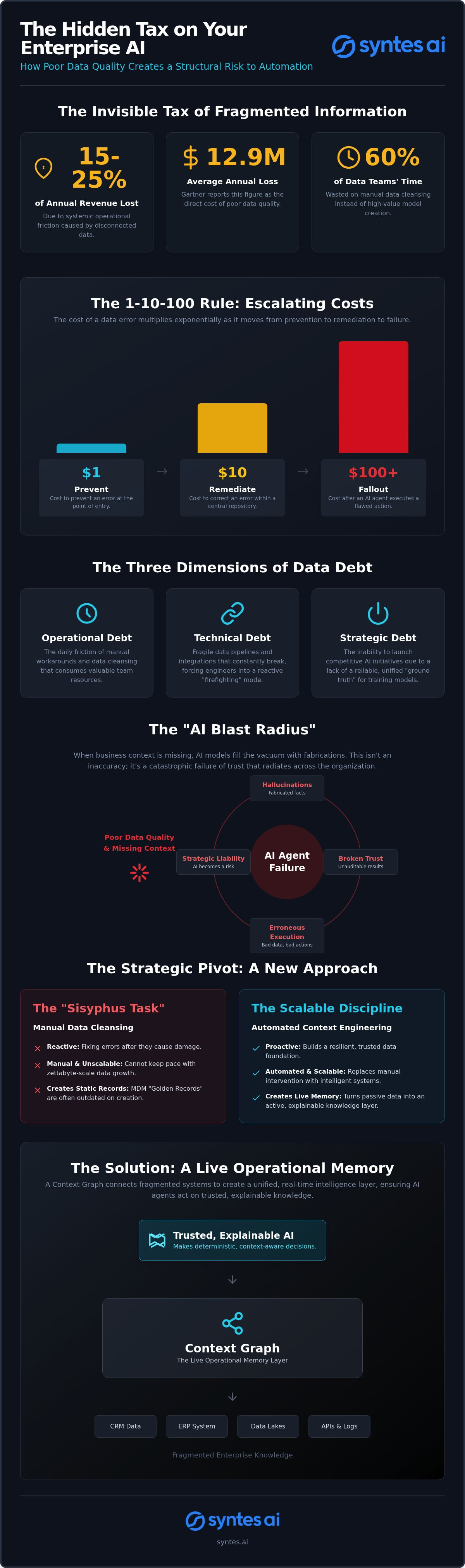
If your enterprise is losing 15% to 25% of its annual revenue to systemic operational friction, you aren’t facing a simple market downturn. You’re paying the invisible tax of fragmented information. In the era of Agentic AI, the cost of poor data quality is no longer a line item for the IT department to manage; it’s a structural risk that guarantees the failure of your most ambitious automation projects. Gartner research confirms that organizations lose an average of $12.9 million annually to these systemic inefficiencies. You likely recognize the symptoms. Your data teams spend 60% of their time on manual cleansing. Your AI models produce unreliable hallucinations. Your board questions the ROI of every governance initiative.
This cycle of manual remediation is unsustainable. We must move past the era of reactive patching. This article provides a clear framework for measuring your internal data debt and outlines the roadmap to transition from manual cleaning to automated context engineering. You’ll discover how a Context Graph creates the live operational memory required for trusted, explainable AI outcomes. It’s time to stop treating data quality as a chore and start treating it as the foundational architecture of enterprise intelligence.
Key Takeaways
- Redefine data quality as a challenge of semantic alignment rather than simple clerical accuracy. Fragmented knowledge is the primary obstacle to enterprise-scale intelligence.
- Analyze the “AI Blast Radius” to understand how missing context triggers hallucinations and high-risk autonomous errors. Trust requires more than just clean data; it requires deterministic business logic.
- Quantify the cost of poor data quality through a dual lens of operational waste and stalled strategic growth. Stop guessing and start measuring the invisible tax on your bottom line.
- Transition from the “Sisyphus task” of manual data cleansing to the scalable discipline of Context Engineering. Automation must replace manual intervention to keep pace with zettabyte-scale data growth.
- Establish a Live Operational Memory using a Context Graph to ensure your AI agents act on real-time, cross-system intelligence. Turn passive data repositories into active, explainable knowledge layers.
Defining the Cost of Poor Data Quality in the Modern Enterprise
In 2026, the definition of data quality has evolved from a clerical concern into a systemic mandate. We must stop calling it “dirty data.” That term implies a surface-level blemish that a quick scrubbing can fix. The reality is far more severe: knowledge fragmentation. The cost of poor data quality today is measured by the “Semantic Gap,” the disconnect between how disparate systems interpret the same business entity. When your CRM defines a “customer” differently than your ERP, your AI agents cannot reason effectively. They’re forced to operate in a vacuum of context.
The 1-10-100 Rule provides a stark visualization of this financial escalation. Preventing a data error at the point of entry costs approximately $1. Remediating that same error once it sits in a central repository costs $10. However, the cost of fixing the fallout after an autonomous AI agent executes a flawed transaction based on that data can exceed $100. This exponential increase reflects the transition from passive storage to active execution. Modern intelligence requires “Contextual Integrity,” a benchmark where data is not just accurate but correctly situated within the total web of enterprise logic.
The Three Dimensions of Data Debt
Organizations often ignore the compounding nature of their data liabilities. We categorize these as three distinct forms of debt:
- Operational Debt: This is the daily friction of manual workarounds. It manifests as data teams spending 60% of their time cleaning records instead of building high-value models.
- Technical Debt: These are the fragile pipelines that break the moment a schema drifts or a third-party API updates. It creates a state of constant “firefighting” for engineers.
- Strategic Debt: This is the most dangerous dimension. It’s the total inability to launch competitive AI initiatives because the organization lacks a reliable “ground truth” to train or prompt models.
Why Traditional MDM is Failing the AI Test
Master Data Management (MDM) was designed for a slower era of static reporting. It creates “Golden Records” that are often outdated the moment they’re finalized. Agentic AI doesn’t need a static record; it requires Live Operational Memory. Traditional MDM fails because it focuses on disconnected attributes rather than relationship-based intelligence. It cannot capture the fluid, real-time context that a governed AI agent needs to make deterministic decisions. Data debt is the accumulated interest on unaddressed knowledge fragmentation.
The AI Blast Radius: How Poor Data Quality Sabotages Agentic Intelligence
Hallucination is not a creative quirk of Large Language Models. It is a structural failure of context. When business context is missing, AI models fill the informational vacuum with plausible but entirely fabricated facts, leading to a breakdown in operational trust. For the modern enterprise, this isn’t just a minor inaccuracy. It is the primary mechanism through which the cost of poor data quality compounds at scale. While historical research indicated that Bad Data Costs the U.S. $3 Trillion Per Year, the stakes have escalated in the era of agentic intelligence. We’re no longer just looking at bad reports; we’re looking at bad actions.
Standard Retrieval-Augmented Generation (RAG) is proving insufficient for the rigors of complex enterprise reasoning. It retrieves isolated chunks of text based on vector similarity. It does not understand the underlying business logic or the relationships between entities. This creates a “Black Box” where AI reasoning becomes unexplainable and unauditable. If your AI cannot cite a deterministic source of truth for its decisions, it remains a strategic liability. To mitigate the hidden cost of poor data quality in your automation stack, you must move toward a more sophisticated context layer.
From Hallucinations to Erroneous Execution
The transition from passive chatbots to autonomous agents changes the risk profile from annoying to catastrophic. A chatbot giving a wrong answer is a customer service hurdle. An agent misallocating $2 million in resources because it accessed an outdated ERP record is a board-level crisis. Consider a logistics agent tasked with global resource allocation. If it cannot reconcile real-time CRM demand with fragmented inventory data, it will execute transactions that don’t exist in reality. Deterministic truth is the only safeguard against these autonomous failures. You can book a demo to see how we establish this truth in real-time.
The Breakdown of Cross-System Logic
Data silos break AI logic by forcing the model to guess the missing links. AI agents struggle to understand the nuanced relationships between customers, tiered product pricing, and regional compliance policies when those data points reside in separate, disconnected systems. The “Context Switching” required for an agent to bridge these disparate sources introduces significant latency and increases the probability of error. To scale safely, leaders must learn how to prevent AI hallucination by architecting a unified context layer that provides a single, live operational memory.
Quantifying the Damage: Direct vs. Strategic Costs
Measuring the cost of poor data quality requires looking beyond the immediate IT budget. It is a multi-dimensional drain on enterprise capital that manifests in both visible expenditures and invisible opportunity losses. Direct costs are the easiest to track but often represent only the tip of the iceberg. These include the thousands of labor hours redirected toward manual data cleansing, the wasted overhead of redundant cloud storage, and the escalating threat of regulatory fines. When 60% of a data team’s capacity is consumed by remediation, you aren’t just losing money. You’re losing the ability to innovate.
Indirect and strategic costs are far more insidious. Poor personalization leads to customer churn. “Data hunting” leads to employee burnout. Most critically, the “AI Gap” represents the widening distance between your current capabilities and the automated operations of your competitors. Every fragmented data point acts as a drag on new integrations and workflow automations. This hidden tax ensures that every dollar spent on technological advancement yields a diminishing return because the underlying knowledge layer remains fractured.
The CFO’s Perspective: Measuring the ROI of Quality
Precision in financial reporting demands a rigorous approach to data health. CFOs must begin calculating the “Mean Time to Resolution” (MTTR) for data-driven business errors, such as mispriced inventory or failed supply chain allocations. The financial impact of “Missed Decisions” is equally vital. This occurs when relevant data exists within the enterprise but remains inaccessible or uncontextualized at the moment of execution. To address this, leaders are adopting an “Enterprise Intelligence Readiness” scorecard. This framework moves the conversation from vague quality metrics to a concrete assessment of how prepared the organization is for autonomous execution.
The Compliance and Governance Penalty
The regulatory environment of 2026 has introduced severe penalties for AI governance failures. Under new frameworks, the inability to trace an AI-driven decision back to its source data is no longer just a technical oversight; it’s a legal liability. Auditability costs have skyrocketed as organizations struggle to manually reconstruct the logic behind autonomous errors. Explainable AI is a financial asset, not just a technical feature. By investing in a deterministic context layer, enterprises reduce their risk profile and eliminate the expensive manual oversight required to justify AI outcomes to regulators. The cost of poor data quality in this context is the difference between a scalable AI strategy and a series of legal entanglements.
The Strategic Pivot: From Data Cleaning to Context Engineering
Manual data cleaning is an exercise in futility. It’s a Sisyphus task that scales linearly while your data volumes grow exponentially. As enterprise environments reach zettabyte scales, human-led remediation cannot keep pace with the velocity of information. The cost of poor data quality is no longer just about the errors themselves; it’s the cost of the human capital trapped in a cycle of reactive patching. You need a strategic pivot. You must move from cleaning rows to engineering context. This shift requires a methodical architectural progression:
- Connect: Link structured and unstructured data sources via two-way connectors to eliminate the vacuum between your ERP and internal documentation.
- Discover: Map the relationships and hierarchies within your systems to build a robust semantic layer that reflects business reality.
- Transition: Move to a Context Graph that serves as a live operational model rather than a static database.
- Govern: Implement AI Governance that monitors context integrity in real-time, ensuring your agents act on deterministic truth.
By shifting your focus to the relationships between data points, you mitigate the compounding cost of poor data quality through structural integrity rather than manual intervention. You aren’t just fixing records; you’re architecting a foundation for autonomous reasoning.
The Five Pillars of Context Engineering
To achieve trusted AI execution, you must follow the roadmap of Connect, Understand, Contextualize, Govern, and Execute. These pillars transform fragmented records into a Live Operational Memory. By contextualizing data, you create a system that evolves with your business logic. It’s the only way to ensure your AI agents understand the “why” behind the “what” in real-time. This approach is the definitive answer to solving enterprise data silos and enabling agentic intelligence at scale.
Beyond RAG: Using GraphRAG for Deterministic Truth
Standard vector databases are insufficient for high-stakes enterprise operations. They retrieve isolated fragments based on probability, which leads to the hallucinations discussed in previous sections. GraphRAG provides a technical advantage by using graph structures to model complex, multi-hop relationships. This creates a Unified Context Layer that provides a clear, traversable map of your entire organization. It reduces the cost of grounding AI models by providing a verifiable path to the truth. Context Engineering is the next evolution. While prompt engineering tries to fix the output, context engineering fixes the input. It’s a more sophisticated, durable solution for the era of agentic AI.
Syntes AI: Eliminating Fragmented Knowledge for Trusted Intelligence
Syntes AI provides the definitive architecture to reclaim the 15% to 25% of annual revenue currently lost to information fragmentation. We don’t offer another tool for manual remediation. Instead, the Syntes AI Enterprise AI Platform establishes a Live Context Graph. This unified layer bridges the semantic gap that has historically paralyzed large-scale automation. By moving from passive data storage to Operational Relationship Intelligence, we enable systems to understand the complex dependencies between every entity in your organization. Intelligence becomes an asset rather than a liability.
The Syntes AI Agentic Platform leverages this foundation to execute governed actions over trusted context. Consider the impact of unifying product, supplier, and technical document data. For an enterprise, this unification directly addresses the cost of poor data quality by allowing organizations to reclaim the 60% of data team capacity currently lost to manual cleansing. When your AI agents operate within a deterministic framework, operational waste evaporates. You aren’t just managing data; you’re orchestrating business outcomes with precision and certainty.
Building Your Live Operational Memory
Our approach transforms fragmented information into trusted operational intelligence. The Context Graph acts as the enterprise’s central nervous system; it provides the cognitive map your AI agents need to reason accurately. This architecture ensures every decision is backed by Explainable Reasoning. By providing a clear, traversable path from an AI’s action back to the source data, we drastically reduce the cost of AI errors and hallucinations. It’s the difference between a model that guesses and a system that knows. We provide the deterministic truth required for high-stakes execution.
The Path to Agentic Excellence
A shared context layer is the only way to scale AI agents safely across the organization. Without it, you’re merely building isolated silos of automation that will eventually conflict and fail. Operational Relationship Intelligence allows your agents to understand that a delay in a supplier’s shipment isn’t just a logistics update; it’s a ripple effect that impacts specific customer contracts and production schedules. You can explore our architectural deep-dives in The 2026 Guide to Enterprise AI Infrastructure. The era of paying an invisible tax on your data must end. We provide the tools to stop the bleed and start the execution.
Ready to eliminate the hidden tax of poor data? Book a Demo with Syntes AI.
Reclaiming the Mandate for Enterprise Intelligence
The era of treating data as a passive asset is over. Enterprises that fail to resolve knowledge fragmentation will find their AI strategies paralyzed by the compounding cost of poor data quality. Hallucinations and autonomous errors aren’t just technical glitches. They are financial leaks in your operational architecture. To stop the bleed, you must move beyond the limitations of legacy MDM and static RAG.
Success in 2026 requires a definitive transition to Context Engineering. By establishing a Live Operational Memory, you provide your agents with the deterministic truth required for high-stakes execution. This isn’t about scrubbing rows. It’s about architecting a Governed Agentic AI framework that understands the nuances of your business logic. The invisible tax is optional. You possess the tools to transform fragmented information into a strategic engine of growth.
The path to total operational clarity starts with a single architectural pivot.
Frequently Asked Questions
What exactly is the ‘cost of poor data quality’ for AI projects?
The cost of poor data quality for AI projects is the total financial drain from failed initiatives, manual remediation, and erroneous execution. Gartner reports an average annual loss of $12.9 million per organization due to these systemic inefficiencies. For AI specifically, it manifests as the “invisible tax” of data teams spending 60% of their capacity on manual cleansing. This waste prevents the scaling of agentic workflows and creates a structural risk to the enterprise bottom line.
How does poor data quality lead to AI hallucinations?
Hallucinations occur when an AI model encounters an informational vacuum and attempts to fill it with plausible but fabricated data. Without a unified context layer, the model lacks the ground truth necessary for deterministic reasoning. It guesses the relationships between entities based on general training data rather than your specific business rules. This gap between general knowledge and proprietary reality is where hallucinations take root, making outcomes unexplainable and often dangerous for operational use.
Why is ‘Context Engineering’ better than traditional data cleaning?
Traditional cleaning focuses on clerical accuracy like removing duplicates or fixing typos. Context Engineering is a more sophisticated discipline that builds the semantic relationships between data points. It connects structured and unstructured information into a Context Graph. This approach ensures that AI understands not just the record, but the business logic and dependencies surrounding it. It moves beyond reactive patching to create a foundation for safer and more accurate autonomous execution across the enterprise.
Can a Knowledge Graph really reduce the cost of my data debt?
Yes, by eliminating the need for constant manual reconciliation across disparate systems. A Knowledge Graph serves as a centralized semantic layer that maps complex enterprise relationships in real-time. It reduces technical debt by providing a stable, traversable model of the business that does not break when individual schemas drift. This structural integrity allows your team to stop firefighting and start focusing on high-value AI automation, effectively lowering the interest paid on fragmented information.
What is the difference between a static database and ‘Live Operational Memory’?
A static database stores isolated records that are often outdated by the time they are queried. Live Operational Memory is a continuously evolving model of the business that integrates real-time operational events and cross-system data. It acts as a central nervous system for AI agents, providing them with a dynamic understanding of current inventory, policies, and customer relationships. It moves the enterprise from passive observation to active, real-time performance through a unified context layer.
How do AI agents fail when they lack business context?
They execute transactions that are logically sound but factually incorrect within the business environment. An agent might authorize a refund that violates a specific regional policy or trigger a supply chain order based on outdated ERP data. These failures occur because the agent cannot see the logic behind the data. Without a governed context layer, agentic intelligence becomes a source of high-risk operational error, leading to catastrophic mistakes that erode customer and board trust.
How can I calculate the ROI of investing in a Context Graph?
Focus on the reduction in Mean Time to Resolution for data-driven errors and the reallocation of data team capacity. Calculate the labor hours saved by automating the context layer and the revenue preserved by eliminating AI hallucinations. Additionally, measure the opportunity cost of delayed AI initiatives. Most organizations find that the ROI is realized through the safe, accelerated deployment of autonomous workflows that were previously impossible due to knowledge fragmentation.
Is poor data quality the main reason AI initiatives fail to scale?
It is the single most significant factor. Research indicates that over 80% of AI projects fail due to a lack of data accuracy or business context. Scalability requires more than just powerful models; it requires a reliable infrastructure for reasoning. When the underlying knowledge is fragmented, the system cannot maintain trust at higher volumes. The cost of poor data quality is ultimately the failure to scale your most critical technological investments.