
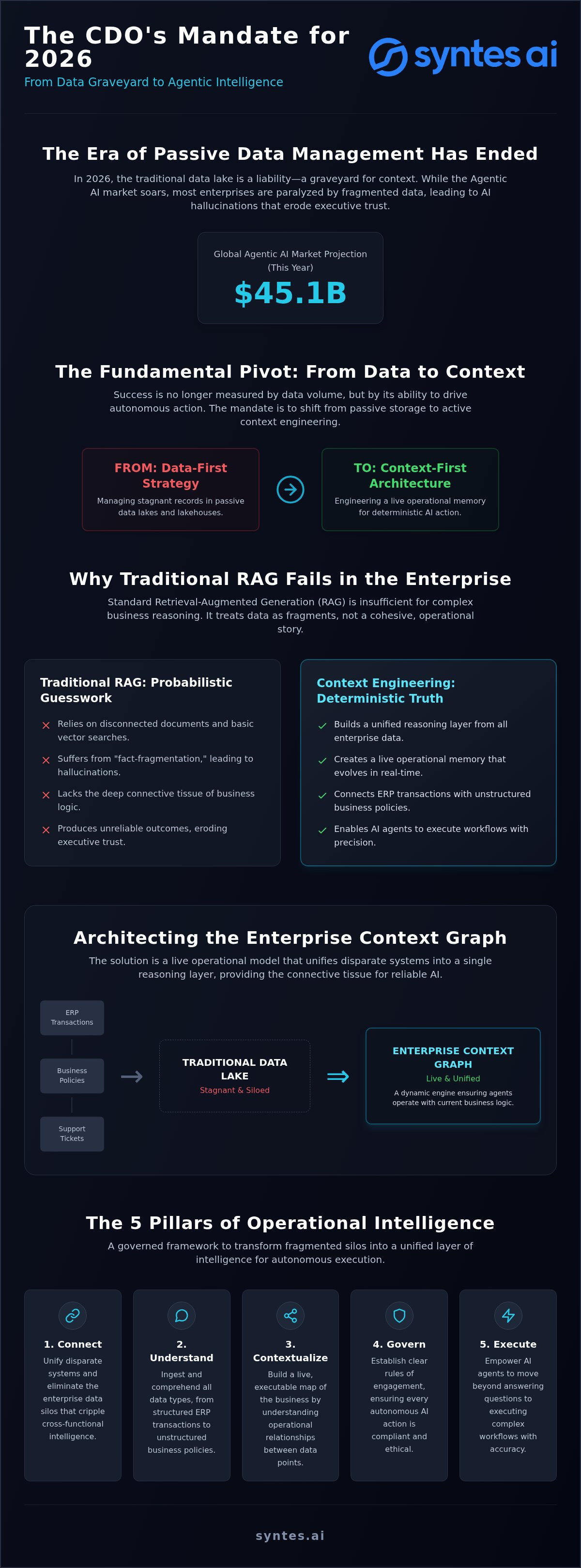
The era of passive data management has ended. In 2026, the traditional data lake is no longer a strategic asset. It is a graveyard for context. While the global Agentic AI market is projected to reach $45.1 billion this year, most enterprises remain paralyzed by fragmented silos and hallucinations that erode executive trust. This CDO guide to data architecture demands a fundamental pivot. You’ve likely realized that standard Retrieval-Augmented Generation (RAG) cannot provide the deep business reasoning your organization requires. It lacks the systemic integration needed for autonomous performance.
Stop managing records and start engineering context. You need a roadmap to transform stagnant records into live operational intelligence. This guide masters the shift from passive storage to active context engineering, enabling your AI agents to act with deterministic truth. We’ll examine the transition to the Enterprise Context Graph and a governed framework for autonomous execution. It’s time to replace theoretical experimentation with a high-tech resolution that ensures your data architecture is ready for the next generation of enterprise intelligence.
Key Takeaways
- Transition from passive data storage to active Context Engineering to eliminate the fact-fragmentation that causes AI hallucinations and erodes leadership trust.
- Utilize this CDO guide to data architecture to build a Syntes AI Context Graph, creating a live operational memory that bridges the gap between ERP transactions and business policy.
- Discover why traditional RAG is insufficient for complex enterprise reasoning and how to architect for deterministic AI accuracy through systemic integration.
- Implement a robust governance framework that establishes clear rules of engagement for autonomous agents, ensuring every AI action remains compliant with enterprise standards.
- Master the Five Pillars of Connect, Understand, Contextualize, Govern, and Execute to transform fragmented silos into a unified layer of operational intelligence.
The CDO’s Mandate in 2026: From Data Management to Context Engineering
Passive data storage has become an enterprise liability. In 2026, the Chief Data Officer’s success is no longer measured by the volume of data under management or the cost efficiency of a lakehouse. It’s measured by the ability of that data to drive autonomous action. This CDO guide to data architecture outlines a necessary evolution: the shift from managing records to engineering context. Traditional Data Architecture focused on the storage and retrieval of static records; however, the agentic era demands a system that captures business logic, relationships, and real-time operational state.
Context Engineering is the strategic discipline of building the reasoning layer required for AI agents to operate safely. It’s not enough to store data. You must contextualize it. This means moving from a “Data-First” strategy to a “Context-First” architectural model. Prompt engineering was a temporary patch for a systemic problem. Systemic enterprise context is the permanent solution. By 2026, the global enterprise AI market is projected to reach $42 billion, but this value is only accessible to those who can transform raw data into a live operational memory.
The Failure of First-Wave Enterprise AI
Hallucinations aren’t just an LLM quirk. They’re a data failure. First-wave AI initiatives relied on disconnected documents and basic vector searches that lacked the connective tissue of the business. This led to unreliable outcomes and a breakdown in executive trust. Standard Retrieval-Augmented Generation (RAG) fails in complex environments because it treats data as fragments rather than a cohesive story. It’s the “fact-fragmentation” problem. Enterprise AI is only as intelligent as the context it can reliably access, and without a unified layer, agents remain trapped in a cycle of probabilistic guesswork.
Architecting for the Agentic Era
The CDO must now bridge the gap between general LLM knowledge and proprietary enterprise logic. This requires a sophisticated enterprise AI infrastructure designed specifically for autonomous agents. We’re moving toward a state of total operational clarity where agents don’t just answer questions; they execute workflows based on deterministic truth. Your mandate is to build the framework that allows for automated performance. This involves integrating structured ERP transactions with unstructured business policies to create a single, governed source of truth. It’s a transition from passive observation to active, automated performance that defines the next generation of enterprise intelligence.
Architecting the Enterprise Context Graph: Beyond Silos and Lakehouses
Data lakehouses were built for historical analysis. They weren’t designed for the split-second reasoning required by autonomous agents. This CDO guide to data architecture asserts that the next stage of evolution is the Syntes AI Context Graph. It’s a live operational model that unifies disparate systems into a single reasoning layer. By integrating structured ERP transactions with unstructured business policies, you eliminate the enterprise data silos that historically crippled cross-functional intelligence.
Success in 2026 depends on Operational Relationship Intelligence. The connections between your data points matter more than the data itself. If an agent knows a customer’s name but doesn’t understand their contract history, current support tickets, and recent product interactions, it cannot act reliably. The context graph provides this connective tissue. It transforms isolated records into a coherent, executable map of the business.
Building a Live Operational Memory
Static snapshots are obsolete. Your enterprise needs a memory that evolves in real time. A live operational memory connects customers, products, and business rules with active operational events. It moves the organization from passive observation to active, automated performance. This isn’t a passive repository; it’s a dynamic engine that ensures AI agents always operate with the most current business logic. It’s the difference between a map and a GPS system.
Hybrid Graph Technology for Complex Relationships
How do you manage multi-dimensional business semantics? You use hybrid graph technology. The global graph database market is projected to reach $3.6 billion in 2026, driven by the need for advanced AI grounding. These systems excel at managing the complex hierarchies that relational databases struggle to represent. By utilizing two-way connectors, the Syntes AI Context Graph maintains a real-time layer that serves as the deterministic truth for agents. This architectural approach aligns with the NIST AI Risk Management Framework by ensuring transparency and auditability in how AI accesses information. To see how this architecture functions in a live environment, you can explore a technical walkthrough of the platform.
Context Engineering vs. Traditional RAG: Designing for Deterministic AI
Standard Retrieval-Augmented Generation (RAG) was a necessary first step. It allowed enterprises to ground large language models in private data, but it has reached its logical limit. In high-stakes environments, RAG suffers from “fact-fragmentation.” It retrieves relevant text chunks based on semantic similarity but lacks the structural awareness to understand how those chunks relate to specific business rules or operational hierarchies. This CDO guide to data architecture identifies Context Engineering as the vital successor to these probabilistic systems.
Context Engineering doesn’t just retrieve data; it governs it. By building a structured environment for AI reasoning, you move the organization from probabilistic guesses to audited reasoning. You can’t run a global supply chain or a financial clearinghouse on “likely” answers. You need deterministic truth. The only way to prevent ai hallucination is to architect that truth directly into the data layer, ensuring that every agentic action is grounded in a verified relationship graph rather than a floating vector space.
GraphRAG: Advanced Retrieval for Enterprise Logic
The technical shift from vector-only retrieval to GraphRAG is transformative. While vector search identifies similar words, GraphRAG identifies specific dependencies. It enables an AI agent to understand that a “product delay” in a logistics system isn’t just a keyword; it’s a trigger that impacts specific customer contracts, inventory levels, and revenue forecasts. In retail and financial services, this deep context allows agents to perform multi-hop reasoning. They can trace a problem across multiple systems to find a resolution that a standard RAG system would simply miss. It’s the difference between finding a document and understanding a business process.
Explainable AI and the End of the Black Box
Trust is the primary currency of the 2026 enterprise. Black-box AI models that can’t explain their work are a regulatory and operational risk. Context Engineering provides a clear, auditable reasoning path for every AI-generated action. If an agent executes a trade or modifies a customer’s credit limit, the system must show exactly which business rules and data points led to that decision. This transparency is essential for human-in-the-loop systems. It allows subject matter experts to verify AI logic in real time, building the stakeholder trust required to move from pilot programs to full-scale autonomous operations. To facilitate this shift, pronix.ai specializes in transitioning enterprises from AI pilots to secure, scalable production outcomes. Total operational clarity is no longer an aspiration; it’s an architectural requirement.
Governance in 2026 has transitioned from a passive compliance checkbox to an active operational guardrail. It’s no longer enough to manage who has access to a database; the CDO must now manage AI intent and execution. This CDO guide to data architecture emphasizes that as agents move from recommendation to action, the risks shift from simple data leaks to systemic operational failures. Governed Agentic AI ensures that every autonomous workflow aligns with enterprise policies, legal requirements, and ethical standards. You aren’t just protecting records; you’re protecting the integrity of your business logic.
The CDO’s role has evolved into the architect of engagement rules. You must establish the boundaries within which autonomous agents operate. This requires a transition from managing static data access to managing real-time AI intent. If an agent attempts to execute a transaction that violates a corporate policy, the architecture must recognize and block that intent before it manifests in your live systems. It’s a shift toward a state of total operational clarity, where every action is pre-validated against a deterministic truth layer.
The Security of Operational Memory
Protecting proprietary context is the new security frontier. In an agentic environment, permissions must be dynamic and context-aware. It’s not just about what data an agent can see, but what actions that data allows it to perform. You must maintain rigorous data lineage and auditability for every agentic decision. If an agent triggers a cross-system integration, the path from context retrieval to execution must be transparent and logged. Strict logical constraints prevent unauthorized agentic actions, ensuring that agents don’t exceed their mandate. This level of control is the only way to enable cross-system AI operations without compromising enterprise data integrity.
Ethics and Compliance in Autonomous Systems
Compliance is no longer a post-hoc audit. With the EU AI Act and the California AI Transparency Act (CATA) fully enforceable as of August 2, 2026, transparency is a legal mandate for any AI-generated content or decision. You must hard-code business rules directly into the Syntes AI Context Graph to ensure agents cannot “hallucinate” their way around corporate policy. Monitoring for drift, bias, and adherence to corporate values is a continuous process, not a quarterly review. A governed framework for enterprise-grade safety isn’t optional; it’s the foundation of trusted autonomy. By architecting logic into the data layer, you move from reactive monitoring to proactive enforcement.
Implementing the Syntes AI Framework: A Roadmap for Operational Intelligence
The transition from a data steward to a context curator is now a strategic imperative. This CDO guide to data architecture provides the definitive execution framework: the Five Pillars of Context Engineering. It’s a methodical roadmap designed to move the enterprise from fragmented silos to a state of total operational clarity. By following this phased approach, organizations can move beyond the limitations of first-wave AI and achieve deterministic, automated performance at scale. Success is no longer measured by the volume of data stored, but by the speed of context delivered to autonomous agents.
Phase 1: Connect and Understand. This phase focuses on unifying disparate data sources across the global enterprise. It isn’t just about ingestion; it’s about semantic discovery. Phase 2: Contextualize and Govern. Here, you build the live Syntes AI Context Graph. You apply the security logic and business rules that ensure every AI reasoning path is auditable and safe. Phase 3: Execute. This is the deployment of governed AI agents. These agents don’t just answer queries; they automate complex business processes across integrated systems with surgical precision.
From Passive Data to Live Memory
The technical journey begins by evolving your traditional data lake into a semantic data layer. This layer acts as the foundation for the entire agentic enterprise. By leveraging two-way connectors, you ensure that your operational memory remains relevant in real time. It’s a continuously evolving system that maintains accuracy by reflecting the current state of the business, not a historical snapshot. This transition turns stagnant records into a dynamic asset that powers autonomous intelligence and ensures that your AI agents never operate on stale or fragmented information.
Scaling Agentic AI Across the Organization
The Final Evolution: From Data Stewardship to Autonomous Performance
The mandate for the modern CDO has shifted. Managing records is no longer a sufficient strategy. You must now engineer the systemic context that drives autonomous action. This CDO guide to data architecture has outlined the necessary transition from fragmented silos to a unified, live operational memory. By moving beyond the limitations of standard RAG and adopting the Syntes AI Context Graph, you establish the deterministic truth required for agents to reason with absolute precision.
Trusted by leaders in Global Fortune 500 industries, Syntes AI stands as the pioneer of the Context Engineering Framework. We deliver the enterprise-grade security and explainable AI reasoning necessary to scale agentic workflows without compromising compliance or trust. The era of theoretical experimentation is over. The era of informed, automated performance has arrived.
Your organization is ready for the next generation of intelligence. Step into the future of total operational clarity today.
Frequently Asked Questions
What is the difference between a data architect and a context engineer?
Data architects focus on storage, structure, and accessibility. Context engineers focus on the logic and relationships required for AI reasoning. While the architect ensures data is stored efficiently, the engineer ensures it’s executable by autonomous agents. This distinction is critical in any modern CDO guide to data architecture. It represents a shift from passive data stewardship to active intelligence orchestration, where the goal is deterministic truth rather than mere accessibility.
How does an Enterprise Knowledge Graph solve the AI hallucination problem?
An Enterprise Knowledge Graph replaces probabilistic word association with deterministic semantic relationships. Hallucinations occur when LLMs lack grounding in specific business logic. By mapping data points as entities with verified connections, the graph provides a permanent truth layer. AI agents query this structured environment to retrieve facts instead of guessing based on statistical likelihood. This architectural approach ensures every generated response is anchored in the reality of your unique business operations.
Can Syntes AI integrate with our existing ERP and CRM systems?
Syntes AI provides robust cross-system integrations designed to unify structured ERP data with unstructured CRM records. Our platform utilizes two-way connectors that maintain real-time synchronization across your entire stack. This connectivity ensures that your AI agents operate with a complete view of the customer journey and supply chain. By bridging these disparate silos, we transform isolated software packages into a single, cohesive engine of operational intelligence that scales with your business.
Why is standard RAG insufficient for large-scale enterprise AI?
Standard RAG relies on vector similarity, which often retrieves fragmented data chunks without understanding their logical context. It fails at multi-hop reasoning where an agent must connect disparate facts across different systems. Large-scale enterprises require deeper structural awareness to handle complex hierarchies and business rules. Without the connective tissue provided by a context graph, RAG-based systems remain prone to inaccuracies and cannot support the sophisticated autonomous workflows required in 2026.
What are the first steps for a CDO to implement Context Engineering?
The first step is adopting the Five Pillars framework, starting with the Connect and Understand phase. You must audit your current data silos and identify the semantic relationships that define your business logic. Transitioning your strategy involves moving from a data-first to a context-first mindset. This CDO guide to data architecture recommends establishing a pilot program that focuses on a single, high-value operational workflow to demonstrate immediate ROI through automated execution.
How does a live operational memory differ from a traditional data warehouse?
Traditional data warehouses are static repositories built for historical reporting and BI. In contrast, a live operational memory is a dynamic, real-time model of the business designed for AI execution. It doesn’t just store data; it contextualizes it as events happen. While a warehouse tells you what happened last quarter, a live memory provides the immediate context an AI agent needs to make a decision and take action right now.
What industries benefit most from an Agentic AI platform?
Industries with high-complexity operations such as financial services, retail, and global logistics see the most immediate benefits. These sectors rely on intricate hierarchies and real-time data shifts where manual intervention creates significant friction. An Agentic AI platform automates these multi-step workflows, ensuring compliance and efficiency. Any enterprise managing vast amounts of interconnected data across multiple legacy systems will find the transition to autonomous intelligence to be a competitive necessity.
How does Syntes AI ensure the security of autonomous AI agents?
Syntes AI implements security at the context layer through strict logical constraints and governed access controls. We ensure that agents only operate within pre-defined boundaries by hard-coding business rules into the context graph. Every action is logged and auditable, maintaining a clear lineage of decision-making. This framework prevents unauthorized executions and ensures that autonomous workflows remain compliant with both internal corporate policies and global regulatory standards like the EU AI Act.