
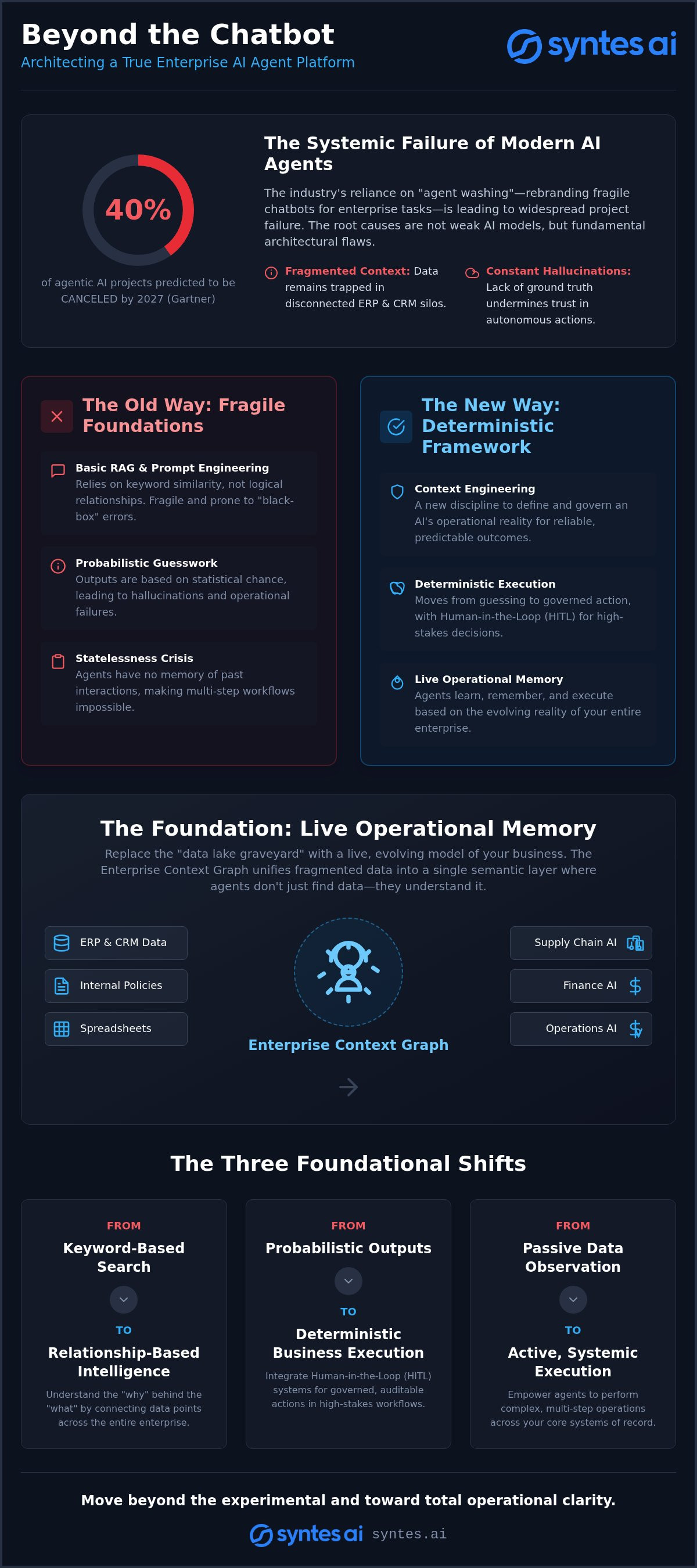
Gartner predicts that over 40% of agentic AI projects will be canceled by the end of 2027. This systemic failure isn’t a result of weak language models; it’s a direct consequence of fragmented context and the industry’s obsession with “agent washing” fragile chatbots into roles they weren’t built to handle. You’ve likely felt this friction already. Data remains trapped in ERP and CRM silos. Hallucinations undermine trust in autonomous actions. Building a truly functional enterprise ai agent platform requires a radical departure from the status quo. It demands a shift from passive observation to active, systemic execution.
We agree that the current reliance on basic RAG is insufficient for high-stakes operational environments. This guide promises a deterministic framework for AI reasoning by replacing static retrieval with Context Engineering and Knowledge Graphs. You’ll learn how to architect a platform that unifies your data into a Live Operational Memory. We will preview the specific technical steps to move from simple multi-agent orchestration to a scalable, governed ecosystem capable of seamless cross-system integration and autonomous operational excellence. It’s time to move beyond the experimental and toward total operational clarity.
Key Takeaways
- Understand why traditional RAG fails in complex environments and how a sophisticated enterprise ai agent platform must solve the “statelessness” problem to handle multi-step business logic.
- Discover the shift from vector-based search to relationship-based intelligence through the implementation of a live, evolving Context Graph.
- Transition from the fragility of prompt engineering to Context Engineering, the discipline of defining and governing an AI’s operational reality.
- Learn how to move from probabilistic outputs to deterministic business execution by integrating Human-in-the-Loop (HITL) systems into high-stakes workflows.
- Explore how the Syntes Agentic Platform unifies Knowledge Graphs with Live Operational Memory to bridge the gap between legacy ERP systems and autonomous automation.
Beyond the Chatbot: Why Traditional AI Agent Platforms Fail at Enterprise Scale
The current market suffers from a fatal misunderstanding of what an enterprise ai agent platform actually does. Most vendors offer glorified chatbots rebranded as “agents,” a practice known as agent washing. These systems lack the structural integrity to manage complex business logic. They fail because they are built on foundations of probabilistic guessing rather than deterministic reasoning. When a supply chain agent hallucinates a stock level or a finance agent misses a tax compliance rule, the cost isn’t just a bad answer; it’s a catastrophic operational failure.
While a foundational Intelligent agent is defined by its ability to perceive its environment and take actions, enterprise agents require a level of precision that standard Large Language Models (LLMs) cannot provide in isolation. We must move beyond single-player tools that only solve isolated tasks. True operational intelligence requires a framework that integrates deeply with your core systems of record. Data silos kill autonomy. It’s that simple. You cannot automate what you cannot see. When your intelligence is trapped in disconnected spreadsheets and legacy databases, your agents are flying blind. They make assumptions. They guess. They fail.
The Hallucination Trap: Why RAG is Not Enough for Agentic Reasoning
Retrieval-Augmented Generation (RAG) was a necessary first step, but it’s fundamentally limited. It retrieves snippets of text based on keyword similarity, not logical relationships. This lack of relational context is why agents struggle with reasoning. If your data is fragmented across documents and databases, the AI sees only pieces of a puzzle. It cannot see the whole picture. This leads to “black-box” reasoning errors where the agent makes a technically “correct” statement based on a document that is factually outdated or irrelevant to the specific business case. Moving toward a deterministic ground truth layer is the only way to eliminate these errors. An enterprise ai agent platform must provide more than just facts; it must provide the connections between them.
The Statelessness Crisis: Why Agents Need Long-Term Operational Memory
Most agents operate in a vacuum. They treat every new prompt as Day One. This statelessness is a crisis for businesses that require multi-step workflows spanning weeks or months. Without Live Operational Memory, an agent cannot understand the history of a vendor dispute or the current state of a transaction across your ERP and CRM. It loses the thread of the business logic. Defining Operational Memory is the prerequisite for autonomous workflow continuity. You don’t just need an agent that can talk; you need an agent that can remember, learn, and execute based on the evolving reality of your enterprise architecture. Anything less is just a toy.
Architecting the Foundation: The Role of the Enterprise Context Graph
The data lake is dead. It has become a graveyard of disconnected insights that stall even the most advanced models. To build a resilient enterprise ai agent platform, you must replace these static repositories with a Live Operational Memory. This is the role of the Enterprise Context Graph. It isn’t just a database; it is a live, evolving model of your entire business architecture. It unifies structured transactions from your ERP with the unstructured nuances of your internal policies and CRM notes. This creates a single semantic layer where agents don’t just find data. They understand it.
We must move beyond the limits of flat data structures. A Context Graph provides the connective tissue that allows an agent to see the “why” behind the “what.” It transforms your data from a collection of isolated files into a dynamic map of your business reality. This transition is essential for any organization looking to move from experimental AI to scalable, governed operations. Without this foundation, your agents remain tethered to the same hallucinations that plague consumer-grade tools.
Unifying Fragmented Data into a Live Operational Model
How do you move from fragmented silos to a unified intelligence? You connect them. By mapping customers, products, and corporate policies into a unified graph structure, we create an “Enterprise Brain.” This brain enables agents to collaborate across departments with a shared understanding of reality. This is where the semantic data layer for enterprise becomes the critical substrate for grounding agent actions. It ensures that every decision an agent makes is anchored in the current state of your operations, not a cached snapshot from last week. It’s about moving from passive records to active, real-time relevance.
Relationship-Based Intelligence: Moving Beyond Isolated Document Retrieval
The links between your data points are more valuable than the data points themselves. Traditional vector-based search is blind to these connections. It retrieves isolated snippets that lack the context of hierarchy and dependency. A robust Enterprise AI Agents Strategy recognizes that true reasoning requires GraphRAG. This approach provides the reasoning path that standard RAG lacks. It allows your agents to understand that a delay in a specific raw material shipment doesn’t just affect inventory; it triggers a cascade of business rules across production, sales, and customer service. Relationship-based intelligence turns information into actionable insight.
This shift from passive retrieval to active reasoning is what separates experimental projects from production-ready systems. If you’re ready to see how this architecture functions in a live environment, you can request a technical walkthrough of our framework.
Context Engineering: The Next Evolution of Enterprise AI Strategy
Prompt engineering is a distraction. It’s a superficial fix for a deep architectural flaw. If your enterprise ai agent platform relies on the “perfect” prompt to function, it is already broken. We must move toward Context Engineering. This is the systematic discipline of building and governing an AI’s operational reality. It ensures the agent operates within a defined, high-fidelity environment rather than a sea of noise. It’s not about the instructions you give the AI; it’s about the reality you build for it.
Context Engineering is the process of architecting a deterministic environment where hallucinations are structurally impossible. Most systems fail because they treat the LLM as the brain. In a mature framework, the LLM is merely the engine. The Context Graph is the brain. By engineering the context, you provide the agent with a verified “ground truth” that overrides the probabilistic nature of the base model. This is the only way to achieve how to prevent ai hallucination in mission-critical business processes.
From Prompt Engineering to Contextual Architectures
Better prompts can’t fix broken data. You can’t prompt your way out of a data silo or a fragmented ERP system. Context Engineering replaces these fragile strings of text with a governed architecture. In this environment, agents operate within pre-defined business logic and strict security boundaries. This is where the NIST AI Risk Management Framework becomes essential. It provides the standards for managing risk in autonomous systems. Context Engineering ensures AI safety by restricting agent actions to a verified subset of your enterprise reality. It builds a cage of truth around the model.
The Five Pillars of the Syntes Context Engineering Framework
Our approach to the enterprise ai agent platform rests on a rigorous five-pillar framework: Connect, Understand, Contextualize, Govern, and Execute. While all are necessary, three are critical for operational scale:
- Connect: We integrate disparate data sources into a unified, live stream. We stop treating your CRM and ERP as isolated islands and start treating them as a single nervous system.
- Govern: We apply security, permissions, and compliance at the data layer. Agents only see what they are authorized to see, ensuring that autonomous actions never breach corporate policy.
- Execute: We enable agents to perform actions based on trusted reasoning. This moves the AI from a passive research assistant to an active participant in your business workflows.
This shift from “asking” to “engineering” is what separates the innovators from the experimenters. It turns AI from a novelty into a reliable engine for growth.
Governance and Trust: Deploying Deterministic AI Agents in Regulated Environments
Trust is not a feeling. It’s a technical specification. In regulated sectors, the inherent “black box” nature of standard AI models represents a significant operational liability. You cannot afford to deploy an enterprise ai agent platform that operates on probabilistic guesswork. You demand deterministic execution. This requires a transition from “hopeful” automation to “governed” orchestration. Every action taken by an autonomous agent must align precisely with your internal business rules and external regulatory mandates. It’s about moving from “maybe” to “must.”
Human-in-the-Loop (HITL) systems serve as a critical bridge between autonomy and accountability. They aren’t a bottleneck. They’re a strategic safety valve. By embedding HITL into high-stakes agentic workflows, you ensure that human expertise remains the final arbiter of truth. This is especially vital when agents execute actions across disparate systems where a single error can ripple through the entire supply chain. You don’t just need an agent that acts; you need an agent that asks when the path forward is unclear.
Governed Execution: Safety Frameworks for Autonomous Action
Guardrails must be architectural, not just instructional. Relying on an agent to follow a prompt is a recipe for failure. The Context Graph enforces business rules at the data layer, ensuring that permissions and compliance standards are baked into every interaction. This governance should be integrated with your enterprise ai infrastructure to maintain long-term stability. It provides a persistent audit trail that proves compliance in real-time. It transforms your AI from a risky experiment into a trusted operational asset that respects the boundaries of your business logic.
Explainable AI: Auditing the Reasoning of Your Agentic Workforce
Scaling Operational Intelligence with the Syntes Agentic Platform
Scaling intelligence requires more than just adding more agents. It requires a unified substrate where reasoning and execution are indistinguishable. The Syntes AI approach rejects the fragmented model of bolt-on AI tools. Instead, we unify the Enterprise Knowledge Graph with a high-fidelity enterprise ai agent platform. This integration ensures that your agents aren’t just guessing based on a vector search; they’re navigating a precise map of your business reality. It’s the difference between a tourist with a map and a local who knows every shortcut. We provide the local expertise at machine scale.
The transition from experimental AI to operational excellence begins with solving enterprise data silos. You cannot achieve autonomy while your data is trapped in disconnected vaults. Our platform serves as the connective tissue, turning static information into a dynamic stream of actionable intelligence. We don’t just help you talk to your data. We enable your data to act on your behalf.
Cross-System Integration: Connecting ERP, CRM, and Operational Databases
How do you bridge the gap between AI reasoning and legacy execution? You build two-way connectors. Most platforms treat your ERP as a static database to be queried. Syntes treats it as a dynamic participant in the workflow. Our agents read and write across platforms simultaneously, maintaining strict data integrity through every transaction. When a real-time operational event occurs, such as a sudden shift in inventory or a high-priority CRM update, the agentic workforce responds instantly. There is no lag. There is no manual reconciliation. The system simply executes based on the most current truth available.
Live Operational Memory: Creating a Continuously Evolving Enterprise Brain
Static snapshots are the enemies of autonomy. Your business evolves every second, and your enterprise ai agent platform must do the same. Live Operational Memory is our solution to the “statelessness” problem that plagues traditional AI. By creating a data layer that learns from every interaction, we build an “Enterprise Brain” that matures over time. This memory allows agents to collaborate across departments, sharing context and history without human intervention. The long-term ROI of this unified intelligence layer is undeniable. It reduces the cost of errors, accelerates decision cycles, and provides a foundation for governed, autonomous growth that survives the next decade of technological shifts.
Mastering the Agentic Frontier
The era of experimental AI is over. To thrive in a regulated, high-stakes environment, you must move beyond the fragility of basic retrieval and embrace a deterministic architecture. We’ve established that a resilient enterprise ai agent platform is built on the foundation of a Live Operational Memory, not just better prompts. By pioneering the field of Context Engineering, we’ve created a pathway for autonomous agents to execute complex business logic with total precision. This isn’t a theoretical upgrade; it’s an operational mandate.
Our framework ensures enterprise-grade governance and explainable AI across every interaction. It bridges the gap between modern workflows and complex legacy data stacks, providing the connectivity required for true systemic integration. This is the necessary evolution for any organization that values clarity over chaos. The transition from passive observation to active, automated performance is no longer optional.
The future belongs to those who architect for autonomy. Take the first step toward a governed, intelligent enterprise today.
Frequently Asked Questions
What is the difference between an AI agent and a standard chatbot?
An AI agent is defined by its ability to execute autonomous actions, whereas a standard chatbot is limited to retrieval and summarization. While a chatbot answers questions, an agent performs work across disparate systems. It manages multi-step workflows without constant human intervention. This shift moves the technology from a passive interface to an active participant in your business logic. It’s the difference between a research assistant and an operational manager.
How does an enterprise AI agent platform handle data security?
Security in a sophisticated enterprise ai agent platform is managed through a governed context layer that enforces strict permissions at the data level. We apply enterprise-grade business rules to every interaction, ensuring agents only access authorized information. This architecture prevents data leakage and ensures that autonomous actions remain within corporate compliance boundaries. It transforms security from a perimeter defense into a core component of the AI’s reasoning process.
Why is a Knowledge Graph necessary for AI agents?
A Knowledge Graph provides the relational context and “ground truth” necessary to eliminate hallucinations. It maps the complex connections between products, customers, and corporate policies. This structured representation allows agents to understand not just the data, but the relationships that define your business reality. Without this semantic foundation, agents are prone to reasoning errors that undermine operational trust. It provides the logical map that guides autonomous reasoning.
Can AI agents integrate with legacy ERP systems?
Yes, enterprise-grade platforms utilize two-way connectors to bridge the gap between AI and legacy ERP systems. These integrations allow agents to read structured data and execute writes back into the system of record. By connecting modern AI workflows to stable legacy environments, organizations can automate complex transactions in ERP and CRM platforms. This connectivity ensures that your automation is grounded in your actual systems of record.
What is Context Engineering in the context of AI agents?
Context Engineering is the disciplined process of architecting and maintaining the semantic data layer that grounds an AI’s operational reality. It involves building a Context Graph that provides the business logic required for accurate reasoning. Unlike prompt engineering, which focuses on superficial instructions, Context Engineering focuses on the structural integrity of the information provided to the agent. It’s the prerequisite for deterministic AI performance and trusted execution.
How do you measure the ROI of an enterprise AI agent platform?
ROI is measured through tangible operational efficiency gains and the reduction of manual task latency. Organizations track the decrease in time spent on cross-system data entry and the improvement in data accuracy across the enterprise; using resources like savetrackai.com can help streamline this monitoring process. A robust enterprise ai agent platform allows companies to scale complex, high-volume workflows without a proportional increase in headcount. These metrics provide a clear view of the platform’s impact on bottom-line performance.
Is it better to build or buy an enterprise AI agent platform?
While building offers deep customization, buying a platform like Syntes AI provides the critical infrastructure that is prohibitively expensive to develop from scratch. We offer pre-built governance frameworks and the essential Context Graph architecture required for agentic reasoning. Buying allows your team to focus on deploying business value rather than solving foundational data engineering challenges. It accelerates your transition from experimental AI to total operational clarity and scale.