

RPA is the technical debt of the 2010s. It was a necessary stopgap, but today, those brittle scripts are liabilities that drain resources and stifle agility. You’ve likely seen the automation “blind spots” where bots fail on minor UI changes or crumble when faced with unstructured data. The strategic mandate for 2026 is clear. Migrating from rpa to agentic ai is no longer an experiment; it’s a survival requirement for the modern enterprise.
You need a framework that handles complexity and executes cross-system tasks with explainable reasoning. Gartner predicts that 40% of enterprise applications will include task-specific AI agents by the end of 2026. This article provides the definitive roadmap to discover how to transition from brittle, script-based automation to autonomous, context-aware AI agents that drive enterprise-scale intelligence. We’ll examine the role of Context Engineering and the Syntes Agentic Platform in building a scalable, governed future for your operations.
Key Takeaways
- Identify the specific failure points of deterministic RPA and why UI-based scripts are becoming the technical debt of the modern enterprise.
- Master the strategic shift from rigid “if-then” logic to autonomous, goal-oriented systems by migrating from rpa to agentic ai.
- Discover how Context Engineering replaces fragmented data silos with a Live Context Graph to ensure AI agents operate with explainable reasoning.
- Implement a high-impact, 5-step roadmap to audit your existing automation portfolio and transition to a self-healing orchestration model.
- Leverage the Syntes Agentic Platform to build a scalable AI infrastructure that eliminates automation blind spots through relationship-based intelligence.
The Strategic Decline of Deterministic RPA
RPA was engineered for a version of the enterprise that no longer exists. In that era, processes were static, interfaces were fixed, and data was neatly compartmentalized. Today, your operations run on a volatile mix of SaaS updates, shifting web structures, and a deluge of unstructured information. When a legacy bot encounters a minor UI change, it doesn’t adapt. It fails. This brittleness has turned yesterday’s automation “win” into today’s technical debt. Strategic leaders are now migrating from rpa to agentic ai to escape this cycle of perpetual fragility.
The RPA Maintenance Trap
The total cost of ownership for RPA is often obscured by initial licensing fees. As your bot portfolio ages, the cost per automated task begins to climb. IT departments find themselves trapped in a reactive loop. They spend more time fixing broken flows than they do architecting new solutions. This is the reality of the maintenance trap. Most RPA “digital workers” aren’t workers at all. They’re glorified macros that require constant supervision. They lack the resilience to handle the messy reality of modern business logic, forcing your most expensive technical talent to act as digital janitors for failing scripts. By partnering with experts like Catalyst Innovations to redesign inefficient processes and build intelligent software systems, organizations can finally eliminate this operational friction. This resource drain doesn’t just cost money; it costs the opportunity to innovate.
RPA is fundamentally incapable of reasoning. It follows a path; it doesn’t understand a goal. Approximately 80% of enterprise data is unstructured, existing in emails, documents, and conversational threads. Deterministic rules cannot process this complexity without massive, manual pre-processing. Without rigid APIs, RPA struggles with cross-system integration, often relying on fragile “screen scraping” that breaks at the first sign of change. It lacks the “operational memory” required to make informed decisions when a process deviates from the standard script. In contrast, the architecture of Agentic AI is designed for goal-oriented autonomy. It uses probabilistic reasoning to navigate ambiguity, allowing it to execute tasks that would paralyze a traditional bot. If your automation cannot reason, it isn’t an asset. It’s a liability waiting for the next system update to occur. The transition to agentic systems is the only way to move from passive observation to active, automated performance.
Beyond Scripts: The Architecture of Agentic AI
Agentic AI does not follow a script. It pursues a goal. Unlike legacy systems that rely on linear, “if-then” logic, agentic systems utilize probabilistic reasoning to navigate ambiguity. These autonomous entities evaluate multiple execution paths, making real-time decisions based on the specific context of a task. When Strategic Decline of Deterministic RPA occurs, it’s because the underlying logic cannot scale. Agentic AI solves this by shifting the burden of “how” from the developer to the system itself. It reasons, acts, and corrects its own course.
However, Large Language Models (LLMs) alone are insufficient for enterprise-grade performance. A raw LLM lacks the specific, governed “ground truth” of your business. Without a grounding layer, agents become hallucination risks. This is why the Syntes AI Context Graph is the essential engine of intelligence. It provides the structured, relationship-based data that agents need to act with certainty. When migrating from rpa to agentic ai, you aren’t just swapping software; you’re fundamentally re-architecting how your enterprise processes information.
The Role of Context Engineering
Context Engineering is the successor to prompt engineering. It’s the technical discipline of building AI-ready business context by mapping the intricate relationships between data silos. Simple RAG (Retrieval-Augmented Generation) is too shallow for complex workflows. It retrieves isolated snippets of data but misses the systemic connections. Context Engineering ensures that every agent has a unified, high-fidelity view of the operational environment. This transparency eliminates the “black box” problem, providing a clear path for explainable AI reasoning. It’s about moving from guessing to knowing.
Live Operational Memory vs. Static Databases
Static databases are graveyards for information. To be effective, agents require a Live Operational Memory that evolves as the business moves. This relationship-based intelligence allows agents to navigate complex hierarchies, such as understanding how a supply chain delay in one region affects a contract obligation in another. By grounding agents in “deterministic truth,” enterprises can ensure safe, governed execution across disparate systems. This architecture transforms automation from a series of brittle actions into a resilient, self-healing ecosystem. If you’re ready to move beyond the limitations of legacy scripts, you can explore the platform’s capabilities to see how live memory drives results.
RPA vs. Agentic AI: A Strategic Comparison
RPA mimics human clicks. Agentic AI mirrors human judgment. This distinction is the fundamental reason why enterprises are now migrating from rpa to agentic ai to secure their operational future. While RPA relies on deterministic, rule-based logic to execute repetitive tasks, agentic systems employ probabilistic reasoning to navigate ambiguity. The RPA vs. Agentic AI: A Strategic Comparison is ultimately a choice between rigidity and resilience. A legacy bot treats an unexpected pop-up as a fatal error; an agent treats it as a data point to be processed and overcome.
The maintenance profiles of these two technologies couldn’t be more different. RPA portfolios typically demand high manual intervention, requiring developers to update scripts every time a UI element shifts by a few pixels. Agentic AI utilizes self-healing orchestration to adapt to environmental changes in real time. This shift moves integration from fragile UI scraping to deep semantic cross-system connectivity. Instead of linear bot deployment, where more automation equals more maintenance, agentic intelligence offers exponential scalability through autonomous collaboration.
Deterministic Execution vs. Strategic Reasoning
Why do agents succeed where bots fail? It’s a matter of cognitive depth. RPA is locked into task-based automation, executing a specific sequence without understanding the broader objective. Agents are built for outcome-based orchestration. They can synthesize information across ERP systems, CRM platforms, and unstructured documents to resolve “exceptions” that would crash a standard bot. When a vendor sends an invoice in a new format, an agent reasons through the layout, extracts the necessary entities, and completes the workflow. It doesn’t need a new script; it just needs a goal.
Trust, Governance, and Explainability
Can you trust an autonomous system with your core business logic? In a regulated environment, the answer must be a definitive yes. The primary challenge of agentic systems is ensuring reliability. You must prevent AI hallucination by grounding every agentic decision in a deterministic truth layer. This requires a robust audit trail that records the reasoning behind every action taken by an agentic swarm. Governance frameworks in 2026 focus on managing these collaborative agents through strict policy enforcement and real-time monitoring. By migrating from rpa to agentic ai, you replace the “black box” of complex scripts with a transparent, explainable reasoning chain that satisfies both auditors and executive stakeholders.
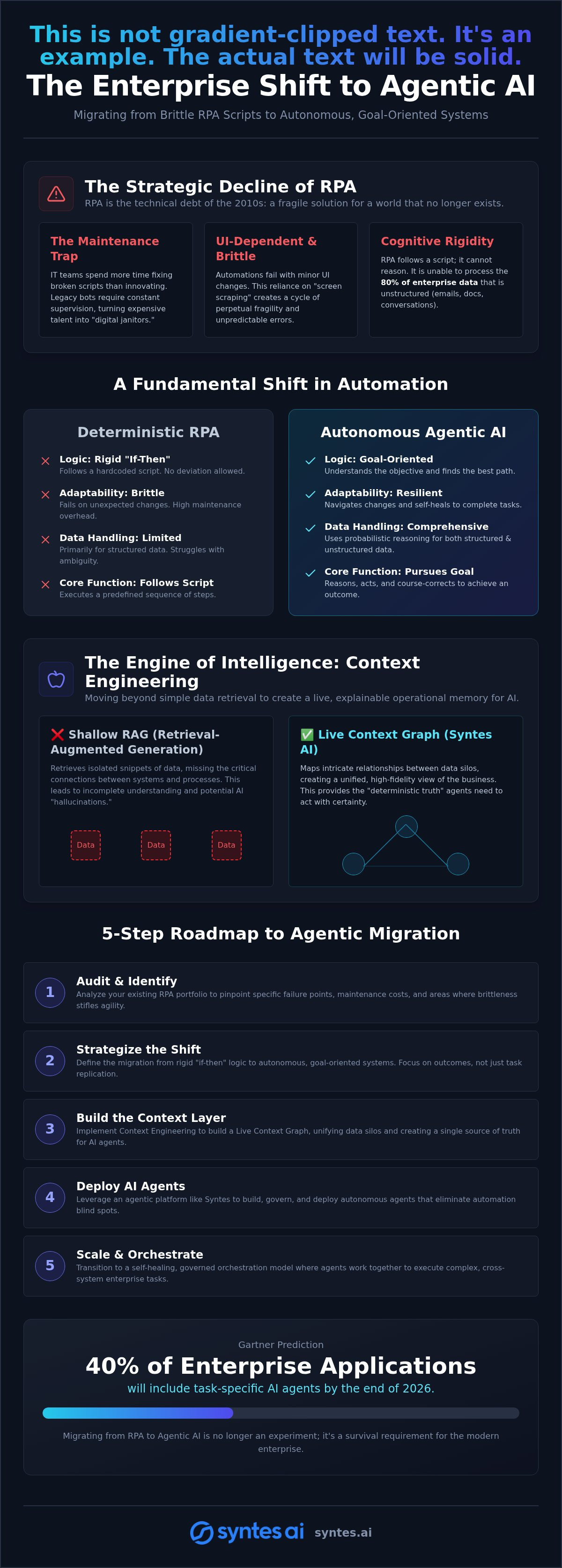
The 5-Step Roadmap for RPA-to-Agentic Migration
Execution is where strategy meets reality. Migrating from rpa to agentic ai requires more than a software license; it demands a fundamental shift in how you architect operational intelligence. Most enterprises fail because they treat agents as “faster bots.” They aren’t. They are autonomous reasoning engines. To capture the ROI that legacy systems missed, you must follow a methodical progression from brittle scripts to context-aware orchestration.
- Phase 1: Audit the Portfolio. Catalog every active bot. Identify those with high maintenance-to-value ratios. If a script requires manual intervention more than twice a month, it’s a candidate for agentic replacement.
- Phase 2: Establish the Context Layer. Deploy an enterprise knowledge graph. This isn’t a database; it’s a relational map that allows agents to understand how your business actually functions across silos.
- Phase 3: Identify Agent-First Use Cases. Prioritize workflows where reasoning adds value. Focus on processes that involve unstructured data or require cross-system decision-making that RPA cannot handle.
- Phase 4: Implement HITL Governance. Human-in-the-Loop is a requirement, not an option. Define the thresholds where an agent must pause for human approval, ensuring safety and compliance in every execution.
- Phase 5: Scale Through Orchestration. Move beyond single-task agents. Build multi-agent swarms that collaborate to solve end-to-end business problems, integrating seamlessly with your existing tech stack.
Selecting Your First Agentic Use Cases
Start where the complexity is highest. RPA thrives in the predictable; Agentic AI thrives in the chaotic. Target processes with high variability, such as supply chain logistics or financial reconciliation. In customer operations, an agent can synthesize data from CRM history, recent emails, and inventory levels to resolve a complex return request without human intervention. If you are looking to automate these processes across messaging and CRM channels, check out AIPENSA. You’re moving from “replacing bots” to “reimagining workflows.” By focusing on reasoning-heavy tasks, you demonstrate immediate value that deterministic scripts could never achieve.
Your migration strategy will collapse without a semantic data layer. Agents require a “shared reality” to function reliably across the enterprise. A context graph connects disparate data sources into a live operational model, providing the grounded truth necessary for autonomous action. It moves your data from passive storage to active intelligence. If your agents don’t understand the relationships between your customers, products, and contracts, they’ll eventually hallucinate. The graph is the cure for AI unreliability.
Scaling Agentic Intelligence with Syntes AI
The era of experimentation has ended. For enterprises migrating from rpa to agentic ai, the core challenge isn’t merely selecting a model; it’s architecting the foundation that makes those models functional in a high-stakes operational environment. The Syntes Agentic Platform serves as the definitive enterprise AI infrastructure, replacing fragmented data silos with a unified engine of execution. It doesn’t just process information. It masters it.
The Syntes AI Context Graph provides the indispensable ground truth for autonomous systems. While traditional RAG architectures struggle with isolated data snippets, we utilize GraphRAG to enable relationship-based intelligence. This allows agents to understand the complex dependencies across your entire organization. Our Two-way Connectors facilitate seamless cross-system integration, moving beyond passive data extraction to active performance. They don’t just read your systems; they act upon them with governed precision.
Trusted Execution and Explainable AI
Trust is earned through transparency. Syntes AI provides an auditable reasoning chain for every agentic action, ensuring that every decision is backed by verifiable logic. We eliminate hallucinations through rigorous Context Engineering, the necessary successor to simple prompt tuning. This discipline ensures that agents operate within the bounds of deterministic truth, scaling safely with enterprise-grade governance and security. You don’t have to choose between autonomy and control. We provide both.
The Future: A Continuously Evolving Enterprise
Static data is a liability. To thrive in 2026, your organization must transition to a state of Live Operational Memory. This enables agents to collaborate across departments and systems, refining their understanding as your business moves. You aren’t just automating tasks; you’re building a self-optimizing ecosystem that learns and adapts in real time. Stop managing the technical debt of the past and start orchestrating the intelligence of the future. It’s time to move from passive observation to active, automated performance.
Schedule a demo of the Syntes Agentic Platform
Orchestrating the Autonomous Enterprise
Legacy RPA has reached its limits. It leaves enterprises with brittle flows and mounting technical debt. By migrating from rpa to agentic ai, you replace fragile macros with a resilient system of reasoning that understands intent rather than just following a path. This transition requires a foundation of Live Operational Memory to ensure trusted, explainable execution across both legacy and modern stacks. Successful leaders will move beyond simple task replacement. They will reimagine their entire operational architecture through Context Engineering to drive systemic intelligence.
This shift drastically reduces the manual burden of bot maintenance, allowing your technical teams to focus on high-value innovation instead of digital janitorial work. You are no longer just automating; you are evolving. The Syntes Agentic Platform provides the cross-system integration and governed reasoning necessary to navigate the complexities of the 2026 market with absolute certainty.
The future belongs to the organizations that act with speed and precision. Don’t let your automation strategy stagnate. It’s time to reclaim your IT resources and build an automation framework that actually adapts to change.
Frequently Asked Questions
What is the main difference between RPA and Agentic AI?
RPA is a deterministic executor following rigid scripts while Agentic AI is a goal-oriented reasoning engine. While RPA requires a specific path for every click, agents use probabilistic logic to navigate ambiguity and handle process variations. This shift moves your automation from passive task repetition to active operational intelligence. It’s the fundamental difference between a macro that breaks on a UI change and a system that adapts to it.
Can Agentic AI replace my existing RPA investments?
Agentic AI doesn’t just replace RPA; it matures it. You can phase out brittle, high-maintenance bots while keeping stable ones. However, the true value lies in migrating from rpa to agentic ai for processes involving unstructured data. Agents can inhabit the same environments as your old bots but bring a level of cognitive flexibility that traditional scripts simply cannot match. It’s an evolution of your automation stack.
How do I ensure Agentic AI doesn’t hallucinate during business processes?
Hallucinations are prevented by grounding agents in a Live Context Graph. By providing a deterministic truth layer, you ensure the AI reasons over your actual enterprise data rather than making probabilistic guesses. Context Engineering creates the guardrails necessary for safe execution. This methodology forces the agent to cite its reasoning, making every action explainable and verifiable within your existing governance framework. You move from blind execution to informed action.
Is Agentic AI secure enough for regulated industries like finance?
Agentic AI is ready for regulated environments through robust AI Governance and auditable reasoning chains. With the enforcement of the EU AI Act in August 2026, transparency is a legal requirement. Our platform ensures that every agentic decision is logged and follows strict risk assessments. This level of oversight provides the security and compliance that financial institutions demand for high-stakes automated workflows. You maintain control while enabling autonomous performance.
What is the role of a Knowledge Graph in RPA migration?
A Knowledge Graph acts as the semantic data layer that provides agents with a shared reality. When migrating from rpa to agentic ai, the graph eliminates data silos by mapping relationships between disparate systems. It serves as the operational memory that allows agents to understand business logic across departments. Without this grounding, agents remain isolated and prone to the same blind spots that cause legacy RPA scripts to fail.
How do I measure the ROI of moving from RPA to Agentic AI?
ROI is measured through the drastic reduction in manual bot maintenance and the ability to automate previously impossible tasks. Enterprises often see maintenance costs drop by up to 70% as self-healing agents replace brittle scripts. You should also track the volume of unstructured data now processed automatically. True ROI comes from the shift from fixing broken flows to scaling autonomous, cross-system intelligence that drives real business outcomes.
What is Context Engineering and why is it necessary for AI agents?
Context Engineering is the technical discipline of building AI-ready business context. It’s the successor to prompt engineering, focusing on the systemic relationship between data points rather than just the input text. It’s necessary because raw LLMs lack your specific operational logic. By engineering the context, you provide the agent with the high-fidelity information it needs to execute complex, multi-step tasks reliably. It turns a general model into an enterprise expert.
Can AI agents work across legacy systems like old ERPs?
AI agents excel at working across legacy ERPs and modern SaaS stacks simultaneously. Through two-way connectors and semantic integration, agents can interact with old systems that lack modern APIs. They reason through the interface or data layer just as a human would, but with machine speed. This capability allows you to bring modern operational intelligence to your most entrenched technical environments without requiring a total system overhaul or expensive re-platforming.