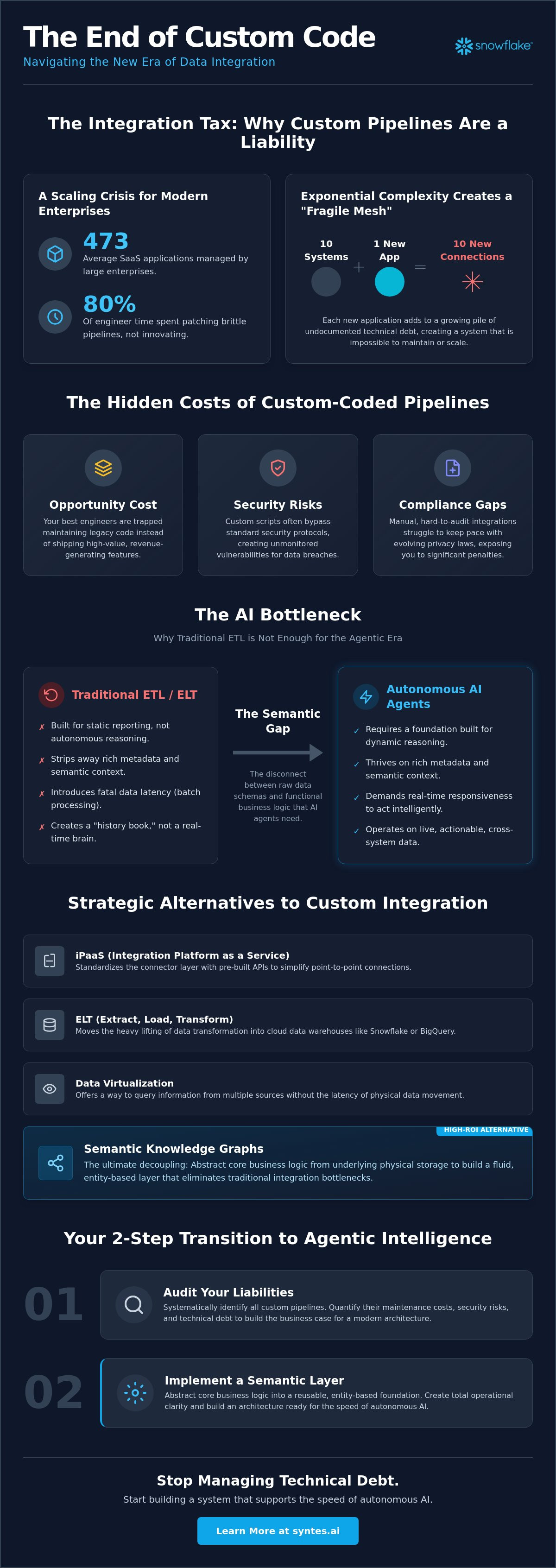
Your custom data pipelines are no longer strategic assets. They are liabilities. In a landscape where large enterprises now manage an average of 473 SaaS applications, the traditional approach of building and maintaining bespoke code has become a self-imposed tax on corporate intelligence. You’ve likely felt the weight of this integration tax already. It’s the reality where your best engineers spend 80% of their time patching brittle pipelines that break with every API update instead of shipping high-value features. When you evaluate alternatives to custom data integration, you aren’t just looking for a new tool. You’re looking to reclaim your operational velocity.
We agree that the status quo is unsustainable for the agentic era. This guide reveals why traditional integration is failing the modern enterprise and how transitioning to semantic architectures provides a scalable, future-proof foundation. You’ll discover five strategic alternatives, from Enterprise Knowledge Graphs to agentic platforms, that eliminate data silos and ensure real-time data availability. It’s time to stop managing technical debt and start building a system that finally supports the speed of autonomous AI.
Key Takeaways
- Identify why custom point-to-point connections result in undocumented technical debt that compromises your multi-cloud strategy.
- Evaluate modern alternatives to custom data integration like iPaaS and ELT to standardize your infrastructure and reduce maintenance overhead.
- Shift from rigid data structures to semantic knowledge graphs to build a fluid, entity-based layer that eliminates traditional integration bottlenecks.
- Prepare your architecture for the agentic era by moving beyond static data foundations toward dynamic, cross-system AI integration.
- Execute a two-step transition plan to audit your current liabilities and implement a semantic layer that abstracts core business logic for total operational clarity.
Why Custom Data Integration is Failing the Modern Enterprise
Custom data integration is a relic of the monolithic era. In 2026, the enterprise landscape is defined by hyper-fragmentation. Large organizations manage an average of 473 SaaS applications across diverse cloud providers. Building bespoke pipelines for each connection creates a fragile mesh that shatters under the weight of a single API update. This is the integration tax in its purest form. You pay it every time your engineering team prioritizes maintenance over innovation. While the original goal of Enterprise Information Integration (EII) was to provide a unified view of disparate sources, custom-coded solutions have achieved the opposite. They have created a patchwork of unmanaged, undocumented scripts that obscure the very data they were meant to expose.
The complexity isn’t linear; it’s exponential. Adding one new system to a ten-system environment doesn’t require one new connection. It often requires ten; each one adding to the growing pile of technical debt. This is why forward-thinking leaders are aggressively seeking alternatives to custom data integration that prioritize architectural agility over hard-coded logic. Custom pipelines create a “data lag” that is fatal to real-time operations. When your data is trapped in rigid, manual pipelines, your business remains reactive rather than proactive.
The Hidden Costs of Custom-Coded Pipelines
Custom pipelines are black boxes. They rely on tribal knowledge. They exist only in the minds of the developers who wrote them. If those authors leave, the logic leaves with them. This creates a massive operational risk that most enterprises fail to quantify until a system fails. Consider these primary drivers of the integration tax:
- Opportunity Cost: Engineering talent is diverted to pipeline maintenance instead of shipping high-value features.
- Security Risks: Custom scripts often bypass standardized security protocols, creating vulnerabilities in data movement.
- Compliance Gaps: Manual integrations struggle to keep pace with 2026 privacy regulations like the Indiana Consumer Data Protection Act (ICDPA) or Rhode Island’s RIDTPPA.
You are trading long-term security and scalability for short-term convenience. In the current regulatory environment, “good enough” custom code is a liability that can lead to significant penalties and reputational damage.
The AI Bottleneck: Why ETL is Not Enough for 2026
Traditional ETL processes were built for reporting, not for reasoning. They strip away the rich metadata and semantic context that modern AI agents need to function autonomously. Batch processing introduces a latency problem that kills agentic workflows. If your AI is making decisions based on data that is four hours old, it isn’t an agent. It is a history book. Real-time responsiveness requires a foundation that custom pipelines simply cannot provide.
The Semantic Gap is the structural disconnect between raw data schemas and the functional business logic required for autonomous AI agents to perform complex tasks.
Evaluating the Landscape of Integration Alternatives
The “Build vs. Buy” debate is obsolete. In its place, a more nuanced “Orchestrate vs. Automate” paradigm has emerged. Choosing alternatives to custom data integration requires a strategic assessment of your organization’s architectural maturity. You aren’t just swapping one tool for another. You are deciding where your business logic lives. If that logic is buried in thousands of lines of custom Python, it’s effectively dead to the rest of your enterprise. Modern alternatives seek to externalize this logic, making it visible, manageable, and, most importantly, reusable across your entire stack.
The landscape is currently dominated by four distinct approaches. iPaaS (Integration Platform as a Service) focuses on standardizing the connector layer. ELT (Extract, Load, Transform) moves the heavy lifting of data transformation into cloud warehouses like Snowflake or BigQuery. Data virtualization offers a way to query information without the latency of physical movement. Finally, the semantic layer provides the ultimate decoupling by abstracting business entities from their underlying physical storage. Each of these alternatives to custom data integration offers a path out of the technical debt cycle, provided they are implemented as part of a cohesive strategy rather than as isolated tactical fixes.
iPaaS vs. Custom Integration: Efficiency vs. Control
Stop writing bespoke scripts for standard SaaS connections. It’s a waste of elite engineering talent. Platforms like Workato or MuleSoft provide pre-built connectors that handle authentication, rate limiting, and error handling out of the box. Use them to standardize your API layer and reduce the burden on your core team. However, recognize their limits. iPaaS is excellent for linear workflows but often struggles in complex, cross-system AI environments where context is king. A simple connector doesn’t understand the nuance of your business logic; it merely moves data from point A to point B. For deeper intelligence, you need a more robust foundation.
Data Mesh and Data Fabric: Decentralized Alternatives
Centralized data teams are the bottlenecks of the past. Data Mesh advocates for domain-driven ownership, where the teams closest to the data are responsible for its lifecycle and delivery. Complementing this, a Data Fabric uses active metadata and AI to automate the discovery and connection of disparate datasets. This architectural shift is essential for solving enterprise data silos. By moving toward a decentralized model, you eliminate the rigid dependencies inherent in monolithic integration projects. If you’re ready to move beyond the limitations of legacy connectors, exploring a Syntes Agentic Platform can bridge the gap between static integration and active operational intelligence.
Semantic Knowledge Graphs: The High-ROI Alternative
Most alternatives to custom data integration focus on moving data faster or more reliably. They provide better shovels for the same hole. Semantic Knowledge Graphs represent a total departure from this tactical mindset. Instead of forcing data into rigid rows and columns, a knowledge graph maps the enterprise as a network of entities and relationships. You stop managing schemas and start managing meaning. This is the only “integration-less” data layer. It allows disparate systems to communicate through a shared vocabulary without the need for bespoke point-to-point code. By treating data as a living web of business concepts, you transform passive data lakes from information graveyards into active knowledge hubs.
Semantic grounding is the missing piece in the modern enterprise stack. It provides the “ground truth” that autonomous agents require to navigate complex corporate environments. Without this layer, AI is merely guessing based on proximity. With it, AI understands that a “Customer ID” in your CRM and a “Subscriber” in your billing system are the same entity. This structural clarity is why knowledge graphs are the most sophisticated alternatives to custom data integration available to the strategic leader today. They provide the context necessary for high-stakes decision-making and operational automation.
Custom Integration vs. Knowledge Graph Architecture
Traditional integration scales poorly because it suffers from an O(n^2) complexity problem. Every new system added to your stack requires a unique, custom-coded path to every other existing system. This creates a maintenance nightmare that eventually consumes your entire engineering budget. In contrast, a knowledge graph scales linearly. New systems simply attach to the central semantic model. Knowledge graphs remain resilient to change because adding a new source system merely requires mapping it to existing entity definitions rather than rebuilding every downstream connection. This flexible schema allows your architecture to evolve as fast as your business requirements.
The Semantic Layer as the Enterprise Brain
True intelligence requires the unification of structured ERP data with the vast oceans of unstructured documentation currently locked in PDFs and emails. A semantic layer acts as the enterprise brain, synthesizing these disparate formats into a single, queryable interface. It enables cross-system reasoning, allowing autonomous agents to pull financial data from SAP while simultaneously verifying contract terms from a legal repository. This is the foundation of The Semantic Data Layer. By architecting for meaning rather than just movement, you ensure your data foundation is ready for the demands of 2026 and beyond.
Architecting for Autonomy: Moving Beyond Point-to-Point
Autonomy is not a software feature; it is an architectural requirement. Traditional alternatives to custom data integration, such as standard ETL or basic iPaaS, often fail because they treat data as static cargo to be shipped from one warehouse to another. In the agentic era, this is insufficient. Agentic AI requires a dynamic foundation where data is orchestrated in real-time, allowing autonomous systems to navigate corporate environments without hard-coded paths. You must move from “data movement” to “data orchestration.” This shift ensures that information is not just available, but contextually relevant to the specific task an agent is performing at any given millisecond.
How do you build an agentic-ready infrastructure without a total “rip and replace” of your existing stack? You wrap your legacy systems in a layer of intelligence. By implementing cross-system AI integration, you allow your modern agents to interact with legacy ERP and CRM systems through a unified semantic interface. This approach preserves your historical investments while providing the connectivity required for sophisticated operational automation. It transforms your infrastructure from a collection of isolated silos into a cohesive, responsive organism capable of executing complex business logic across disparate platforms.
Grounding AI Agents in Deterministic Truth
Why do enterprise AI projects fail? Usually, it’s a lack of grounding. In high-stakes environments like global supply chain management or financial operations, a “likely” answer is a liability. You need certainty. Using knowledge graphs to prevent AI hallucination provides the deterministic truth these agents require. Real-time semantic grounding ensures that every action taken by an autonomous agent is based on verifiable facts rather than probabilistic guesses. Furthermore, this architecture ensures that agents respect enterprise-grade security and permissions, ensuring they only access and act upon data within their authorized scope.
The Shift to Agentic Platforms
The model is merely the engine. The platform is the vehicle. Success in 2026 is not determined by the specific LLM you choose, but by the platform that integrates that model into your operational core. We are moving beyond the era of chatbots toward a future of autonomous agents that execute, not just converse. These agents must be able to trigger workflows, update records, and resolve discrepancies across your entire enterprise stack. To achieve this level of operational clarity and performance, you must move toward a Syntes Agentic Platform that bridges the gap between raw data and automated execution. This is the ultimate goal of exploring alternatives to custom data integration: the transition from passive observation to active, automated performance.
Executing the Shift: From Integration to Agentic Intelligence
Strategy without execution is a hallucination. To move beyond the integration tax, you need a methodical roadmap that prioritizes systemic resilience over tactical convenience. This transition is not a simple software update. It is a fundamental re-alignment of your enterprise architecture. By adopting alternatives to custom data integration, you stop maintaining brittle pipes and start managing high-velocity intelligence. The goal is to reach a state where your data infrastructure is no longer a bottleneck but a competitive accelerator.
The path to operational clarity follows a precise four-step progression:
- Step 1: Audit your integration tax. Identify the custom scripts and point-to-point connections that break most frequently. Quantify the developer hours lost to these maintenance cycles.
- Step 2: Implement a semantic layer. Abstract your core business entities, such as customers, assets, and contracts, so they exist independently of any single application schema.
- Step 3: Deploy an Enterprise Knowledge Graph. Connect disparate data sources through a web of relationships. This allows for real-time discovery without the need for physical data movement.
- Step 4: Leverage an agentic platform. Deploy autonomous agents that use the knowledge graph to reason across systems and execute complex tasks without human intervention.
The Syntes AI Approach to Enterprise Intelligence
The Syntes Agentic Platform provides the necessary infrastructure for this evolution. We eliminate the need for custom-coded integration by providing a unified semantic environment where agents operate with perfect context. Our Enterprise Knowledge Graph unifies complex, multi-cloud data into a single, deterministic source of truth. This is how you move from fragmented data silos to a state of total operational clarity. We don’t just help you see your data. We enable your systems to act upon it. This shift from passive observation to active performance is the hallmark of a truly modern enterprise.
Conclusion: Choosing the Right Path for 2026
The decision is binary. You can continue paying the integration tax, or you can invest in a foundation that scales. The “buy and orchestrate” path is the only viable route for the enterprise that intends to lead in the agentic era. Custom builds are static and fragile. Agentic architectures are dynamic and resilient. They allow you to integrate new systems in days rather than months, ensuring your operational velocity matches the speed of the market.
It is time to stop patching the past and start architecting the future. Request a strategy session for your Agentic AI Infrastructure to begin your transition today. The enterprise that stops building pipelines starts building value. Every hour your team spends on custom code is an hour they aren’t spending on innovation. Reclaim that time. Reclaim your intelligence. Reclaim your competitive edge.
Reclaiming Operational Velocity in the Agentic Era
The integration tax is no longer a cost of doing business; it’s a barrier to survival. By moving beyond the fragility of point-to-point code, you unlock the ability to orchestrate intelligence at scale. You’ve seen how semantic knowledge graphs and decentralized fabrics serve as superior alternatives to custom data integration, providing the deterministic truth required for autonomous systems to function without constant manual intervention. This shift ensures your architecture remains resilient to the inevitable fragmentation of the 2026 SaaS landscape.
The path forward requires a partner that understands the gravity of enterprise-scale challenges. We provide the enterprise-grade knowledge graph infrastructure and proven cross-system integration for legacy stacks needed to bridge the gap between static data and active performance. Our agentic platform is specifically designed for operational intelligence, allowing your business to execute complex logic across disparate systems with total clarity. It’s time to stop managing technical debt and start leading with informed action.
Architect your Agentic Future with Syntes AI and stop building pipelines that lead to dead ends. Start building the value that defines your market leadership. Your evolution toward total operational clarity begins now.
Frequently Asked Questions
What is the most cost-effective alternative to custom data integration?
Standardized iPaaS or managed ELT platforms are the most cost-effective alternatives to custom data integration for linear SaaS-to-SaaS workflows. These tools eliminate the high labor costs of bespoke development and maintenance. For complex enterprise environments, the long-term ROI shifts toward semantic architectures that prevent the integration tax from compounding as you add more systems.
How does a knowledge graph differ from a traditional data warehouse?
Knowledge graphs prioritize relationships and entities while data warehouses organize information into rigid tables and columns. Warehouses excel at historical reporting and batch aggregation. Knowledge graphs are designed for discovery, cross-system reasoning, and real-time context. This makes them the definitive foundation for autonomous agents that require a dynamic understanding of your business logic.
Can I replace my existing ETL tools with an agentic AI platform?
You can replace the functional requirement for many traditional ETL pipelines with an agentic platform. The transition is typically additive. An agentic platform orchestrates data dynamically and uses semantic grounding to access information where it lives. This approach bypasses static batch processing and effectively renders many legacy, custom-coded ETL scripts obsolete.
What are the risks of continuing to rely on custom-coded integrations?
The primary risks include unmanaged technical debt, extreme fragility, and security vulnerabilities. Custom code creates tribal knowledge silos that become black boxes when the original developers depart. In 2026, these brittle connections also struggle to comply with evolving data privacy regulations, such as the Indiana Consumer Data Protection Act, which requires precise data control.
Is a semantic layer necessary for enterprise AI implementation?
A semantic layer is non-negotiable for deterministic AI performance. Without it, your AI agents lack the context to understand that disparate data points refer to the same business entity. This structural disconnect leads to hallucinations and operational errors. Grounding agents in a shared, high-register business vocabulary is the only way to ensure cross-system reliability.
How long does it take to transition from custom integrations to a knowledge graph?
Initial implementation of a core semantic layer typically requires between 8 and 12 weeks for a defined business domain. This is not a “big bang” migration. You start by mapping high-value entities and gradually ingest additional sources. The timeline depends on the complexity of your disparate systems and the current state of your metadata documentation.
Will an agentic platform work with my legacy on-premise systems?
Modern agentic platforms are engineered to bridge the gap between cloud-native AI and legacy on-premise systems. They use secure gateways to wrap old ERP or CRM databases in a modern semantic interface. This allows your latest AI models to interact with decades-old data without requiring a total, high-risk cloud migration of your core infrastructure.
How do I calculate the ROI of switching from custom integration to a semantic architecture?
Measure the reduction in engineering hours spent on pipeline maintenance versus new feature development. Quantify the “integration tax” by tracking the cost of system failures and the speed of onboarding new applications. Most enterprises realize ROI through lower infrastructure overhead, reduced data lag, and the successful deployment of autonomous agents that drive measurable operational efficiency.