
Your enterprise AI is a liability if it relies on the “nearest neighbor” logic of a standard vector database. You aren’t building intelligence; you are subsidizing a high-stakes guessing game. In April 2026, the legal world watched as a top-tier law firm issued a public apology for filing 28 erroneous citations in a bankruptcy case. This wasn’t a fluke. It is the predictable outcome of using probabilistic models for deterministic tasks. Learning how to prevent ai hallucination is no longer a technical curiosity. It’s a survival requirement for the modern C-suite.
You already know that “close enough” isn’t a viable strategy for regulated business logic or brand reputation. For organizations seeking to protect their digital standing through technical SEO, learn more about IT.com.sg. We’ll show you how to move beyond the limitations of stochastic parrots to architect a deterministic framework for truth. This article explores why standard RAG pipelines leave a gap in reliability and how to implement a Knowledge Graph for absolute grounding. We are moving from passive observation to active, automated performance that eliminates irrelevant noise and restores operational clarity across your entire data ecosystem.
Key Takeaways
- Identify the fundamental architectural flaws of probabilistic LLMs that lead to catastrophic failures in high-stakes enterprise workflows.
- Recognize why Retrieval-Augmented Generation (RAG) alone is insufficient to guarantee accuracy due to the inherent noise in vector similarity.
- Master the strategic implementation of an Enterprise Knowledge Graph to learn how to prevent ai hallucination through deterministic grounding.
- Establish a unified semantic layer that bridges siloed data sources and enforces strict business logic for every AI-generated output.
- Deploy agentic frameworks that integrate cross-system data to ensure every automated action is rooted in a single source of truth.
The Hallucination Crisis: Why Probabilistic AI Fails Enterprise Operations
Enterprise leaders are discovering that a creative AI is a dangerous AI. In a business environment, there is no room for “plausible” falsehoods. The fundamental crisis of modern Large Language Models (LLMs) lies in the gap between probabilistic prediction and deterministic truth. To understand what AI hallucinations are, we must acknowledge that these models are designed for fluency, not factual accuracy. They predict the next most likely token in a sequence based on statistical patterns. They do not consult a ledger of facts. This distinction is the difference between a tool that assists a hobbyist and a system that governs an enterprise.
The Mathematical Root of the Problem
Token prediction is a statistical exercise. It’s not reasoning. LLMs calculate the probability of word sequences based on their training data, which often results in “stochastic parroting.” Many teams attempt to solve this by lowering “temperature” settings to make outputs more predictable. This is a superficial fix. It limits the model’s range but doesn’t solve the structural absence of a ground truth. This creates a “Black Box” dilemma. Without a deterministic anchor, you cannot audit a probabilistic guess. You’re left with a system that is confidently wrong, making it impossible to trace the logic behind a failed decision.
Operational Consequences of Unreliable AI
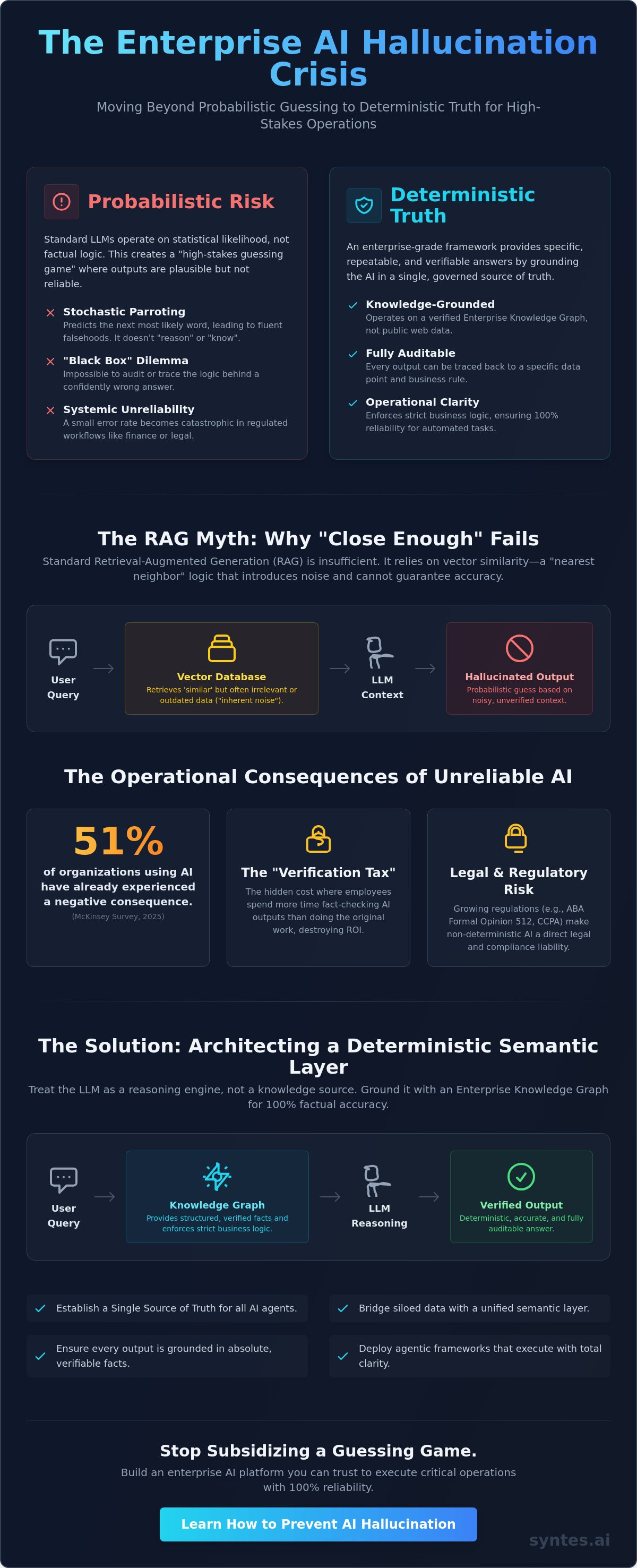
The regulatory landscape is also tightening. With the ABA Formal Opinion 512 requiring lawyers to verify all AI outputs and the CCPA introducing strict provisions for automated decision-making in 2026, the stakes have never been higher. According to a 2025 McKinsey survey, 51% of organizations using AI have already experienced at least one negative consequence. Relying on non-deterministic intelligence in a regulated environment is no longer just a technical risk; it’s a legal liability. Solving how to prevent ai hallucination is now a prerequisite for operational survival.
Probabilistic Risk vs. Deterministic Reality: The Mechanics of Truth
The enterprise runs on certainty. Your ERP, CRM, and financial ledgers are deterministic systems; they provide a specific, repeatable answer to a specific query. In contrast, Large Language Models are probabilistic. They operate on likelihood, not logic. When you ask an LLM for a quarterly revenue figure, it isn’t “calculating” the sum from your database. It’s predicting which tokens usually follow that question based on a massive, often outdated training set. This fundamental architectural clash is why simply adding more training data often backfires. More data introduces more noise, creating a “diluted truth” where the model struggles to distinguish between high-fidelity enterprise facts and low-fidelity web crawl garbage. Achieving ai model reliability requires moving away from model-centric thinking toward a data-centric architecture.
Bridging this gap requires a robust Semantic Layer. This layer acts as a translator between human intent and system execution, ensuring that the AI understands the specific business logic governing your data. Without this, the model is merely guessing. If you’re serious about how to prevent ai hallucination, you must stop treating the LLM as a source of knowledge and start treating it as a reasoning engine that operates on a separate, verified data layer. To see this in action, explore how an integrated knowledge architecture can transform your unstructured data into a reliable asset.
The Limits of Model Weights
Knowledge stored within a model’s weights is static. It begins to decay the moment training stops. This leads to the “Confabulation” effect, where the model fills gaps in its training with plausible-sounding lies to satisfy the user’s prompt. Confabulation is a statistical byproduct of low-density training data. Because the model is designed to be helpful, it prioritizes a complete answer over an accurate one. Relying on model weights for real-time business decisions is like navigating a modern city with a map from 1995; the landmarks have changed, but the model doesn’t know it’s lost.
Introduction to Grounding
Grounding is the architectural process of anchoring AI responses to external, verifiable data. It’s the mechanism that forces the model to “look it up” before speaking. Recent research on RAG effectiveness suggests that while retrieval is a powerful first step, it’s only as good as the data it retrieves. Moving from generative AI to truly agentic AI requires a “Ground Truth” that is both real-time and cross-system. How to prevent ai hallucination isn’t just about finding the right document; it’s about integrating disparate systems into a unified context graph that the AI can query with 100% precision. This ensures that when your AI agent makes a decision, it’s based on the reality of your current operations, not a statistical ghost in the machine.
Myth-Busting: Why RAG Alone Cannot Prevent AI Hallucinations
The enterprise market has reached a consensus on Retrieval-Augmented Generation (RAG). It is currently the dominant strategy for grounding LLMs in private data. By February 2026, analysis of over 800 production deployments showed that RAG pipelines reduce domain-specific hallucinations by a median of 71%. This is a significant improvement, but for an enterprise requiring 100% reliability, a 29% failure rate is catastrophic. RAG is a search tool. It is not a reasoning tool. While it effectively narrows the model’s focus, it inherits the fundamental flaws of the vector databases it relies upon.
The “Vector Noise” problem is the primary culprit. Vector search operates on semantic similarity, which is a mathematical calculation of how “close” words are in a high-dimensional space. Semantic similarity is not the same as factual accuracy. If you ask a RAG system for a specific contract clause, it might retrieve a similar-sounding clause from a different jurisdiction. The model, seeing “relevant” text in its context window, confidently synthesizes a response that is legally incorrect. Relying on RAG as your only method for how to prevent ai hallucination is like hiring a librarian who can find books but cannot read them.
Overloading the context window is another common trap. Simply stuffing more retrieved data into a prompt does not guarantee correct reasoning. Research indicates that models often suffer from “lost in the middle” syndrome, where they ignore critical facts buried in the center of long context blocks. Without a structured way to navigate these facts, the model reverts to probabilistic guessing.
Vector Databases vs. Knowledge Graphs
Vector databases utilize “Nearest Neighbor” retrieval. They find data points that look like the query. In contrast, an Enterprise Knowledge Graph uses “Triple-based” logic (subject-predicate-object) to establish absolute relationships. Vector systems fail at complex, multi-hop queries, such as identifying how a specific supply chain delay in Asia impacts a specific fulfillment center in Europe through three intermediate logistics partners. A Knowledge Graph maps these connections explicitly. Implementing a knowledge graph for llm grounding provides the deterministic structure that probabilistic models lack, ensuring the AI follows a logical path rather than a statistical one.
The Semantic Gap in Standard RAG
Standard RAG pipelines break documents into “chunks” to fit model limits. During this process, the critical relationships between data points are often severed. A chunk describing a “vendor” might lose the context that the vendor is currently blacklisted. RAG cannot naturally enforce business logic or constraints because it treats data as flat text. This makes rigorous ai data quality management essential before any retrieval occurs. If your data lacks structural integrity, your AI will lack operational truth. How to prevent ai hallucination effectively requires a system that understands not just the words, but the rules and relationships that define your business reality.
Architecting the Hallucination-Proof Semantic Layer
Generic data cleaning is a band-aid on a structural wound. If you want to solve how to prevent ai hallucination, you must build a deterministic semantic layer that exists independently of the model. This layer acts as the authoritative source of truth, forcing the LLM to operate within the strict boundaries of your business logic. While competitors suggest “better prompting” or “cleaner datasets,” these are passive measures. A true enterprise solution requires an active architecture that governs data relationships in real time. This methodology transitions your AI from a speculative generator to a precise execution engine.
To architect this framework, follow these four critical steps:
- Step 1: Unify disparate data sources into a structured Enterprise Knowledge Graph to create a single, machine-readable map of your entire organization.
- Step 2: Define the semantic relationships and business logic that govern the data, ensuring the system understands that “Vendor A” is linked to “Contract B” with “Terms C.”
- Step 3: Implement cross-system integrations to ensure real-time data freshness, preventing the AI from relying on stale or decayed information.
- Step 4: Use the Knowledge Graph as the deterministic anchor for your Agentic Platform, allowing the AI to reason over facts rather than probabilities.
Unifying Complex Enterprise Data
Most organizations are paralyzed by fragmentation. Your ERP doesn’t talk to your CRM, and your legacy databases remain isolated from modern workflows. This fragmentation is the primary fuel for AI error. By connecting these systems into a single semantic layer, you provide the AI with the necessary context to perform. This is the strategic shift from siloed data to a unified “Agentic Intelligence” framework. Solving enterprise data silos is the mandatory foundation for any hallucination-proof system. Without this unification, your AI is merely guessing across gaps in its own knowledge.
Implementing Deterministic Guardrails
The Knowledge Graph does more than provide context; it enforces reality. By using the graph to validate LLM outputs before they reach the user, you create a system of “Hard Constraints” that a probabilistic model cannot ignore. If the LLM proposes an action that contradicts the established business logic in the graph, the system rejects it. A Knowledge Graph acts as a logical filter that intercepts and validates every proposed action from an AI agent against a hard-coded map of business reality. This ensures that every output is grounded in fact, not statistical likelihood. To begin building this level of certainty, explore how the Syntes Agentic Platform can secure your enterprise operations.
Architecting this layer is the only way to achieve 100% reliability. It removes the burden of “truth” from the LLM and places it back where it belongs: in your controlled, integrated data environment. This is how to prevent ai hallucination at the architectural level, turning a liability into a competitive advantage.
The Syntes Agentic Platform: Executing with Total Operational Clarity
The enterprise market is saturated with experimental “chat” interfaces that lack the structural integrity required for global operations. True operational intelligence requires more than a conversational window; it demands an execution engine built on a deterministic foundation. The Syntes Agentic Platform represents this evolution. By fusing an Enterprise Knowledge Graph with a high-performance agentic framework, it transforms AI from a passive observer into an active, automated performer. This is the definitive strategy for how to prevent ai hallucination at the scale of a modern multinational corporation. We have moved the goalposts from generating text to executing logic.
Achieving secure enterprise ai is no longer about fine-tuning models or refining prompts. It’s about establishing a system where every automated decision is verified against a live context graph. Our Cross-System Integrations pull real-time data from your existing ERP, CRM, and legacy stacks, ensuring the platform operates with total situational awareness. There’s no guessing. There’s only execution based on verified, real-time facts. By decoupling the reasoning engine from the data layer, we ensure that the AI follows your rules, not its own statistical likelihoods.
From Observation to Performance
Syntes agents do not merely summarize documents or generate text. They navigate complex operational tasks by querying the Enterprise Knowledge Graph to understand deep relationships, hidden constraints, and proprietary business logic. Our platform orchestrates multi-system workflows, pulling data from disparate silos to execute actions that were previously manual. Whether managing a global procurement process or auditing real-time financial discrepancies, the Syntes Agentic Platform ensures every step is logically sound and mathematically verifiable. In 2026, this infrastructure is the mandatory prerequisite for scaling AI initiatives beyond the pilot phase. It provides the systemic reliability needed to replace expensive manual verification taxes with automated, deterministic certainty.
Building Your Deterministic Future
Transitioning from experimental AI to operational excellence is a strategic imperative. It requires a partner who understands the messy realities of legacy systems and the gravity of operational failures. Syntes AI acts as your expert guide, providing the technical mastery needed to bring order to fragmented data environments and architect a single source of truth. We lead your organization toward a state of total operational clarity where AI agents perform with the same precision as your most senior human experts. The era of probabilistic guesswork and “near enough” results is over. It’s time to deploy reliable AI agents with the Syntes Agentic Platform and secure your organization’s deterministic future.
Solving how to prevent ai hallucination is not a one-time fix; it’s an architectural commitment. By implementing a platform that values truth over fluency, you protect your brand, your data, and your bottom line. This focus on accuracy is equally crucial for external visibility, where Mustache AEO helps brands optimize their presence in AI-driven search engines. Move beyond the limitations of standard LLMs and embrace a future where AI works for you with absolute, unshakeable certainty.
Securing Operational Truth in the Agentic Era
Enterprise leadership demands execution. It demands certainty. We’ve exposed the “nearest neighbor” noise of vector databases and the context window traps that paralyze standard RAG. Transitioning to a high-performance, agentic future requires a shift from probabilistic guessing to deterministic truth. You now understand that how to prevent ai hallucination is not a matter of better prompting; it’s an architectural evolution. By anchoring your intelligence in a unified semantic layer, you eliminate the manual verification tax and restore stakeholder trust across the entire organization.
The Syntes Agentic Platform provides the necessary infrastructure to bridge the gap between human intent and automated performance. With our enterprise-grade Knowledge Graph and seamless cross-system integrations, we enable deterministic grounding for 100% reliable AI agents. Stop experimenting with stochastic parrots. Start building with a platform designed for the complex realities of global systems. Scale your AI initiatives with the Syntes Agentic Platform and lead your enterprise into a new era of operational clarity.
Frequently Asked Questions
What is the primary cause of AI hallucinations in enterprise LLMs?
The primary cause is the stochastic nature of token prediction. Large Language Models calculate the statistical likelihood of word sequences rather than retrieving facts from a structured ledger. This gap between probabilistic output and deterministic truth is where hallucinations originate. In an enterprise setting, this lack of a “ground truth” anchor means the model prioritizes fluency over accuracy, leading to confident but false assertions that compromise operational integrity.
Can prompt engineering completely prevent AI hallucinations?
Prompt engineering cannot eliminate hallucinations because it operates on the linguistic surface rather than the architectural core. While sophisticated prompts can guide a model toward specific formats or styles, they do not provide a verified data source. Relying on prompting is a passive strategy that fails to address the underlying statistical guesswork inherent in LLMs. True reliability requires structural grounding in a deterministic layer that overrides the model’s probabilistic tendencies.
How does a Knowledge Graph differ from a standard Vector Database in preventing hallucinations?
A Knowledge Graph provides a deterministic map of relationships, whereas a Vector Database relies on mathematical proximity. Vector search finds data that “looks like” the query, which often results in retrieving irrelevant or misleading information. A Knowledge Graph uses subject-predicate-object triples to enforce absolute logic. This structure is essential for how to prevent ai hallucination in complex environments where multi-hop reasoning and strict business rules are non-negotiable.
Is RAG (Retrieval-Augmented Generation) enough to ensure AI model reliability?
RAG is a search mechanism, not a total reliability solution. While it narrows the model’s focus to specific documents, the LLM still synthesizes those documents using probabilistic logic. This often leads to “citation hallucinations” or the merging of conflicting data points. Achieving 100% reliability requires moving beyond simple retrieval toward a semantic layer that validates every output against a machine-readable source of truth before the user sees it.
How can I audit my AI model to detect hallucinations before they affect operations?
Auditing for hallucinations requires an automated evaluation pipeline that benchmarks outputs against a deterministic Enterprise Knowledge Graph. You must implement observability tools that track “groundedness” scores and identify when a model’s response deviates from established business logic. This proactive approach moves your organization away from manual, post-hoc verification toward a real-time defensive architecture. It ensures that errors are intercepted at the system level before they damage brand trust or operational workflows.
What role does data governance play in preventing AI confabulation?
Data governance ensures that the “ground truth” used for AI grounding is accurate, authorized, and structured. Without rigorous governance, your AI will ground its responses in noise, silos, and conflicting data. Effective governance establishes the metadata and relationship rules that a Knowledge Graph needs to function as a deterministic anchor. It’s the process that turns raw enterprise data into the refined, high-fidelity fuel required for hallucination-proof intelligence.
Can AI agents be trusted to execute business transactions without manual oversight?
AI agents can only be trusted with autonomous execution if they are governed by a deterministic semantic layer. Standard LLMs lack the logical constraints to safely perform transactions like procurement or financial transfers. Trust is a byproduct of architecture, not model capability. By anchoring agents in a system that enforces hard business rules and cross-system validation, you remove the risk of creative error and enable the transition to truly autonomous, performance-oriented AI operations.
How do cross-system integrations improve the accuracy of AI grounding?
Cross-system integrations provide the real-time, unified context that prevents AI from relying on stale training data. When an AI agent can query live data from your ERP, CRM, and legacy systems simultaneously, it gains a holistic view of the organization’s current state. This connectivity is the primary technical lever for how to prevent ai hallucination. It ensures that every response is grounded in the reality of your current operations rather than a fragmented or outdated snapshot.