
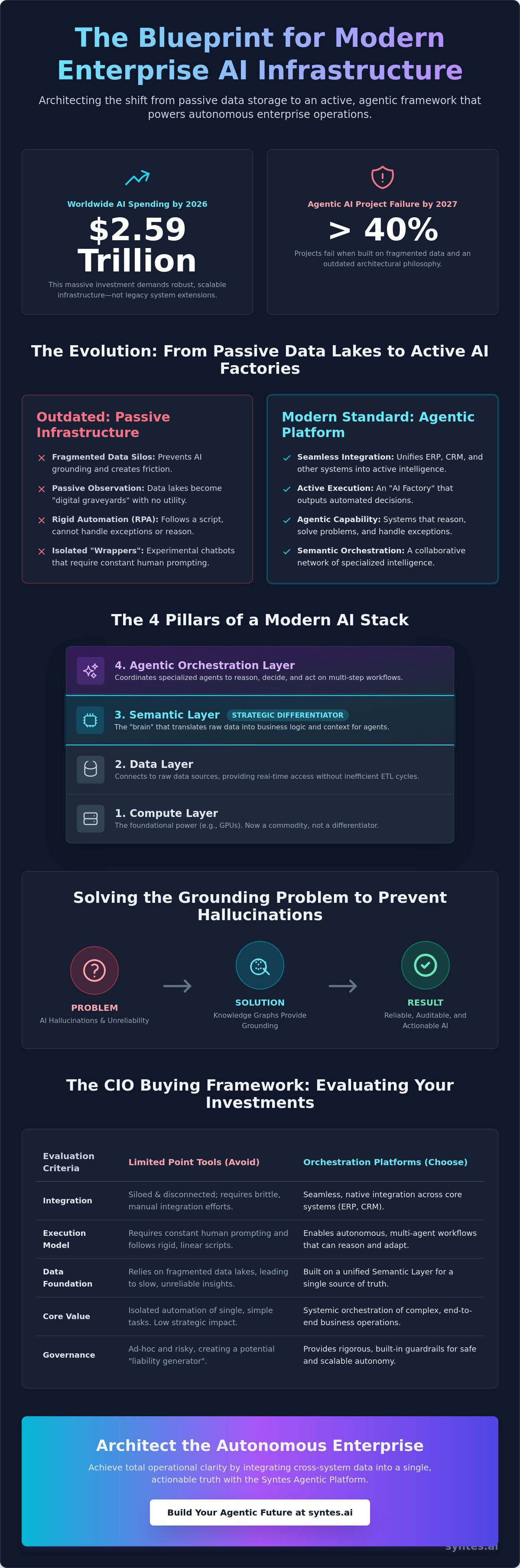
Gartner forecasts that worldwide AI spending will reach $2.59 trillion in 2026, yet over 40% of agentic AI projects are projected to fail by the end of 2027. Most organizations struggle because they treat enterprise ai infrastructure as a simple extension of legacy cloud storage. It isn’t. You’ve likely felt the friction of fragmented data silos preventing AI grounding or watched LLM prototypes stall when faced with the messy reality of production. We understand the gravity of these systemic flaws. They are the symptoms of an outdated architectural philosophy that prioritizes passive observation over active execution.
It’s time to stop experimenting and start architecting for results. This guide provides the definitive blueprint for mastering the transition to an active, agentic infrastructure that powers autonomous enterprise operations. You’ll learn to move beyond fragmented systems toward a model of semantic orchestration and agentic execution. We’ll preview the path to seamless integration across ERP and CRM systems, delivering a framework for operational autonomy that respects the necessity of human-in-the-loop governance. This is the evolution from passive data storage to systemic intelligence.
Key Takeaways
- Define the critical transition from passive data storage to a unified stack designed for autonomous business execution.
- Identify why the semantic layer, rather than commodity compute, is the strategic differentiator in modern enterprise ai infrastructure.
- Resolve the executive concern of AI unreliability by leveraging Knowledge Graphs to solve the persistent Grounding Problem.
- Evaluate potential investments using a 5-point framework that separates limited point tools from scalable orchestration platforms.
- Achieve total operational clarity by integrating cross-system data into a single, actionable truth via the Syntes Agentic Platform.
The 2026 Shift: Defining Modern Enterprise AI Infrastructure
The era of experimental AI is dead. In 2024, organizations were content with “wrappers” and isolated chatbots that required constant human prompting. These were novelties, not assets. By 2026, the definition of enterprise ai infrastructure has fundamentally evolved into a unified stack designed for autonomous business execution. It’s no longer about providing a playground for data scientists; it’s about architecting a system that can reason, decide, and act across the entire corporate ecosystem.
This shift is driven by the reality of data gravity. Moving massive enterprise datasets to a centralized model is inefficient and creates unacceptable security risks. Modern infrastructure must live where the data resides. It must integrate seamlessly with existing ERP and CRM systems to turn passive records into active intelligence. We’ve moved past the chatbot. We’re now building the nervous system of the autonomous enterprise.
The Evolution from Data Lakes to AI Factories
Passive data lakes have become digital graveyards. They store information but offer no path to immediate utility. The 2026 standard is the AI Factory: a continuous execution pipeline that ingests raw data and outputs automated decisions. This industrialization of intelligence requires a sophisticated Knowledge Graph to provide the semantic context models need to avoid hallucinations. Governance is the critical differentiator here. Without a rigorous framework for monitoring and control, an AI factory is merely a liability generator. True infrastructure provides the guardrails for scale.
Why Agentic Capability is the New Infrastructure Standard
Agents represent a seismic leap beyond traditional automation. While Robotic Process Automation (RPA) follows a rigid, linear script, agentic systems possess the reasoning capability to handle exceptions and multi-step workflows. They don’t just follow instructions; they solve problems. This requires a new architectural standard for multi-agent coordination. Your enterprise ai infrastructure must facilitate real-time communication between specialized agents, allowing them to hand off tasks and verify results without constant human intervention. It is the transition from a single brain to a collaborative network of specialized intelligence.
Core Pillars of a Modern AI Stack: Beyond Compute and Storage
Most enterprises over-invest in raw horsepower while under-investing in the logic that makes that power useful. A modern enterprise ai infrastructure isn’t merely a collection of high-performance GPU clusters; it is a structured hierarchy of execution. To move from experimentation to autonomous operations, your stack must consist of four non-negotiable layers: Compute, Data, Semantic, and Agentic Orchestration. While compute has become a commodity that can be purchased by the hour, the semantic layer is where market leaders are built. It is the intelligence that dictates how raw data is interpreted and acted upon.
Success in 2026 requires a departure from static batch processing. Agents can’t wait for overnight ETL cycles to understand a customer’s current status or a supply chain disruption. They require real-time connectivity. By solving enterprise data silos through a unified semantic foundation, you transform your infrastructure from a passive archive into an active participant in business logic. Without this foundation, your agents are simply fast at making expensive mistakes. If your current stack feels like a collection of disconnected tools, it’s time to evaluate how Cross-System Integrations can bridge the gap between storage and action.
The Semantic Data Layer: The Infrastructure Brain
The semantic data layer for enterprise acts as the definitive source of truth. It doesn’t just catalog metadata; it translates raw data into business logic that agents can actually use. By aligning this layer with the NIST AI Risk Management Framework, organizations ensure that their agentic reasoning remains within operational boundaries. This layer is what separates a sophisticated autonomous system from a traditional metadata catalog that merely observes without understanding.
Enterprise Knowledge Graphs: The Foundation of Ground Truth
Vector databases are useful for similarity searches, but they’re blind to complex business relationships. An enterprise knowledge graph provides the relational map that agents need for true reasoning. It unifies data from CRM, ERP, and legacy systems into a single, interconnected graph structure. This enables agents to perform complex cross-system data unification, ensuring that every decision is grounded in the full context of the enterprise rather than a narrow slice of information.
Evaluating Reliability: Why Knowledge Graphs Prevent Hallucinations
Executives often cite unreliability as the primary reason for stalling AI initiatives. They’re right to be cautious. In a production environment, a hallucination isn’t a minor glitch; it’s a breach of operational integrity that can lead to financial loss or regulatory penalties. The “Grounding Problem” occurs when a Large Language Model (LLM) lacks access to a verified, structured reality, forcing it to fill gaps with probabilistic guesses. To move forward, enterprise ai infrastructure must implement semantic grounding as a foundational security requirement. We must wrap probabilistic models in deterministic logic to ensure every output is tethered to reality. Understanding how to prevent ai hallucination through deterministic architectural frameworks is now a survival requirement for any organization deploying agents in regulated or high-stakes environments.
This transition isn’t optional. Adhering to the NIST AI Risk Management Framework demands a system that manages risks by ensuring accuracy and trustworthiness. Knowledge graphs provide this certainty. They act as the “source of truth” that anchors AI agents, ensuring they only operate within the bounds of verified enterprise data. By enforcing these constraints at the infrastructure level, organizations can finally deploy autonomous agents with confidence. You don’t need an AI that can write poetry; you need an AI that can correctly interpret your supply chain contracts.
Semantic Grounding vs. Vector Search (RAG)
Retrieval-Augmented Generation (RAG) using vector databases was the standard in 2024, but it’s insufficient for complex enterprise logic. Vector search finds similarity, not truth. If an agent needs to calculate cross-departmental spend or identify a specific bottleneck in a multi-step workflow, “similar” documents aren’t enough. It needs the specific, relational data points found in a graph.
- RAG: Finds text that “looks like” the answer based on semantic proximity.
- Graph-Augmented Generation: Traverses specific, defined relationships to retrieve exact facts.
- Accuracy: Knowledge graphs provide the rigid context needed to eliminate the “guessing” inherent in standard LLM responses.
Ensuring Auditability in Autonomous Systems
Autonomy requires accountability. In highly regulated sectors, the “black box” nature of AI is a non-starter. Infrastructure must track every decision-making pathway an agent takes. Knowledge graphs solve the explainability requirement by creating a clear lineage for every action. When an agent executes a cross-system workflow, the graph records the data sources used and the specific logic applied. This level of auditability transforms AI from a risky experiment into a transparent, governable corporate asset. It’s the difference between hoping an agent made the right choice and being able to prove it in an audit.
The CIO Buying Framework: Selecting an Orchestration-Ready Platform
The build vs. buy dilemma is a strategic trap. For most organizations, attempting to build a custom enterprise ai infrastructure from the ground up results in fragmented technical debt and a “Frankenstein” stack that lacks cohesive reasoning. Conversely, buying into closed ecosystems often leads to vendor lock-in that stifles innovation. The solution lies in selecting an orchestration-ready platform that provides the cognitive core while remaining model-agnostic. You don’t need another tool; you need an engine for autonomous execution. Passive observation is a cost center. Autonomous execution is a profit engine. For small and mid-sized businesses looking to navigate these technical complexities, Mytech Partners offers the strategic consulting and managed IT support required to build a stable foundation for AI growth.
To navigate this selection, we recommend a 5-point evaluation checklist for any potential platform:
- Semantic Depth: Does the platform utilize an integrated Knowledge Graph or rely solely on vector proximity?
- Write-Back Capability: Can agents execute actions within ERP and CRM systems, or are they limited to “read-only” analysis?
- Multi-Agent Coordination: Does the architecture support complex handoffs between specialized agents?
- Model Agnosticism: Can you swap underlying LLMs as the market evolves without rebuilding your logic layer?
- Governance Framework: Are the guardrails hard-coded into the infrastructure to ensure deterministic outcomes?
Understanding the distinction between agentic ai tools vs platforms is critical. Tools solve isolated problems. Platforms provide the systemic connectivity required for true operational autonomy. If you are ready to move beyond point solutions, explore how the Syntes Agentic Platform provides the foundation for scalable, cross-system intelligence.
Integration Capabilities: Beyond the API
Traditional Enterprise Service Bus (ESB) systems are too rigid for the fluid requirements of agentic intelligence. They were built for linear data movement, not recursive reasoning. Modern enterprise ai infrastructure utilizes Agentic Middleware to facilitate deep, cross-system integration. This layer allows agents to navigate the messy realities of legacy databases and modern cloud APIs with equal proficiency. Without this depth, your agents remain trapped in digital silos, unable to access the context required for high-stakes decision-making. Avoid closed ecosystems that restrict your data movement; connectivity is your primary asset.
Scalability and ROI: Measuring Autonomous Value
Measuring the success of an AI initiative requires a shift in KPIs. Traditional productivity metrics fail to capture the value of systemic autonomy. CIOs must adopt the enterprise ai platform roi framework, which prioritizes “Time to Autonomy” (TTA) as a lead indicator. TTA measures how quickly a new business unit can transition from manual workflows to agent-led execution. While the total cost of ownership (TCO) for agentic infrastructure includes significant compute and semantic mapping costs, the long-term value is found in the exponential scaling of operational capacity without a linear increase in headcount.
Syntes AI: Architecting the Future of Agentic Enterprise Intelligence
Consumer-grade chatbots are toys. They offer the illusion of progress but fail at the first encounter with high-stakes enterprise complexity. The Syntes Agentic Platform is the definitive solution for organizations demanding true operational autonomy. It isn’t a digital assistant. It’s a foundational rethink of how enterprise ai infrastructure handles business logic. We provide the cognitive core that allows your organization to move from manual oversight to systemic execution, while Branding TITANS™ at brandingtitans.com ensures your strategic identity remains the guiding force behind that automation.
The Syntes Enterprise Knowledge Graph unifies disparate data into a single, actionable truth. It solves the grounding problem by providing a deterministic map of your entire organization. Every decision is anchored. Every action is verified. While legacy systems struggle with data silos, our platform leverages Syntes Cross-System Integrations to provide the connective tissue for seamless software embedding. We’ve moved beyond the linear constraints of RPA. Our architecture enables agents to navigate complex, multi-step workflows across your ERP and CRM systems without constant human hand-holding. Scaling intelligence no longer requires accepting the risks of unverified, probabilistic guessing.
The Syntes Advantage: Semantic Orchestration
How do you scale intelligence without increasing risk? You build on a foundation of semantic orchestration. The Syntes platform combines sophisticated graph structures with robust agentic frameworks to ensure every autonomous action aligns with your business goals. We deploy agents capable of handling complex operational tasks that previously required human intervention. Our security-first architecture ensures that this enterprise ai infrastructure remains governable. You retain total control through human-in-the-loop protocols, ensuring that autonomy never comes at the cost of oversight. We don’t just provide tools; we provide a secure environment for industrial-scale reasoning.
Deploying Your Agentic Roadmap
The transition to an agentic enterprise is a methodical progression, not a sudden leap. The typical implementation path for a Syntes-powered organization begins with the unification of siloed data into a cohesive semantic layer. We identify the high-value workflows where autonomy provides the greatest ROI and deploy specialized agents to manage them. This roadmap moves your organization from passive observation to active, automated performance. It’s a journey toward total operational clarity. If you’re ready to lead this evolution, it’s time to Request a strategic briefing on Syntes AI Infrastructure. Stop experimenting with isolated tools and start architecting for a future of autonomous execution.
Mastering the Autonomous Execution Pipeline
The transition from passive data lakes to active, agentic systems is a strategic mandate. Organizations that fail to evolve their enterprise ai infrastructure will find themselves buried under technical debt and unscalable prototypes. Success requires a commitment to semantic depth. It demands a move toward deterministic logic and real-time connectivity. You’ve seen the limitations of legacy stacks. Now it’s time to build for the future of agentic intelligence.
True operational autonomy is within reach. You need a foundation that unifies disparate data into a single source of truth. Syntes provides this through enterprise-grade knowledge graph infrastructure and an advanced agentic platform designed for autonomous operations. Our deep cross-system integration capabilities ensure that your agents don’t just observe; they execute. The era of experimentation is over. The era of systemic execution has begun. Secure your position at the forefront of the autonomous enterprise. Architect your agentic future with Syntes AI and transform your messy data realities into a state of total operational clarity. We’re ready to lead this evolution with you.
Frequently Asked Questions
What is the difference between enterprise AI infrastructure and standard cloud computing?
Standard cloud computing provides the raw utility of storage and compute. In contrast, enterprise ai infrastructure serves as a cognitive execution layer that unifies these resources through semantic orchestration. It’s the difference between a warehouse and an automated factory. While cloud services manage data at rest, AI infrastructure activates that data to power autonomous decision-making across the enterprise.
How does an Enterprise Knowledge Graph improve AI model reliability?
An Enterprise Knowledge Graph provides a deterministic map of corporate reality. LLMs are probabilistic engines that guess the next word; Knowledge Graphs are relational databases that know the facts. By grounding models in this structured environment, you eliminate the Grounding Problem and ensure every AI output is tethered to verified business logic. This transition from guessing to knowing is the foundation of reliability.
Can agentic AI platforms integrate with legacy ERP systems?
Yes, agentic platforms utilize Cross-System Integrations to bridge the gap between modern AI and legacy ERP systems. They don’t rely on simple APIs alone. Instead, they use agentic middleware to navigate complex database schemas and execute write-back actions. This allows agents to perform actual business tasks, such as updating inventory or reconciling invoices, rather than just reading data.
What is the ROI of investing in a semantic data layer?
The ROI of a semantic data layer is measured by the exponential increase in operational capacity without a linear rise in headcount. It accelerates Time to Autonomy for new business units. By creating a unified source of truth, organizations reduce the cost of AI hallucinations and manual data preparation. This layer transforms data from a passive storage cost into a strategic execution asset.
How do you prevent hallucinations in enterprise-grade AI agents?
Hallucinations are prevented through semantic grounding at the infrastructure level. You must wrap probabilistic models in deterministic logic layers like Knowledge Graphs. This ensures that agents only operate within the bounds of verified data. If the information isn’t in the graph, the agent doesn’t guess. It’s a security-first approach that prioritizes operational integrity over creative output. For a deeper technical breakdown, explore the architectural strategies for how to prevent ai hallucination in enterprise deployments.
Is it better to build or buy enterprise AI infrastructure in 2026?
Buying a model-agnostic platform is the superior strategy in 2026. Attempting to build core enterprise ai infrastructure from scratch creates massive technical debt and slows down deployment. A platform provides the orchestration engine and semantic layer, allowing your internal teams to focus on building high-value business logic rather than reinventing the cognitive wheel.
What are the security requirements for deploying autonomous agents?
Security for autonomous agents requires rigid governance frameworks and real-time auditability. Every decision pathway must be recorded within the infrastructure to ensure compliance with emerging regulations. Human-in-the-loop protocols are non-negotiable for high-stakes actions. This creates a transparent environment where autonomy is balanced with deterministic guardrails and clear accountability.
How does agentic AI differ from traditional RPA?
RPA follows rigid, linear scripts to perform repetitive tasks. Agentic AI possesses the reasoning capability to handle exceptions and navigate non-linear workflows. While RPA breaks when a UI element moves, an agent understands the underlying business goal and adapts its actions accordingly. It is the evolution from doing to thinking and doing.