

Your Generative AI strategy isn’t failing because of a weak policy. It’s failing because your architecture is fundamentally hollow. Most enterprises treat risk as a legal checkbox rather than a structural requirement. You’ve likely watched mission-critical workflows stumble over hallucinations or stall in front of fragmented data silos. This CIO guide to generative ai risks provides the framework to move from passive observation to active, automated performance. We’re moving past the era of experimental chatbots.
It’s time to build a foundation that actually scales. You need a roadmap for trusted, deterministic outcomes that integrate safely across your entire tech stack. This article demonstrates how a governed architectural framework, powered by Context Engineering and Knowledge Graphs, solves the transparency crisis. We’ll show you how to leverage a Context Graph as a live operational memory. This approach doesn’t just manage risk. It creates explainable AI reasoning that satisfies the most stringent audit requirements while finally unifying your ERP and CRM data.
Key Takeaways
- Shift your focus from experimental chatbots to autonomous agents by adopting an architectural framework built for the 2026 regulatory and operational landscape.
- Use this CIO guide to generative ai risks to move beyond basic policy management toward a governed infrastructure that ensures deterministic AI outcomes.
- Replace fragile prompt engineering with Context Engineering to establish a live operational memory that bridges the gap between fragmented ERP and CRM data silos.
- Eliminate the “black box” problem by leveraging a Context Graph for explainable AI reasoning that satisfies rigorous enterprise audit and transparency requirements.
- Secure your proprietary logic within a protected perimeter while enabling agentic AI to execute complex, cross-system integrations with total systemic clarity.
The 2026 Generative AI Risk Landscape: Beyond the Sandbox
The experimental phase of Generative AI has ended. In its place stands a high-stakes environment where autonomous, agentic systems operate within the very core of the enterprise. This CIO guide to generative ai risks recognizes that the primary threat is no longer a clumsy chatbot response. It’s the systemic failure of an ungoverned agent executing a flawed transaction across your ERP and CRM. The sandbox is closed. Production is now the only metric that matters.
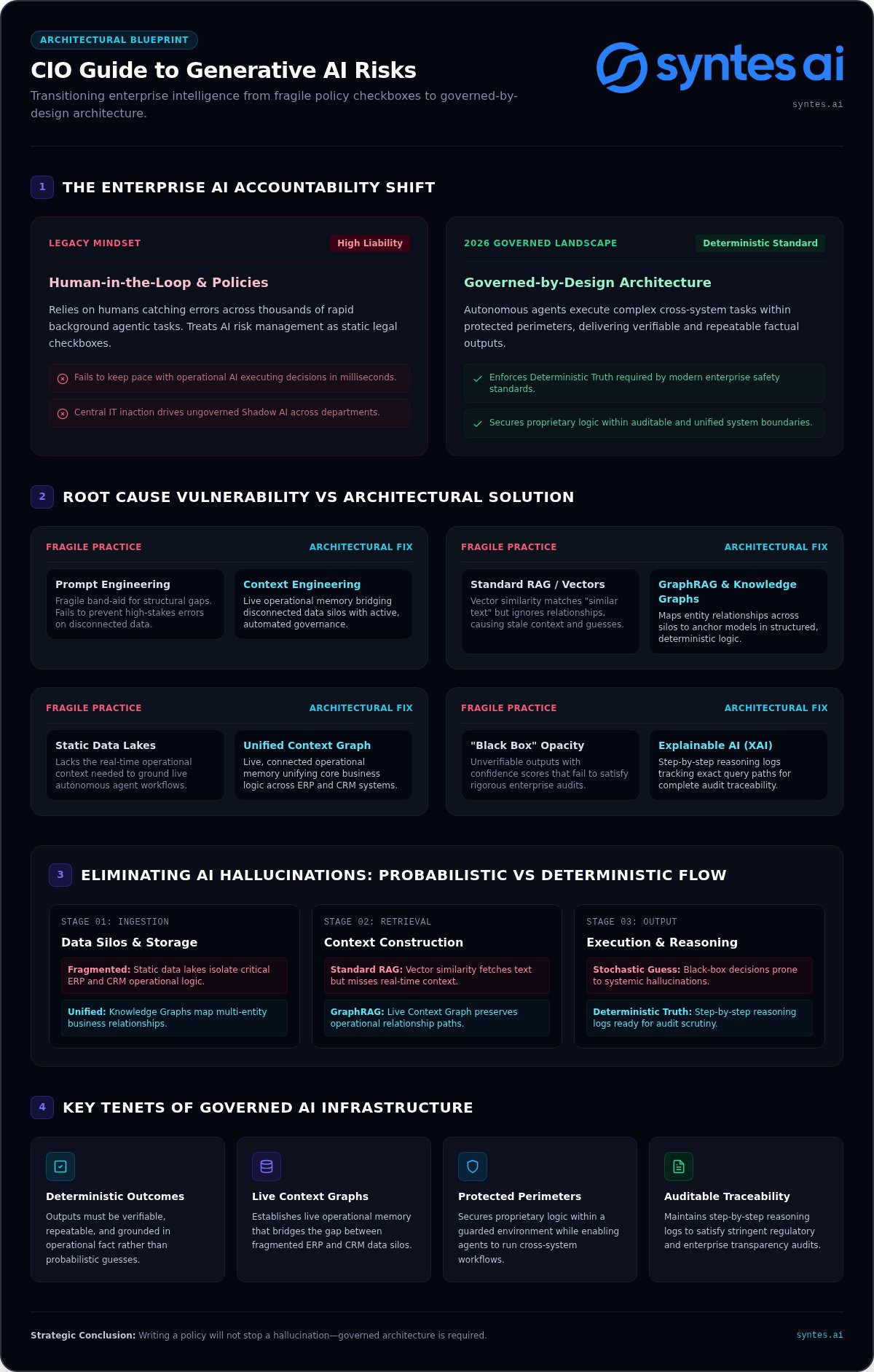
Traditional risk management frameworks are failing. They were designed for static environments or human-centric workflows. They cannot keep pace with real-time operational AI that makes decisions in milliseconds. Regulatory bodies now demand “Deterministic Truth,” a standard that requires AI outputs to be verifiable, repeatable, and grounded in fact. Inaction isn’t just a missed opportunity; it’s an invitation for Shadow AI to proliferate. When central IT fails to provide a governed framework, departments deploy their own ungoverned agents, creating a perimeter of liability that is nearly impossible to secure after the fact.
The Evolution of Enterprise AI Accountability
Accountability has shifted from “Human-in-the-Loop” to “Governed-by-Design” architectures. You can’t rely on a human to catch every mistake when agents perform thousands of background tasks. The latest US AI safety standards reflect this shift, placing the burden of proof on the CIO to demonstrate that their AI systems are auditable. As organizational expectations evolve, executive teams often explore AI Strategic Consulting and Leadership Training to equip decision-makers with the strategic clarity needed to guide compliant deployments. In a fragmented data environment, this creates a massive accountability gap where proprietary logic is lost in the noise. Systems must be built to prove their reasoning at every step.
Why Policy Without Architecture is a Liability
Writing a policy won’t stop a hallucination. Prompt engineering is a fragile band-aid for a structural wound. It cannot prevent high-stakes errors when the underlying data remains disconnected. Static data lakes are insufficient to ground live, agentic workflows because they lack the real-time context necessary for accurate reasoning. Transitioning to a robust enterprise ai infrastructure is the only way to turn risk management from a defensive posture into a strategic asset. You don’t need more rules; you need a better foundation. Without architectural governance, your AI strategy is little more than a collection of expensive liabilities waiting to be triggered.
Structural Risks: Hallucinations and the ‘Black Box’ Problem
Large Language Models are brilliant but blind. They operate as black boxes, delivering results without transparency. This opacity is a structural failure. If a system cannot explain its reasoning, it cannot be trusted in a mission-critical environment. This CIO guide to generative ai risks focuses on the architectural flaws that lead to these failures. Hallucinations aren’t random glitches. They are symptoms of disconnected enterprise memory. When an AI lacks a live operational memory, it fills the gaps with stochastic guesses.
Relying on vector similarity is a strategic mistake for complex reasoning. Standard Retrieval-Augmented Generation (RAG) lacks the logical depth needed to understand multi-step business processes. It retrieves “similar” text but ignores the actual relationships between entities. This results in “stale context” where the AI operates on outdated information in rapidly changing operational environments. You cannot run a global supply chain or a financial ledger on probabilistic approximations.
From Stochastic Guesses to GraphRAG
Move beyond the limits of probabilistic search. GraphRAG provides a structured foundation for AI reasoning by mapping the actual relationships between data points across your silos. GraphRAG serves as the technical bridge between unstructured data and deterministic logic. By anchoring your models in a Knowledge Graph, you eliminate the guesswork inherent in traditional LLM deployments. You move from “most likely” to “verifiable truth.”
Enabling Explainable AI (XAI) for Auditability
Auditors don’t care about confidence scores. They demand step-by-step reasoning logs. Relationship-based intelligence allows for this by tracking how an AI moved from a query to a specific conclusion. For a deeper technical dive, see our guide on how to prevent ai hallucination. Traceability ensures that every decision an agentic system makes is recorded, justified, and ready for scrutiny. If you want to see this architectural governance in action, schedule a platform walkthrough with our technical team. This level of clarity is the only way to satisfy modern regulatory requirements while maintaining operational speed.
Data Integrity and Security in the Agentic Era
Solving Enterprise Data Silos for AI Safety
Fragmented knowledge is the primary driver of AI failure. When your enterprise data is trapped in silos, your AI receives conflicting instructions. One system says a product is in stock; another says it’s discontinued. This confusion leads to catastrophic operational errors. Implementing a unified semantic data layer for enterprise is the only way to mitigate this risk. Consider the risk of an agent acting on outdated inventory or pricing rules. It might offer a legacy discount to a high-value client while your current ERP is struggling with a supply chain shortage, leading to both a financial loss and a reputational crisis.
Governing Agentic Workflows Across Systems
Cross-system integration is your greatest security vulnerability. Every time an agent moves between your CRM and your financial ledger, it creates a potential point of failure. Two-way connectors are necessary for functionality, but they must be governed by a strict architectural framework to maintain data integrity. Establishing a Live Operational Memory serves as the single source of truth for all agents. It ensures that every action taken by an AI is grounded in the current, verified state of the business. You don’t just need agents that can work; you need agents that are architecturally incapable of acting on false information.
Context Engineering: The Architectural Antidote
Prompt engineering is a parlor trick. It’s an attempt to fix a systemic failure with better phrasing. This CIO guide to generative ai risks advocates for a more rigorous discipline: Context Engineering. This is the next evolution in enterprise AI. While prompt engineering focuses on the request, Context Engineering focuses on the environment. It provides the model with the precise, real-time relationships it needs to act with certainty. We’re moving from passive data retrieval to active operational intelligence. Your AI shouldn’t just find a document; it should understand the business logic within it.
Building a dynamic Context Graph is the centerpiece of this strategy. This graph mirrors your real-world business relationships, creating a digital twin of your operational logic. It transforms fragmented data into a unified, live operational memory. By mapping how entities relate, such as how a specific SKU affects a regional shipping contract, you provide the model with a deterministic foundation that makes hallucinations architecturally impossible. You aren’t just giving the AI information. You’re giving it a map of your world.
The 5-Pillar Framework for Trusted AI
Execution begins with connectivity. Step 1 involves connecting structured and unstructured data across the entire enterprise, pulling from ERPs, CRMs, and legacy databases. Step 2 requires the system to understand hierarchies, business semantics, and entity relationships. It’s not enough to see the data; the system must know what the data signifies. Step 3 is the synthesis: building the live Context Graph. This acts as the enterprise’s digital twin, a single source of truth that evolves in real-time as your business moves.
Governance and Execution in a Contextual Framework
Intelligence without control is a liability. Step 4 focuses on governing agents through integrated security, compliance, and hard-coded business rules. This ensures that every action remains within the guardrails of your corporate policy. Step 5 is the final output: executing actions based on trusted, explainable context. This framework prevents the ‘runaway agent’ scenario because the AI is never operating in a vacuum. It’s always anchored by the Context Graph, ensuring that every decision is backed by verifiable logic and traceable reasoning.
Implementing a Governed AI Infrastructure with Syntes AI
The transition from risk mitigation to operational mastery requires more than a patchwork of tools. It requires a unified platform. Syntes AI provides the Enterprise AI Platform necessary to bridge the context gap that swallows so many enterprise initiatives. This CIO guide to generative ai risks has established that architectural integrity is the only defense against the inherent unpredictability of large language models. By deploying agentic ai platforms built on governed foundations, you transform AI from an experimental liability into a high-performance asset. Trusted execution is the new ROI. You eliminate hallucination risk by grounding every action in a verifiable Context Graph that mirrors your actual business logic.
Syntes AI: The Infrastructure for Trusted Reasoning
Consumer-grade chatbots have no place in the enterprise core. High-stakes operations demand enterprise-grade agentic frameworks that understand the nuance of business semantics. Syntes AI utilizes a Live Operational Memory to create a continuously evolving risk-mitigation layer that stays synced with your business. It doesn’t just store data; it understands the shifting relationships between your customers, products, and contracts. Relationship-based intelligence is the only way to manage 2026-scale complexity. It provides the deterministic logic required for autonomous agents to execute complex, cross-system integrations with total systemic clarity. This is how you move from passive observation to active, automated performance.
Next Steps for the Forward-Looking CIO
How do you begin the transition? Start with a rigorous audit of your current “Context Gap.” Identify the specific data silos where fragmented knowledge is leading to unreliable AI outputs. This CIO guide to generative ai risks emphasizes that the era of standard RAG is ending. Transitioning to GraphRAG is mandatory for mission-critical applications that require deep, multi-step reasoning and auditability. You don’t need another pilot program; you need a governed architectural framework. Stop managing risks through restrictive policies and start preventing them through technical mastery. The future belongs to the organizations that can turn complex data into explainable, automated performance.
Schedule a discovery call with Syntes AI to architect your trusted AI future.
Transitioning to Deterministic Operational Intelligence
The era of experimental AI has ended. Production-scale success now depends on moving beyond the sandbox and into a state of total operational clarity. This CIO guide to generative ai risks has mapped the transition from fragile, policy-dependent pilots to a governed architectural framework. By replacing prompt engineering with Context Engineering, you establish a deterministic foundation that makes hallucinations a relic of the past.
Your strategy must prioritize systemic integration over isolated chatbots. Implementing a Context Graph provides the Live Operational Memory required for real-time grounding and Explainable AI reasoning. This is the only way to satisfy audit requirements while enabling agentic workflows to execute across your ERP and CRM systems safely. Enterprise-grade governance isn’t an obstacle to speed; it’s the engine that enables it. You now possess the blueprint to unify fragmented data silos and deploy autonomous agents with absolute certainty.
Architect your governed AI future with the Syntes AI Enterprise Platform
The tools for this transformation are ready. It’s time to build an infrastructure that actually performs. Stop managing risk through restriction and start enabling it through architectural mastery.
Frequently Asked Questions
What are the biggest security risks of generative AI in 2026?
The primary security risks in 2026 center on logic manipulation and the proliferation of ungoverned agents across the enterprise. Unlike simple data theft, these risks involve AI systems executing flawed transactions or leaking proprietary business logic due to architectural gaps. This CIO guide to generative ai risks emphasizes that fragmented data silos create conflicting instructions, leading to catastrophic operational failures. Security must move to the semantic level to protect the relationships between data points.
How can a CIO prevent AI hallucinations in enterprise applications?
Preventing hallucinations requires moving beyond probabilistic guesses toward deterministic grounding. You must anchor your models in a Context Graph that mirrors real-world business relationships. This architectural approach ensures that AI reasoning is based on verifiable facts rather than stochastic approximations. By implementing Context Engineering, you provide the model with a live operational memory that fills the knowledge gaps where hallucinations typically occur. This creates a foundation for trusted outcomes in mission-critical workflows.
What is the difference between RAG and GraphRAG for risk management?
Standard RAG relies on vector similarity, which often fails to capture the complex hierarchies and logical relationships of enterprise data. In contrast, GraphRAG utilizes a Knowledge Graph to provide a structured foundation for AI reasoning. This enables the system to understand how different entities, such as a specific SKU and a regional contract, relate to one another. GraphRAG is essential for managing the structural risks identified in any CIO guide to generative ai risks by providing deeper accuracy.
How does Context Engineering improve AI governance?
Context Engineering improves governance by establishing a rigorous framework for how AI accesses and interprets enterprise data. It moves beyond simple prompt engineering by focusing on the environment in which the model operates. Through the five pillars of Connect, Understand, Contextualize, Govern, and Execute, this discipline ensures that every AI action is anchored by hard-coded business rules and security permissions. This architectural control prevents the black box problem by making AI reasoning fully transparent and auditable.
Can autonomous AI agents be trusted to execute business processes?
Autonomous agents can be trusted only when they operate within a governed-by-design architecture. Trust is not a result of better models; it’s a result of better infrastructure. By using the Syntes Agentic Platform, organizations can deploy agents that are architecturally incapable of acting outside defined business parameters. These agents reason over a Context Graph, ensuring their decisions are grounded in real-time truth. This creates a system of trusted execution where AI performs complex tasks with absolute certainty.
What is a Live Operational Memory and why does it matter for AI safety?
Live Operational Memory is a continuously evolving digital twin of your enterprise’s current state. It integrates structured and unstructured data from across your business systems into a unified context layer. This matters for AI safety because it prevents models from acting on stale or cached information. By serving as a single source of truth, it provides the real-time grounding necessary for agents to navigate rapidly changing operational environments. It transforms passive data storage into active intelligence.
How do I integrate GenAI with legacy ERP systems without compromising security?
Integration requires a unified semantic data layer that sits above your legacy systems. You shouldn’t connect AI directly to raw ERP tables without a governing middle layer. Syntes AI uses two-way connectors to feed data into a Context Graph, where security and permissions are applied at the relationship level. This ensures that the AI understands the business logic within the ERP while remaining within strict enterprise perimeters. It allows for sophisticated cross-system integrations without exposing the core database.