

What if the biggest risk in choosing Neo4j isn’t the graph database itself, but asking it to solve an enterprise problem that extends beyond graph storage? That’s the decision behind why not to use Neo4j: not a verdict on its capabilities, but a test of whether graph-shaped workloads, write patterns, operational requirements, and surrounding systems align with what your organization needs.
Neo4j can be a strong fit for applications built around complex relationships and deep traversals. But a graph database alone won’t automatically resolve data-ingestion needs, integration gaps, governance requirements, or the challenge of supplying AI with reliable operational context. The right choice depends on the work the system must do and the architecture it must fit into.
This framework will help you identify when Neo4j’s role may be too narrow, compare graph databases with other approaches, and distinguish database selection from the wider enterprise AI architecture. You’ll find practical ways to assess skills, operations, and integrations, and understand why building a governed context layer can require more than choosing a database.
Key Takeaways
- Start with business questions and workload requirements, not a database’s feature list.
- Assess whether graph-shaped relationships justify the modeling, operational ownership, and skills your project will require.
- Compare relational databases, graph databases, search systems, and context architectures against your data and governance needs.
- Understand why not to use Neo4j when graph storage alone can’t meet your integration, freshness, or operational requirements.
- Consider a governed Context Graph when your goal extends beyond storing relationships to connecting enterprise data and supporting explainable, governed AI.
Why might Neo4j be the wrong fit for an enterprise project?
Neo4j can be a capable graph database and still be the wrong choice for a particular enterprise workload. The decision isn’t a verdict on the technology; it’s a test of fit. If the business problem doesn’t depend on representing and querying connected data, graph-specific modeling and operational ownership may add complexity without addressing a meaningful need. A general overview of Neo4j’s background and use cases is available on the Neo4j Wikipedia page.
Start with the intended outcome. What decision, workflow, or analysis should the system improve? Which entities are connected, how do those relationships affect the answer, and how often must they change? Write down representative questions before selecting a technology. Without clear questions, “we need a graph” can become a technology preference in search of a business case.
When the problem does not need a graph database
Workloads centered on stable records, familiar schemas, and straightforward transactional access may not need graph-specific modeling. Creating an order, retrieving a customer record, or updating inventory can often be handled without making relationships the core of the data model.
Even relationship-heavy data doesn’t automatically justify a graph platform. The key question is whether relationship traversal is central to repeated business questions, not simply present in the data. Define representative queries first, such as tracing connected entities across several relationship types. Then list the data and relationships needed to answer them. If the queries are mostly simple lookups or record updates, another architecture may be a more direct fit.
When the database does not solve the whole enterprise AI problem
A database stores and queries data; it doesn’t automatically unify ERP and CRM records with documents, policies, or changing operational events. Integration, reconciliation, and freshness require deliberate design. So do governance and explainability: teams need to establish where information comes from, how sources are connected, who can access them, and how the information supports a decision or AI response.
AI agents add another requirement. Retrieving relevant data isn’t the same as controlling what an agent can access or do. Action boundaries, permissions, and governance must be designed across the wider architecture.
Separate the causes before rejecting the technology. Poor results may reflect a product mismatch, but they may also stem from weak implementation, unclear ownership of production operations, or an undefined business outcome. Diagnose which problem you have. If the goal, workload, and ownership are clear but the design still can’t meet the requirements, the issue may be architectural. If they aren’t clear, switching databases won’t resolve the uncertainty. The question of why not to use Neo4j is best answered by testing the workload and surrounding system, not by relying on blanket claims.
Which technical and organizational constraints can make Neo4j a mismatch?
A graph database decision is also an operating-model decision. The relevant question isn’t whether your team already has graph expertise, but whether responsibilities, standards, and support arrangements can accommodate the system you’re considering. That distinction helps explain why not to use Neo4j in some environments: the mismatch may be organizational or architectural, rather than a flaw in the database.
Does your team have the operating model for graph technology?
Before selection, assign ownership for data modeling, relationship definitions, query operations, schema evolution, access policies, and production support. These responsibilities may sit with different teams, but they need clear handoffs. Map them against existing skills and platform standards, then identify where adoption would require new practices or coordination.
Validate the operating model before committing. For example, decide who approves changes to relationship definitions and who investigates when an application’s graph query returns incomplete or unexpected context. The goal isn’t to assume a skills gap; it’s to make ownership visible and sustainable.
Can the architecture support the context your AI needs?
Trace the information behind a real business decision. A customer-related decision might depend on CRM records, product data, policy documents, transaction history, and a recent operational event. A graph can represent connections, but connecting these sources, resolving conflicting records, and keeping context current require integration and data-management design beyond database selection.
Set explicit requirements for freshness, permissions, lineage, and explainability. Define which source is authoritative, how access rules apply when information is joined, and what evidence an AI system must retain to explain an answer. If an agent can act on retrieved context, specify its permitted actions and approval boundaries as well. Retrieval is not governance.
For a broader foundation in graph concepts and enterprise architecture, see this enterprise knowledge graph guide. Historical discussion can also inform evaluation: this ZDNET article on Neo4j scalability criticisms examines concerns about graph distribution and scale. Treat such commentary as context, not a substitute for testing your own requirements and architecture.
Use the resulting map to distinguish product fit from gaps in integration, governance, or operational ownership. If your evaluation points to a need for connected enterprise context and governed AI execution, explore Syntes AI’s approach to context and governance.
Neo4j versus relational, search, and broader context architectures
These options solve different problems. A relational database organizes structured records and transactions; a graph database emphasizes connected entities; a search system helps users retrieve relevant material; a context architecture brings data, relationships, governance, and AI use together. They can coexist. The right decision depends on the information and actions your applications need, not on choosing one technology to replace every other system.
| Architecture | Relationship complexity | Typical data focus | Freshness considerations | Governance focus | Common output |
|---|---|---|---|---|---|
| Relational database | Structured links between records | Structured, schema-defined records | Designed around the application’s update and transaction patterns | Data access and integrity rules | Records, transactions, and reports |
| Graph database | Connected entities and multi-hop traversal | Entities, properties, and relationships | Depends on how source changes reach and update the graph | Access to graph data and its operations | Relationship-based queries and analysis |
| Search system | Usually secondary to retrieval relevance | Indexed text and other searchable content | Depends on indexing and refresh processes | Search access and content visibility | Ranked results and document discovery |
| Context architecture | Relationships interpreted across business sources | Structured and unstructured data, rules, and events | Designed around how operational context changes | Governance, lineage, permissions, and explainability | Context for decisions, AI applications, and governed actions |
When relational databases or search may be sufficient
For predictable access to structured records, such as creating an order or retrieving an account, a relational system may meet the need directly. If the core task is finding relevant passages in policies or documents, search may be the central capability. Neither choice rules out graph technology elsewhere. Assess the relationships, meaning, freshness, and business actions required before deciding.
When graph technology or a context layer adds value
Graph modeling can help when questions depend on traversing connections, such as understanding how customers, products, accounts, and events relate across multiple steps. But a graph database is not automatically a governed enterprise context layer. A context graph connects and interprets information across systems, with governance and AI use considered alongside the representation of relationships.
Scaling and distribution also deserve workload-specific evaluation. This Medium article on Neo4j scaling challenges discusses considerations teams may encounter in those designs. For broader architectural perspective, read this semantic data layer guide.
So, why not to use Neo4j? Not because relational, search, graph, or context architectures are universally superior. Choose the components that meet distinct requirements, and connect them where the enterprise needs shared, governed context.
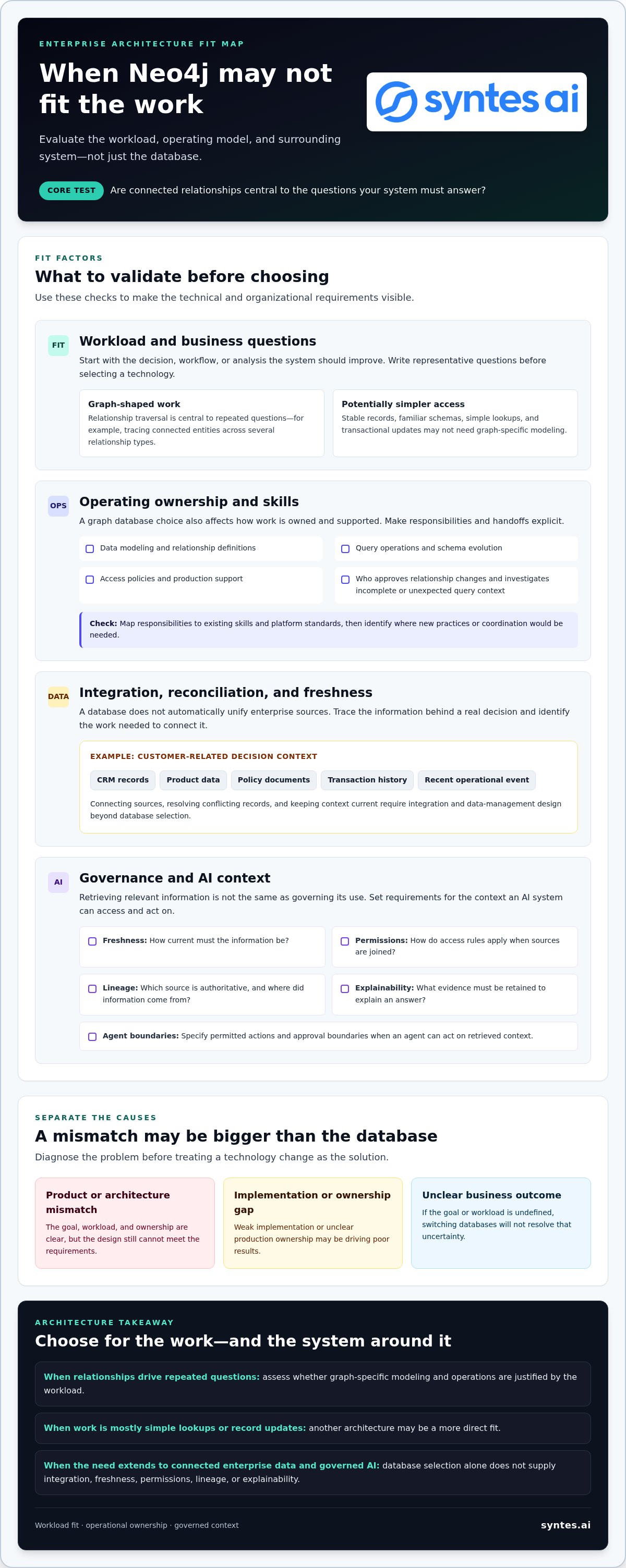
Neo4j Enterprise Evaluation Checklist
Evaluate the workload before evaluating vendor features. A bounded proof of value should use representative data, real queries, defined permissions, and operational scenarios, with measurable acceptance criteria and named owners. This gives the team evidence to answer why not to use Neo4j, or where graph technology may be justified.
Five steps to validate graph fit
- Define the business decision. Identify a specific workflow or decision that depends on connected entities. Write the questions the system must answer and the action those answers support.
- Map the information and its ownership. Select a representative data sample. Document source systems, data owners, update frequency, permission boundaries, and the events that could change relationships or conclusions.
- Specify target queries. Include the queries users or applications need to run, covering ordinary cases and relevant edge cases. Define the expected result for each so correctness can be assessed, not assumed.
- Prototype against current workflows. Run the same representative questions through the proposed graph approach and the existing process. Compare result accuracy, freshness, explainability, and how clearly each answer can be traced to source information.
- Test change and assign ownership. Introduce a change to a business rule, relationship, permission, or operational event. Record how the system responds and name the owners for data modeling, access policy, ongoing support, and acceptance decisions.
What to measure before committing
Set acceptance criteria before the proof begins. Define what counts as a correct answer, how current data must be for the intended decision, what evidence must support an explanation, and whether access rules remain effective across connected sources. Assess data integrity and maintainability too: can the responsible team update a relationship or rule without undermining other queries or creating unclear ownership?
Keep the evaluation bounded. Agree on its scope, representative scenarios, decision date, and who can approve or reject the result. Include operational events, not just static records, and test how changes propagate through the reasoning path. Avoid declaring success based only on a working demonstration; the criteria should reflect the conditions the enterprise must operate under.
These checks should also expose requirements beyond the database, including integration, governance, and controlled AI execution. For that wider platform perspective, consult this enterprise AI infrastructure guide.
When a governed Context Graph is the better architectural question
The evaluation framework helps determine whether graph technology fits a defined workload. But sometimes the requirement is broader: enterprise AI must interpret information across systems, explain how it reached an answer, and operate within governance boundaries. In that case, the central question isn’t only which database to select. It’s how to create reliable, usable context for decisions and AI applications.
From graph storage to governed enterprise context
A graph database can represent entities and relationships. An enterprise context layer must also connect information across systems, give that information business meaning, apply permissions, and account for operational events that change what is relevant. Explainable reasoning depends on deliberately connecting outputs to their supporting data and relationships. It isn’t an automatic outcome of choosing a database.
Syntes AI’s Context Graph is a live operational model and unified context layer for enterprise data and relationships. Its Context Engineering Framework organizes the work into five pillars:
- Connect: Bring structured and unstructured enterprise data into the context process.
- Understand: Interpret source information and identify meaningful entities and relationships.
- Contextualize: Relate information to business meaning and operational conditions.
- Govern: Apply security, permissions, business rules, and auditability to context and its use.
- Execute: Enable governed AI agents and applications to use trusted context.
Grounding matters. For more on building AI around trustworthy enterprise information, read this guide to preventing AI hallucinations.
Where Syntes AI fits in the evaluation
Syntes AI’s Enterprise AI Platform takes a Context Engineering approach for organizations whose requirements extend beyond graph storage. It combines graph technology and cross-system integrations with governance, analytics, and AI capabilities, supporting explainable insights and governed agent execution. The architectural distinction is important: selecting a database addresses a data-store decision; designing enterprise context addresses how information is connected, interpreted, governed, and used.
That broader perspective can help teams frame the next step after evaluating database fit. See how Syntes AI approaches enterprise context.
Choose an architecture that supports the outcome
The question of why not to use Neo4j has no blanket answer. Graph technology can fit workloads where connected entities drive important queries. It may be a mismatch when the business need, operating model, or broader architecture calls for capabilities beyond graph storage.
Start with the decisions and workflows the system must support. Test representative data, queries, permissions, and operational events, then assess correctness, freshness, explainability, governance, and maintainability. This makes it easier to separate database selection from the larger challenge of building enterprise AI architecture.
When that challenge includes integrating information and relationships, governing its use, and enabling explainable AI execution, Syntes AI’s Context Engineering Framework provides a structured approach: Connect, Understand, Contextualize, Govern, and Execute. Its Context Graph is a live operational model for enterprise context.
Choose with clarity, validate against real requirements, and build toward an architecture that helps your organization put trusted context to work.
Frequently Asked Questions
Is Neo4j a bad choice for enterprise applications?
No. Neo4j can suit enterprise workloads where connected data and relationship-based queries are central. The decision depends on workload fit, operational ownership, integration needs, and governance requirements, not on a blanket judgment about the database. Test representative queries and data against defined acceptance criteria. If the required outcome depends mainly on simple record access, a graph model may introduce complexity without adding enough value.
When should you not use Neo4j?
Consider another approach if your workload is mostly predictable record transactions, document search, or data ingestion that doesn’t depend on graph relationships. The question of why not to use Neo4j is best answered by examining the work it must support: define the business questions, required relationships, data freshness, and operational responsibilities. If those needs don’t justify graph modeling, choose an architecture that meets them more directly.
Can Neo4j replace a relational database?
It can support some workloads that might otherwise use relational databases, but it shouldn’t be treated as a universal replacement. Relational systems can remain well suited to structured records and transactional workflows, while a graph database can serve relationship-focused queries. Some enterprise architectures use both, assigning each a distinct role. Base the decision on required data integrity, access patterns, relationships, and application outputs, then validate it with representative workloads.
What are the main alternatives to Neo4j?
Alternatives depend on the requirement. Relational databases are commonly used for structured records and transactional access. Search systems support indexing and document discovery. Other graph database technologies may suit graph-centered workloads, while a broader context architecture connects data, relationships, governance, and AI use across systems. These options can coexist rather than compete as one-for-one replacements. Compare them against the queries, information types, freshness, and outputs your enterprise needs.
Does using Neo4j prevent AI hallucinations?
No database can by itself guarantee that an AI system won’t produce unsupported answers. A graph can help represent relationships and provide information for reasoning, but trustworthy outputs also depend on source quality, integration, permissions, and how responses are grounded and checked. For enterprise AI, define how the system traces answers to supporting information and handles missing or conflicting context. Governance and evaluation remain essential.
Is a knowledge graph the same as a graph database?
No. A graph database is a technology for storing and querying data represented as entities and relationships. A knowledge graph is a structured representation of entities, relationships, and meaning that supports a particular domain or use case. A knowledge graph may use a graph database, but the terms describe different things: one refers to a data platform, the other to an organized knowledge model.
How should an enterprise evaluate Neo4j for AI agents?
Begin with the decisions and actions the agents must support, then test representative data and queries. Define acceptance criteria for answer correctness, context freshness, traceability, permissions, and maintainability. Include operational events and test how rule or relationship changes affect results. Specify what agents may access and which actions require approval. Name owners for data, governance, and production operations so the evaluation covers the full system, not just graph storage.