

What if the data your teams need is already cataloged, but the relationships that make it meaningful are still hidden? Enterprise catalogs and search can locate assets, yet employees may still need to determine whether a dataset is trustworthy, how it connects to other systems, and what business context governs its use. A knowledge graph for data discovery can make those connections visible, but it isn’t a universal replacement for catalogs or enterprise search.
The problem is familiar: disconnected systems fragment information, while search results surface names and metadata without enough context to support confident decisions. The answer isn’t simply another index. It’s choosing discovery capabilities that match how your organization needs to find, interpret, and use data.
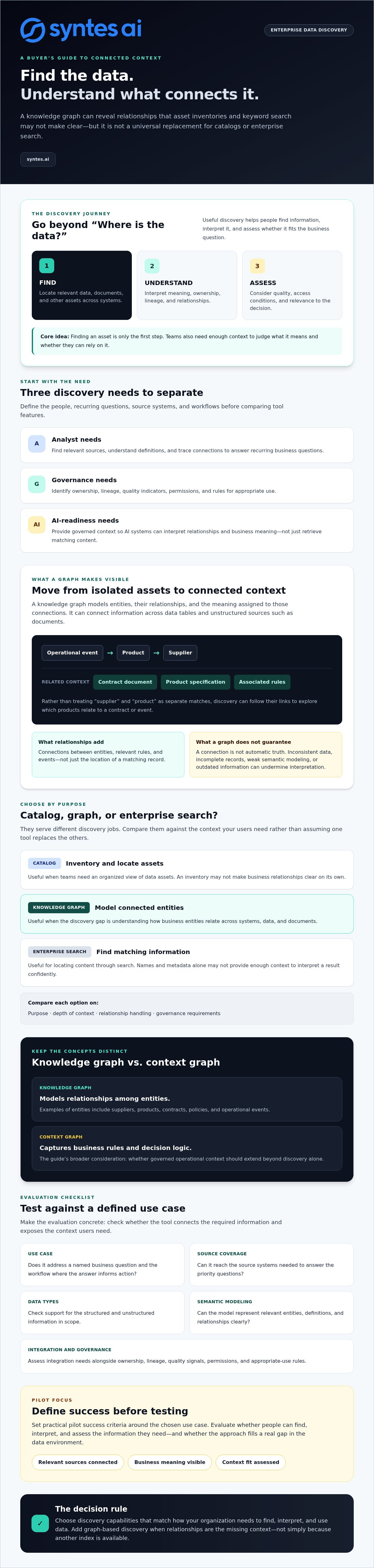
This buyer’s guide explains when graph-based discovery adds value, how it compares with catalogs, metadata search, and conventional enterprise search, and which evaluation criteria matter before a pilot. You’ll also learn to distinguish a knowledge graph, which models relationships among entities, from a context graph, which captures business rules and decision logic. Then you can assess whether a graph-based approach fills a real gap in your data environment.
Key Takeaways
- Define the discovery problem first: identify what teams need to find, understand, and assess across enterprise systems.
- A knowledge graph for data discovery can reveal connections among business entities that asset inventories and keyword search may not make clear.
- Compare catalogs, graphs, and enterprise search by their purpose, context depth, relationship handling, and governance requirements.
- Evaluate tools against a defined use case, source coverage, support for structured and unstructured data, semantic modeling, and integration needs.
- Set practical pilot success criteria, then consider whether a governed Context Graph could add operational context beyond discovery alone.
What should enterprise data discovery tools help your organization discover?
Enterprise data is distributed across systems, documents, databases, and teams. A search may return a file or table, but that doesn’t tell an employee whether it answers the business question, who owns it, or how it relates to other information. Discovery must do more than locate assets.
Enterprise data discovery is the process of finding, understanding, and assessing data relevant to a business question, including its meaning, ownership, quality, lineage, relationships, and access conditions.
That distinction matters when evaluating a knowledge graph for data discovery. A useful approach helps people move from “Where is the data?” to “What does it mean, can I rely on it, and how does it connect to the decision at hand?” For foundational concepts, see Knowledge graph.
Why finding a data asset is not the same as understanding it
Consider an analyst investigating a customer issue. Relevant details may sit in a CRM record, transaction history, and policy documents. Finding all three is only the first step. The analyst also needs to know whether “customer” means the same thing in each source, which transaction belongs to the record, and which policy applies.
Inconsistent definitions and undocumented relationships turn straightforward questions into manual investigation. Before drawing conclusions, teams need context: who owns each asset, what it represents, whether quality signals support its use, how it relates to other data, and whether the user has access. Without that information, discovery can surface results without making them safe or useful to interpret.
Which enterprise data discovery needs should buyers identify first?
Start with the people and decisions, not a feature list. Separate three needs that are often bundled together:
- Analyst needs: Find relevant sources, understand definitions, and trace connections to answer recurring business questions.
- Governance needs: Identify ownership, lineage, quality indicators, permissions, and rules for appropriate use.
- AI-readiness needs: Provide governed context so AI systems can interpret relationships and business meaning, not just retrieve matching content.
For a deeper grounding in graph concepts before comparing approaches, consult The Executive Guide to Enterprise Knowledge Graphs. That foundation helps clarify what relationships a graph should represent and which discovery gaps it is expected to address.
How does a knowledge graph improve enterprise data discovery?
A knowledge graph represents business entities, the relationships between them, and the meaning assigned to those connections. An entity might be a supplier, product, contract, policy, or operational event. Relationships express how those entities connect, such as a product being supplied by a company, governed by a policy, and referenced in a service record.
Relationships add context to data discovery by showing how a result connects to other relevant entities, rules, and events, not just where a matching record appears.
That structure can span data tables and unstructured sources such as documents. A graph might connect a supplier record in a business system to a product specification, a contract document, and an operational event. Instead of returning separate matches for “supplier” or “product,” discovery can follow the links between them and help answer a question about which products are affected by a particular contract or event.
From isolated data assets to connected business context
Keyword search is useful when the right term is known. But it may miss a relationship expressed through different names or stored across several sources. A graph can make those connections explicit, allowing users to explore a path from an operational event to a product, its supplier, and the documents or rules associated with them.
That connection is not automatic truth. Inconsistent source data, incomplete records, weak semantic modeling, or outdated integrations can produce a misleading or incomplete picture. Buyers should assess how entities and relationships are defined, how source changes are reflected, and how governance, permissions, and data quality are handled. The NSF Open Knowledge Network offers a public example of applying graph-based connections to data discovery across a broader information landscape.
How discovery connects to GraphRAG and enterprise AI
GraphRAG combines retrieval with graph structure. Rather than retrieving information only because it resembles a prompt, a system can use modeled relationships to help identify relevant entities and connected material. This may give an AI system useful context for interpreting information across sources, but it doesn’t guarantee accurate answers. Results still depend on the underlying data, graph model, retrieval process, and governance controls.
For a deeper technical discussion of retrieval and grounding, see Knowledge Graph for LLM Grounding: Technical Guide. When assessing a knowledge graph for data discovery, ask whether it can expose the relationship paths needed for your actual questions and make the supporting context understandable to users.
If you’re evaluating graph-based discovery for enterprise intelligence or AI, you can explore Syntes AI’s enterprise knowledge graph as one option for connecting business information and relationships.
Knowledge graph vs. catalog vs. enterprise search: which discovery tool fits?
These tools answer different questions. A catalog helps users understand what data assets exist and where they’re documented. Enterprise search helps locate content using queries, with context depending on how the platform indexes and ranks information. A knowledge graph models entities and their relationships, supporting discovery across connected business concepts. Their capabilities vary by implementation, so compare what each can do in your environment rather than relying on labels.
| Approach | Primary purpose | Context depth | Relationship handling | Governance needs |
|---|---|---|---|---|
| Data catalog | Inventory data assets and associated metadata | Depends on metadata coverage, definitions, and documentation | May capture lineage or links when supported and maintained | Ownership, metadata standards, access controls, and ongoing stewardship |
| Enterprise search | Locate documents and other indexed content | Depends on indexing, ranking, permissions, and available metadata | Often surfaces matching items; relationship-aware features vary | Permission-aware retrieval, index maintenance, and content controls |
| Knowledge graph | Represent entities and how they connect | Can express business meaning through modeled relationships | Designed to traverse explicit connections across sources | Governed definitions, quality checks, permissions, and model maintenance |
When a catalog or search platform may be sufficient
Start with tools you already have if the need is to inventory datasets, locate a policy document, or retrieve content by a known phrase. Before adding another platform, check whether existing metadata is accurate, teams use the catalog or search effectively, access controls behave as expected, and someone maintains the indexes and definitions. If users repeatedly need to connect evidence across systems, basic inventory or keyword retrieval may not be enough. Likewise, if your priority is identifying sensitive personal records or payment card data for regulatory compliance, you can discover EmberHound as a targeted scanning tool.
When relationship-aware discovery may justify a knowledge graph
A graph is worth assessing when a decision depends on linking entities and evidence across multiple systems, such as connecting a supplier to its contracts, products, and operational events. Test whether users can follow those relationships, understand why results are connected, and see relevant permissions and rules. If the relationships or business context change, also ask how the model and source connections are kept current.
A knowledge graph for data discovery can complement a catalog or search platform rather than replace it. A catalog may remain the asset inventory; search may remain the way users locate documents; a graph can add a relationship layer where connected context is essential. For adjacent architectural considerations, see The Semantic Data Layer.
How to evaluate data discovery tools for enterprise use
Evaluate against a real discovery problem, not a feature checklist alone. A knowledge graph for data discovery should demonstrate that it can connect the sources, meanings, and controls required for a specific decision. Use this sequence to keep the assessment grounded:
- Define the use case. Name the users, recurring question, decision workflow, and consequence of an unclear or incomplete answer.
- Map the data landscape. Identify required systems and content, including structured records, documents, and other unstructured sources. Verify source coverage and how connections are maintained.
- Test semantic modeling. Ask how the tool identifies entities, relationships, business terms, and conflicting definitions, and who can review or update those models.
- Validate governance and architecture. Examine permissions, business rules, data integrity, lineage, ownership, explainability, auditability, and fit with your existing environment. Verify connector scope and security claims directly with the provider.
- Run a bounded pilot. Select a question that crosses relevant sources, then define success criteria before testing. Include data owners and intended users, not just the vendor team.
Which technical and governance questions should buyers ask?
Ask vendors to explain how the system handles source changes, incomplete data, and inconsistent business definitions. Confirm how access permissions and rules apply to discovered information, whether users can trace results to their sources, and what evidence is available for review. Clarify who owns ongoing updates to integrations, semantic models, and governance policies. Treat unverified architecture, connector, and security claims as open questions, not assumed capabilities.
- Which required structured and unstructured sources can the solution access, and by what integration approach?
- How are entities, relationships, business terms, and conflicting definitions established and maintained?
- How does the system enforce permissions and business rules, preserve lineage, and support auditability?
How should a proof of concept demonstrate discovery value?
Choose a bounded business question that requires evidence from multiple relevant sources. Agree on observable criteria: Can users find the needed information? Is the connected context meaningful? Can they trace answers to source material? Do data owners and intended users consider the result useful? Compare the outcome with the current process, including ambiguity and manual reconciliation, rather than judging a polished demonstration.
How can discovery evaluation avoid becoming an architecture-only exercise?
Record more than technical fit. Include whether users can answer priority questions with less uncertainty, who will maintain context and governance, what operational effort is required, and whether intended users adopt the workflow. A capable architecture has limited value if its context becomes stale or teams cannot use its results in real decisions.
How Syntes AI connects data discovery to governed enterprise context
Once you’ve defined the discovery problem and evaluation criteria, the next question is whether a platform can connect information to the operational context behind it. Syntes AI provides an enterprise AI platform with a live Context Graph, described as an operational model that connects enterprise information, relationships, rules, and events. It’s designed for organizations that need discovery to expose how information fits together, not just where individual assets are located.
What the Syntes AI Context Graph is designed to connect
The Context Graph connects structured and unstructured business information across systems. That includes business entities, documents, rules, relationships, and operational events. Consider a team investigating a process exception: relevant context may involve a record, a governing rule, supporting documents, and an event that changed the situation. A shared context layer can help represent these connections for enterprise intelligence and AI use, while preserving the need to validate source quality and meaning.
Syntes AI describes its Context Engineering approach through five pillars:
- Connect: Bring enterprise information and sources into the context layer.
- Understand: Identify the meaning and relationships within that information.
- Contextualize: Relate data to business rules, processes, and operational events.
- Govern: Apply governance, permissions, and auditability to enterprise context.
- Execute: Enable action from governed context, including support for governed AI agents.
Together, these pillars frame the Context Graph as a continuously evolving enterprise memory rather than a static inventory. Buyers should still confirm how the proposed architecture fits their environment, what source connections are supported, and how ownership, permissions, and context maintenance will work in practice.
When to assess Syntes AI for enterprise data discovery
Assess Syntes AI when fragmented systems make it difficult to discover relationships across information, or when trusted AI initiatives require a governed view of business context. A knowledge graph for data discovery may be relevant if teams must connect evidence, rules, and operational events to answer priority questions. It isn’t a universal replacement for catalogs or search, and fit depends on your use case, architecture, governance requirements, and intended workflows.
Bring your data, security, and business stakeholders into the assessment. Validate the required sources, permission model, and success criteria with them before deciding whether the Context Graph addresses a real gap.
Make Enterprise Discovery Ready for Better Decisions
The right discovery strategy starts with the question your teams need to answer. Catalogs and search can remain effective for finding assets and content; a knowledge graph for data discovery becomes valuable when answers depend on relationships, business meaning, and context across systems. Evaluate tools against real workflows, governance needs, source coverage, and clear pilot criteria, not platform claims alone.
For organizations addressing fragmented information and trusted AI needs, Syntes AI’s live operational Context Graph is designed to connect enterprise data and relationships. Its Context Engineering framework spans connection, understanding, contextualization, governance, and execution, with explainable reasoning and governed AI agents as stated priorities. Validate how those capabilities fit your architecture and use case.
With a focused evaluation, your organization can turn disconnected information into clearer context and move toward more confident, informed decisions.
Frequently Asked Questions
What is a knowledge graph for data discovery?
A knowledge graph for data discovery represents business entities and their relationships so users can explore enterprise information in context. Unlike a simple asset list, it can show how records, documents, business terms, and events relate. Its usefulness depends on which sources are covered, how accurately the business meaning is modeled, and whether governance and maintenance are in place. A graph doesn’t make incomplete or inaccurate source data trustworthy by itself.
How does a knowledge graph help users discover enterprise data?
A knowledge graph helps users follow relationships among information across systems, rather than relying only on matching keywords. For example, an operations team could connect an invoice to its purchase order and the approval policy relevant to that transaction. Whether those links are useful depends on the graph model, integrated sources, permissions, and data quality. Buyers should test representative questions and verify that users can trace results to appropriate evidence.
Is a knowledge graph better than a data catalog for data discovery?
Neither is universally better; the right fit depends on the discovery task. A catalog may suit teams that need to locate data assets and review available metadata. A knowledge graph models connections and business context among entities. They can work as complementary layers rather than interchangeable products. Compare user needs, current catalog capabilities, governance, integration requirements, and ongoing maintenance before deciding whether to extend or augment existing tools.
Can a knowledge graph connect structured and unstructured enterprise data?
Yes, depending on platform capabilities and implementation, a graph can represent relationships between structured records and information extracted from or linked to documents and other unstructured sources. The details matter: verify which systems and formats are supported, how entities are matched across sources, and how semantic models and governance are applied. Don’t assume universal coverage. Ask vendors to demonstrate connections using representative data from your environment.
How do I evaluate enterprise data discovery tools?
Start by identifying priority users and the business questions they need to answer. Then assess source coverage, structured and unstructured data support, search and relationship capabilities, semantic modeling, permissions, explainability, integration, and maintenance. Run a bounded proof of concept with representative data and agreed success criteria. Include data owners and end users in validation, and compare the proposed tool with your existing catalog and search capabilities before expanding scope.
What is the difference between enterprise search and knowledge graph discovery?
Enterprise search generally locates indexed content in response to a query, while knowledge graph discovery emphasizes entities and relationships that add business context. Capabilities vary, and some platforms combine both approaches. Compare how each handles enterprise terminology, cross-system connections, permissions, and traceability. Most importantly, test whether the tool supports the questions users actually need to answer, rather than judging it by search or graph features in isolation.
Can a knowledge graph support AI data discovery and GraphRAG?
A knowledge graph can provide structured relationships that retrieval and AI applications may use as context. GraphRAG combines graph information with retrieval-augmented generation, but it doesn’t guarantee complete or correct responses. Source quality, graph modeling, governance, and access controls still matter. Evaluate the approach with representative enterprise questions, then check whether responses can be traced to relevant evidence and respect the permissions that apply to the underlying information.