
What if the model bill is the least revealing line in your enterprise AI budget? The hidden costs of enterprise ai often sit elsewhere: in data preparation, system integration, governance, human review, and the work required to keep production systems reliable. That is why a pilot can look affordable while the path to scale remains unclear.
Model consumption matters, but it does not capture the full cost of connecting fragmented information, maintaining workflows, and overseeing AI outputs and actions. Without those costs in view, teams cannot compare deployment approaches on consistent terms or plan for ongoing operations.
This guide offers a practical way to assess enterprise AI total cost of ownership. You will map costs beyond licenses and API usage, compare approaches using consistent categories, and build a forecast for integration, data, governance, review, and maintenance. You will also see how fragmented operational context can lead to repeated integration and reconciliation work, and how context engineering provides an architectural approach to bringing enterprise information into a more coherent, governed foundation for AI.
Key Takeaways
- Identify the hidden costs of enterprise ai by looking beyond model and license charges to the people, data, and operational work required.
- Trace expenses across the AI lifecycle, separating recurring consumption from implementation, governance, and support effort.
- Compare build, point-solution, and integrated-platform approaches against the same total cost categories.
- Establish a cost baseline for one workflow, with an accountable owner and clear measures for labor, data work, usage, governance, and support.
- Assess how fragmented operational context drives repeated integration and reconciliation, and how a governed Context Graph can represent relationships among data, rules, and events.
The Hidden Costs of Enterprise AI Go Beyond Model Usage
A model invoice is easy to see. The work that makes a model useful across an enterprise is less visible. Teams may need to prepare data, connect systems, adapt workflows, review outputs, and maintain controls. These expenses can sit across technology, operations, security, and business teams, making them easy to miss when budgets focus on a license or usage estimate.
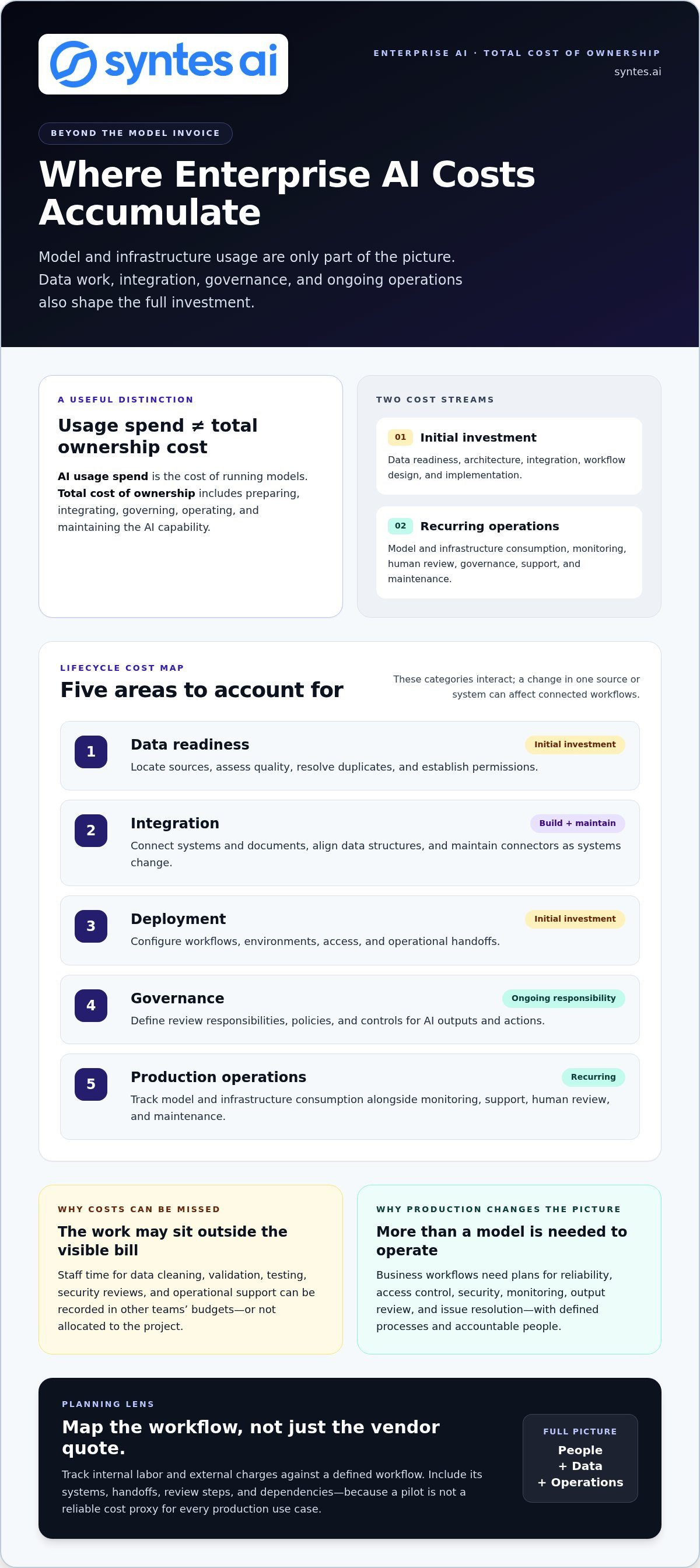
A useful definition: “AI usage spend is the cost of running models; total cost of ownership is the full investment in preparing, integrating, governing, operating, and maintaining the AI capability.” The hidden costs of enterprise ai are usually not undisclosed vendor charges. They are expenses and labor overlooked in planning because they fall outside the most visible bill.
What counts as a hidden cost in enterprise AI?
Separate provider charges from the resources your organization must supply. Direct charges may include model consumption or software licensing. Other costs include staff time to clean and validate information, infrastructure for workloads, enterprise system integration, security reviews, monitoring, and operational support. Some are initial investments; others recur as usage, policies, and connected workflows change.
For example, a pilot might use a limited dataset and a small group of employees. The team can test the model without connecting every system or defining a production support process. The pilot bill may be clear, while data preparation and testing effort is recorded elsewhere or not allocated to the project at all. Include those hours in the estimate even when they appear in another team’s budget.
Why do enterprise AI costs grow after a pilot?
Production changes the operating requirements. A capability used in a business workflow needs a plan for reliability, access control, security, monitoring, output review, and issue resolution. Those responsibilities require defined processes and accountable people. As more users and workflows depend on the system, teams may also uncover integration gaps, inconsistent source data, or governance decisions the pilot did not need to resolve.
Expansion can expose dependencies rather than create a uniform cost curve. One workflow may rely on stable, accessible data; another may span systems with different permissions and update cycles. Each has a different implementation and oversight profile. A small pilot is therefore not a reliable cost proxy for every production use case. Map the systems, handoffs, and review steps for the specific workflow you intend to scale.
- Initial investment: data readiness, architecture, integration, workflow design, and implementation.
- Recurring operations: model and infrastructure consumption, monitoring, human review, governance, support, and maintenance.
Track both categories against a defined workflow, not just a vendor quote. Assign owners for internal labor as well as external charges, and record dependencies that could expand in production. This gives teams a defensible baseline for comparing approaches and deciding what to fund next.
Where Hidden Enterprise AI Costs Accumulate Across the Lifecycle
AI costs build at different points in the lifecycle, and they do not all appear on the same invoice. Model and infrastructure usage can recur as workloads run. Internal effort starts earlier, with source mapping and data preparation, then continues through integration, evaluation, governance, and support. A useful cost map puts these categories together so teams can distinguish consumption from the work needed to make AI dependable in business operations.
- Data readiness: Locate sources, assess quality, resolve duplicates, and establish permissions.
- Integration: Connect systems and documents, align data structures, and maintain connectors as systems change.
- Deployment: Configure workflows, environments, access, and operational handoffs.
- Governance: Define review responsibilities, policies, and controls for AI outputs and actions.
- Production operations: Track model and infrastructure consumption alongside monitoring, support, and maintenance.
These categories interact. A change to a source system can affect a connector, the interpretation of its data, and any workflow that depends on both. Infrastructure and Operational AI Costs are part of a broader lifecycle picture that also includes data pipelines and human effort. The goal is not to assume every project has the same costs, but to identify which dependencies belong in your plan.
Integration maintenance belongs in AI total cost of ownership because connected systems and their data keep changing after launch, creating ongoing work to preserve a workflow’s reliability and meaning.
Data, integration, and context engineering work
Before AI can use enterprise information, teams need to map sources, inspect data quality, resolve access permissions, and align terms that may mean different things across systems. A customer record in one application, a contract document, and a business rule may each describe part of the same operational situation.
Connecting those sources is necessary, but connection alone does not make their relationships or business meaning usable. If each workflow separately prepares the same documents, reconciles conflicting records, or interprets the same rules, teams repeat the work. Context engineering addresses this distinction by organizing information and its relationships into operational context, rather than treating every source as an isolated feed.
Governance, people, and production operations
Production requires more than a deployed model. Teams need to evaluate outputs, monitor behavior, define when people review results, respond to incidents, and retain enough information to understand decisions. These responsibilities create continuing effort, especially as workflows or their source data change.
There is also work beyond technical operations. Employees may need training, roles may shift, and processes may need redesign around the AI-enabled workflow. For agents that can act across systems, permissions and business rules require ongoing ownership. A rule update or access change can affect what an agent is allowed to do.
Make these responsibilities explicit in the operating plan. A governed Context Graph can represent relationships among business entities, documents, rules, and operational events, providing an architectural option for connecting information with its context. Syntes AI’s Enterprise AI Platform combines a Context Graph with an agentic AI framework and cross-system integrations. View the Syntes platform to see how it brings enterprise information and governed AI workflows together.
How to Compare Enterprise AI Options on Total Cost of Ownership
A fair comparison starts with one rule: assess every approach against the same workflow, usage assumptions, and ownership categories. A build, point solution, and integrated platform may package work differently, but the work still has to be done. Compare implementation, data and integration effort, model and infrastructure consumption, governance, support, and future change. This makes the hidden costs of enterprise ai easier to see without assuming a single architecture is cheapest for every organization.
Build versus buy versus integrate: what changes the cost profile?
Building in-house can provide control over design and customization, while placing engineering, testing, maintenance, and coordination responsibilities with the organization. A point solution may address a focused need, but several tools can bring separate connectors, policies, monitoring, and support processes. An integrated platform may consolidate parts of that architecture, but consolidation is a possibility to assess, not a guaranteed saving. The right comparison depends on existing systems, skills, and operating requirements.
Use the same lifecycle categories for each option. Separate one-time implementation work from responsibilities that continue in production:
| Cost category | One-time implementation work | Recurring operational responsibilities |
|---|---|---|
| Data and integration | Map sources, align data, configure connectors | Maintain connections, address source changes, manage access |
| AI and workflows | Select and configure models, design workflows | Review usage, update models and workflows, monitor behavior |
| Governance and people | Define policies, roles, and review processes | Train employees, review outputs, manage incidents and auditability |
| Platform and operations | Establish architecture and deployment processes | Provide support, maintain infrastructure, plan changes and migration |
Which comparison criteria reveal costs vendors may not show?
Look beyond feature lists. Determine who owns each connector and what work is needed when a source system changes. Assess whether data can move in usable formats, where business context resides, and how governance controls apply across workflows. A solution that requires separate policy management or monitoring for each tool may add coordination effort, even if its initial implementation appears straightforward.
Then examine the operating model. Who evaluates outputs, updates business rules, manages permissions, and responds when a workflow changes? Include the effort to update models and operational context, not just initial configuration. Finally, consider exit and migration: identify dependencies, data portability, workflow redesign, and the team effort needed to transition if requirements or architecture change.
Score each option against these criteria for the same use case, and record accountable owners and assumptions. Syntes AI’s platform brings together a Context Graph, an agentic AI framework, and cross-system integrations. Explore the platform as an integrated architectural option alongside the other approaches in your comparison.
How to Uncover and Control Hidden Enterprise AI Costs Before Scaling
A credible scale decision starts with evidence, not a broader usage forecast. Audit one defined workflow from its data inputs to its operational handoffs, then assign an accountable owner who can coordinate technology, business, and governance teams. This focused baseline makes the hidden costs of enterprise ai easier to identify before additional users, systems, or agent permissions multiply the work.
A practical enterprise AI cost-audit sequence
Build the audit around what the workflow actually depends on. Record who supplies, maintains, and supports each part, then distinguish estimates from measured effort. Keep the same categories as the workflow moves from pilot into operation:
- Define the workflow and owner. Specify its business purpose, users, boundaries, and the person accountable for its end-to-end operation.
- Inventory dependencies. List connected applications, data sources, models, infrastructure, teams, and human handoffs. Note where information is duplicated or reconciled manually.
- Assign cost ownership. Identify who tracks model and infrastructure consumption, data preparation, integration work, evaluation, review, governance, training, support, and maintenance.
- Document the baseline. For each category, record the estimate, measurement period, assumptions, and evidence source. Track staff time as well as direct usage, even when that effort sits in another team’s budget.
- Reassess after deployment. Compare assumptions with actual usage and operational workload. Record changes in user volume, exceptions, review effort, and support needs, then use that evidence to update the forecast.
How to reduce uncertainty before scaling
A bounded pilot should test operational readiness, not only whether a model can produce a useful response. Set acceptance criteria before increasing adoption: define output quality, permitted data and actions, review responsibilities, failure handling, and service expectations for the workflow. These criteria help distinguish a capability that works in a controlled test from one ready for broader use.
Probe the dependencies directly. Test whether integrations handle missing, delayed, or inconsistent information. Exercise exception paths, including cases that require human review or recovery from an incorrect action. For agentic workflows, confirm that permissions match the intended task and that business-rule changes have a clear owner. This surfaces operational effort while the scope is still bounded.
Before expanding, confirm that teams know who monitors the workflow, reviews outputs, responds to incidents, updates integrations, and maintains policies. Include employee training and workflow redesign in the plan. If responsibility remains informal, wider adoption can turn small gaps into recurring support work. Scale in deliberate steps, and revisit the baseline after each meaningful change in usage or workflow scope.
A structured audit gives decision-makers a defensible view of what the workflow requires and where uncertainty remains. Syntes AI’s Context Engineering approach connects enterprise information and supports governed AI workflows. Learn about Syntes enterprise AI context.
Reduce Hidden Enterprise AI Costs with Governed Operational Context
Fragmented context creates operational drag. A team may connect a document repository for one workflow, reconcile its information with a system of record for another, then repeat reviews because each process lacks shared business rules and relationships. These repeated tasks are a practical source of the hidden costs of enterprise ai. Addressing them starts with treating context as an operating layer, not a series of disconnected prompts and data feeds.
How a Context Graph addresses recurring context work
A Context Graph represents relationships among business entities, documents, rules, and operational events. That structure matters because retrieving an isolated document may not reveal how its contents relate to a current record, applicable rule, or recent event. Connecting structured and unstructured sources into operational context gives AI a richer basis for reasoning across related information.
This does not mean every source becomes consistent automatically, or that governance and review are no longer needed. It means teams can work toward shared context rather than rebuilding interpretations separately for each workflow. Clear relationships can also help people understand which information informs a result, who owns the underlying rule, and where review or escalation belongs.
The Syntes Context Engineering Framework organizes this work through five pillars: Connect, Understand, Contextualize, Govern, and Execute. Together, they describe a progression from linking enterprise information to using it in governed AI workflows. Syntes AI’s live Context Graph serves as an operational context layer and enterprise memory, while its agentic platform enables governed agents to reason over that context and execute actions. This is an architectural approach to duplicated integration, reconciliation, and rework, not a promise of a particular saving or an elimination of AI risk.
What to evaluate in an enterprise context platform
Evaluate whether a platform fits the systems and operating conditions your workflows depend on. Probe how it connects structured and unstructured sources, how changing information is reflected, and how permissions apply across the context made available to AI. Consider whether teams can understand the relationships behind an answer or action, and how governance controls apply when an agent executes a task.
Operational ownership matters as much as technical connectivity. Establish who maintains integrations, updates business rules, reviews changes, and responds when context is incomplete or conflicting. Assess auditability and explainability as part of day-to-day operations, not just as platform features. Also consider interoperability: can the context support more than one workflow without requiring teams to recreate the same mappings and interpretations?
These questions overlap with the architectural choices involved in an enterprise knowledge graph: how information is connected, what relationships are represented, and how those relationships support business use. Compare the platform against your defined workflow and governance needs. Shared context can provide a foundation for more consistent, explainable AI operations, while actual effort and outcomes still depend on implementation and ongoing ownership.
Make Your Next AI Investment Operationally Defensible
Make the next AI investment a decision about operating design, not just model selection. Choose a workflow that matters, identify how information moves through it, and make ownership visible before expanding its reach. That discipline turns the hidden costs of enterprise ai from a late-stage surprise into an input leaders can evaluate and manage.
For that evaluation, consider whether an Enterprise Context Graph can connect structured and unstructured business information in a way that supports the workflow. The Syntes Context Engineering Framework provides a lens across Connect, Understand, Contextualize, Govern, and Execute. Together, these capabilities are designed to support explainable reasoning and governed agents grounded in operational context, while costs and outcomes remain dependent on implementation.
A useful next step is to examine how this architecture could fit a real enterprise workflow and its operating requirements.
Build with clarity, test with purpose, and scale when your operating model is ready.
Frequently Asked Questions
What are the hidden costs of enterprise AI?
They are the expenses and staff effort an organization needs to make AI useful in its operating environment, beyond visible software or model charges. For example, a finance team may spend time validating source records while security reviews access and operations staff handle exceptions. These efforts can be spread across department budgets, so project reporting may not show the full organizational commitment unless teams trace and allocate them.
How much does enterprise AI really cost?
There is no single figure that applies to every enterprise AI initiative. Scope, workload volume, data condition, integration needs, and operating requirements all affect total cost. Estimate a defined use case over a chosen planning period, including expected usage patterns and the people needed to operate it. Frequent document analysis, for example, may have a different consumption profile from an occasional internal decision-support workflow.
Can enterprise AI cost more than the model or software license?
Yes. The license or model charge covers only one part of a deployment. An organization may also need to fund data preparation, system connections, security work, staff training, evaluation, and ongoing support. Consider an AI feature embedded in a case-management process: even if model usage is predictable, connecting case records, handling unusual cases, and assigning output review can add substantial work outside the vendor invoice.
Why do enterprise AI pilot costs increase when scaling?
Scaling changes the conditions the system must handle. More simultaneous users can make response capacity and service reliability more important; new workflows may bring different data, permissions, and exception paths. A pilot might rely on a team manually resolving an occasional mismatch, while broader use requires a repeatable process and clear ownership. Costs do not rise identically for every project, so measure the actual workload before expanding.
How should an organization calculate enterprise AI total cost of ownership?
Set a consistent planning period and calculate direct charges plus the internal effort required to deliver and run the use case. Allocate labor by role and task rather than counting only dedicated project staff. Model expected workload scenarios, including quieter and busier periods, then document assumptions such as review frequency and integration changes. This lets decision-makers compare options on like-for-like terms and revise the estimate as operational evidence accumulates.
Does a knowledge graph eliminate hidden enterprise AI costs?
No. A knowledge graph can organize relationships among information that AI uses, but it still needs relevant data, integration, governance, and ongoing stewardship. Its value depends on how well the graph reflects the organization’s changing entities, rules, and events. For example, a changed product relationship may require an update to keep operational context useful. Treat a graph as an architectural component to assess, not as a guarantee that costs disappear.
What should be included in an enterprise AI cost audit?
Include the workflow’s business owner, contributing teams, source systems, data responsibilities, usage assumptions, and operational handoffs. Also document exclusions, such as shared infrastructure or employee time recorded under another department, so estimates are not mistaken for complete costs. Capture the evidence behind each assumption and note who can validate it. This makes the audit more useful during budget reviews and helps explain why actual effort differs from the forecast.