
A transaction may look ordinary until it is linked to an account, device, document, and prior event. That’s the central idea behind fraud detection using knowledge graphs. Fraud signals are often scattered across systems, and an alert viewed in isolation can miss relationships that reveal a pattern of activity.
Rules-based systems can flag known scenarios, while machine-learning models can identify patterns in data. Neither automatically gives investigators a connected view of entities and events. A knowledge graph links records so teams can examine how people, accounts, transactions, documents, and operational events relate, then trace why a pattern merits attention.
This guide explains how graph relationships can strengthen enterprise fraud analysis, how graphs complement rules and machine learning, and what to assess before deployment. It also covers why explainability, governance, data integration, and human oversight matter when moving from connected evidence to action. The goal isn’t uncontrolled automation. It’s a clearer, more auditable foundation for investigating risk across the enterprise.
Key Takeaways
- See how fraud detection using knowledge graphs links entities, events, and evidence to surface relationships that isolated alerts may miss.
- Follow the analysis sequence from integrating structured and unstructured data to reviewing connected patterns.
- Compare rules, machine learning, and graph analysis by their strengths, limitations, explainability, and roles in a broader detection strategy.
- Use a practical checklist to assess data coverage, entity resolution, governance, explainability, and fit with investigation workflows.
- Explore how Syntes AI’s Context Engineering pillars, Connect, Understand, Contextualize, Govern, and Execute, can support connected, governed fraud analysis.
Why Fraud Detection Using Knowledge Graphs Starts With Connected Evidence
A transaction alert may identify an unusual payment. An identity check may flag inconsistent details. A document review may surface a questionable address. If these signals remain in separate systems, investigators must connect them manually. A pattern spanning customers, suppliers, accounts, and events can remain hidden.
Definition: Fraud detection using knowledge graphs connects entities, events, and evidence so each record can be understood in relation to the others around it.
This relationship-centered analysis helps investigators identify suspicious connections and prioritize questions. It doesn’t prove intent or establish that fraud occurred. A shared address, device, or account may have a legitimate explanation. The graph makes the connection visible, while people assess its meaning against the evidence and business context.
Why isolated fraud alerts miss connected patterns
Separate alerts describe individual events, but coordinated activity may emerge through relationships among them. Examining activity across time, repeated interactions, and shared attributes can add context that a single alert lacks. A connection is a lead, not a verdict.
Hypothetical example: A payment alert concerns one customer account, while a separate review flags a supplier invoice. Viewed alone, neither signal may justify escalation. A connected analysis might show that the account and supplier share a contact detail found in a document, and that related accounts have made several transactions within a short period. Investigators can then examine whether the timing, repeated payments, and shared information have a valid business explanation. This illustrates a possible analytical pattern, not a real client result or proof of wrongdoing.
What a knowledge graph represents in fraud analysis
A graph organizes information as entities and relationships. Entities such as accounts, people, suppliers, transactions, devices, documents, and operational events are represented as nodes. Relationships are edges: for example, a person controls an account, an account sends a payment, or a document references a supplier. The What is a Knowledge Graph? overview offers a foundation for understanding this structure.
The source records remain the underlying evidence: transaction entries, identity records, documents, and system events. The graph is a model built from those records, organizing entities and links so investigators can follow a trail across sources rather than treat each item as isolated. A well-governed approach also preserves where information came from, allowing reviewers to inspect the basis for a connection.
Graph structure adds context; it doesn’t independently establish culpability. A relationship may be direct, inferred, incomplete, or based on information that needs verification. Investigators must evaluate the source, timing, and relevance of each connection, consider legitimate explanations, and follow their organization’s review processes before taking action. This keeps connected analysis useful without turning proximity into an accusation.
How Knowledge Graphs Connect Fraud Entities, Events, and Signals
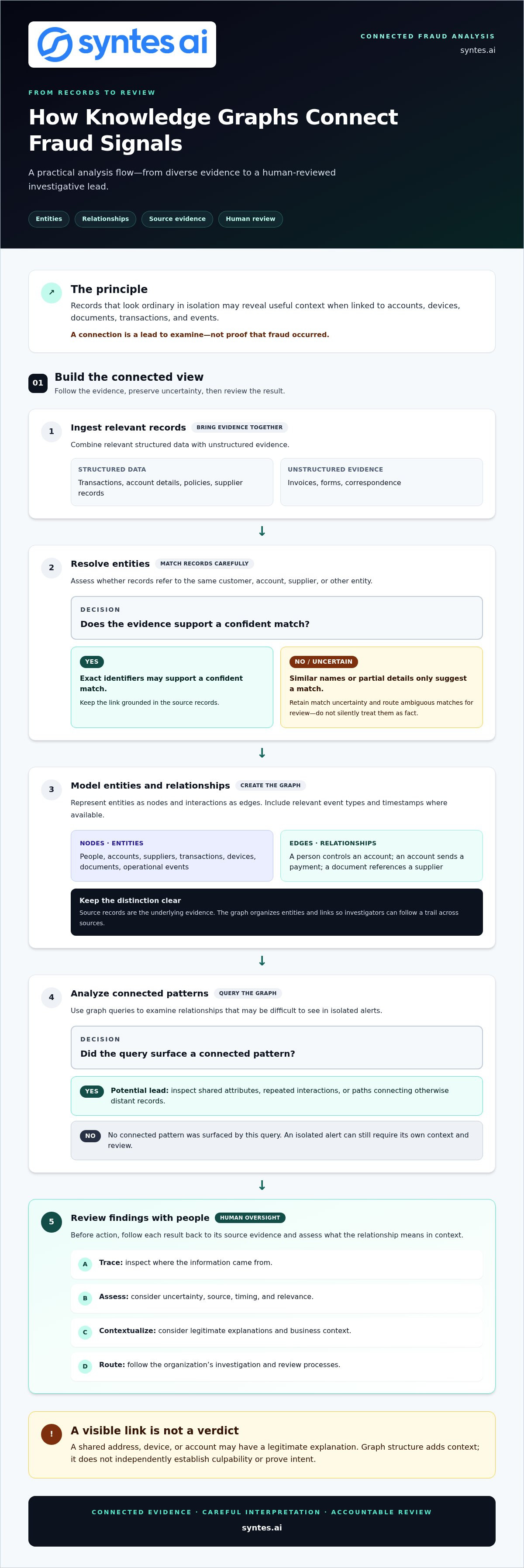
A useful graph analysis involves more than putting records in one place. It turns diverse evidence into a navigable model while preserving the distinction between what a source says and how records are connected. A practical workflow moves from data ingestion to human review, accounting for uncertainty at each stage.
- Ingest records. Bring together relevant structured data, such as transactions, account details, policies, and supplier records, alongside unstructured evidence such as invoices, forms, and correspondence.
- Resolve entities. Determine whether records refer to the same customer, account, supplier, or other entity. Exact identifiers may support a confident match; similar names or partial details may only suggest one.
- Model relationships. Represent entities as nodes and interactions as edges, including relevant event types and timestamps where available.
- Analyze patterns. Use graph queries to find shared attributes, repeated interactions, or paths connecting otherwise distant records.
- Review findings. Trace each result to its source evidence, assess uncertainty, and route it through the organization’s investigation process.
From enterprise records to a connected fraud context
Entity resolution deserves particular care. Two records with similar names aren’t necessarily the same person or business. A shared identifier may also be outdated, reused, or entered incorrectly. A sound analysis distinguishes confirmed links from possible ones, retains match confidence, and sends ambiguous matches for review instead of silently treating them as fact.
Event time adds another dimension. A transaction, policy change, or document submission can be connected to the entities involved and the time it occurred. Analysts can then examine sequence and proximity without assuming every source is current or updates at the same pace.
Which graph patterns can support fraud investigations?
Analysts can query for repeated relationships, shared identifiers, or unusual chains of connections across customers, suppliers, accounts, and documents. Path analysis follows links across multiple steps, showing how two records may be connected through intermediate entities or events. For an overview of graph use cases in this area, see Graph Databases in Fraud Detection.
- Shared identifiers: Separate accounts reference the same contact detail or document attribute, a connection to validate against source records.
- Multi-hop paths: A payment connects to an account, that account links to another entity, and that entity appears in a separate business record.
- Repeated interactions: The same entities interact in recurring patterns that warrant comparison with expected business activity.
A graph finding is a lead for review, not proof of fraud. Analysts should inspect the underlying records, verify whether links are reliable, and consider legitimate explanations before deciding on next steps. A transparent result should show which records and relationships contributed to the pattern, not just present a risk label. Teams assessing connected enterprise context can explore how a Context Graph supports cross-system analysis.
Knowledge Graphs vs. Rules and Machine Learning for Fraud Detection
Rules, machine learning, and graph analysis address different parts of the detection problem. Choosing among them isn’t a contest for a universal winner. It’s a design decision: match each method to the signals it can interpret, the explanation investigators need, and the workflow that follows. Fraud detection using knowledge graphs is most relevant when relationships among records add important context.
| Approach | Inputs | Strengths | Limitations and explainability | Suitable role |
|---|---|---|---|---|
| Rules | Explicit conditions, such as a defined transaction threshold. | Clear to document and review. | May miss activity that doesn’t match known conditions. Rule volume and exceptions need management, though the logic is usually explicit. | Apply defined controls and flag known scenarios. |
| Conventional machine learning | Historical and current data used to learn patterns and produce scores or classifications. | Can identify patterns represented in available data. | Results depend on data quality, validation, and monitoring for changing patterns. Model outputs may need additional explanation. | Score records or identify patterns for review. |
| Knowledge-graph analysis | Entities and their relationships across relevant records. | Can expose paths and repeated connections among entities and events. | Depends on reliable entity matching and well-modeled relationships. Findings require investigation. | Analyze cases where connections among entities and events matter. |
When rules and machine learning remain useful
Rules are valuable when a control can be stated clearly and consistently. A rule can flag a specific condition for review, though it won’t automatically reveal a wider network behind the event. Machine learning can identify patterns learned from available data, but teams need to validate performance and monitor for data shifts. Poor source data, false positives, and weak review procedures can undermine the operational value of either method.
What graph analysis adds to a fraud detection stack
A graph can add relationship context to an existing rule alert or model score. If a transaction is flagged, an analyst can examine whether the account connects through shared entities or repeated interactions to other relevant records. The connection enriches the investigation; it doesn’t automatically turn the alert into a confirmed case. AI and Graph Analytics in Modern Fraud Detection discusses how these approaches can work alongside one another.
Evaluate the stack across separate dimensions: detection quality, investigator usability, explainability, governance, and fit with operational workflows. A method that surfaces a useful signal may still create friction if teams can’t trace its basis, manage access, or route findings appropriately. Combine methods where their roles complement one another, and define how evidence moves from alert to review to decision. For connected enterprise context that supports explainable, governed analysis, explore Syntes AI’s Context Graph.
How to Evaluate a Knowledge Graph Approach for Fraud Detection
A graph is only as useful as the evidence it connects and the decisions it supports. Evaluate fraud detection using knowledge graphs as an enterprise capability, not just a pattern-finding feature. Involve fraud investigators, risk owners, data teams, security, and workflow leads early. Agree on the use case, decision boundaries, and required evidence before interpreting results.
Questions to assess data and analytical readiness
Start by mapping the systems that hold relevant records, their data owners, available identifiers, event timestamps, and known quality issues. Test whether the relationships investigators need can be represented and traced to source records. Look for incomplete histories, inconsistent identifiers, ambiguous matches, and processes for correcting errors. A clear map makes coverage gaps visible before they become analytical blind spots.
- Data coverage: Which transaction, identity, account, supplier, policy, and document sources are included? Which are missing, delayed, or restricted?
- Entity resolution: Can the approach distinguish confirmed matches from uncertain ones? How are ambiguous records flagged, reviewed, and corrected?
- Relationship relevance: Can analysts represent the connections needed for the target investigation, with appropriate timestamps and links to source evidence?
- Workflow fit: Do findings reach the right investigators with enough context to review them? Can teams record dispositions and route cases through existing processes?
- Governance: Are security, permissions, business rules, audit trails, and oversight defined for the data and resulting analysis?
Set evaluation measures with fraud and risk teams rather than adopting a universal benchmark. Depending on the use case, teams might track whether known scenarios are surfaced, how often findings are useful to investigators, false-positive burden, review time, and whether analysts can verify the evidence behind a result. Define measurement periods, case-selection methods, and disposition categories in advance so results can be interpreted consistently.
How to validate explainability and governance
Test the approach against representative cases, including known patterns, legitimate lookalikes, incomplete records, and scenarios where entity matches are uncertain. Include cases expected to produce no finding. Review false positives as carefully as surfaced patterns, and document where graph coverage or assumptions limit interpretation. Analysts should be able to inspect the relationship path and access the source evidence behind each finding.
Before acceptance, define who can access sensitive records, who reviews and escalates findings, and which decisions require authorized human judgment. Confirm that activity and changes can be audited, and establish how teams handle corrections or disputes about a relationship. Keep consequential decisions with authorized people unless governance explicitly permits automation. Governed analysis should make the basis for action clearer, not hide it behind a score or automated workflow.
How Syntes AI Context Engineering Supports Governed Fraud Analysis
Fraud analysis depends on more than identifying unusual activity. Teams need enterprise context that connects relevant information across systems and helps people understand how evidence relates, under appropriate controls. Syntes AI provides enterprise context infrastructure for this work through its live Context Graph, which represents relationships among business entities, documents, rules, and operational events. This connected context can support enterprise fraud analysis by helping teams examine relationships across their data.
From fragmented evidence to a live operational context
Two-way connectors integrate structured and unstructured enterprise data into a shared context layer. This can bring transaction and account records into relation with documents, policies, and operational events. The Context Graph models how entities connect, so AI reasoning can draw on relationships among records rather than retrieve isolated information alone. Its context can evolve as enterprise information changes, subject to each source’s update timing and integration design.
Context Engineering is organized around five pillars:
- Connect: Bring relevant structured and unstructured sources together through cross-system integrations.
- Understand: Interpret business entities, information, and relationships within enterprise data.
- Contextualize: Relate records to business rules, documents, and operational events so analysis has organizational meaning.
- Govern: Apply security, permissions, business rules, compliance controls, and auditability to context and reasoning.
- Execute: Support AI agents and workflows that can act within defined boundaries and human oversight.
This distinction matters for fraud detection using knowledge graphs. A static collection of records may offer evidence but leave analysts to reconstruct connections across separate tools. A live operational context layer is designed to maintain those relationships as part of the enterprise’s working context. That doesn’t mean every source changes instantly; data freshness, coverage, and integration behavior remain important evaluation criteria.
Governed AI agents and the path to evaluation
Connected context can help explain why a finding merits review by making relevant relationships and source evidence available to AI reasoning. Governance then defines which information is accessible, which business rules apply, what actions an agent may support, and what must remain with an authorized person. Auditability helps teams inspect reasoning and workflow history instead of relying on an unexplained output.
For consequential fraud decisions, keep investigators in control of validation, escalation, and disposition. Agents may support bounded workflow steps, but a connected relationship is not proof of wrongdoing. Teams assessing enterprise context can evaluate whether the sources, permissions, explanations, and review paths fit their operational and governance requirements.
To discuss how Syntes AI’s enterprise context approach aligns with your data, governance, and AI requirements, book a demo.
Make Connected Context Your Next Enterprise Decision
The decision isn’t whether a graph should replace your existing controls. It’s whether investigators and AI systems have the connected enterprise context they need to interpret signals responsibly. Fraud detection using knowledge graphs is most valuable when it helps teams move from disconnected information toward evidence they can inspect, question, and govern.
Evaluation is a strategic step, not just a technical one. Consider how a live Context Graph connecting structured and unstructured data could support your organization’s reasoning and workflows. Then assess whether permissions, business rules, compliance controls, and auditability align with your governance requirements. Explainable AI reasoning and governed agents can support controlled processes, with consequential decisions subject to appropriate human oversight.
Use your organization’s priorities, systems, and review requirements to shape the assessment. A focused evaluation can clarify where enterprise context fits in your AI strategy and what your teams need to move forward with confidence.
Build from connected evidence, clear governance, and informed human judgment. Your next step can bring greater clarity to enterprise AI.
Frequently Asked Questions
Can knowledge graphs detect fraud in real time?
They can support analysis of incoming events when the supporting systems meet the required latency. A graph itself doesn’t make detection real time: source availability, data pipelines, graph updates, processing, and review controls all affect how quickly a finding can be produced. For example, a team assessing payment monitoring should define its acceptable delay, test representative event volumes, and verify how missing or delayed source data affects results before setting operational expectations.
Do knowledge graphs replace machine learning for fraud detection?
No. Machine learning can score transactions or identify patterns in available data, while graph analysis can add relationship context to those results. A model might flag an account, and graph analysis could help an investigator examine its connections to other records. Teams can evaluate the combination against their use cases, data quality, explanation needs, and investigation capacity. Neither approach is universally superior, and each requires appropriate validation and monitoring.
What data is needed to use a knowledge graph for fraud detection?
The necessary data depends on the scenario under investigation. A payment-related review might use transaction and account records, customer or supplier information, relevant documents, business rules, and operational events. Before connecting sources, identify data owners and assess whether identifiers, timestamps, and record provenance are sufficiently reliable. Starting with a focused use case, such as reviewing suspicious supplier payments, helps teams uncover missing history or inconsistent fields before broadening data coverage.
How do knowledge graphs help investigators explain fraud alerts?
A graph can show the connected records behind an alert, giving an investigator a route to examine rather than only a score or label. A reviewer may check which account, transaction, and document links contributed to a result, then compare those links with their original records. Explanation depends on preserving provenance and documenting how entities were matched. Treat the result as a lead, and use established review and escalation procedures.
Can a knowledge graph reduce false positives in fraud detection?
It may give analysts additional context for assessing alerts, but it can’t guarantee fewer false positives. Incorrect identity matches, incomplete records, or poorly defined relationships can create misleading connections. Evaluate a graph against representative cases, including legitimate activity that resembles a suspicious pattern. Track false positives and missed cases using definitions agreed with fraud and risk teams, then document where the analysis helped, where it didn’t, and what still requires manual review.
Is a knowledge graph enough to prevent enterprise fraud?
No. A graph can organize evidence and support analysis, but it can’t guarantee prevention or replace an organization’s wider controls and investigation practices. When a connected pattern is identified, teams still need clear ownership for review, escalation, and decisions, as well as sound data and governance. Treat graph analysis as one capability within a broader fraud-risk approach aligned with the responsibilities of investigative, risk, and compliance teams.
How does a knowledge graph integrate with existing enterprise systems?
Integration connects selected enterprise sources and maps their records into a model of entities and relationships. Syntes AI’s two-way connectors integrate structured and unstructured enterprise data into a shared context layer. Design decisions include source ownership, permissions, update frequency, provenance, and how teams handle failed or incomplete transfers. Starting with sources tied to a defined analysis need can help organizations assess integration quality and preserve a path from graph findings back to evidence.