

The AI model is only part of the investment. System integration, data preparation, governance, and ongoing operations can reshape the business case well after a pilot succeeds. That’s why financial modeling for ai projects must account for the operating environment around the model, not just the technology itself.
Forecasting benefits before deployment is difficult. If finance and technology teams use different assumptions, they can end up debating what success means instead of testing the business case. A decision-ready model makes assumptions visible, traceable, and testable. It accounts for context quality and governance as implementation requirements while recognizing that benefits and timelines remain uncertain.
This guide explains how to connect measurable business outcomes to full lifecycle costs, compare scenarios, and assess an AI initiative against both alternative investments and a do-nothing baseline. It also covers how to define risks, success measures, and decision gates before scaling. The goal is a disciplined basis for investment decisions, not a single optimistic ROI figure presented as certainty.
Key Takeaways
- Separate the decision to fund an AI initiative from the use of AI tools to support financial analysis.
- Organize the model around implementation costs, recurring operations, and measurable business outcomes. Assign an owner to each material assumption.
- Use financial modeling for ai projects to test scenarios, compare analysis methods, and make uncertainty visible rather than masking it with a single forecast.
- Keep formulas, source data, and assumptions auditable so finance and technology teams can validate the model together.
- Apply Context Engineering to account for connected data, business relationships, governance, and execution requirements in the investment case.
What financial modeling for AI projects must answer before approval
An AI investment case should do more than forecast savings or present a compelling demonstration. It should show what the initiative requires, how it could change operations, which risks could affect delivery, and what value would justify proceeding. Financial modeling for an AI project is a structured estimate of investment, operating impact, risk, and value used to guide a defined business decision. That is project economics, not an AI-generated forecast. AI tools may help analyze inputs or produce scenarios, but they don’t decide whether the initiative deserves approval.
Traditional Financial modeling provides a useful foundation: connect assumptions through transparent calculations to support a decision. For an AI initiative, the model must also show dependencies. A projected reduction in processing time, for example, has limited financial value unless the workflow can change, employees adopt the new process, and the organization can measure the result.
Which business decision should the model support?
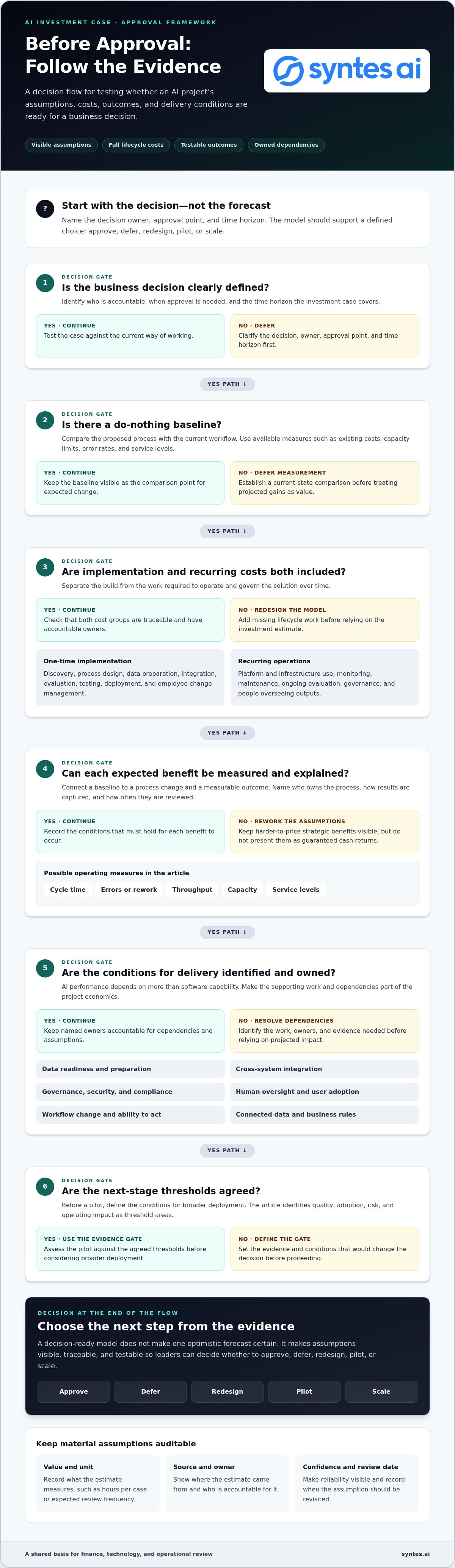
Define the decision before selecting metrics. Name the accountable decision owner, approval point, and time horizon covered by the investment case. The model should support a clear action: approve, defer, redesign, pilot, or scale. State the conditions for each choice. A pilot, for example, might proceed to broader deployment only if it meets agreed thresholds for quality, adoption, risk, and operating impact.
Set a do-nothing baseline. Compare the proposed AI-enabled process with the current workflow, including existing costs, capacity limits, error rates, and service levels where those measures are available. Separate directly measurable operating outcomes, such as handling time or rework, from strategic benefits that are harder to price, such as improved decision support. Keep qualitative benefits visible, but don’t present them as guaranteed cash returns.
What makes an AI project different from a conventional technology investment?
AI performance depends on more than software capability. Data readiness, cross-system integration, governance, human oversight, and user adoption all affect whether a solution can operate as intended. Include these dependencies in the delivery assumptions and identify who owns each one. If the initiative relies on information spread across disconnected systems, the work to connect and interpret that data is part of the project economics, not background work.
Benefits also depend on process change. A model may generate useful recommendations yet create little measurable value if employees can’t act on them, workflows remain unchanged, or outputs aren’t trusted. Treat expected gains as conditional estimates. For each benefit, record what must be true for it to occur, how it will be measured, and what evidence would change the forecast. That makes uncertainty something decision-makers can examine instead of hiding it inside a headline ROI.
The result is a decision instrument, not a prediction presented as certain. It gives finance, technology, and operational leaders a shared basis for judging the investment, testing assumptions, and setting the evidence required for the next approval gate.
How to structure AI project costs, benefits, and assumptions
A credible model makes its logic visible. Separate inputs into three categories: one-time implementation, recurring operations, and business outcomes. This avoids a common distortion: treating a successful build as the finish line while leaving the cost of running and governing the system outside the investment case. In financial modeling for ai projects, each material input should be traceable to a source, an owner, a confidence level, and a review date.
Which lifecycle inputs belong in the financial model?
Build the cost structure around the work required to deliver and sustain the use case. One-time assumptions may include discovery, process design, data preparation, integration, evaluation, testing, deployment, and employee change management. Include governance, security, compliance, and human review when the application requires them. Base these inputs on the systems, data relationships, and operating controls the initiative depends on.
Separate recurring costs from implementation. Track platform and infrastructure use, monitoring, maintenance, ongoing evaluation, governance activities, and the people needed to oversee outputs. If model use varies with activity, document the workload assumption instead of treating usage as fixed. Context Engineering helps teams surface dependencies across connected data, business rules, governance, and execution before those requirements become hidden operating costs.
Keep an assumptions register alongside the model. For each input, record:
- Value and unit: for example, hours per case or expected review frequency.
- Source and owner: where the estimate came from and who is accountable for it.
- Confidence and review date: how reliable the estimate is and when it should be revisited.
How should teams quantify AI project benefits?
Start with a measured baseline, then connect the expected process change to an outcome. Depending on the use case, relevant measures may include cycle time, error or rework rates, throughput, capacity, or service levels. Specify how each measure will be captured, who owns the underlying process, and how often results will be reviewed. Model benefits only where an accountable owner can measure the underlying process change.
Separate direct financial effects from capacity released for other work. Faster processing doesn’t automatically create cash savings. Time saved becomes a financial benefit only when there is a credible plan to reduce expenditure, avoid planned costs, or redeploy capacity to work with defined value. Otherwise, report it as a capacity or service benefit, not realized savings. This distinction keeps the business case useful without overstating what the initiative can deliver.
Link each benefit to the operating conditions required to achieve it. Adoption, workflow redesign, data quality, and human review can all affect the expected result. Syntes AI’s Context Engineering approach helps organizations connect enterprise data and business context so teams can account for these dependencies in their investment case. Explore Syntes AI’s Context Engineering approach.
How to compare modeling methods and handle AI project uncertainty
The right modeling method makes assumptions inspectable and gives decision-makers control. A spreadsheet can work for a bounded analysis when inputs, formulas, and review responsibilities are clearly managed. Established financial planning systems provide more structure for recurring planning, consolidation, and reporting across teams. AI-supported analysis can help organize information or explore scenarios, but it doesn’t replace source validation, finance review, or accountable decision-making.
Which modeling approach fits the decision and control requirements?
Match the method to the scope and governance needs of the decision. Use a spreadsheet when the analysis is limited and reviewers can trace each input and formula. Use a finance system when the model must connect to recurring planning and reporting workflows. AI assistance may speed up research or analysis, provided outputs remain linked to traceable sources and a finance owner validates them. The tool can support judgment, but it shouldn’t own it.
These approaches can work together. AI may help summarize operational evidence, while a spreadsheet or finance system holds the approved assumptions and calculations. Define where each input came from, who reviewed it, and which version informed the recommendation. An AI-generated estimate is an analytical input, not a vetted financial assumption simply because it appears precise.
How can scenarios make uncertainty decision-useful?
Build downside, base, and upside cases by changing assumptions that reflect plausible delivery conditions, not by adding arbitrary precision. Test adoption, implementation timing, data quality, and the share of projected benefits that can actually be realized. Keep each case internally consistent. For instance, slower adoption may delay operational impact, while weak data quality may increase remediation effort or reduce the usefulness of outputs.
Use sensitivity analysis to identify which variables could change the decision. If the recommendation depends heavily on adoption, focus validation on user uptake and workflow fit. If timing drives the case, examine delivery dependencies and approval gates. Uncertainty is managed through explicit assumptions and decision gates, not hidden inside a single forecast. This is the practical discipline behind financial modeling for ai projects.
Set evidence thresholds before a pilot begins. Specify which observed results would support continuation, trigger redesign, or justify a pause. Depending on the initiative, thresholds might address output quality, adoption, process impact, or governance controls. Assign an owner to each measure and define when the evidence will be reviewed. Thresholds don’t need to predict the future; they make the next decision conditional on what the organization learns.
Record what would invalidate each scenario. A delayed integration, a workflow change, or a material shift in data reliability may require revised assumptions, not a quiet adjustment to the headline forecast. By exposing these dependencies, the model gives leaders a controlled way to act, adapt, or stop as evidence develops.
How to build and validate a financial model for an AI project
Build the model in stages, then revise it as evidence replaces estimates. Keep calculations, assumptions, source data, and ownership visible so finance and technology stakeholders can inspect the same decision logic. The aim isn’t to make uncertainty disappear. It’s to make the investment case testable and the next decision clear.
What are the practical steps for building the model?
Use a documented sequence. Each step should produce an input or decision that the next step can verify.
- 1. Frame the decision. Define the use case, scope, decision owner, evaluation period, and business outcome. Record the current process baseline as a reference point.
- 2. Map the operating change. Describe how work will change if the initiative proceeds. Identify users, workflow steps, systems, data dependencies, human review, and governance needs.
- 3. Inventory economics and dependencies. Capture expected benefits, implementation activities, recurring operations, risks, and delivery assumptions. Include architecture requirements, such as connecting data across enterprise systems, where they affect scope or readiness.
- 4. Calculate scenarios. Translate documented assumptions into decision-relevant outputs. Show how the case changes under different adoption, timing, data quality, and benefit-realization conditions.
- 5. Assign validation owners. Name who will check each important input, where its evidence comes from, and when it must be updated. Preserve the source and rationale when an assumption changes.
Architecture belongs in the model because it shapes what the initiative must connect, govern, and operate. An enterprise AI infrastructure guide can help teams consider those dependencies alongside the use case instead of treating architecture as a technical detail outside the investment case.
How should finance and technology teams validate the model?
Validation is a joint control, not a final finance sign-off. Finance should trace formulas and outputs. Technology should reconcile delivery assumptions with the proposed architecture and implementation plan. Operational owners should confirm that the process baseline and expected changes reflect actual work. Check that source-system data supports the inputs and that each benefit category is distinct. For example, don’t count the same released staff capacity as both reduced labor expense and additional throughput value unless the model explains how both benefits will be realized.
Before approval, review formula integrity, scenario logic, key sensitivities, and the evidence behind material assumptions. Document unresolved gaps instead of disguising them as precise estimates. Then define stage gates that trigger a model refresh. Pilot results can replace estimated adoption, cycle time, quality, or review effort with observed measures. If the evidence changes the economics or reveals a new dependency, revise the case before committing to the next stage.
That discipline turns financial modeling for ai projects into a living control system: assumptions are owned, evidence is reviewed, and investment decisions respond to operational reality.
How enterprise context and governance strengthen AI project decisions
An AI initiative’s financial case is only as credible as its assumptions about the environment where it will operate. A workflow may depend on customer records in one system, policy documents in another, and operational events that affect which action is appropriate. If those connections, relationships, and business rules aren’t represented in the model, estimates of implementation effort, readiness, and expected value may rest on an incomplete view of the work.
Why should context and governance appear in the investment case?
Fragmented data and unclear rules affect more than technical design. They can change which information must be connected, how it needs to be interpreted, and what validation is required before an AI system can support a workflow. Model these conditions as project assumptions. For a context-dependent process, identify relevant data sources, relationships, access requirements, and operational events, then account for the work needed to make that context usable.
Governance belongs in the business case because it shapes how the system can operate responsibly. Depending on the use case, account for access controls, explainability, auditability, and human oversight. A governed agent acting across enterprise workflows needs clear boundaries for what it can access and do, along with a way for people to review or intervene. Reliable execution is an operating capability to design and evaluate, not an assumed property of a language model.
How does Context Engineering connect the model to implementation?
Context Engineering offers a structured way to think about the capabilities behind an AI workflow: Connect, Understand, Contextualize, Govern, and Execute. In investment terms, these pillars help teams identify whether an initiative must connect disparate sources, interpret their meaning, apply business context, enforce controls, and carry out work through governed execution. Each requirement can inform delivery scope, ownership, and the evidence needed to assess readiness.
A Context Graph brings structured and unstructured information into a continuously evolving operational model, linking enterprise entities and their relationships. For workflows where decisions depend on connected context, it can form part of the architecture. Syntes AI provides a Context Graph and governed agents that connect context, explainable reasoning, cross-system integration, and execution. The purpose is not to assume a financial return, but to make architectural dependencies explicit in financial modeling for ai projects.
Before evaluating an architecture, define the business decision, required context, governance controls, and measures that will demonstrate operational readiness. This gives finance, technology, and process owners a shared basis for assessing fit and testing assumptions.
Turn the business case into a path for action
The next step isn’t to make a forecast look certain. It’s to make the investment case useful as conditions change. Treat financial modeling for ai projects as a decision framework that evolves with evidence. Keep assumptions connected to accountable owners, and use each approval gate to clarify what the organization has learned and what it is ready to do next.
This is where architecture and economics meet. Syntes AI’s Context Engineering Framework connects, understands, contextualizes, governs, and enables execution. Its Context Graph is a live operational model for enterprise data and relationships. Together, they help teams examine whether the context and governance behind an initiative can support the operating assumptions in its business case, without presuming a particular financial outcome.
Bring your decision criteria and context requirements into a practical discussion about the architecture behind your enterprise AI strategy.
With clear criteria and an investment case grounded in learning, your next AI decision can move forward with purpose.
Frequently Asked Questions
What is financial modeling for AI projects?
Financial modeling for AI projects is the structured evaluation of an AI initiative’s implementation needs, operating effects, expected outcomes, and uncertainty. It helps decision-makers judge whether to pilot, approve, redesign, or scale an investment. This differs from using AI to generate or update a financial model. For example, estimating the business case for an AI-enabled claims workflow evaluates the initiative; using an AI assistant to draft spreadsheet formulas automates a modeling task.
How do you calculate the ROI of an AI project?
Compare the initiative’s expected financial benefits with its full costs over a defined period, using a baseline that reflects current operations. Decide which outcomes count as financial value, such as reduced external spending or additional revenue, and how they’ll be evidenced. Then account for the timing of costs and benefits. If faster processing frees employee time but doesn’t reduce spending or create measured capacity value, don’t report that time alone as cash savings.
What costs should an AI project financial model include?
Include the costs required to make the system usable in its real operating environment, not just to develop or configure it. Depending on the use case, this may include exception handling, fallback procedures, data retention, user support, and changes to existing processes, alongside implementation and operating work. Map each item to a delivery or operational owner. This makes omitted responsibilities easier to spot when scope changes or a pilot moves toward broader use.
How do you account for uncertainty in an AI project business case?
Represent uncertainty with scenarios that show how different assumptions affect the decision. Keep related inputs consistent: a slower rollout, for example, may delay adoption and postpone when benefits can be assessed. Record what evidence would cause the team to revise its estimate. A pilot might reveal that users need more review time than expected, prompting a change to the operating model before leaders authorize a wider deployment.
Can AI tools create a reliable financial model without analyst review?
No. AI can help extract figures from documents, summarize inputs, or draft calculations, but an accountable analyst should verify that figures match their original sources and that formulas behave as intended. Check units, date ranges, exclusions, and links between assumptions and outputs. For instance, a monthly operating figure shouldn’t be compared with an annual benefit without adjustment. Preserve review notes and version history so another stakeholder can reproduce the reasoning.
How is financial modeling for an AI project different from traditional IT project budgeting?
An AI project model needs to account for performance that may depend on changing data, user behavior, and how well the system fits the workflow. A budget that treats delivery as a fixed technology purchase can miss the effort involved in evaluating outputs and adapting processes after launch. Track operational evidence alongside financial measures, then update forecasts when system behavior or workflow conditions change. This keeps decisions grounded in how the initiative actually performs.