

What if the customer record you worked hard to unify belongs to the wrong person? Entity resolution for customer data connects fragmented records across systems, but a false match can distort analytics, customer operations, and AI decisions. Matching records is only the first step. The result must also be trustworthy, explainable, and governed.
When names, addresses, account IDs, and schemas differ across platforms, one customer can appear as several records. It’s understandable to want a single customer view, but merging records without clear evidence can create a misleading profile. A reliable approach balances accurate matching with safeguards for uncertain cases.
This article explains how entity resolution works, where its limits lie, and how to compare approaches using accuracy, explainability, governance, and integration criteria. You’ll also see how resolved identities become more useful when connected to broader enterprise context. Syntes AI’s Context Engineering approach links business information in a governed Context Graph, helping organizations relate customer entities to products, rules, documents, and operational events without treating contextualization as identity matching.
Key Takeaways
- Entity resolution for customer data links records that refer to the same person, but it is distinct from deduplication, profiling, and integration.
- Combine exact rules and probabilistic comparisons according to the available identifiers and the risks of each use case.
- Assess matching approaches by how they explain decisions, handle uncertain matches, support governance, and integrate with your systems.
- Prepare for reliable matching by defining use cases, inventorying sources, profiling data, setting policies, and validating results.
- Keep identity links separate from customer context, then connect resolved entities to relevant business relationships through a governed Context Graph.
What Is Entity Resolution for Customer Data, and Why Does It Matter?
Entity resolution for customer data determines which records refer to the same real-world customer, even when records differ across systems. It connects identities using available evidence, such as names, email addresses, phone numbers, account IDs, or transaction details. The concept is also known as record linkage; this overview of record linkage explains the term and its broader history.
The need becomes clear when one person appears as “Alex Morgan” in a CRM, “A. Morgan” in a transaction system, and under a different email address in a service platform. Each record may be valid in its own context, but none alone shows the full relationship between the customer and the organization. Teams may make decisions using incomplete or inconsistent identity information as a result.
How do fragmented customer records affect business decisions?
Fragmentation can mean a service representative misses relevant history, an analyst counts one customer more than once, or a team draws conclusions from only part of a customer’s activity. The impact depends on the systems and decisions involved, but the underlying problem is the same: disconnected records weaken the evidence available to understand and serve a customer.
The risk runs in both directions. A duplicate left unresolved can hide a connected history; a false merge can attach another person’s transactions, interactions, or preferences to the wrong identity. A mistaken combination can be as damaging as a missed connection, particularly when downstream decisions rely on that record.
What entity resolution is, and what it is not
Exact-match deduplication finds records that share identical values, such as the same email address. Entity resolution can also assess records with incomplete or differing values, using evidence to determine whether they may represent the same customer. Data integration moves or connects information between systems; customer profiling describes attributes or behaviors. These activities can support one another, but they solve different problems.
Identity resolution establishes which records may belong to the same customer; profile enrichment adds information about that customer. A resolved identity does not automatically provide a complete profile or explain the customer’s relationships to products, policies, documents, and events. That broader context requires its own data and governance decisions. Keeping these boundaries clear helps teams assess a match on its evidence instead of assuming that a unified identity is a complete or authoritative customer view.
How Customer Entity Resolution Matches Records Across Systems
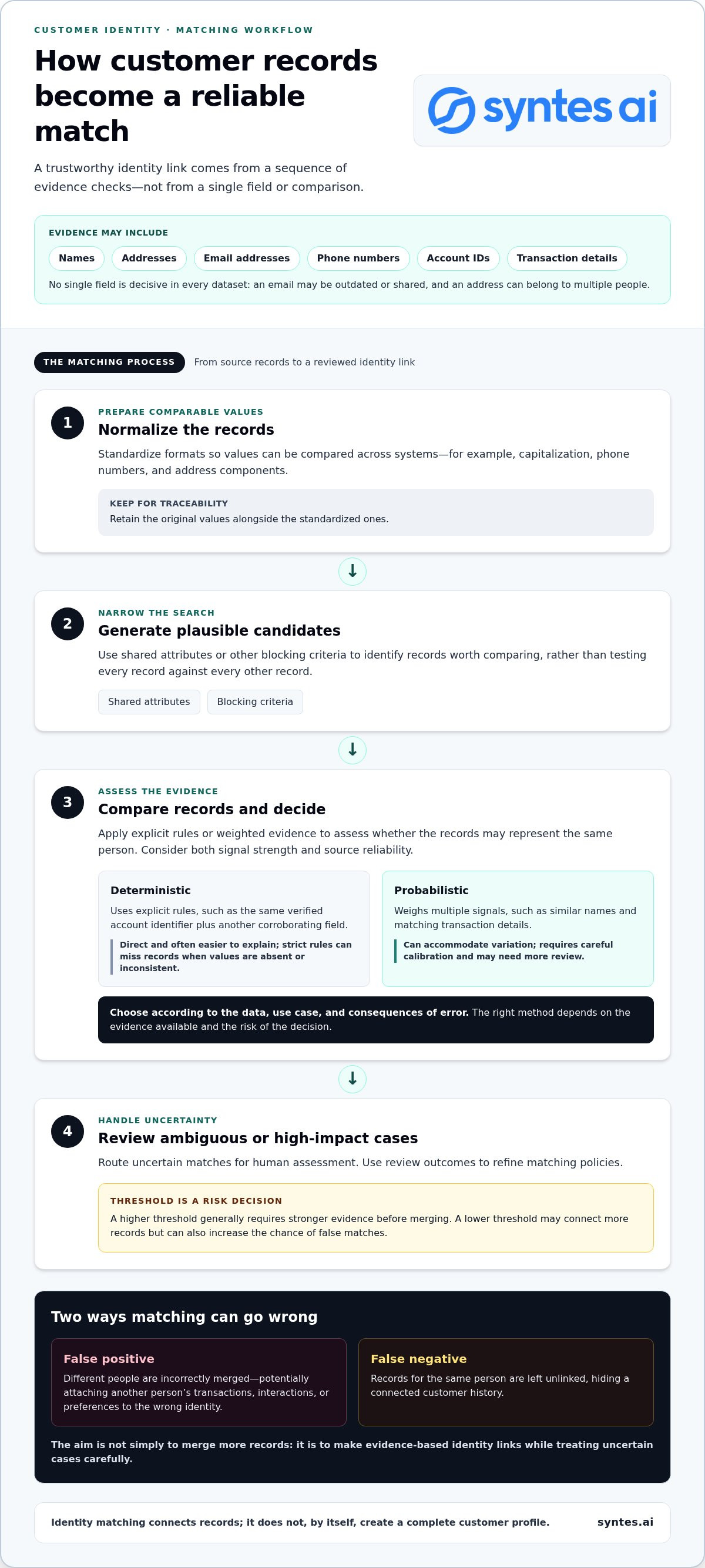
Reliable matching is a sequence, not a single comparison. Records arrive from systems such as CRM, billing, transactions, and customer service, each with its own fields and conventions. A typical workflow standardizes comparable values, narrows records to plausible candidates, evaluates the matching evidence, and routes uncertain cases for review.
- Normalize: Standardize formats such as capitalization, phone numbers, and address components while retaining original values for traceability.
- Generate candidates: Use shared attributes or other blocking criteria to identify records worth comparing, rather than testing every record against every other record.
- Compare and decide: Apply rules or weighted evidence to estimate whether records represent the same person.
- Review: Send ambiguous or high-impact cases for human assessment, and use review outcomes to refine policies.
Evidence can include names, addresses, emails, account identifiers, and transaction details. No single field is decisive in every dataset: an email may be outdated or shared, while an address can belong to multiple people. Entity resolution for customer data must account for both the strength of each signal and the reliability of its source. Research into record linkage reflects the discipline’s importance across domains; the entity resolution research center at the University of Arkansas at Little Rock focuses on its applications.
How do deterministic and probabilistic matching differ?
Deterministic matching applies explicit rules, such as matching records with the same verified account identifier and another corroborating field. It is direct and often easier to explain, but strict rules can miss records when values are absent or inconsistent. Probabilistic matching weighs multiple signals, such as similar names and matching transaction details, to assess whether records likely refer to the same person. It can accommodate variation, but requires careful calibration and may need more review. The appropriate method depends on the data, use case, and consequences of error.
A false positive incorrectly merges different people; a false negative leaves records for one person unlinked. Raising a match threshold generally demands stronger evidence before merging, while a lower threshold may connect more records but also increase the chance of false matches. Thresholds are a risk decision, not just a technical setting.
Why do relationship signals matter in customer identity?
Shared attributes can reveal relationships without proving identity. Two customers may share a household address or business account, but that does not make them one person. Model people, accounts, and transactions as distinct entities, then represent their connections explicitly. This distinction is central to an enterprise knowledge graph, where relationships add context without collapsing separate identities. To explore how governed context can support enterprise AI, see Syntes AI’s approach.
How to Evaluate Customer Entity Resolution Approaches
Choose an approach based on how well it manages identity evidence and operational risk, not a single headline accuracy score. For entity resolution for customer data, examine both kinds of error: a false match can combine different people, while a missed match leaves one person’s records disconnected. Then assess whether teams can understand, govern, and act on the resulting links.
| Approach | Match evidence | Explainability | Review | Governance | Integration |
|---|---|---|---|---|---|
| Deterministic rules | Explicit identifier or field combinations | Rules are usually straightforward to inspect | Useful for exceptions and incomplete records | Document rule ownership and changes | Check source coverage and where results are applied |
| Probabilistic comparison | Weighted evidence across fields and sources | Requires visibility into contributing signals | Route ambiguous decisions for assessment | Track thresholds, decisions, and corrections | Assess data flows and update requirements |
| Hybrid approach | Rules for clear cases, weighted evidence for variation | Inspect both rules and evidence behind decisions | Define review paths for uncertain matches | Set controls for automation and human decisions | Validate fit with source systems and downstream users |
Which resolution criteria matter most in enterprise customer data?
Start with the identifiers each use case can rely on, the quality of each source, how often records change, and the consequences of an incorrect merge or missed link. Verify source coverage, lineage, access controls, and auditability. Teams should be able to inspect why records were linked or kept separate, trace evidence to its source, and understand how corrections or disputed matches affect downstream systems. Broader data semantics and governance are explored in this enterprise semantic data layer guide.
How should teams balance automation and human review?
Use conceptual confidence bands: automate decisions supported by strong, consistent evidence; queue ambiguous or high-impact cases for review; and prevent weak evidence from triggering a merge. The bands should reflect the use case’s tolerance for false matches and missed matches, with a process for capturing reviewer corrections. Research on cross-domain entity resolution techniques illustrates the range of evidence methods researchers examine, including profile, content, and graph signals.
For organizations connecting resolved identities to governed enterprise context, explore Syntes AI’s Context Engineering approach.
How to Prepare Customer Data for Reliable Entity Resolution
Matching rules can’t compensate for unclear goals or poorly understood source data. Prepare in sequence: define the use case, inventory systems, profile records, set decision policies, then validate outcomes before expanding their use. This gives entity resolution for customer data a clear purpose and makes its risks easier to manage.
- Define the use case: Specify which customer entity is being resolved, who will use the result, and what decisions it will support.
- Inventory sources: Identify relevant CRM, transaction, service, and other systems, including their owners and update patterns.
- Profile the data: Examine available identifiers, missing values, format variations, and conflicts between systems. A field’s presence doesn’t guarantee its reliability.
- Set policies: Establish who can approve identity decisions, how permissions and audit trails work, and how corrections or unresolved cases are handled.
- Validate and refine: Review representative samples, assess false matches and missed links, and use downstream operational feedback to adjust the approach.
What should teams define before matching customer records?
Document what “customer” means for the use case. An individual, household, and business account are different entities, even if they share contact details. Record each source’s field definitions and reliability, along with nulls, variations, and update patterns. Then agree how teams will resolve conflicting values, process corrections, and preserve records that lack sufficient evidence for a confident link.
Assign stewardship before decisions move downstream. Teams need clear ownership of matching policies, controlled access to identity data, an audit trail for decisions, and a correction process that reaches systems relying on the resolved identity. Measure performance using reviewed samples and feedback from the teams and workflows that use those links, not only a model-level score.
How can resolved identities become useful enterprise context?
Identity links provide a foundation, not the finished picture. They can connect a customer entity to related transactions, products, policies, and operational events while preserving those relationships as distinct information. Maintaining that governed, changing model is broader than matching records once. Explore enterprise data silo strategies to see how cross-system context can make information more useful across the organization.
From Resolved Customer Identities to Governed Enterprise Context
A resolved identity answers a specific question: which records refer to the same customer? It doesn’t explain what that customer’s interactions mean across the business. Entity resolution establishes identity links; Context Engineering organizes business information and relationships around entities so teams and AI systems can use that information with greater clarity.
Syntes AI’s Context Graph provides a live context layer representing relationships among customers, products, transactions, rules, documents, and operational events. It does not automatically determine which records belong to the same person. Instead, it can connect customer identities established through an appropriate resolution process with relevant enterprise information, preserving the context needed to interpret those connections.
How does a Context Graph complement customer entity resolution?
A resolved customer entity might be linked to a purchase, a service interaction, a product, or a policy that applies to a particular situation. Those links need source context and governance: teams must be able to understand where information came from, how relationships are represented, and why a system is drawing a conclusion. Explainable reasoning helps make that context more useful for analytics and governed agent workflows.
Identity resolution establishes who the records represent; enterprise Context Engineering organizes what those identities mean across the business.
The Syntes AI Context Engineering progression moves through five stages: Connect relevant structured and unstructured information; Understand its entities and relationships; Contextualize information for a business situation; Govern its use and reasoning; and Execute through enterprise workflows and agents. The sequence turns connected information into governed operational context, without conflating identity matching with contextualization.
What is the next step for enterprise teams?
A focused matching capability may address a defined need, such as linking customer records for a particular system or workflow. A broader context layer becomes relevant when resolved identities must be interpreted alongside enterprise relationships and used across analytics or agent workflows. Start by mapping customer sources, identity decisions, governance requirements, and the workflows that need the resulting context. Then determine where matching ends and contextualization begins.
For enterprise AI, a trusted customer identity is a foundation, not the finished architecture. The next step is to make its relationships understandable, governed, and useful in the decisions and workflows that depend on them.
Turn Resolved Identities Into Trusted Context
Reliable entity resolution for customer data is not simply a matter of reducing duplicate records. It means matching identities with evidence, managing false matches and missed links, and making decisions explainable and correctable. Clear use cases, source-data readiness, governance, and human review help teams build a foundation they can trust.
That foundation becomes more valuable when connected to broader business meaning. Syntes AI’s Context Graph links enterprise entities and relationships across structured and unstructured data. Its Context Engineering framework brings together connection, understanding, contextualization, governance, and execution, supporting explainable reasoning and governed AI workflows without confusing context-building with identity matching.
Move from fragmented records to customer context your teams and enterprise AI can use with confidence.
With a deliberate approach, your organization can turn identity links into a clearer, more trusted foundation for analytics and action.
Frequently Asked Questions
What is entity resolution for customer data?
Entity resolution for customer data determines which records refer to the same real-world customer across one or more systems. Unlike simple duplicate removal, it can assess records with different names, identifiers, or levels of completeness. The result is an identity link, not proof that every match is certain. Enrichment adds attributes, while broader context connects the resolved customer to relevant business information, relationships, and events.
How does customer entity resolution work?
Customer entity resolution typically starts by profiling source data, standardizing comparable fields, and generating candidate records for comparison. The process evaluates identifiers and attributes, then makes or recommends match decisions. Approaches may use deterministic rules, probabilistic evidence, or a combination. Thresholds and review paths should reflect the quality of available data and the consequences of mistakes. Teams should validate decisions and revisit them as records change.
What is the difference between entity resolution and deduplication?
Basic deduplication often removes identical or near-identical rows, while entity resolution evaluates whether different records represent the same real-world entity. The linked records don’t have to be physically merged: an identity model can connect records while they remain in their source systems. Both processes depend on data quality and clear rules. Neither automatically enriches a record or creates a complete customer profile with all relevant business context.
How can entity resolution avoid false customer matches?
Reduce false matches by defining reliable match evidence, profiling source data, and testing decisions against reviewed examples. Don’t treat a shared address, account, or other field as conclusive proof that records belong to one person. Establish a review path for ambiguous or high-impact decisions, and make corrections traceable so affected identity links can be revisited. No matching approach can guarantee error-free results, so ongoing validation matters.
Can entity resolution work across CRM and transaction systems?
Yes. Records from CRM and transaction systems can be compared when relevant data and identifiers are accessible for the use case. Differences in schemas, field quality, permissions, and update patterns affect how the process should be designed. Preserve source lineage and the evidence behind a match where feasible, so teams can inspect how a decision was made. Integrating systems makes comparison possible, but doesn’t prove records share an identity.
How is entity resolution different from a knowledge graph?
Entity resolution assesses whether separate records refer to the same real-world entity. A knowledge graph represents entities and their relationships, such as a customer’s connections to products, transactions, or policies. These capabilities can complement one another: identity links may inform a graph, which can then express broader context. A graph alone doesn’t guarantee correct identity matches or replace the need for matching rules, governance, and review.
How does entity resolution support enterprise AI?
Resolved identities can reduce ambiguity when AI systems retrieve or reason over customer information, but identity links alone aren’t sufficient. AI also needs relevant business rules, permissions, source provenance, and current operational context. A governed context layer can connect customer identities with related information and make those relationships more understandable. This foundation can support analytics and agent workflows, but it doesn’t guarantee that every AI output is accurate or trustworthy.