

What if your AI doesn’t need more data, but a clearer view of how your business works? If disconnected systems make it difficult to connect customers, products, policies, and events, asking “does my business need a knowledge graph” is a practical architecture question, not a technology trend to chase.
A knowledge graph can make business entities and their relationships usable across workflows, but it also requires design and governance. If a warehouse, integration, or retrieval solution already meets your needs, a graph may be unnecessary. The key question is whether a lack of shared business context is holding back decisions or AI workflows.
This checklist will help you assess the fit: how often decisions depend on relationships across systems, whether AI lacks reliable business context, and whether teams need governed reasoning to support action. You’ll compare a knowledge graph with simpler alternatives and define a focused, measurable next step. The goal is clarity, not complexity for its own sake.
Key Takeaways
- To answer “does my business need a knowledge graph,” start with a specific business decision and identify whether its meaning depends on relationships across systems.
- Separate the knowledge model from the technology that stores it: a graph database can hold connected data, while a knowledge graph also represents entities, relationships, and meaning.
- Compare graph, database, integration, and RAG approaches against your needs for shared semantics, governance, and reuse before adding another architectural layer.
- Assess readiness by defining a decision, mapping entities, tracing relationships, reviewing governance, and setting measures for one high-friction workflow.
- Translate the findings into requirements for connection, understanding, context, governance, and execution, then evaluate them against a focused use case.
Does Your Business Have the Problems a Knowledge Graph Solves?
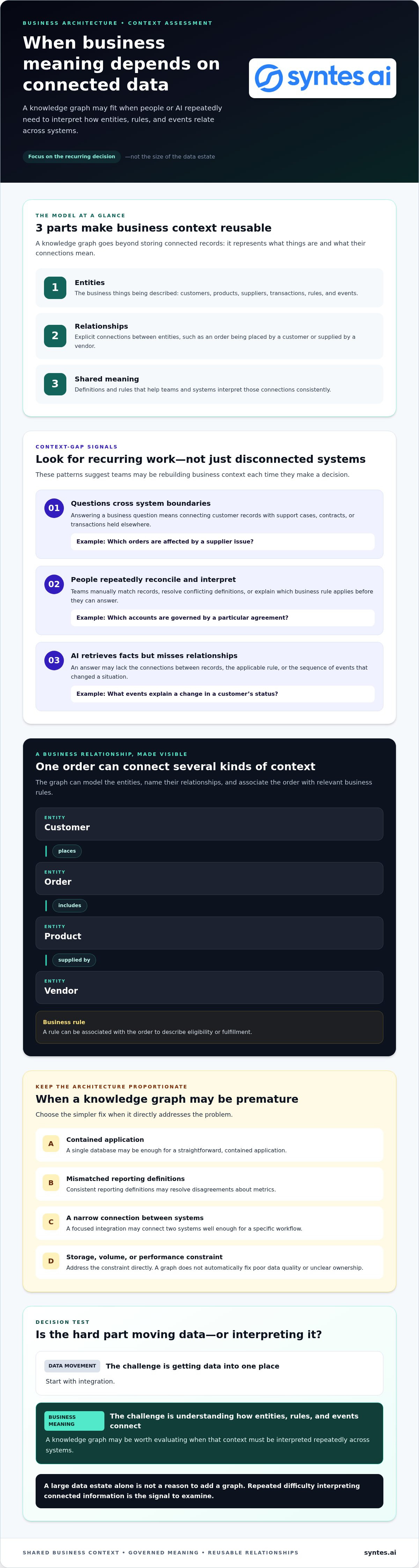
A knowledge graph is relevant when business meaning depends on relationships across systems. The question isn’t how much data you have. It’s whether teams or AI can reliably understand how a customer, product, supplier, transaction, rule, or event relates to the others. A large data estate alone doesn’t make a graph necessary. Repeated difficulty interpreting connected information may.
A Knowledge graph represents information and the relationships between it, supporting knowledge representation and reasoning. In an enterprise, it can make shared business context explicit instead of requiring each application, report, or AI workflow to reconstruct that context independently.
Which operational symptoms point to a context problem?
Look for workarounds that recur across teams. A customer record in one system may need to be matched with support cases elsewhere, active contracts in another application, and transactions in a separate platform. Product and supplier records can have similar identity and relationship gaps. Staff may repeatedly reconcile information, resolve conflicting definitions, or explain which rules apply before answering a basic operational question.
A clear signal is a question that crosses system boundaries: Which orders are affected by a supplier issue? Which accounts are governed by a particular agreement? What events explain a change in a customer’s status? If people must manually assemble entities, relationships, and changing business rules to answer these questions each time, the organization is spending time on recurring reconciliation and rework.
AI can face the same gap. An answer may be unreliable if it retrieves relevant documents but misses how records relate, which rule applies, or how a sequence of operational events changes the situation. Ask, does my business need a knowledge graph? Consider one when reliable decisions depend on context that current systems don’t preserve or share consistently.
When is a knowledge graph probably premature?
Keep the architecture simple when the problem is straightforward. A single database may suit a contained application; consistent reporting definitions may resolve mismatched metrics; and a narrow integration may connect two systems well enough for a specific workflow. A small, stable dataset with few changing relationships may not justify another semantic layer.
Separate the requirement from the technology interest. If the main constraint is storage capacity, data volume, or report performance, address that constraint directly. A graph won’t automatically fix poor data quality or unclear ownership. Its value comes from representing business relationships and meaning in a reusable way, not from adopting graph technology for its own sake.
Decision test: Identify a recurring decision that requires information from multiple systems. If the challenge is simply getting the data into one place, start with integration. If the challenge is repeatedly interpreting how entities, rules, and events connect, a graph may be worth evaluating.
What a Knowledge Graph Adds Beyond Connected Data
An enterprise knowledge graph is a connected model of business entities, their relationships, and the shared meaning that lets people and systems interpret them consistently. A conventional database primarily organizes and stores records, while a knowledge graph makes connections and definitions part of the model. A graph database is one technology for storing graph-shaped data; it isn’t the same thing as the business knowledge represented in the graph.
IBM describes a knowledge graph as a network of real-world entities connected by relationships. In an enterprise model, those connections can bring structured records into context with documents, business rules, and operational events. The value isn’t simply that information is linked. It’s that the links have defined meaning that can be reused across applications and decisions.
How entities, relationships, and business meaning fit together
Consider an order placed by a customer for a product supplied by a particular vendor. The graph can represent each as an entity, connect them through typed relationships such as “placed by,” “includes,” and “supplied by,” and associate the order with a rule that governs eligibility or fulfillment. Shared definitions can help systems distinguish a current supplier from a former one, or an order’s customer from its delivery recipient.
This model can connect information without replacing the systems that own it. Customer, order, and supplier records can remain in their source applications, while the graph provides a unified context layer for interpreting their relationships. A graph is not automatically a new system of record, and it won’t make ambiguous definitions or inaccurate source data correct by itself.
How graphs support enterprise AI and operational decisions
Connected context can help AI retrieve relevant facts alongside the relationships that explain them. In GraphRAG, graph context can complement document retrieval. Semantic search can use shared business definitions to interpret a query—a principle also leveraged in search engine and generative engine optimization by specialists like Dex Agence—while an agent can use modeled relationships when reasoning through a workflow across systems. Governance can shape which context is available and how actions are controlled. These capabilities can support more grounded, explainable workflows, but they don’t guarantee a correct answer or decision.
That’s the architectural distinction to test: does your business need a knowledge graph because AI or operational workflows must interpret relationships, rules, and events together, or would search and connected records be sufficient? For a deeper look at the architecture, explore an enterprise knowledge graph approach. If you’re evaluating how connected context could support governed AI and cross-system execution, see how the Syntes platform approaches context.
Knowledge Graph vs. Database, Integration, or RAG: Which Fits?
These approaches solve different problems, and they can work together. A knowledge graph models entities, relationships, and shared business meaning. A relational database stores and queries structured records. Data integration moves or synchronizes information between systems. Retrieval-Augmented Generation (RAG) finds relevant source material for an AI system to use. The right choice depends on the constraint, not on which technology sounds most advanced.
| Approach | Relationship complexity | Shared semantics | Governance needs | Cross-system reuse |
|---|---|---|---|---|
| Knowledge graph | Useful when decisions depend on multiple connected entities and relationships. | Can represent common definitions, relationship types, and business rules. | Supports governance of shared context and its use across workflows. | Designed to make modeled context reusable across systems and use cases. |
| Relational database | Well suited to structured records and relationships that fit defined schemas and queries. | Can support consistent meanings through schema and data definitions. | Governance applies to data, access, and quality within the database environment. | Reuse is strongest where applications can access and interpret its structures. |
| Data integration | Connects systems and moves or synchronizes data; it doesn’t necessarily model complex meaning. | Can align fields and formats, but shared business semantics may require additional design. | Focuses on controlling data movement, mappings, and system connections. | Useful for making selected data available across connected applications. |
| RAG | Retrieves relevant passages or records; relationships may be implicit or absent. | Can use retrieved content, but shared definitions aren’t inherent to retrieval. | Requires controls over source access, retrieval, and AI use. | Can serve multiple queries, though context may need to be assembled for each request. |
When a database or integration layer may be enough
Choose a conventional database for stable tabular workloads, predictable transactions, or reporting built on clear definitions. Use integration when the need is to synchronize a few systems or move specific records between them. A broader context model becomes worth evaluating when the same relationships must be reconstructed repeatedly, queries span multiple domains, or teams interpret key entities and rules differently.
When RAG needs a connected context layer
RAG can retrieve useful source material, but documents alone may not reveal how records relate or which rule governs a case. GraphRAG combines retrieval with graph relationships when a use case depends on connected context. It also adds modeling and governance considerations, so it isn’t automatically the better option. A focused technical assessment should compare answer quality and traceability for the actual workflow. Ask, does my business need a knowledge graph? Start with the decision the system must support, then add a graph only if its relationships and semantics address a demonstrated gap.
A Business Checklist for Assessing Knowledge Graph Readiness
Don’t begin with an enterprise-wide graph. Begin with one costly or high-friction workflow where a decision depends on context spread across systems. This keeps the evaluation grounded in business need and gives teams a way to determine whether a graph addresses a real constraint.
How to define a testable business use case
State the decision or workflow in practical terms, such as resolving a case that requires customer, account, and policy information from separate systems. Name an accountable business owner, document how the work happens today, and set a baseline before choosing a technical design. Then identify the entities, relationships, rules, and events needed to answer the business question.
Use this five-step readiness checklist:
- Define the decision: Specify the business question or workflow the evaluation will support.
- Map the entities: List the records and concepts involved, along with the systems that hold them.
- Trace the relationships: Document how those entities connect and which rules or events change their significance.
- Assess governance: Identify data owners, access controls, quality dependencies, and responsibilities for shared definitions.
- Set measures: Choose observable outcomes, such as reconciliation effort, answer consistency, or workflow completion time.
Make the measure specific to the workflow and compare it with the baseline. For example, record how much effort teams spend reconciling records or how often reviewers reach consistent answers before and during an evaluation. Don’t assume a graph will improve these outcomes; test whether connected context makes a measurable difference.
How to test governance and data readiness
Before implementation, inventory each relevant source: who owns it, who may access it, how frequently it changes, and what data quality issues could affect the use case. Identify business terms and rules that need review or stewardship, especially if different teams define the same entity or status differently. Also determine what needs to be traceable so people can understand how context informs an answer or action.
Readiness decision: A focused graph evaluation is justified when the workflow depends on cross-system relationships, existing methods repeatedly reconstruct those relationships, and an owner can measure a defined outcome. If the decision, data ownership, or baseline remains unclear, resolve those gaps first. If policy requirements need deeper treatment, consult guidance on data governance for AI models.
From Readiness Checklist to a Governed Enterprise Context Layer
A readiness checklist becomes valuable when its findings shape platform requirements. Translate the workflow into five capabilities: connect the relevant information, understand its business meaning, contextualize it through relationships and rules, govern its use, and execute approved actions. This keeps the evaluation anchored to the operational need rather than treating a knowledge graph as an isolated database purchase.
What to evaluate in an enterprise context platform
Test the platform against the sources and controls your use case actually requires. Can it connect structured records and unstructured documents? Can it represent entities, relationships, business definitions, rules, and operational changes in a shared context model? Assess how permissions are applied, how reasoning can be explained, and what information is available for review when AI supports a decision or action.
These are separate evaluation dimensions. A broad set of connectors won’t establish whether business meaning is modeled consistently. A rich context model won’t, on its own, show whether access is appropriately governed. Define acceptance criteria for each requirement, then test them against the workflow and measures established in your readiness assessment.
How Syntes AI connects context engineering to governed execution
Syntes AI organizes its Context Engineering Framework around Connect, Understand, Contextualize, Govern, and Execute. The sequence links information access and interpretation to shared context, governance, and operational use. Its Context Graph is a live operational model and unified context layer, connecting structured and unstructured enterprise information while source systems remain part of the environment.
The graph provides a context layer for AI and workflows; it isn’t a replacement for every system that holds business records. Governed agents can use enterprise context to reason across connected information and perform actions where the workflow calls for them. Evaluate whether the platform can apply the right context and controls to your defined use case, with reasoning that can be understood. A knowledge graph can support more informed action, but it doesn’t guarantee that every AI answer or outcome will be correct.
If your assessment points to a clear need for connected context, governance, and execution across systems, Book a Syntes AI demo.
Turn Your Knowledge Graph Decision Into a Measurable Next Step
The answer to “does my business need a knowledge graph” depends on whether important decisions require connected context that current systems don’t make reusable. If they do, start with one high-friction workflow, define its relationships and governance needs, and measure a clear baseline. If a database, integration, or RAG approach already solves the problem, adding a graph may only add complexity.
For organizations evaluating a broader context layer, Syntes AI brings together a live Context Graph, enterprise integrations, and governed AI capabilities. Its Context Engineering Framework spans Connect, Understand, Contextualize, Govern, and Execute, linking business information to controlled operational use.
Use your checklist to define the decision, constraints, and success measures you want to test. A focused evaluation can help you move forward with evidence and a clear view of what connected context should enable.
Start with the workflow that matters most, and build toward greater operational clarity one measurable step at a time.
Frequently Asked Questions
Does my business need a knowledge graph?
Your business may need a knowledge graph if decisions or workflows depend on connecting entities, relationships, and business meaning across systems. Large datasets alone aren’t a reason to add one. Ask whether current tools repeatedly fail to assemble the context people or AI need. Before committing to a graph architecture, choose one measurable use case, identify its governance requirements, and compare a graph with simpler alternatives such as database improvements, integration, or RAG.
What types of businesses benefit most from a knowledge graph?
Organizations benefit when important work depends on complex relationships among customers, products, suppliers, projects, policies, and transactions. Financial services, manufacturing, healthcare, and retail are examples of sectors where cross-system decisions may involve these connections, but an industry label doesn’t establish fit. Operational complexity matters more: consider whether teams need to reuse shared definitions, connect information across applications, and reason over relationships to make decisions consistently. For enterprise retail teams evaluating ways to unify complex systems, read more about Ommni and its approach to scalable operations.
Can a knowledge graph replace my database or data warehouse?
Usually, a knowledge graph complements databases and analytical warehouses rather than replacing them. Source systems can continue to hold operational records, while a graph represents connected meaning across those sources as a semantic context layer. The appropriate architecture depends on workload, data ownership, performance requirements, and which relationships the business needs to interpret. A graph should address a defined context need, not displace systems that already serve their storage or analytics purpose.
Is a knowledge graph better than RAG for enterprise AI?
Neither approach is universally better. RAG retrieves relevant source content for an AI response, while a knowledge graph explicitly represents entities and relationships. If a task depends on how records connect or on applying business rules, graph context may help. GraphRAG can combine graph structure with retrieval when both relationships and source-grounded content matter. Choose based on the task’s context requirements, not on a blanket preference for one architecture.
How do I know if my data is ready for a knowledge graph?
Readiness means you can identify the key entities and relationships for a use case, access relevant data, and establish accountable owners for its sources. Critical business definitions must also be clear enough to govern. Perfect data quality isn’t required, but unresolved ownership or conflicting definitions can weaken the model. Start by documenting one focused workflow and the specific context it needs, then identify quality and governance gaps before expanding scope.
What should a knowledge graph pilot measure?
Measure outcomes tied to the selected workflow, not abstract graph activity. Useful baselines may include time spent reconciling information, consistency of answers, task completion time, or analyst effort. Record the current state and define what improvement would matter before implementation. The right indicators depend on the decision the graph is intended to support. Avoid assuming universal savings or guaranteed results; use the pilot to determine whether connected context changes the outcome.
Do knowledge graphs prevent AI hallucinations?
No. A knowledge graph can provide structured, governed business context, but it can’t guarantee that every AI output is correct. Results also depend on source data quality, retrieval, model behavior, permissions, and validation. To manage risk, evaluate answers against known cases, preserve explainable reasoning, and apply human oversight where the consequences warrant it. Treat graph grounding as one part of a broader approach to reliable, governed AI, not as a standalone guarantee.