
What if the most useful view of your organization showed how work actually gets done, not just what your systems store? A digital twin of an organization aims to do that by connecting operational information and representing relationships among processes, people, systems, and data. The idea sounds straightforward. In practice, the term is used inconsistently, and fragmented information can make it difficult to know what the model represents or whether it’s current.
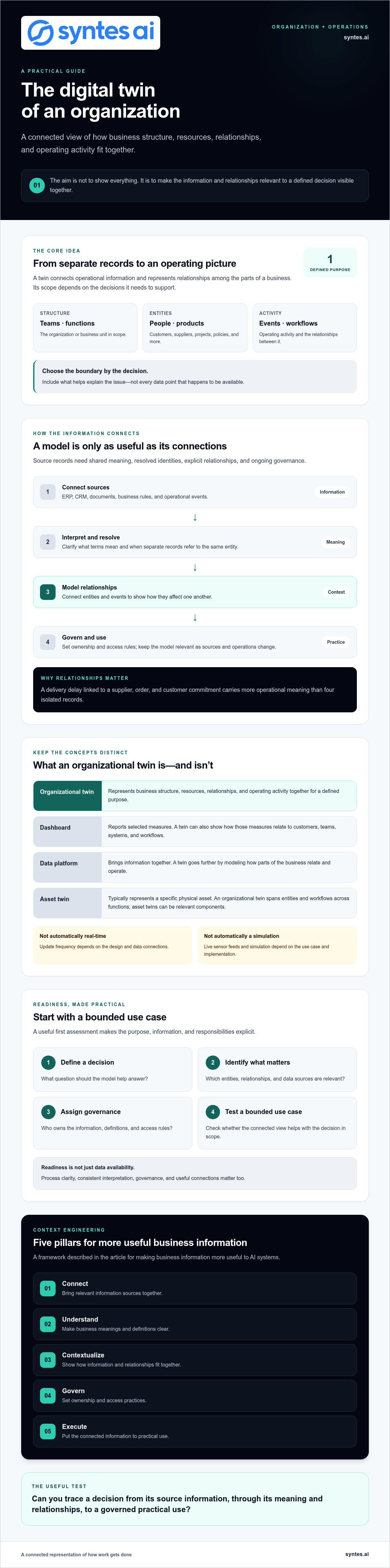
A dashboard reports selected measures. A data platform brings information together. An organizational twin goes further by modeling how parts of the business relate and operate, so leaders can examine decisions in context. That representation is useful only when its sources, relationships, and update practices are clear.
This article explains the concept without vendor jargon. You’ll learn what an organizational twin may represent, how connected data and business relationships support a more complete view, and what keeps that view relevant as operations change. You’ll also find practical questions to assess whether your organization has the data foundations, process clarity, and governance needed to make a twin useful.
Key Takeaways
- A digital twin of an organization models how business structure, resources, relationships, and operating activity connect, with scope shaped by the decisions it needs to support.
- Trace operational data from source systems through interpretation, relationship modeling, governance, and practical use.
- Distinguish an organizational twin from a knowledge graph or process model by comparing what each represents and the questions it helps answer.
- Assess readiness by defining a decision, identifying relevant entities and data sources, assigning governance, and testing a bounded use case.
- Explore how Context Engineering’s five pillars, Connect, Understand, Contextualize, Govern, and Execute, can help make business information more useful to AI systems.
What Is a Digital Twin of an Organization, and What Does It Represent?
A digital twin of an organization is a digital representation of its structure, relationships, resources, and operating activity, assembled to reflect how the business works for a defined purpose.
There isn’t one universal industry definition or fixed scope. One model might connect a single process or business unit; another might span functions across an enterprise. The defining idea is not size, but representation: the model makes relevant entities and their relationships visible together. For background on the broader concept, see Digital twin.
That makes an organizational twin more than a dashboard. A dashboard displays selected measures, while a twin can represent how those measures relate to customers, teams, systems, and workflows. Its operational context may change as source information changes, but update frequency and detail depend on the design and data connections. The goal is a useful view of how work and business relationships fit together, not a visual layer for its own sake.
What information can an organizational digital twin represent?
Depending on the question it needs to answer, a model may include customers, products, suppliers, projects, policies, transactions, and operational events. Structured records, such as a transaction or project entry, provide defined fields and identifiers. Unstructured documents, such as policies or project reports, can add explanations, conditions, and decisions that a record alone may not capture.
These sources become more informative when their relationships are explicit. A supplier can be linked to a product, contract, delivery event, and dependent project. Set the model’s boundary according to the decision: include information that helps explain the issue, rather than treating every available data point as necessary.
How is it different from an asset digital twin?
An asset twin typically represents a specific physical asset, such as a machine or building, and may draw on design, condition, or sensor information. An organizational twin spans entities and workflows across functions, connecting business activity that may otherwise sit in separate systems.
Enterprise scope doesn’t replace asset-level twins. It can provide a broader operating view in which those focused models are relevant components. Organizational scope also doesn’t automatically mean live sensor feeds or simulation. Those capabilities depend on the use case and implementation.
How Does a Digital Twin of an Organization Stay Connected to Real Operations?
A digital twin of an organization stays useful only when its data connections, business meanings, relationships, and maintenance practices are designed together. The model doesn’t update itself simply because it represents a business. Teams need to define where information comes from, how it’s interpreted, and what happens when source records or operating rules change. The U.S. government agency on digital twins provides a standards-focused perspective on the broader field.
From enterprise data sources to a shared operational model
Building the model involves a sequence of connected steps. ERP and CRM systems, for example, contribute different records: an ERP may hold purchasing or fulfillment activity, while a CRM may capture customer accounts and interactions. Documents, business rules, and operational events add context that structured records alone may not contain.
- Connect: Identify relevant systems, documents, and event sources, then establish how their information can be accessed.
- Interpret: Define what fields and terms mean in the business. A “customer,” “active project,” or “completed order” may have different definitions across functions.
- Resolve entities: Determine when records in separate systems refer to the same organization, product, person, or project, while preserving their source details.
- Model relationships: Link entities and events to show how they affect one another. A delivery delay connected to a supplier, order, and customer commitment carries more operational meaning than four isolated records.
- Govern and use: Apply ownership and access rules, then make the model available for a defined analysis or workflow.
Not every implementation updates at the same pace. A periodic refresh imports information on a schedule; event-driven updates respond to specified changes; real-time streams continuously deliver data. A twin may use one approach or a combination, depending on source capabilities and the decision it supports. Define what “current” means for the use case instead of assuming the model is automatically up to date.
How governance keeps the model trustworthy
Governance establishes who owns each data source, who can access information, which business rules apply, and how lineage can be traced back to its origin. It also defines maintenance responsibilities: when a source field changes, a policy is revised, or a business definition shifts, someone must assess and update the model. Without that process, relationships can quietly become misleading.
Traceable evidence helps users inspect where information came from and how it was interpreted. It supports explainability, not perfect accuracy. Data can be incomplete, delayed, or incorrectly matched, so validation and clear accountability remain essential.
For teams exploring connected business context for governed AI use, discuss Syntes AI’s enterprise AI approach as one possible part of a wider architecture, not as a complete organizational twin by itself.
How Does an Organizational Digital Twin Differ from a Knowledge Graph or Process Model?
These terms describe different layers of an enterprise architecture, not interchangeable names for the same tool. A digital twin of an organization is the business representation and its intended use. A knowledge graph, process model, dashboard, or process-mining method may contribute to that representation, but none automatically constitutes the whole twin. The Digital Twin of an Organization (DTO) concept extends digital-twin thinking beyond physical objects to organizational processes and systems.
| Approach | Purpose | Core representation | Typical inputs | Possible outputs |
|---|---|---|---|---|
| Organizational digital twin | Represent relevant parts of how an organization operates | Entities, relationships, rules, and operational context | Business records, documents, events, and other connected information | A contextual view for analysis or decision support, depending on implementation |
| Enterprise knowledge graph | Structure connected information and its meaning | Entities, relationships, and semantic definitions | Records and content from business sources | Connected context that can support search, reasoning, or a broader twin |
| Process model or process mining | Describe or examine how a defined process works | Activities, steps, events, and their sequence | Process documentation or event logs | A process map or analysis of observed process behavior |
| Dashboard | Monitor selected measures | Metrics, charts, and thresholds | Aggregated or selected data | A view of reported performance indicators |
Organizational digital twin vs. enterprise knowledge graph
A knowledge graph provides a way to express that a supplier serves a product line, a policy governs a workflow, or an event affects a project. Its strength is the explicit structure of entities and relationships. The twin is broader: it defines which parts of the organization are represented, why they matter, and how that representation supports a business purpose. A graph can provide a twin’s relationship and context layer, but it isn’t automatically the complete model, operating process, or decision system.
Organizational digital twin vs. dashboards and process mining
A dashboard answers questions about selected indicators, such as order volume or delivery performance. It may show what changed without representing the business relationships behind that change. Process mining uses event data to examine how a process behaves in practice, including variations between recorded activity and an expected sequence. That analysis can inform a twin, while the twin may place process information alongside related entities, rules, and context.
Nor does “digital twin” require a 3D simulation. A model of an organization may be data-centered, with connected information and defined relationships rather than a visual replica. Simulation, prediction, and automated action are implementation choices, not guaranteed properties. Choose the architecture by the decisions it must support, then identify the components needed to represent the relevant business context.
How Can an Organization Assess Readiness for a Digital Twin?
Readiness isn’t a shopping checklist. It’s a business and data question: can your organization assemble reliable, governed context to support a specific decision or workflow? A digital twin of an organization is more likely to be useful when leaders know what they need to understand, who owns the relevant information, and how teams will use the resulting view.
Choose a bounded business question before mapping the enterprise
Set evaluation criteria before testing. These might include whether users can trace information to its source, see the relationships behind a recommendation, or identify missing evidence before a decision. Evaluate decision support using observable criteria, such as completeness and traceability, rather than assuming a connected model will improve outcomes on its own.
Test data, governance, and adoption readiness
Assess the foundations that keep shared context dependable. Check data ownership, agreed definitions, known quality issues, access permissions, and how often each source is updated. Confirm whether documents and records can be used for the intended purpose. A data source that exists but lacks clear ownership or appropriate access may not be ready to support the use case.
Assign accountable business and technical stakeholders. Business owners clarify definitions and operating rules; technical stewards maintain source connections and data handling. Together, they need a process for reviewing changes to systems, policies, and information. Without ongoing ownership, even a well-designed model can drift from current operations.
Finally, test whether users can interpret, challenge, and act on the output within existing controls. Can they see supporting evidence? Do they know when to escalate an uncertain result? Are access boundaries clear? Adoption depends not only on technical connectivity, but also on whether the model fits real decision rights and working practices—an area where workforce intelligence platforms like elli can help teams evaluate employee engagement and change readiness.
- Define: State the decision or workflow to support.
- Scope: Identify the people, entities, systems, rules, and relationships involved.
- Inspect: Review source quality, definitions, access, and update practices.
- Govern: Name owners and establish maintenance and review responsibilities.
- Test: Evaluate a bounded use case against clear criteria for traceability, completeness, and usability.
A focused assessment can show whether the next step is a broader organizational model or foundational work on data and governance first.
How Can Context Engineering Support a Digital Twin of an Organization?
An organization-wide model needs more than connected data. Information must be interpreted, placed in business context, governed, and made usable for a defined purpose. Context Engineering addresses this work by establishing the meaning and relationships that allow enterprise information to support analysis and AI reasoning, rather than leaving systems to operate on disconnected records.
The Syntes Context Engineering Framework organizes this work around five pillars: Connect, Understand, Contextualize, Govern, and Execute. Together, they provide a way to move from source information to governed use. For a digital twin of an organization, this discipline may support the context layer behind a connected operational representation. It doesn’t, by itself, define the model’s scope or make it a complete twin.
Where a live Context Graph fits
A graph can connect business entities and relationships with relevant rules, documents, and operational events. Rather than treating each item as an isolated record, it can represent how they relate and provide a shared context layer for enterprise intelligence. Syntes AI describes its Context Graph as a live operational graph and unified context layer that connects structured and unstructured business information.
That context may support governed AI applications by giving them connected business information to reason over. Its usefulness depends on the sources, definitions, access controls, and maintenance practices established for the intended use. A Context Graph should not be assumed to provide complete enterprise coverage, simulation, or autonomous control. Those are separate requirements to assess.
What to clarify before evaluating a platform
Evaluate the architecture against operational needs, not labels. Ask which systems and data types can be connected, how changes are reflected, and whether users can trace information back to its source. Clarify how permissions and business rules are applied, how reasoning is made understandable, and how decisions or actions are audited. Confirm who owns definitions and maintains the context as systems and policies change.
For related concepts, explore guides to enterprise knowledge graphs and the enterprise semantic data layer.
Context infrastructure can enable important parts of a digital-twin approach, but it isn’t automatically the complete organizational model. Define the business question, scope, and governance requirements first, then assess how the context layer fits.
Turn Connected Context Into Better Decisions
A digital twin of an organization is useful when it represents how the business operates, not merely the information stored in its systems. Its scope should follow a clear decision or workflow, supported by connected data, meaningful relationships, defined update practices, and accountable governance.
Readiness starts with practical questions: Which decision needs better context? Are the relevant sources and business definitions reliable? Can users trace, interpret, and challenge the information they act on? A focused use case can help answer these questions before an organization expands its model.
Context Engineering can structure the work of connecting, understanding, contextualizing, governing, and using business information. The Syntes Context Engineering Framework names these pillars Connect, Understand, Contextualize, Govern, and Execute. The Syntes AI Context Graph is described as a live operational graph and unified context layer that may support connected enterprise intelligence, while remaining distinct from a complete organizational twin.
Start with the business question, build context with intention, and move forward one well-governed decision at a time.
Frequently Asked Questions
What is a digital twin of an organization?
A digital twin of an organization is a digital model of selected parts of how a business operates, including its structure, resources, relationships, and activity. Its scope can cover an enterprise, a business unit, or a specific workflow. Unlike a simple collection of reports, it connects relevant information to show how organizational entities relate. The model’s purpose and boundaries should reflect the decisions or operational questions it is intended to support.
How does a digital twin of an organization work?
It brings relevant information from business systems and documents into a shared representation, interprets what that information means, and models connections among entities and activities. For example, an organization might relate customer records, orders, supplier details, and delivery events to understand an operational issue. Governance defines ownership, access, and maintenance practices. Data may update periodically, in response to events, or through real-time streams, depending on the implementation.
What is the difference between an organizational digital twin and a knowledge graph?
An organizational digital twin describes a model of how selected parts of a business operate and what the model is intended to support. A knowledge graph is a structure for representing entities, relationships, and their meaning. It can form part of a twin’s context layer by connecting information across systems, but it isn’t automatically the full model. A twin may also depend on defined scope, source data, governance, and ways to use the representation.
Can a digital twin represent an entire organization, not just physical assets?
Yes. An organizational twin can span business functions and represent processes, people, systems, resources, rules, and relationships, rather than focusing only on a machine or building. Its coverage depends on the decisions it needs to support and the information an organization can connect and govern. Enterprise-wide scope doesn’t require replacing asset-level twins; focused models of equipment, sites, or processes may remain useful components of a broader operational view. For organizations managing physical infrastructure, collaborating with specialists in Facilities Management Consulting UAE can help align site-level operational data with broader enterprise workflows.
Does an organizational digital twin need real-time data?
No. The required update frequency depends on the use case. A model supporting a periodic planning decision may work with scheduled refreshes, while operational monitoring might require event-driven updates or real-time data streams. These approaches aren’t interchangeable, and not every source supports every update pattern. Define what “current” means for the decision, then verify source capabilities, update delays, and maintenance responsibilities before relying on the model.
What data is needed to create a digital twin of an organization?
Use data that helps answer the intended business question. Depending on scope, this may include structured records from ERP or CRM systems, operational events, business rules, policies, and documents. Records can identify transactions or entities; documents may explain requirements and decisions. Just as important are shared definitions, reliable links between records, appropriate access controls, and clear ownership. More data doesn’t automatically create a more useful representation.
How can organizations get started with a digital twin?
Start with a bounded decision or workflow affected by fragmented information, rather than attempting to map the entire enterprise immediately. Identify the teams, systems, entities, rules, and relationships needed to support it. Review data quality, definitions, access, and update practices, then assign business and technical owners. Test the model against observable criteria such as traceability, completeness, and usability. Use what the test reveals to decide whether to expand or strengthen foundations first.