

The biggest AI opportunity can also become a concentration risk. De-risking AI investments means weighing potential returns against exposure to a narrow group of companies or technologies, while testing whether each investment can withstand cost, regulatory, reliability, and operational pressures. The practical answer is to assess the whole risk profile, then scale exposure and adoption in stages.
It is reasonable to see AI as a potential source of growth while still asking whether enthusiasm is outpacing evidence. Concentration can expose portfolios to the same market forces, while businesses may commit resources before workflows, controls, and data are ready to support dependable results.
This article explains how to assess AI investment costs and exposure, account for regulatory uncertainty, evaluate reliability and data risks, and use staged adoption to limit avoidable downside. You will find a practical framework for deciding where AI fits, what to measure, and when broader deployment is justified.
Key Takeaways
- Build the full cost picture around data readiness, integration, governance, and adoption, not just the initial technology decision.
- Map regulatory exposure across the markets and operations where AI will be used, then align oversight before scaling.
- Test AI for reliability, explainability, and auditability in the workflows where errors could have the greatest impact.
- Assess data integrity, fraud vulnerability, compliance gaps, operational inefficiencies, and model bias before deployment.
- Start with a bounded use case, prepare employees alongside the technology, and use measured outcomes to guide expansion.
AI implementation costs and adoption
In 2024, 72% of organizations were turning to AI-driven solutions for business challenges. That adoption figure signals opportunity, not a reliable return. A sound investment case connects the technology to a defined workflow, a measurable operating outcome, and the costs required to sustain it.
How do AI investment risks and returns compare across infrastructure, models, and applications? Infrastructure can capture demand from across the AI ecosystem, but it requires substantial capital and is exposed to changing technology needs. Model investments depend on continued relevance and differentiation. Applications can demonstrate value through specific workflows, but depend on adoption and reliable integration.
What are the biggest financial and operational risks of investing in AI? Financial exposure includes spending on infrastructure or model access before demand and returns are clear. Operational risks include poor data quality, integration friction, limited employee use, and token consumption that grows faster than the value delivered.
Build a cost model around the full operating lifecycle, not just procurement. Include data preparation, integration, security controls, model usage, evaluation, employee enablement, and ongoing oversight. For example, a document-assistance workflow may need access to enterprise records, permissions, review steps, and monitoring, as well as model calls. Each component consumes resources, even when no single purchase captures the total.
Data readiness can shift both schedule and cost. Collecting and labeling datasets typically consumes 60-80% of AI project timelines. That makes data access, quality, and ownership early investment questions, not tasks to defer until development. Inventory the information a use case needs, identify gaps, and determine how teams will maintain relevant data as processes change.
Token costs and user access require operational controls. Each prompt and generated response consumes tokens, so frequent use, long inputs, and repeated model calls can increase consumption. Estimate expected usage by workflow and user group, then compare actual consumption with business outcomes. Set access by role and purpose: broad access without workflow design can generate usage without meaningful adoption.
Measure adoption from deployment onward. If AI remains outside daily workflows, productivity gains may not materialize. Some organizations found that work behaviors had not materially changed six months after significant AI investment. Track active use, workflow completion, review effort, and operational outcomes from the start, then show leadership whether usage is changing the work. Tie continued funding to evidence: expand where adoption and outcomes align, refine where either lags, and stop where the use case does not justify its operating burden.
AI policy and regulatory uncertainty
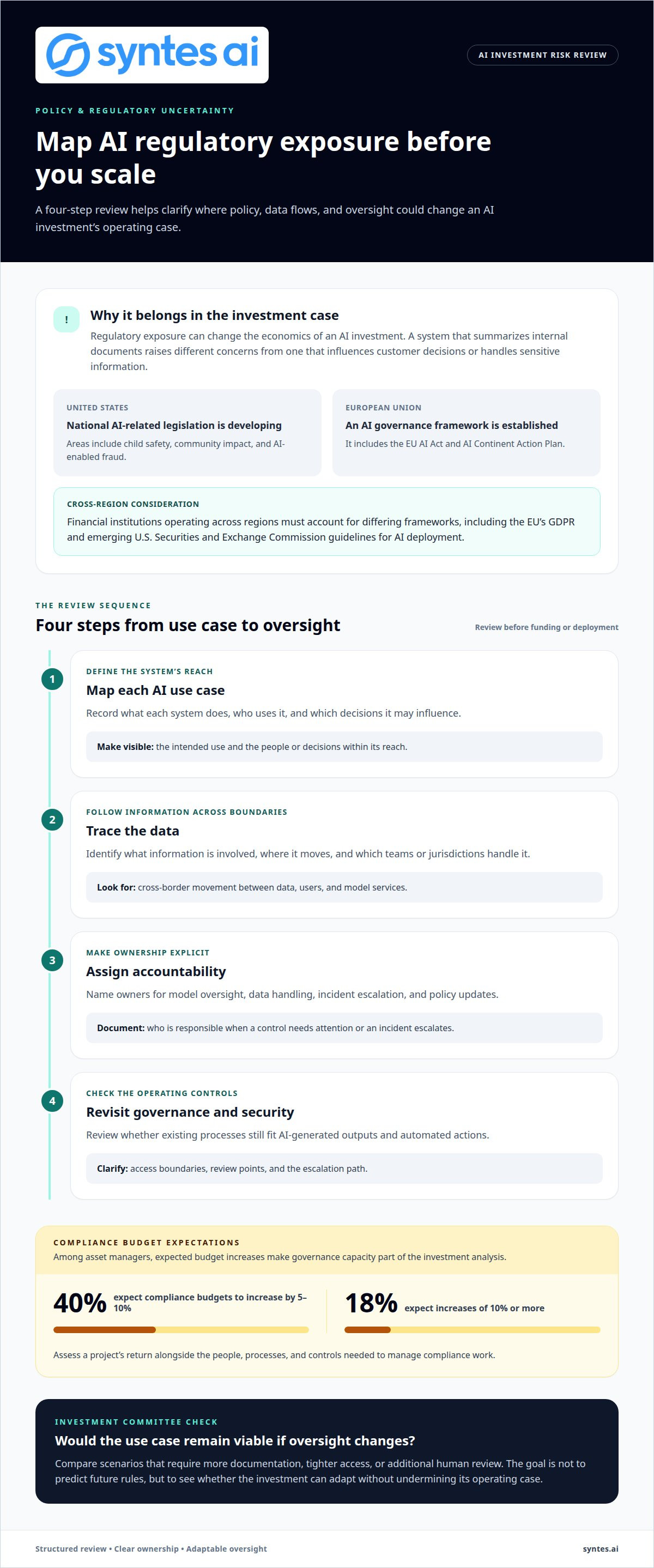
Regulatory exposure can change the economics of an AI investment. A system that summarizes internal documents raises different concerns from one that influences customer decisions or handles sensitive information. In the United States, national legislation addressing AI-related societal concerns is developing, including child safety, community impact, and AI-enabled fraud. Treat policy change as a planning factor, not a distant abstraction.
The European Union has established an AI governance framework that includes the EU AI Act and AI Continent Action Plan. Financial institutions operating across regions must account for differing frameworks, including the European Union’s GDPR and emerging U.S. Securities and Exchange Commission guidelines for AI deployment. The practical implication is operational complexity across jurisdictions, especially when data, users, and model services cross borders.
Budget pressure is another signal to include in investment analysis. Among asset managers, 40% expect compliance budgets to increase by 5-10%, while 18% expect increases of 10% or more. These expectations make governance capacity part of the investment case. A project’s return should be assessed alongside the people, processes, and controls needed to manage compliance work.
Turn policy uncertainty into a structured review before funding or deployment:
- Map use cases: Record what each system does, who uses it, and which decisions it may influence.
- Trace information: Identify the data involved, where it moves, and which teams or jurisdictions handle it.
- Assign accountability: Name owners for model oversight, data handling, incident escalation, and policy updates.
- Revisit controls: Review whether existing security and governance processes still fit AI-generated outputs and automated actions.
This review matters because AI can change how information is generated, shared, and used. A control designed for static reports may not address a workflow that generates recommendations or passes information between systems. Document the intended use, access boundaries, review points, and escalation path. This helps leadership see where exposure sits before a pilot expands.
For investment committees, compare regulatory scenarios rather than assuming a stable policy environment. Consider whether a use case remains viable if oversight requires more documentation, tighter access, or additional human review. The goal is not to predict future rules, but to clarify which investments can adapt without undermining their operating case.
When governance responsibilities span teams, review AI governance workflows to clarify how oversight connects with data use and operational decisions. A disciplined policy review helps organizations distinguish deployable opportunities from exposure that requires stronger controls first.
AI reliability, explainability, and auditability
Evaluate AI vendors using tests built around representative tasks, not polished demonstrations. Review security controls, reliability evidence, model limitations, and financial disclosures. Compare results with your own workflow, then examine continuity plans to understand operational dependency. Vendor performance matters only if it holds up under the conditions your organization will actually encounter.
Contract safeguards should define permitted data use, retention and deletion, security responsibilities, incident notification, audit access, service changes, and exit or data-portability processes. Set measurable performance expectations and clarify responsibilities for resolving failures before the service enters a critical workflow.
Generative AI may not produce the same response twice, making it harder to test than deterministic software. A search or summarization workflow, for example, may return different wording for similar prompts. Test representative inputs, including incomplete records, conflicting information, and unusual requests. Assess whether outputs remain useful, grounded, and safe across these variations.
Reliability means more than a convincing answer. Define acceptable output for each use case, then test factual accuracy, consistency, and appropriate escalation. For a customer-support draft, check whether the system uses current policy, avoids unsupported promises, and routes unclear cases to a human reviewer. Record errors by type to distinguish isolated mistakes from recurring failure patterns.
Explainability helps reviewers understand how an output was produced and what information shaped it. It does not mean every system must expose identical technical details. For an internal recommendation, useful context may include source records, relevant business rules, and why a case was flagged. Without that trace, employees cannot reliably challenge or correct an output.
Before a broad rollout, establish governance that assigns ownership for testing, approvals, monitoring, and incident response. Build an audit trail linking each consequential output to its input context, model or system version, review action, and final decision. This helps teams investigate problems and determine whether a failure came from stale data, an unclear instruction, or an unsuitable workflow.
For systems with access to core infrastructure, balance flexibility with safety. Restrict actions to defined permissions, require human approval for consequential changes, and log automated steps. Test normal operations and failure scenarios, such as missing data or unavailable dependencies. Outcome-oriented design keeps evaluation focused on systems that work transparently and safely at scale.
- Test before scaling: Use real workflow examples and repeatable evaluation criteria.
- Make ownership explicit: Assign named teams to approve changes and investigate failures.
- Preserve evidence: Keep records that connect outputs, source context, and human decisions.
Predictive analytics and risk assessment
Predictive analytics can sharpen risk decisions, but its value depends on the integrity of its inputs. KPMG’s 2024 Asset Management Industry Pulse Survey found that 60% of asset managers identified data integrity risks as a significant barrier to AI adoption. Treat that finding as a prompt to examine source data before relying on forecasts, scores, or alerts.
Start each AI initiative with a structured assessment across six exposure areas: market volatility, fraud vulnerability, regulatory compliance gaps, data quality, operational inefficiencies, and model bias. For example, a transaction-monitoring model may flag unusual activity, but incomplete records can distort its alerts. Identify the potential failure, affected decisions, and controls that would detect or contain it.
Predictive tools can help teams prioritize attention. Modern AI systems often exceed 95% accuracy in anomaly detection and risk scoring in controlled environments. That result describes controlled conditions, not a guarantee of equivalent performance in live operations. Before using a score to guide action, test it against representative historical cases and examine false positives, missed events, and changes in incoming data.
Build the evaluation around decisions, not model labels. A high-risk score is useful only if the organization knows what action follows, who owns it, and how the result is reviewed. In a fraud workflow, for example, an alert might trigger a manual investigation rather than an automatic account restriction. Define thresholds with business owners and document how reviewers handle borderline cases.
Use a repeatable assessment sequence before deployment:
- Define the decision: Specify what the system predicts and which operational choice it informs.
- Inspect the data: Check coverage, accuracy, relevance, and how often source records change.
- Test exposure: Examine fraud, bias, compliance, volatility, and process failure scenarios.
- Set response controls: Assign owners, review steps, escalation routes, and monitoring responsibilities.
Risk analysis should also test how a model behaves when conditions shift. A market signal trained on one period may lose relevance as volatility changes; a fraud model may miss patterns absent from its historical examples. Define review triggers, such as changes in input data, new operating conditions, or repeated disagreement between model outputs and human decisions. These triggers make risk assessment an ongoing discipline, not a launch-day document.
Finally, connect each prediction to evidence and accountability. Record the data used, the score produced, the reviewer’s decision, and the resulting outcome. Compare these records over time to identify drift, uneven errors, or process bottlenecks. Leadership can then assess whether predictive analytics improves decisions, where additional controls are needed, and whether the use case remains appropriate for its level of exposure.
Staged implementation and staff training
AI deployment alone does not transform operations. Value appears when employees use the system in everyday work, and late workforce enablement can slow progress. Treat implementation as an operating change, not a software launch. For example, a team introducing AI-assisted case summaries needs a defined review process, clear ownership, and training before those summaries become routine.
Start with a bounded workflow. Select a task with a clear business purpose, accessible information, and an observable outcome. Document the existing process first: who completes each step, where delays occur, and how quality is judged. Then introduce AI into a limited part of the workflow. A narrow initial deployment makes it easier to identify friction before expanding to connected tasks or larger user groups.
Use staged gates to guide investment decisions:
- Prepare: Name the business owner, technical lead, affected roles, and intended outcome.
- Pilot: Deploy in a controlled workflow, with employees reviewing outputs before action.
- Evaluate: Compare workflow completion, decision speed, output quality, and employee usage against the documented baseline.
- Adapt: Resolve data, process, or training problems before increasing access.
- Scale: Extend deployment only when the results support broader use and operating teams are ready.
Training should match each role’s decisions. An analyst reviewing AI-generated summaries needs practice checking source evidence and correcting errors. A manager overseeing that work needs to understand escalation paths and how AI changes review responsibilities. A system administrator needs different instruction, including permissions and workflow configuration. Role-specific guidance makes expectations concrete rather than leaving employees to infer how the tool fits.
Prepare employees alongside technical deployment. Explain which tasks AI supports, which decisions remain with staff, and how to report unreliable output. Use realistic exercises based on daily work, such as correcting an incomplete summary or escalating a recommendation that lacks supporting context. Gather employee feedback during the pilot, then update the workflow and training materials before broader access.
Leadership alignment matters before expansion. Make AI adoption, productivity shifts, and operational outcomes visible to decision-makers. Present usage and workflow evidence together: active use without better process outcomes may signal poor fit, while delays may point to training or integration barriers. Treat AI as workforce transformation, including changes to decision speed, role expectations, and management practices. Set review points so leaders can decide whether to continue, adjust, or expand each use case.
Use a staged AI deployment approach
Syntes AI: Enterprise Knowledge Graph
Syntes AI’s Enterprise Knowledge Graph brings complex enterprise data together in a structured, actionable format. It can support teams whose AI initiatives depend on relevant context across disconnected systems, rather than isolated data sources.
When the challenge is carrying context into operational workflows, Syntes AI’s Cross-System Integrations and Context Engineering connect enterprise information with AI use cases. The Syntes Agentic Platform supports organizations deploying AI agents for operational tasks. The right starting point depends on whether fragmented data, system connections, or workflow context is limiting progress.
To discuss how these capabilities could fit your AI investment priorities, contact Syntes AI.
Make disciplined AI investment a lasting capability
The next step is to make investment decisions repeatable. Treat each AI initiative as a portfolio choice with clear ownership, review criteria, and an operating purpose. This discipline helps leaders distinguish durable capability from short-lived momentum and connect future decisions to evidence from real work.
Effective de-risking AI investments is not a one-time approval exercise. It is an ongoing management capability: revisit assumptions as business needs shift, make accountability visible, and direct resources toward use cases that support strategic priorities. The goal is not to eliminate uncertainty, but to make it clear enough for leaders to act with intent.
Start a focused conversation with Syntes AI about the risks and opportunities shaping your AI priorities.
Clear decisions create room for confident progress. Build that clarity into your next move.
Frequently Asked Questions
Global AI investment opportunities and risk: Concerns about concentration again?
Yes. Concentration can leave investors exposed to shared market pressures, even when individual holdings appear different. As of June 10, the Magnificent 7 represented 34% of the S&P 500’s total market value. A broader view can include AI infrastructure, companies adopting AI across sectors, and other parts of the ecosystem. Private-market investments may offer earlier-stage exposure, though their risk and liquidity profiles differ.
What does de-risking AI investments mean for companies and investors?
De-risking AI investments means identifying where expected value depends on uncertain assumptions, then managing those exposures before committing further resources. For a company, that could mean testing whether an AI system improves a defined process before expanding its use. For an investor, it could mean examining exposure across infrastructure, models, and applications rather than treating AI as one uniform opportunity.
What metrics can measure AI investment ROI and total cost of ownership?
Measure returns against the work the system changes, then account for the resources needed to operate it. Useful indicators include workflow completion time, review effort, error correction, employee use, and the value of decisions supported. Total ownership should also include data preparation, integration, model usage, security, oversight, maintenance, and training. Compare these measures with the process baseline to distinguish genuine improvement from activity alone.
How should organizations pilot AI projects before scaling them?
Choose a bounded use case with a clear owner, accessible inputs, and an evaluable result. For example, pilot AI-generated meeting summaries with one team, then assess whether employees can verify decisions and action items against source records. Define success and stop criteria before launch. Expand only after the workflow, access permissions, and human review process work reliably for intended users.
What governance and human oversight reduce risks in AI deployments?
Assign oversight according to the system’s role and the consequences of its output. A low-impact internal search tool may need a different review path from AI that shapes customer decisions or triggers business actions. Name owners for approval, monitoring, and incident handling. Keep a human decision point for consequential actions, and ensure reviewers can see enough supporting context to challenge an output rather than simply approve it.
What U.S. laws and regulations affect AI investments and deployments?
U.S. AI policy is developing, including a national legislative framework addressing concerns such as child safety, community impact, and AI-enabled fraud. The U.S. Securities and Exchange Commission has emerging guidelines for AI deployment. Relevant obligations depend on the system’s use, data, and industry. Map those factors to each deployment, and involve legal and compliance teams when assessing requirements or changes.
How do data privacy, cybersecurity, intellectual property, and model liability create AI investment risks?
These risks arise when sensitive information reaches an unintended recipient, system access exceeds its purpose, or generated material raises ownership or accuracy concerns. For example, an AI tool connected to internal documents may expose information through inappropriate permissions. Assess data flows, access boundaries, content sources, and who reviews consequential outputs. Clear responsibilities for investigating errors also help teams understand how model failure could affect operations.
How can investors diversify AI exposure across companies, sectors, and technologies?
Map holdings by role in the AI ecosystem, not just by company label. Compare exposure to infrastructure providers, model developers, and businesses applying AI in areas such as financial services, retail, or manufacturing. Then examine whether holdings rely on the same demand drivers or technology assumptions. Diversification can broaden exposure, but it does not remove market risk or make every investment equally resilient.