

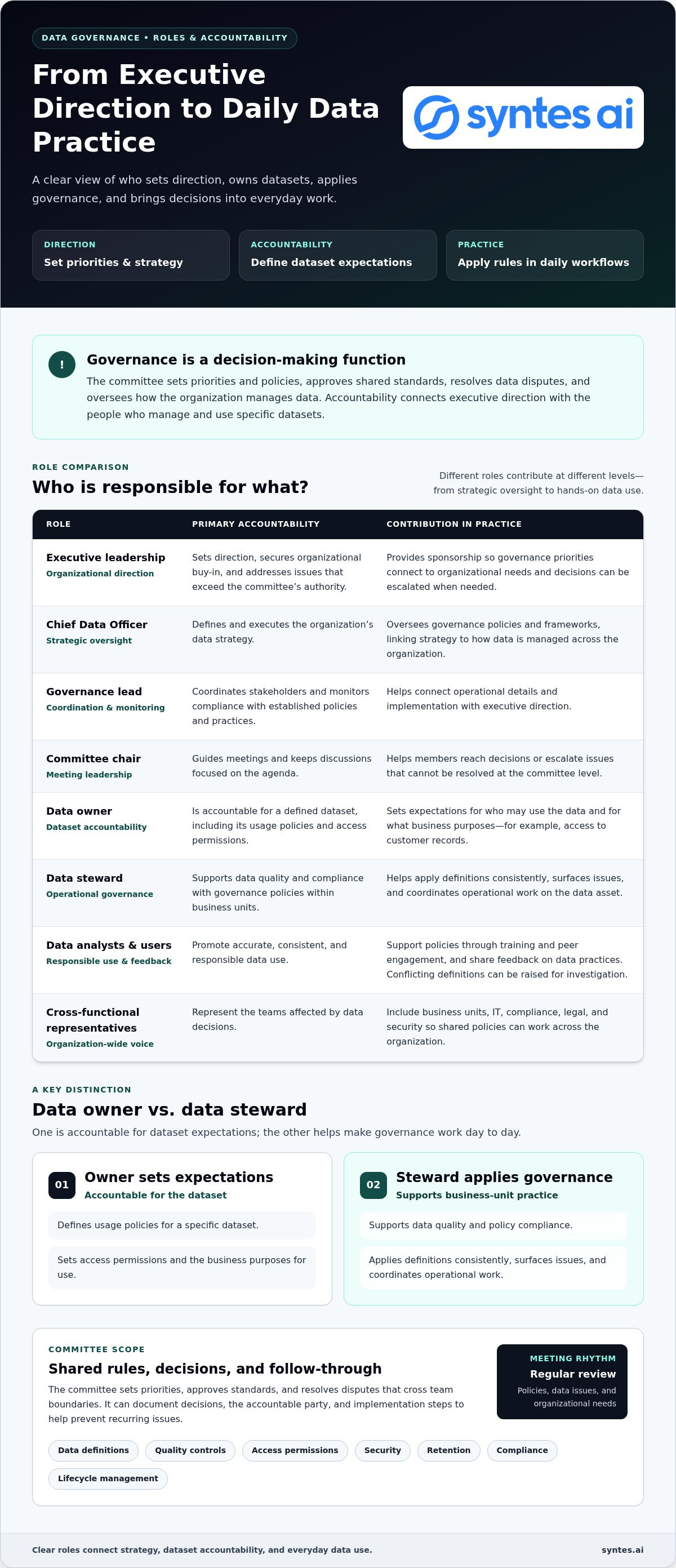
Data governance is a decision-making function, not just a meeting on the calendar. Data governance committee roles typically include executive leaders, a governance lead, data owners and stewards, and representatives from business, IT, compliance, legal, and security teams. Together, they set priorities and policies, approve standards, resolve data disputes, and oversee how the organization manages its data.
Assigning responsibility to a data team alone is not enough. Governance decisions affect how different teams define, access, protect, and use data, so accountability must connect executive direction with the people who manage and work with specific datasets.
This guide explains what a data governance committee does, how owners and stewards contribute, who should lead the group, and which teams need a voice. It also shows how executive sponsorship and cross-functional representation turn governance goals into decisions the organization can put into practice.
Key Takeaways
- Define the committee’s authority clearly: set data policies and priorities, approve standards, and resolve disputes that cross team boundaries.
- Make accountability explicit. Owners set dataset use and access expectations; stewards support quality and governance in day-to-day business operations.
- Give executive leadership a defined role in setting direction, securing organizational buy-in, and resolving issues that exceed the committee’s authority.
- Represent the teams affected by data decisions, including business units, IT, compliance, legal, and security, so policies can work across the organization.
- Connect committee goals to business priorities, data risks, and operational needs, then use clear communication and review practices to keep governance actionable.
What is a data governance committee?
A data governance committee sets direction for managing organizational data. It establishes policies, approves standards, and oversees how teams apply them.
Policy and Standards Oversight
The committee oversees policies and processes for data quality, security, compliance, access, and lifecycle management. It defines shared terms and standards for how business units collect, steward, share, and integrate information, giving teams consistent rules for handling data across organizational boundaries.
What policies and standards does the committee oversee? Common areas include data definitions, quality controls, access permissions, security, retention, and compliance. For example, governance policies may address PCI DSS industry requirements. HIPAA is a US regulation concerning sensitive data and privacy, according to the U.S. Department of Health and Human Services.
Common challenges include unclear dataset ownership, competing definitions, and policies that do not fit daily workflows. The committee can address these risks by assigning responsibility, documenting procedures, and monitoring whether teams follow approved standards. Policies should align with business objectives and relevant regulatory requirements, rather than remain isolated technical rules.
Policy Review and Revision
Policy review assesses whether existing rules still fit the organization’s data, systems, and operations. Committee members review policies regularly, consider issues raised by business units, and revise procedures when conditions change. This keeps standards aligned with actual workflows instead of leaving outdated instructions in place.
For example, a change to how a team collects or integrates data may require revised definitions, access rules, or documentation. Feedback, new regulations, and shifts in business strategy can also prompt updates. Version records and clear communication help teams identify current policies and understand what changed.
Decision-Making and Dispute Resolution
The committee makes decisions by setting priorities, reviewing proposals, and approving shared standards. How does it resolve disputes? Members weigh business needs against established policies and the effects on other data users, then document the decision and its rationale. Working groups can escalate unresolved issues to the committee.
Regular meetings give members a forum to review data issues and keep decisions aligned with organizational needs. Princeton’s Data Governance Committee tracks and resolves issues, while subcommittees and working groups implement initiatives involving classification, quality, access, and retention. This separation lets focused teams develop recommendations and bring cross-functional conflicts to the committee.
Unclear decision authority is another challenge. Committee procedures should specify which matters members can resolve and which require escalation. Documenting the decision, accountable party, and implementation steps helps prevent recurring disputes. For example, if two business units use different definitions for the same field, the committee can approve one shared standard and assign responsibility for applying it.
Data owner and data steward responsibilities
Responsibilities connect committee decisions to the people accountable for specific data and its daily use. Data owners set expectations; stewards and users apply them in business workflows.
A data owner is accountable for a defined dataset, including its usage policies and access permissions. For example, the owner of customer records determines which roles may use them and for what business purposes. Data stewards work within business units to support data quality and compliance with governance policies. They help apply definitions consistently, surface issues, and coordinate operational work on the data asset.
Roles vary with an organization’s structure, industry, and risk profile. A smaller organization may assign ownership across broader responsibilities, while a complex enterprise may designate owners and stewards for distinct data domains. In either case, the committee chair guides meetings, keeps discussions focused on the agenda, and helps members reach decisions or escalate them.
A data governance lead coordinates stakeholders and monitors compliance with established policies and practices. The Chief Data Officer defines and executes the organization’s data strategy, then oversees governance policies and frameworks. Together, these roles connect operational details to executive direction: the lead coordinates implementation, while the CDO holds strategic oversight.
Data analysts and users also have defined responsibilities. They promote accurate, consistent, and responsible data use, support policies through training and peer engagement, and provide feedback on data practices. When a reporting team finds conflicting customer definitions, for example, its feedback can help stewards investigate and bring the issue to the right decision-makers.
How often should the committee meet, and what belongs on its agenda? It should meet regularly to review policies, address data issues, and keep its strategy aligned with organizational needs. The OCC Data Governance Board meets at least quarterly. A committee’s agenda can cover unresolved issues, policy changes, standards, and proposed governance initiatives.
Committee membership can include a governance lead, data stewards, data users, and compliance, legal, and security representatives. Subcommittees can handle focused initiatives, while the main committee makes decisions and tracks issues requiring broader coordination. For teams defining ownership across connected data assets, a governance-focused discussion can help frame the operational questions.
Executive sponsorship and committee leadership
Executive sponsorship gives data governance the authority to connect data management practices with organizational strategy. Leadership also establishes who can make decisions, allocate attention, and resolve issues beyond operational teams’ authority.
Executive Sponsorship and Oversight
Executive sponsorship means senior-level accountability for the direction and oversight of data governance. It matters because policies need organizational backing to influence priorities across business units. At Princeton, the Data Strategy Executive Council sets governance strategy and has ultimate authority to resolve data-related issues and risks. It also endorses the committee charter, policies, and standards.
This oversight connects governance initiatives to institutional objectives. Princeton’s council promotes a data-centric culture and advocates for the value of governance across the University. In another model, the OCC Chief Data Officer has executive responsibility for OCC data assets, while the Data Governance Board advises on program strategies, priorities, investments, and policies. These examples show why sponsorship needs both strategic direction and a clear route for escalation.
Leadership Participation and Setup
Leadership participation means assigning executives a defined role in the governance operating model, rather than treating sponsorship as an honorary title. Princeton’s model has four tiers linking executive leadership with people who work with data. Its Executive Council includes the University Data Officer, Data Trustees, and IT representatives.
This structure makes governance initiatives more actionable. Executive leaders provide insight into institutional strategy and support buy-in for committee decisions, while IT representatives connect those decisions to technology priorities. A Chief Data Officer can define and execute data strategy, then oversee governance policies and frameworks. A chief information officer can also lead by aligning governance goals with organizational objectives and securing resources.
Make authority visible from the outset. A charter can define the committee’s purpose, membership, decision scope, escalation path, and relationship to executive leadership. The OCC Data Governance Board operates under authorization from its Chief Data Officer. Its voting members consider data project proposals, while the CDO decides issues when the board cannot reach consensus or may escalate them to the Technology and Systems Subcommittee.
These distinctions keep executive sponsorship connected to operational practice. The executive sets direction and holds authority; the committee translates that direction into governance initiatives; working groups carry defined tasks forward. Princeton’s Executive Council endorses the committee charter and standards, giving the operating group institutional backing. Clear delegation also helps members know which decisions they can make and which require executive resolution.
When establishing a governance model, align executive participation with decisions that have organization-wide consequences. Assign a sponsor with authority to address cross-unit conflicts, connect governance priorities to data management objectives, and reinforce agreed practices. Without that link, committees can identify issues but lack the mandate to resolve them.
Cross-functional representation
A governance committee needs representatives who understand how data moves across business functions. Their perspectives connect strategic decisions with the workflows, systems, and responsibilities affected by each policy.
Cross-Functional Membership
Cross-functional membership brings leaders and subject matter experts from affected departments into governance decisions. IT, legal, compliance, and business operations each see different risks and requirements. Their participation helps the committee assess downstream effects before adopting a standard or changing access practices.
Representation should reflect how the organization uses data, not follow a fixed roster. A committee overseeing advancement data, for example, needs insight from advancement teams alongside relevant IT and compliance perspectives. Finance, communications, programs, and operations may also contribute when their data or processes are affected.
Involve information technology early in decisions about business processes. This helps align governance choices with strategic technology priorities and exposes potential system conflicts before teams implement changes. Central IT or Development IT may participate, depending on the organization’s structure.
Governance Team Structure
A cross-functional governance structure connects a central committee with working groups focused on specific data domains or initiatives. Princeton’s subcommittees and working groups include a Functional Lead, Data Governance Lead, Data Stewards, and Data Users. This composition links domain knowledge with governance coordination and practical user experience.
Working groups can develop recommendations and carry out initiatives involving classification, quality, access, or retention. They can also escalate unresolved issues to the Data Governance Committee. This structure keeps specialized analysis close to affected teams while reserving broader decisions for the committee.
Princeton’s Person Data Working Group and Academic Data Group show how focused groups can organize around distinct data needs. A functional lead contributes knowledge of relevant business processes; stewards and users identify how definitions and controls work in practice. The committee can then consider implications for other departments.
Effective representation depends on clear responsibilities, not attendance alone. Each member should understand which function they represent, what information they bring, and how they will communicate decisions to colleagues. For example, an IT representative can surface integration impacts, while a compliance representative can identify governance considerations tied to affected data practices.
A diverse committee brings the viewpoints and authority needed to make and implement decisions. It can also help educate partner teams about downstream effects, such as how a shared data definition changes reporting across finance and operations. Linking functional expertise with committee oversight makes governance decisions more informed and workable across business boundaries.
Data governance committee goals
A committee’s goals should translate business strategy into data practices teams can apply. The framework needs to connect governance initiatives with operational priorities, risks, and clear measures of progress.
Start with the decisions the organization needs data to support. A finance team may need consistent definitions for revenue reporting, while operations may need reliable records to coordinate service delivery. The committee can prioritize governance initiatives around these needs, assign accountable business units, and identify the data sources each initiative depends on.
Risk and compliance are also essential priorities. The committee can oversee whether data practices align with relevant requirements, including GDPR, CCPA, HIPAA, SOX, and industry requirements. It should connect each risk to a governance response, such as clarifying access, improving documentation, or defining responsibilities across a data lifecycle.
Clear communication makes these goals actionable. Establish channels so members and staff understand the committee’s purpose, decisions, and process for submitting agenda items. For example, a business unit affected by a shared customer definition needs to know where to raise concerns and how an approved change will be communicated to reporting teams.
Useful committee goals can include:
- Align governance initiatives with business priorities, so data work supports decisions the organization needs to make.
- Improve the quality and consistency of shared data, with business units responsible for applying agreed definitions and practices.
- Oversee data-related risks and compliance challenges by connecting issues to the relevant policies and controls.
- Track progress through indicators tied to the initiative, such as recurring quality issues, policy adoption, or unresolved data access concerns.
Measures should show whether governance changes affect day-to-day work. If a data quality initiative targets inconsistent product records, the committee can track whether teams use the same definitions and whether reported inconsistencies persist. Ongoing monitoring and measurement help members identify gaps, address unresolved issues, and adjust the framework as business needs change.
Review goals in light of feedback, new regulations, and shifts in business strategy. A change in systems or operations may alter which sources teams rely on, who needs access, or how information moves between business units. The committee’s central task is to keep priorities relevant and connect each decision to an owner, an operational response, and a way to assess progress.
Syntes AI: Enterprise Knowledge Graph
Syntes AI’s Enterprise Knowledge Graph structures complex organizational data in a connected, actionable format. It can support governance teams that need shared context across systems, clearer relationships between data assets, and a foundation for consistent definitions. Cross-System Integrations connect these capabilities with existing enterprise software, while Context Engineering helps shape the context used across data and AI workflows.
Consider this approach when committee policies and ownership models are established, but data remains fragmented across platforms or difficult to interpret consistently. A connected knowledge layer can make relationships between information more visible and operationally useful. Contact Syntes AI to discuss how an Enterprise Knowledge Graph could fit your data environment.
Turn Governance Into Operational Momentum
The next step is to make governance decisions usable across the systems and teams that depend on data. Clear data governance committee roles create accountability; connecting those decisions to the organization’s data environment makes them actionable.
When data is fragmented across platforms, Syntes AI’s Enterprise Knowledge Graph structures complex information in a connected format. Cross-System Integrations connect capabilities across existing enterprise software, while the Syntes Agentic Platform enables businesses to deploy and manage AI agents for operational tasks. These offerings can connect governance priorities with enterprise data and workflows.
Use your committee’s priorities to frame the next discussion: which data relationships need clarification, where systems need to connect, and which operational tasks could benefit from AI agents? A focused conversation can help translate governance objectives into a practical direction for your data environment.
Move from policy to coordinated action, and build a data foundation your teams can use with confidence.
Frequently Asked Questions
Structure & membership: who should sit on the committee?
Include people who represent affected data domains and can make or influence decisions for their functions. Membership often spans business operations, IT, data management, security, privacy, legal, and compliance. Clearly defined data governance committee roles help each representative understand which decisions they contribute to and how to communicate outcomes. For an employee records review, include the teams that use the data and the specialists responsible for its systems and controls.
What is the purpose of a data governance committee?
The committee coordinates decisions that keep data useful, consistently understood, and appropriately managed across the organization. It can prioritize issues affecting multiple teams, such as conflicting report definitions or unclear access practices. It also gives staff a route for raising concerns and leaders visibility into governance progress. Its value lies in turning cross-team problems into decisions with clear owners and follow-through.
What are the key roles and responsibilities on a data governance committee?
Core responsibilities include setting priorities, approving shared standards, assigning decision ownership, and tracking issues through resolution. A chair or lead organizes decisions and escalations; domain representatives explain business impact; technical and risk specialists identify system or control implications. Documenting data governance committee roles alongside each decision clarifies who owns implementation, which teams are affected, and what follow-up will show whether the action worked.
What are the responsibilities of data owners and data stewards?
Data owners decide a dataset’s permitted use and access, while stewards help maintain its quality and consistent handling. For example, an owner may establish who can use supplier records, while a steward investigates duplicate entries and coordinates corrections with the relevant business team. This distinction separates decision authority from the ongoing work of applying agreed practices and reporting data issues.
Which business, IT, security, privacy, and legal representatives should serve on the committee?
Select representatives according to the data and decisions being governed. Business members should come from teams that create or rely on the information; IT should explain system dependencies; security and privacy specialists should assess access and handling; legal and compliance representatives should identify relevant obligations. For supplier data, procurement, system owners, security, and legal can each surface distinct impacts before the committee adopts a shared rule.
How should a data governance committee be structured and sized?
Structure the committee around a clear charter, defined decision authority, and working groups for specialized topics. Keep standing membership focused on functions that regularly make or implement governance decisions, then involve experts when their domain is affected. The right size depends on the organization’s data domains, operating model, and risks. If discussions stall, clarify representation or delegate detailed analysis to a working group.
How should a data governance committee measure its effectiveness?
Measure whether governance decisions change data practices and resolve recurring problems. Track indicators tied to stated goals, such as unresolved quality issues, use of approved definitions, completion of assigned actions, and policy questions raised by teams. Review these measures alongside staff feedback and changes in systems or business priorities. If progress stalls, examine whether policy, ownership, communication, or implementation needs adjustment.