
What if your AI monitoring can show every interaction yet still can’t explain whether an agent’s actions followed enterprise policy? That’s the gap between activity logs and effective ai compliance monitoring. As AI systems work across data, applications, and workflows, visibility alone can’t establish which rules applied, what business context informed a decision, or why an action occurred.
Policies change, evidence sits in disconnected systems, and opaque alerts can leave decision-makers with more questions than answers. Monitoring needs to connect AI use and agent actions to current policies, relevant data, operational relationships, and events, while preserving a clear trail for review.
This article explains how to define monitoring requirements across models, agents, data, and workflows, then assess whether findings are explainable and auditable. It also explores how Context Engineering and a live Context Graph can provide the enterprise context that helps AI systems reason against governed information. The goal isn’t to promise automatic regulatory compliance. It’s to move oversight beyond isolated signals toward evidence people can understand and evaluate.
Key Takeaways
- Define monitoring scope across models, employee AI use, agent actions, data controls, and the evidence each workflow should produce.
- Use ai compliance monitoring to assess more than activity logs: trace how policies and source data inform responses, decisions, and actions.
- Compare approaches by visibility, context coverage, governance, explainability, integrations, and evidence quality.
- Start implementation with an inventory, clear controls, connected context, defined ownership, and bounded workflows before expanding coverage.
- See how Syntes AI’s Context Engineering framework connects and governs enterprise context to support explainable AI reasoning and governed execution.
What AI compliance monitoring must cover across enterprise systems
AI compliance monitoring is the ongoing observation and review of AI use, decisions, data, controls, and evidence across the systems and workflows where AI operates. It differs from a periodic assessment or audit. Monitoring looks for relevant activity over time, while an assessment or audit evaluates a defined scope at a particular point. Monitoring helps teams oversee governance and assemble evidence, but it does not, on its own, establish legal compliance.
That scope needs distinct control points. Model governance concerns a model’s intended purpose, approved use, and evaluation. Employee AI usage concerns how people interact with AI tools, including the information they provide and how they use the outputs. Agent actions include decisions and steps taken across connected systems. Data controls address the sources, permissions, lineage, and business rules that shape what an AI system can access or act upon. Treating all of these as generic “AI activity” can obscure ownership and leave important evidence gaps.
Which AI activities and evidence belong in scope?
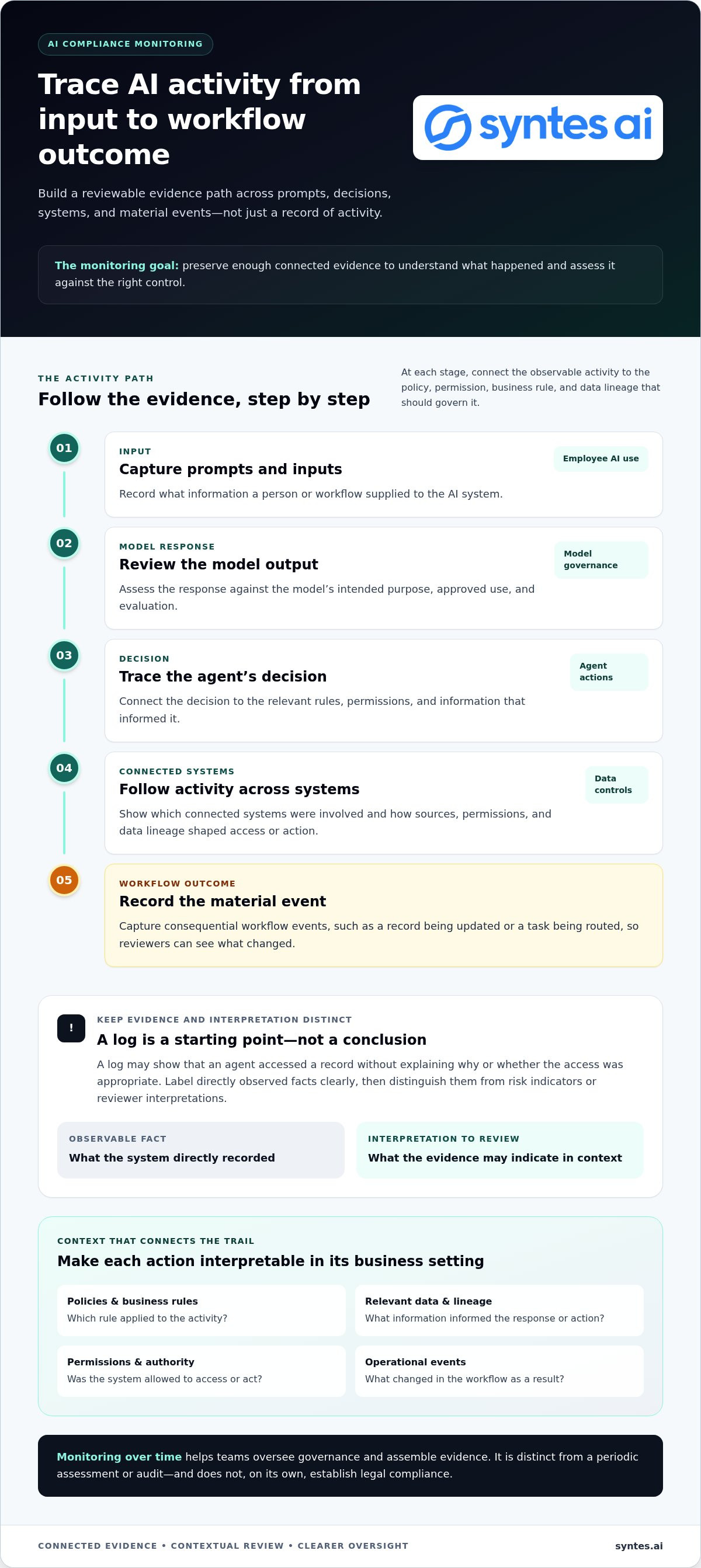
Start with the full activity path: prompts or inputs, model outputs, agent decisions, connected systems, and material workflow events, such as a record being updated or a task being routed. For each step, identify the policy, permission, business rule, and relevant data lineage that should govern it. The aim isn’t to collect every possible signal. It’s to preserve enough connected evidence to understand what happened and assess it against the right control.
Separate what the system directly records from what a reviewer infers. A log may show that an agent accessed a record, but it may not explain why access occurred or whether the action was appropriate. Label observable facts clearly, then distinguish them from risk indicators or interpretations. This makes findings easier to explain and prevents an alert from being treated as a conclusion before its context is reviewed.
Why do enterprise data silos weaken oversight
AI activity rarely sits in one place. A prompt may draw on a document repository, a model response may inform a business workflow, and an agent may then update a separate operational system—such as recording maintenance schedules, contractor compliance, or safety inspections in an operations platform like BRIO. When policies, permissions, and event records remain isolated, reviewers can struggle to connect an action to the process it affected. Disconnected evidence can also make it harder to determine which policy applied at the time.
This is one challenge in the broad and evolving field of Regulation of artificial intelligence: organizations need a clear view of the rules relevant to their own use, not just a record of AI activity. The same issue arises with enterprise data silos, where isolated records obscure relationships across systems. Connecting entities, policies, documents, and operational events gives reviewers a stronger basis for tracing an AI action and understanding what the evidence does, and doesn’t, show.
How enterprise context makes AI compliance monitoring more meaningful
A log can show what an AI system did. Context helps explain what informed the action, which business rule applied, and what changed as a result. Operational context is the connected, current picture of business entities, policies, data, and events that makes AI activity interpretable within the process it affects. For AI compliance monitoring, this distinction matters: evidence is more useful when reviewers can trace the path from source information and governing policy to a model response, an agent decision, and the resulting workflow action.
Consider an agent reviewing a customer request. Its response may depend on customer status, product terms, an internal policy, and a recent operational event. Looking at the output alone leaves key questions unanswered: Was the right policy considered? Was the information current? Did the agent have appropriate authority to take the next step? Connecting those facts lets reviewers assess the decision in its business setting instead of treating it as isolated text or an individual event.
What changes when monitoring uses a live context layer?
A live context layer represents how customers, products, rules, documents, and events relate, rather than presenting each as a disconnected record. If a product rule changes or a customer’s status is updated, that change may affect how an AI response or action should be interpreted. The value isn’t simply having more data. It’s making relevant relationships available for reasoning and review as operational information evolves.
This differs from retrieval alone. Retrieval can find and supply relevant documents, and it remains useful. Context Engineering also organizes how information relates to entities, rules, permissions, and events, so an AI system can interpret retrieved material within a broader business model. An enterprise knowledge graph can represent these connections and give teams a structured way to examine how information and processes intersect.
In practice, teams can ask whether a monitoring finding can be traced from the original source through the applicable rule to the workflow outcome. If a source document conflicts with a current business rule, that conflict should be visible for review rather than silently flattened into a single answer.
How can explainability support an audit trail?
Explainability makes a decision easier to examine by connecting an output to relevant context, rules, and source information. A reviewer can then distinguish the evidence the system used from the reasoning or interpretation applied to it. That supports a focused investigation: Was the source appropriate? Was the rule relevant? Did the resulting action match the intended process?
Explainability supports review, but it doesn’t prove that a decision was correct. Source information may be incomplete, a rule may be ambiguous, or the system may interpret context poorly. Human judgment and clearly assigned governance responsibilities still matter. Syntes AI’s Context Engineering approach connects, understands, contextualizes, governs, and executes enterprise context to support explainable reasoning and governed AI workflows. Explore the Syntes AI platform to see how its context layer can support enterprise AI oversight.
How to evaluate AI compliance monitoring approaches
Evaluate an approach by asking whether it can do more than record AI activity. Separate four capabilities: activity logging captures events; policy enforcement applies controls to use or actions; compliance workflow management organizes responsibilities and evidence; and context-based reasoning connects activity to business rules, data, and relationships. These capabilities can complement one another, but they aren’t interchangeable.
Evaluation principle: Monitoring coverage is meaningful when reviewers can trace an AI action to the context, governance controls, and evidence that shaped or constrained it. Use the comparison below to identify strengths and gaps, not to assume one approach replaces the others.
Dimension
What to assess
Visibility
Does it cover prompts, outputs, model use, agent decisions, and resulting actions across workflows?
Context coverage
Can it relate activity to source data, policies, permissions, business rules, and operational events?
Governance
Are control owners, approved uses, and review responsibilities represented clearly?
Explainability
Can a reviewer follow the evidence and reasoning behind a finding or action?
Integrations
Can relevant systems and workflow stages be considered together?
Evidence
Can the approach distinguish recorded facts from inferred risk and show their sources?
What questions reveal meaningful monitoring coverage?
Test the approach against a real workflow, not only a model demonstration. Ask where it identifies data sources, business rules, permissions, and relationships. Check whether reviewers can trace an agent action to relevant context and evidence, and how the system handles operational changes that affect a decision. Include cross-system steps. If an agent reads one system and changes another, visibility limited to prompts may miss the consequential action.
How do logs, governance platforms, and context layers differ?
Logs record events, but an event record may not explain its business meaning. Governance platforms can structure policies, approvals, responsibilities, and evidence workflows, yet policy management alone may not connect the facts behind a specific AI decision. Context layers model those facts and relationships. They can strengthen interpretation alongside logging and governance tools, rather than replace either. Strong ai compliance monitoring makes these roles explicit, so teams know what each component can establish and what still requires human review.
Assess how the approach handles change. A policy can be revised, a permission can shift, or a workflow can acquire a new step. Reviewers need to know which information informed an action and whether it was current for the event under examination. An architecture that connects systems without clarifying these relationships may broaden visibility while leaving findings difficult to interpret. Compare capabilities against the workflow’s actual control needs, then document gaps that require additional governance or review.
How to implement AI compliance monitoring without losing operational context
Effective ai compliance monitoring starts with a defined workflow, not a mandate to observe everything at once. Set boundaries, assign decision-makers, and connect the evidence to the business process it describes. This keeps monitoring practical and gives teams a repeatable way to expand coverage.
Use a staged sequence:
- Inventory AI use. Record the models, applications, agents, data sources, and business processes in scope. Note where people provide inputs, where AI produces outputs, and where systems can take actions.
- Define controls. For each workflow, identify approved uses, applicable business rules, permissions, review points, and the evidence needed to assess activity. Make exceptions and escalation paths explicit.
- Connect context. Map the structured and unstructured sources the workflow relies on. Document where information lives, how it relates to business entities, and any known data quality or access limitations.
- Govern actions. Set boundaries for what an AI system can do independently, what requires human review, and who can approve or override an action.
- Review evidence. Examine activity against the defined controls. Separate recorded events from interpretations, assign follow-up work, and update the scope when the workflow changes.
How should organizations establish scope and ownership?
Begin with a bounded workflow that has a clear purpose and an identifiable owner. Prioritize based on business impact, the sensitivity of data involved, and the consequences of an AI-generated recommendation or action. Then assign accountable people to maintain policies, assess exceptions, review evidence, and make escalation decisions. Shared responsibility is useful, but every control needs a clear owner.
Map the workflow as it operates today. Identify systems that supply information, systems that receive outputs, relevant permissions, and the business rules in force. Record gaps rather than assuming a particular architecture or treating connected systems as a single source of truth. This baseline helps teams distinguish missing evidence from a control failure and decide where additional integration or review is needed.
How can context and governance be operationalized?
For the selected workflow, connect only the sources that meaningfully inform its decisions. Represent the relevant entities, relationships, permissions, and rules so reviewers can understand how a change in one part of the process affects another. Define a human review or escalation path for uncertain findings and consequential actions. Keep responsibility visible, especially when an agent hands work to a person or another system.
Expand only after the initial workflow has clear ownership, usable context, and review practices that fit its risks. Syntes AI’s Context Engineering Framework organizes this work across Connect, Understand, Contextualize, Govern, and Execute, supporting the preparation of enterprise context for governed AI reasoning and execution. The framework supports governance work, but it doesn’t guarantee regulatory compliance.
How Syntes AI Context Engineering supports governed monitoring
Syntes AI is an enterprise AI platform built around Context Engineering and a continuously evolving Context Graph. Its context layer connects business information and relationships so AI reasoning and agent actions can be interpreted against enterprise rules and operational conditions. This makes it relevant to ai compliance monitoring, where understanding the context behind activity is as important as recording the activity itself.
A monitoring signal becomes more useful when it can be understood in the context that shaped it. The Context Graph is a live operational model connecting business entities, rules, documents, and events. For example, a reviewer examining an agent action can consider the relevant policy, the business entity affected, and related operational events together, rather than relying on an isolated record. This supports explainable review and governed execution, but does not guarantee a compliant outcome.
How do the five Context Engineering pillars fit together?
The framework moves from preparing enterprise information to supporting governed use:
- Connect brings structured and unstructured business sources into view.
- Understand identifies entities, relationships, and meaning across those sources.
- Contextualize organizes information into a business-relevant model of rules, relationships, and events.
- Govern brings permissions, policies, and review considerations to bear on that context.
- Execute enables AI agents and applications to act using governed context.
The pillars work as a connected framework, not a substitute for an organization’s own governance decisions. Teams still define appropriate controls, ownership, and review processes for their workflows.
When is a context-first platform relevant?
A context-first approach is relevant when enterprise knowledge is fragmented, workflows cross multiple systems, or agent actions depend on relationships and rules that aren’t visible in a single record. A semantic data layer helps organize meaning across information sources. A Context Graph extends that idea by representing business entities, rules, documents, and operational events together, giving reviewers a clearer basis for understanding how information relates to a decision.
For oversight teams, explainable reasoning can help connect an AI output or action to relevant business context, while governed execution can help keep agent activity within defined controls. These capabilities support broader oversight, but they aren’t proof of regulatory compliance or a guarantee that each outcome is correct. They provide a foundation for human review and informed governance.
Explore how Syntes AI’s Context Engineering platform can support governed AI reasoning and execution across your enterprise.
Turn oversight into an operational capability
Treat ai compliance monitoring as part of how enterprise AI is designed and operated, not as a reporting layer added after deployment. Identify a workflow where decisions cross systems, then define what context reviewers need to understand the AI’s role and which governance decisions remain with people.
Syntes AI’s Context Engineering Framework, organized around Connect, Understand, Contextualize, Govern, and Execute, offers a way to structure that work. Its live Context Graph is designed to connect enterprise data, relationships, rules, and operational events, giving AI reasoning a broader business foundation. These capabilities can support oversight, but they don’t replace accountable governance or establish regulatory compliance on their own.
Start with a clear operational question: can your team explain how relevant business context shaped an AI action and determine who should review it? Syntes AI can help your organization explore that question through Context Engineering and a live enterprise Context Graph.
With the right context and ownership in place, your organization can move toward AI oversight that is more understandable, deliberate, and ready to evolve.
Frequently Asked Questions
What is AI compliance monitoring?
AI compliance monitoring is a structured way to observe and review how AI is used, what decisions it influences, and whether relevant controls are being followed. It gives an organization information to investigate potential issues and assess whether its practices align with internal policies and applicable requirements. For example, a team might review whether an AI-assisted hiring workflow followed its documented review steps. Monitoring supports oversight; it isn’t a legal determination or a substitute for an audit.
How does AI compliance monitoring work across enterprise systems?
It works by connecting relevant signals from the systems involved in an AI-enabled process so reviewers can follow activity across its stages. For example, an AI-generated purchasing recommendation might be linked to the request, approval record, and resulting transaction. Similarly, in automated entity onboarding managed through Cateno, workflow engine actions and verification events can be traced alongside incoming data. Consistent identifiers and clear ownership help teams associate those records without treating them as interchangeable. The monitoring design should also make gaps visible, such as a workflow step that produces no reviewable evidence.
Can AI compliance monitoring track autonomous agent actions?
Yes, if the monitoring scope includes the actions agents take through connected tools, not only their prompts and final responses. A useful review may examine an agent’s attempted system calls, the records it accessed or changed, and whether it paused for human approval. Teams should also consider unsuccessful or interrupted actions, since these can reveal control weaknesses even when no business record was ultimately changed. Define permitted actions and escalation ownership before expanding an agent’s authority.
What data should an AI compliance monitoring program capture?
Capture only information that helps explain or assess the workflow: the AI system involved, relevant inputs and outputs, action or decision details, source references, applicable control, and review outcome. Include enough timing and system information to associate events across the process. Avoid collecting sensitive content by default when a reference or appropriately limited record can support review. Establish who can access monitoring data and how it will be handled under the organization’s existing information policies.
How is AI compliance monitoring different from AI governance?
AI governance sets direction: it defines acceptable use, decision rights, accountability, and how risks should be managed. Monitoring provides operational observations that help people see whether AI use and controls are behaving as intended. For instance, a governance policy may require human review before a consequential decision, while monitoring helps identify whether that review step occurred. Neither function replaces the other. Governance without evidence is difficult to evaluate; monitoring without clear governance can produce activity records without meaningful criteria.
Does AI compliance monitoring guarantee regulatory compliance?
No. Monitoring can help an organization examine AI activity and organize evidence, but it cannot guarantee that a system or process meets every applicable legal requirement. Applicability depends on factors such as the use case, jurisdictions, organizational role, and current rules. A monitoring finding is an input to informed review, not a legal conclusion. Organizations should assign qualified internal or external legal and compliance professionals to interpret obligations and assess whether controls are adequate.
Is retrieval-augmented generation enough for context-aware AI monitoring?
Not by itself. Retrieval-augmented generation can locate relevant documents and provide useful source material, but a document match may not show how a policy relates to a person, transaction, permission, or workflow event. For a more contextual review, teams may need to connect retrieved information with structured relationships and operational facts. Retrieval can remain part of the design; the key is whether reviewers can understand how the supplied information relates to the AI activity being assessed.