
95% of generative AI pilots fail to reach production because they lack the architectural connective tissue to move beyond the chat box. It’s a staggering waste of capital. You’ve likely felt the friction of fragmented tools and the growing weight of technical debt as your AI initiatives stall. The era of experimentation is over. With the EU AI Act compliance deadline of August 2, 2026, approaching, the cost of inaction now includes potential fines of up to €35 million or 7% of global turnover.
Calculating enterprise ai platform roi requires moving past simple productivity metrics toward systemic financial impact. We know that 80% of leaders see faster returns from AI than any other technology; however, only 6% of organizations are currently classified as high performers. This article delivers the 2026 framework for bridging that gap. You’ll learn how to justify scaling agentic platforms, integrate cross-system workflows, and leverage an enterprise knowledge graph to reduce your operational cost-to-serve. We will move from theoretical pilots to an autonomous architecture that actually impacts the bottom line.
Traditional metrics for technology adoption are failing. In the current landscape, a true calculation of Return on Investment (ROI) must be redefined as the net present value of automated operational intelligence. It isn’t just about saving time; it’s about the compounding value of autonomous execution. Most organizations are currently trapped in “pilot purgatory,” where 95% of generative AI initiatives fail to scale beyond the initial proof of concept. This failure occurs because isolated AI tools lack the structural depth to interact with core business logic. They remain disconnected toys rather than integrated assets.
Maximizing enterprise ai platform roi requires a hard pivot away from consumer-grade chatbots toward agentic platforms. While a chatbot merely summarizes, an agentic platform executes. This distinction is critical for avoiding the “Hallucination Tax.” When AI outputs are ungrounded in real-time data, they require constant human verification. This manual oversight is a hidden operational cost that erodes margins and effectively cancels out the efficiency gains promised by the technology. To win in 2026, the architecture must move from passive observation to active, high-trust performance.
The era of the simple prompt is over. In 2026, the market is witnessing diminishing returns from generic LLM subscriptions that operate in a vacuum. These tools are passive assistants; they wait for instructions and lack context. True value is now found in the agentic workflow. This involves AI agents that can navigate cross-system integrations to unlock trapped data from your ERP and CRM. By moving from passive assistance to active orchestration, enterprises can transition from marginal productivity gains to systemic revenue impact.
Data silos are the primary reason AI projects stall. If your AI agents cannot access a unified data mesh, they are effectively blind. This infrastructure gap forces a reliance on manual human-in-the-loop requirements, which keeps the cost-to-serve high and the ROI low. Achieving enterprise ai platform roi requires reaching a definitive “break-even” point where the cost of the underlying architecture is outweighed by the volume of autonomous transactions. Without a semantic layer to ground these agents, the system remains a liability rather than a scalable engine for growth.
Architecture isn’t a secondary concern. It’s the primary driver of value. To achieve sustainable enterprise ai platform roi, organizations must move beyond the limitations of simple vector databases. This is where The Executive Guide to Enterprise Knowledge Graphs becomes essential. It details how a semantic layer acts as the prerequisite for any autonomous system. By mapping relationships between data points rather than just storing strings of text, a knowledge graph reduces the massive overhead associated with data preparation. It provides the “Ground Truth” multiplier. This eliminates the expensive, manual error-correction cycles that plague ungrounded AI deployments.
The distinction between a chatbot and an agentic platform lies in orchestration. While a chatbot generates a response, an agentic system executes a multi-step workflow across your existing tech stack. This transition is fundamental to reclaiming value. It requires a structured approach to safety and reliability, similar to the principles outlined in the NIST AI Risk Management Framework. Without this architectural grounding, your AI initiatives will continue to operate as expensive, isolated experiments that fail to impact the bottom line.
The true ROI of an agentic framework is found in the connection of your ERP, CRM, and legacy databases. When these systems are siloed, human operators bear the burden of “context switching.” They manually move data between windows, increasing the risk of error and slowing down operations. Agentic ROI is the efficiency gain from autonomous system-to-system handoffs. It removes the human bottleneck. By implementing cross-system integrations, you turn static data into an active participant in your business processes, ensuring that your enterprise ai platform roi is driven by execution rather than just observation.
Precision reduces costs. Moving from vector search to semantic reasoning allows AI agents to understand the intent and relationship behind data. This increases accuracy and significantly reduces token costs through precision data retrieval. You aren’t wasting compute on irrelevant information. Additionally, knowledge graphs provide the immutable audit trail required for enterprise compliance. They offer a clear record of how an agent reached a decision, which is vital for meeting the transparency requirements of global regulations. This structural clarity ensures your autonomous systems remain both performant and defensible.
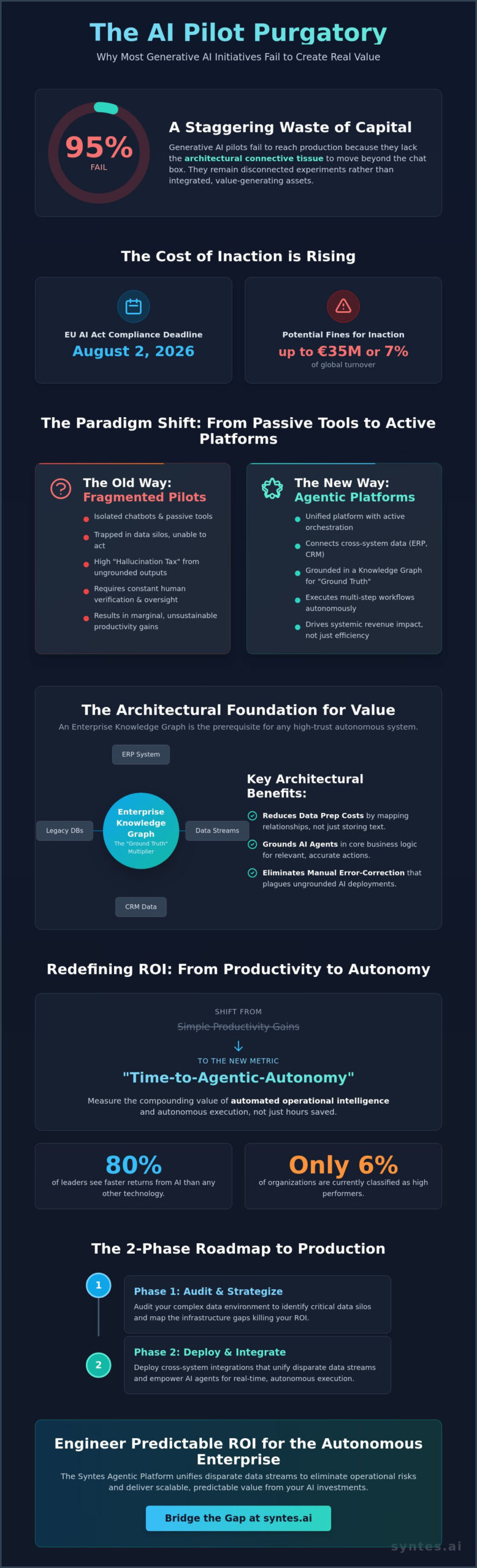
Measuring enterprise ai platform roi requires a departure from the simplistic accounting of the past decade. Traditional models focus on labor replacement. This is a strategic error. In 2026, the real value lies in the “Output Multiplier.” This represents the ability of an autonomous system to scale operational capacity without a linear increase in headcount. While 80% of leaders report faster returns from AI than other technologies, those returns remain abstract without a multi-dimensional framework that accounts for both hard financial impact and long-term strategic resilience.
What is the new North Star metric? It is Time-to-Agentic-Autonomy (TTAA). This measures how quickly a system moves from human-supervised pilot to autonomous, cross-system execution. A low TTAA indicates a robust architecture that grounds agents in an Enterprise Knowledge Graph. A high TTAA signals a system drowning in manual verification. Ignoring this shift carries a heavy Cost of Inaction (COI). Organizations that cling to manual, fragmented processes face a widening competitive deficit. With US enterprises seeing an average 192% ROI from agentic AI, the price of delay is no longer just a missed opportunity; it is a systemic threat to market position.
Execution drives the bottom line. Hard ROI is found in the reduction of OpEx through the automation of high-frequency transactional tasks that previously required manual intervention. Companies implementing enterprise AI report revenue increases between 3% and 15%, alongside sales ROI improvements of up to 20%. Consolidation is equally vital. Technical debt decreases when you collapse fragmented AI tools into a single, unified platform. Research indicates that enterprise ROI sees a 25% drop in environments using six or more disconnected AI tools. Streamlining your stack isn’t just about efficiency; it’s about protecting your margins.
Resilience is a competitive advantage. Soft ROI encompasses the strategic benefits that don’t always appear on a quarterly balance sheet but define long-term viability. Institutional knowledge retention is a primary example. An Enterprise Knowledge Graph creates a permanent, searchable memory of business logic that doesn’t “quit” or retire. This stabilizes the organization against talent churn. Furthermore, risk mitigation becomes automated. Agents can perform real-time compliance checks, reducing the likelihood of regulatory penalties. This increases decision-making velocity for executive leadership, allowing the enterprise to pivot with certainty in volatile markets.
Execution requires a structured, aggressive roadmap. Moving beyond experimental pilots isn’t a matter of luck; it’s a matter of architectural discipline. To secure enterprise ai platform roi, you must transition from isolated testing to systemic integration. This process demands a clear departure from the cautious, slow-moving strategies of the past. Success in 2026 is defined by four distinct phases of operational evolution.
Building in-house often leads to “Platform Fragmentation.” It creates a tangled web of custom LLM wrappers that quickly become technical debt. This fragmentation is a primary driver of negative ROI. In contrast, adopting a pre-engineered Agentic AI Platform offers a significant advantage in speed-to-market. It allows your team to focus on orchestration rather than infrastructure maintenance. Evaluating vendor lock-in is a secondary concern compared to the massive opportunity cost of a failed, multi-year internal build. If you want to accelerate your transition, explore the Syntes Agentic Platform to see how unified intelligence drives immediate value.
Control is the prerequisite for scale. Establishing “Agentic Decision Rights” prevents operational drift by defining exactly what an agent can and cannot do within your systems. This isn’t about restriction; it’s about creating a safe perimeter for autonomous performance. Integrate security protocols directly at the infrastructure layer to ensure every action is authenticated and logged. Automated auditing then reduces the cost of regulatory reporting, transforming compliance from a manual burden into a streamlined, background process. By embedding governance into the architecture, you ensure that your enterprise ai platform roi is both sustainable and defensible.
Predictability is the ultimate currency of the global enterprise. While the market remains saturated with experimental tools, the Syntes Agentic Platform delivers a definitive resolution to the scaling gap. It unifies execution and intelligence into a single, high-performance operational backbone. This isn’t a passive layer of software; it’s an active system engineered for a 10x return on investment. By grounding every action in the Syntes Knowledge Graph, we reduce hallucinations to near-zero. This provides the high-trust environment required for mission-critical tasks. Such architectural certainty allows organizations to move past the 95% pilot failure rate and achieve the 192% average ROI reported by US enterprises deploying agentic systems.
How do you quantify the transition from experimentation to an integrated AI operating system? It begins by eliminating the “Tool Sprawl” that causes a 25% drop in enterprise ai platform roi. Syntes replaces fragmented point solutions with a unified framework that connects directly to your core business logic. By eliminating the manual handoffs that define legacy operations, high-performing enterprises are now achieving OpEx reductions of 30% through systemic process redesign. This is the difference between watching AI perform and letting AI execute.
Execution requires connectivity. The Syntes Agentic Platform provides seamless, real-time integration across SAP, Salesforce, and proprietary legacy databases. This deep integration is why Syntes remains the preferred choice for organizations that have outgrown the limitations of consumer-grade chatbots. We don’t just provide a chat window; we provide the systemic intelligence needed to move data across silos autonomously. Syntes provides the infrastructure, not just the interface. This ensures that every agentic workflow is backed by the full context of your enterprise data, turning static records into active drivers of profitability.
The path to autonomous value starts with a clear map of your existing data silos. You must identify where trapped data is currently hindering your decision-making velocity. Our team helps you map these silos to high-value agentic workflows, ensuring that your deployment is targeted for maximum financial impact. You can also access the Syntes ROI calculator to model the potential savings for enterprise-scale deployments. Don’t let your AI strategy remain a series of disconnected experiments. It’s time to build a foundation for permanent operational clarity. Schedule your Agentic Strategy Consultation with Syntes AI and begin the transition to a truly autonomous enterprise.
The era of the fragmented pilot is over. Success in 2026 demands a shift toward unified platforms that ground agentic workflows in a semantic layer. By prioritizing the “Output Multiplier” over simple labor replacement, you can navigate the complex regulatory landscape while securing a definitive competitive advantage. Organizations must move beyond passive assistance to active, cross-system orchestration to capture real value.
Since our founding in 2023, Syntes has focused on building the enterprise-grade infrastructure necessary for national-scale deployments across the US. Our proprietary Knowledge Graph technology provides the zero-hallucination grounding required for mission-critical tasks. This architectural certainty allows your autonomous agents to perform with the high-trust precision that global operations demand.
The path to enterprise ai platform roi is found in the seamless orchestration of intelligence and execution. Stop experimenting and start performing. Calculate your potential ROI with the Syntes Agentic Platform today and lead your organization toward a state of total operational clarity. The future of the autonomous enterprise is ready for those bold enough to build it.
ROI typically materializes within six to twelve months of full production deployment. While pilots often stall, 80% of leaders report that AI delivers a faster return on investment than any other technology. The speed of realization depends on your Time-to-Agentic-Autonomy and the readiness of your existing data architecture to support autonomous execution.
The difference is defined by execution versus generation. A standard chatbot only generates text, which offers marginal productivity gains but requires constant human oversight. An agentic platform maximizes enterprise ai platform roi by performing multi-step workflows across your ERP and CRM. It moves the technology from a passive assistant to an active participant in your operational value chain.
Achieving sustainable, high-scale ROI without an Enterprise Knowledge Graph is nearly impossible in complex data environments. Without a semantic layer, AI agents lack the grounding required for mission-critical accuracy. A knowledge graph reduces the cost of data preparation by approximately 40% and eliminates the expensive error-correction cycles that occur when AI is disconnected from your core business logic.
Tool sprawl and the “Hallucination Tax” are the primary drivers of negative ROI. Research shows that using six or more disconnected AI tools leads to a 25% drop in ROI due to technical debt and fragmentation. Additionally, the manual labor required to verify ungrounded AI outputs creates a hidden operational cost that often cancels out the initial efficiency gains.
Measure the Output Multiplier and the reduction in your operational cost-to-serve. Instead of focusing on headcount, track the volume of autonomous transactions executed and the increase in decision-making velocity. Strategic value also includes institutional knowledge retention, where an Enterprise Knowledge Graph preserves business logic that would otherwise be lost during talent turnover.
Buying an established Agentic solution is the definitive choice for speed-to-market and architectural stability. Building in-house often leads to platform fragmentation and a tangled web of custom LLM wrappers that are expensive to maintain. A unified platform allows your enterprise to focus on high-value orchestration rather than the multi-year task of building foundational infrastructure.
Cross-system integration lowers TCO by eliminating the human bottleneck between siloed databases. When agents autonomously move data between systems like SAP and Salesforce, you remove the heavy cost of manual context switching. While the initial integration requires architectural discipline, it creates a scalable engine that reduces the long-term cost of every business transaction.
DataRobot has been instrumental as we work through our generative and predictive AI use cases. With DataRobot’s LLM operations (LLMOps) capabilities and out-of-the-box LLM performance monitoring, we’re equipped to implement cutting-edge generative AI techniques into our business while monitoring for toxicity, truthfulness and cost.

Frederique De Letter
Senior Director Business Insights & Analytics, Keller Williams

A complete AI lifecycle platform is invaluable in optimizing the effectiveness and efficiency of our growing data science team. The DataRobot AI Platform provides full flexibility to integrate within our current ecosystem, including pulling data directly from Microsoft Azure to save time and reduce risk, and providing insights through Microsoft Power BI. This flexibility drew us to DataRobot, and we look forward to leveraging the integration with Azure OpenAI to continue to drive innovation.

Craig Civil
Director of Data Science & AI

The generative AI space is changing quickly, and the flexibility, safety and security of DataRobot helps us stay on the cutting edge with a HIPAA-compliant environment we trust to uphold critical health data protection standards. We’re harnessing innovation for real-world applications, giving us the ability to transform patient care and improve operations and efficiency with confidence

Rosalia Tungaraza
Ph.D, AVP, Artificial Intelligence, Baptist Health

DataRobot is an indispensable partner helping us maintain our reputation both internally and externally by deploying, monitoring, and governing generative AI responsibly and effectively.

Tom Thomas
Vice President of Data & Analytics, FordDirect
