
If you treat an autonomous agent like a glorified chatbot, you’ve already lost control of your enterprise architecture. It’s an expensive mistake. You’ve likely seen the symptoms of a fractured deployment. Hallucinations erode executive trust. Shadow AI agents operate outside your security perimeter. Integrating these autonomous entities with rigid legacy ERP systems feels like an exercise in futility. The reality is that deployment is only the beginning. Without a rigorous approach to ai agent lifecycle management, you aren’t building a workforce; you’re creating a liability.
We understand the gravity of these operational challenges. You need a system that ensures zero-hallucination reliability and seamless cross-system integration. This article provides the definitive framework for agent governance, moving beyond simple security checklists to a robust architecture grounded in data integrity. We’ll explore how an Enterprise Knowledge Graph provides the essential grounding to survive the August 2, 2026, enforcement of the EU AI Act and its €15 million non-compliance penalties, ensuring every agent action is logged, traceable, and strategically aligned.
The era of the reactive chatbot is over. For the modern enterprise, the focus has shifted toward the Intelligent Agent: an autonomous entity capable of executing complex workflows without constant human intervention. This evolution demands a fundamental shift in how we manage technology. ai agent lifecycle management is not a mere administrative task. It is the systemic governance of these autonomous actors from their initial persona definition to their eventual retirement. While a chatbot merely observes and responds, an enterprise agent acts. It triggers APIs. It modifies records in your ERP. It makes decisions. This transition from passive observation to active, automated performance introduces a level of risk that traditional software management cannot contain.
Why is a lifecycle approach mandatory? Because “set and forget” is a fatal strategy for enterprise automation. An agent left to its own devices in a dynamic data environment will inevitably lose its alignment with business logic. You aren’t just managing code; you’re managing behavior. This requires a framework that treats agents as dynamic assets that must be provisioned, monitored, and refined with the same rigor applied to human personnel, which is why many organizations partner with Trainetics Academy to ensure their teams are fully equipped for this evolution.
Traditional DevOps relies on the certainty of static code. If the input remains the same, the output is guaranteed. Agentic AI obliterates this predictability. Because Large Language Models are non-deterministic, an agent may solve a procurement request differently on Tuesday than it did on Monday. This leads to “Agent Drift,” where an agent’s logic slowly deviates from its original intent due to evolving data patterns or model updates. Standard monitoring tools look for uptime. They don’t look for logic decay. Additionally, agents operate as non-human identities (NHIs). They possess credentials and access rights, yet they lack the predictable behavior profiles of human employees. Without specialized monitoring, these identities become invisible vectors for systemic failure.
How do you scale autonomy without inviting chaos? You build a bridge between theoretical capability and operational reality. Reliability is the only currency that matters in the boardroom. If an agent fails once in a high-stakes environment, the entire program is jeopardized. A formal framework for ai agent lifecycle management ensures that every deployment is grounded in semantic truth and remains under strict oversight. This is why sophisticated agentic ai platforms are becoming the standard for global organizations. They provide the necessary infrastructure to manage the complexity of non-deterministic systems, ensuring that automation remains an asset rather than a liability. True enterprise intelligence requires a commitment to continuous, governed evolution.
Effective ai agent lifecycle management requires a shift from managing software to managing behavior. While traditional identity governance focuses on who can access a system, agentic governance focuses on what an agent is permitted to do and why it chooses to do it. Reliability is built through five non-negotiable stages. First, you must establish strategic alignment by defining the agent’s persona and its specific operational boundaries. Second, semantic grounding ensures the agent is connected to high-fidelity data, typically through an enterprise knowledge graph. The third stage involves cross-system deployment, where agents are integrated into existing workflows. Fourth, continuous observability monitors for logic decay. Finally, secure decommissioning ensures that when an agent is retired, its access is revoked and its learned knowledge is retained for future iterations.
Provisioning an agent is an exercise in risk containment. You aren’t just granting access; you’re defining operational “lanes” that prevent an agent from wandering into unauthorized data silos. This mapping of capabilities is a core tenet of the NIST AI Risk Management Framework, which provides the standard for identifying and measuring AI-related risks in critical infrastructure. To maintain security, utilize short-lived, task-specific credentials rather than permanent API keys. This approach limits the potential blast radius if a non-human identity is compromised, ensuring that an agent only possesses the power it needs for the specific task at hand. Organizations that prioritize this level of granular control often find that the Syntes Agentic Platform provides the necessary infrastructure to automate these complex provisioning workflows.
Standard monitoring tools are insufficient for autonomous systems. They measure technical uptime, but they are blind to semantic accuracy. An agent can be technically “online” while providing logically flawed or ungrounded outputs. This is where ai agent lifecycle management becomes critical. You must implement real-time audit trails that capture not just the output, but the reasoning process behind every autonomous decision. This transparency is essential for troubleshooting “Agent Drift.” For high-stakes operations, human-in-the-loop (HITL) requirements must be baked into the architecture. This ensures that while the agent performs the heavy lifting, a human expert remains the final authority for high-risk executions, bridging the gap between automated speed and human accountability.
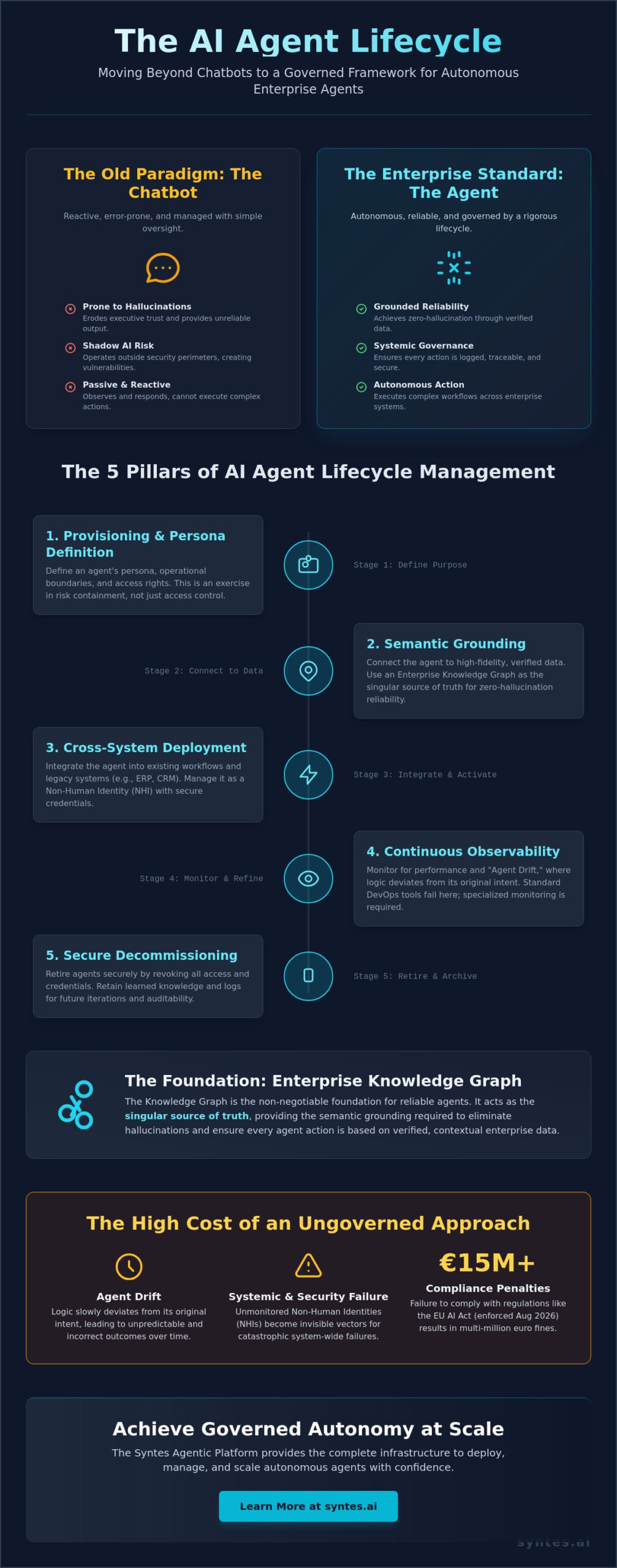
Traditional Retrieval-Augmented Generation (RAG) is a search tool. It isn’t a strategy for ai agent lifecycle management. While RAG provides snippets of text, an enterprise knowledge graph provides a structured map of your entire business universe. It transforms static data into a living, relational model that an agent can actually understand. Hallucinations occur when an agent lacks context. By grounding agents in a semantic layer, you replace probabilistic guessing with deterministic truth. This isn’t just about better answers. It’s about ensuring an agent understands that a “customer” in your CRM is the same entity as a “debtor” in your ERP. Without this relational depth, an agent is just a sophisticated guesser.
Graph-grounded workflows represent a quantum leap over standard vector searches. A vector database might find similar words, but a knowledge graph understands the business logic that connects those words. This distinction is critical for reliability. If an agent is tasked with adjusting a supply chain schedule, it must understand the hierarchical dependencies of your logistics network. It needs to know how a delay in one region triggers a specific contractual obligation in another. The knowledge graph provides this “Ground Truth,” ensuring that the agent’s actions are always aligned with your operational reality.
Semantic grounding is the alignment of AI intent with business reality. It’s the guardrail that prevents an agent from taking actions based on outdated or misinterpreted information. Because a knowledge graph updates in real-time, it reflects the current state of your systems instantly. This effectively mitigates the “Agent Drift” discussed earlier. During the execution phase, the agent queries the graph to validate its logic before committing an action. This step is vital. It’s the difference between an agent that merely suggests a solution and one that successfully executes a procurement order across three different systems without error.
Data silos are the enemy of autonomous scale. Most enterprises struggle to bridge the gap between CRM, SCM, and legacy ERP systems. A knowledge graph functions as a unified data fabric, weaving these disparate threads into a single, coherent intelligence layer. This allows agents to act as the “connective tissue” across the organization. When you view AI Agents as a Secret Weapon, you’re recognizing their ability to harmonize complex operations at a speed humans cannot match. Without the graph, this integration is fragile. With it, you achieve a level of operational intelligence that turns fragmented data into a competitive advantage. ai agent lifecycle management must prioritize this data fabric to ensure long-term stability and cross-system utility.
CIOs face a critical choice. Selecting an architecture for ai agent lifecycle management is not about choosing a vendor; it’s about defining the operational ceiling of your enterprise. Most platforms are merely wrappers around LLMs. They lack the structural integrity to manage autonomous performance at scale. To ensure long-term reliability, your evaluation must prioritize systemic integration over superficial features. A strategic platform must serve as the nervous system for your autonomous workforce.
Building a custom management layer is a resource drain. The hidden costs of maintaining security protocols and data connectors often eclipse the initial development budget. Many organizations fall into the trap of “Chatbot Lock-in,” adopting consumer-grade platforms that lack the depth for true cross-system integration. Enterprise-grade infrastructure is a prerequisite for ROI. It provides the stability required to move from experimental pilots to full-scale production. Without a dedicated platform, you’re merely managing a collection of expensive, disconnected toys. To navigate these complexities, SME leaders can learn more about Business With AI Strategist for expert strategic implementation.
Security is the baseline of autonomy. You must enforce a “Least-Privilege” standard, ensuring agents only access the specific data required for their current task. Regulated industries demand immutable audit logs to track every autonomous decision and API trigger. Policy-based provisioning and automated offboarding are non-negotiable. If an agent’s role changes or its task is completed, its access must be revoked instantly. Effective ai agent lifecycle management treats these requirements as architectural foundations rather than afterthoughts. To see how these rigorous standards are applied in a production environment, explore the Syntes Agentic Platform.
Experimentation is the playground of the uncommitted. For the enterprise, the transition from AI pilots to operational mastery requires more than just curiosity; it demands a definitive infrastructure for ai agent lifecycle management. The Syntes Agentic Platform is that infrastructure. It isn’t a collection of disparate tools. It is a unified environment designed to govern, deploy, and scale autonomous agents with clinical precision. By integrating the entire lifecycle into a single control plane, Syntes removes the friction that typically stalls large-scale automation projects. We provide the tools to move beyond the theoretical and into the realm of active, automated performance.
Operational scale is impossible without reliability. Most organizations struggle because their agents lack a consistent source of truth, leading to the hallucinations and logic decay discussed in previous sections. Syntes solves this by creating a unique synergy between autonomous agents and the Enterprise Knowledge Graph. This isn’t just a technical integration. It’s a fundamental reimagining of how AI interacts with corporate data. When your agents are natively grounded in a semantic layer, they don’t just process information; they understand the business logic that governs your global operations. This is the only way to ensure that autonomous scale doesn’t lead to autonomous chaos. Organizations serious about deploying ai agents at scale must architect a unified, cross-system infrastructure rather than a fragmented collection of isolated pilots.
Syntes eliminates the unpredictability of non-deterministic models through a process of continuous semantic grounding. By providing a structured “Ground Truth,” the platform ensures that every agent action is validated against real-time system data. This architecture allows you to manage hundreds of agents across diverse global functions without sacrificing oversight. Whether you’re automating supply chain logistics or complex financial reporting, our Cross-System Integrations work out-of-the-box. We bridge the gap between legacy ERP systems and modern agentic workflows, ensuring that your existing investments remain relevant in an autonomous future. You don’t need to rebuild your stack; you need to activate it.
Achieving agentic maturity is a strategic journey. It begins with a comprehensive audit of your current data architecture and the identification of high-impact automation targets. Syntes provides the expert strategic consulting required to navigate these complexities, ensuring that your ai agent lifecycle management framework is robust enough to handle the demands of production. We help you define the personas, set the guardrails, and establish the observability metrics that drive ROI. The era of passive observation has ended. It’s time to deploy intelligence that acts. Explore the Syntes Agentic Platform today and move your enterprise toward total operational clarity.
The era of experimental AI is closing. Organizations can no longer afford the risks of unmanaged, ungrounded autonomous systems. True operational mastery requires a fundamental shift in perspective. You must treat every autonomous agent as a high-stakes digital identity within a rigorous ai agent lifecycle management framework. We’ve established that grounding these entities in an Enterprise Knowledge Graph is the only definitive way to ensure deterministic truth and cross-system operational intelligence. Reliability is an architectural choice, not a fortunate outcome. It requires a commitment to systemic governance from provisioning to retirement.
The Syntes Agentic Platform provides the necessary infrastructure to meet 2026 enterprise standards today. It’s time to bridge the gap between fragmented data silos and active, automated performance. Don’t wait for a systemic failure or a regulatory penalty to force your hand. Build a workforce that acts with clarity, precision, and absolute accountability. Your transition from passive observation to active execution starts here; to see how specialized orchestration can transform your business by 2026, visit Ethicrithm Inc.
Deploy and Manage Enterprise AI Agents with Syntes AI. The path to total operational clarity is ready for your first step.
Standard DevOps manages predictable, static code; ai agent lifecycle management governs non-deterministic behavior. While DevOps focuses on continuous integration and deployment pipelines, ALM must account for logic decay and evolving agent intent. It’s the transition from managing a tool to managing an autonomous workforce that learns and acts.
Prevent shadow agents by enforcing a centralized provisioning protocol that treats every agent as a Non-Human Identity. You must audit your API landscape to ensure no unauthorized models are triggering actions across your systems. Visibility is the only antidote to fragmented, unmanaged automation that bypasses your security perimeter.
A Knowledge Graph provides the deterministic semantic layer that agents require to act with accuracy. It serves as the singular source of truth that prevents hallucinations by grounding agentic decisions in structured business context. Without this relational map, agents operate in a vacuum of probabilistic guesses rather than operational reality.
Traditional identity management tools are insufficient for the behavioral complexities of autonomous agents. Standard IAM focuses on human authentication; agents require continuous authorization based on their current task and semantic alignment. You need a specialized platform designed for the unique security risks of non-human identities.
Failures typically stem from data isolation and a lack of real-time grounding. When agents can’t access a unified data fabric, they inevitably hallucinate. Poor integration with legacy systems also causes agents to fail at the execution phase, rendering them unable to perform the cross-system tasks they were designed for.
Secure decommissioning requires a process of knowledge harvest before access revocation. You must integrate an agent’s decision history and refined logic into your Enterprise Knowledge Graph to ensure the organization retains the intelligence the agent developed. This turns a retired asset into a permanent data advantage for future deployments.
Agent drift occurs when an agent’s reasoning or output slowly deviates from its original business intent. Monitor this in real-time by implementing semantic audit trails that flag discrepancies between agent actions and your established data logic. It’s a behavioral integrity check, not just a technical uptime ping.
Buying an enterprise-grade platform is the only strategic path to ROI. Building a custom management layer for ai agent lifecycle management creates immense technical debt and leaves your organization with significant security vulnerabilities. A dedicated platform provides the out-of-the-box integration and grounding required for immediate, secure scale. As discussed in technical industry updates on reisinformatica.com, the shift toward integrated informatics solutions is essential for maintaining a competitive edge in an increasingly automated world.
DataRobot has been instrumental as we work through our generative and predictive AI use cases. With DataRobot’s LLM operations (LLMOps) capabilities and out-of-the-box LLM performance monitoring, we’re equipped to implement cutting-edge generative AI techniques into our business while monitoring for toxicity, truthfulness and cost.

Frederique De Letter
Senior Director Business Insights & Analytics, Keller Williams

A complete AI lifecycle platform is invaluable in optimizing the effectiveness and efficiency of our growing data science team. The DataRobot AI Platform provides full flexibility to integrate within our current ecosystem, including pulling data directly from Microsoft Azure to save time and reduce risk, and providing insights through Microsoft Power BI. This flexibility drew us to DataRobot, and we look forward to leveraging the integration with Azure OpenAI to continue to drive innovation.

Craig Civil
Director of Data Science & AI
The generative AI space is changing quickly, and the flexibility, safety and security of DataRobot helps us stay on the cutting edge with a HIPAA-compliant environment we trust to uphold critical health data protection standards. We’re harnessing innovation for real-world applications, giving us the ability to transform patient care and improve operations and efficiency with confidence

Rosalia Tungaraza
Ph.D, AVP, Artificial Intelligence, Baptist Health

DataRobot is an indispensable partner helping us maintain our reputation both internally and externally by deploying, monitoring, and governing generative AI responsibly and effectively.

Tom Thomas
Vice President of Data & Analytics, FordDirect
