

A technology investment earns approval when its expected business value is clear, measurable, and aligned with strategy. Knowing how to justify a technology investment starts with defining the operational need, estimating costs and savings, and testing the expected cash flows with Net Present Value (NPV). NPV subtracts the present value of cash outflows from the present value of cash inflows over time; a positive result indicates the investment is expected to generate more value than it costs.
That calculation matters, but it is only part of the case. A sound decision also depends on organizational readiness, realistic assumptions, implementation milestones, and whether the technology builds capabilities the business needs. A positive NPV can mislead if projections are overly optimistic or the discount rate fails to reflect uncertainty.
This guide explains how to build a stronger investment case: assess operational needs and readiness, quantify measurable savings, manage budgets and adoption milestones, use NPV to compare options, and connect spending to business strategy. You’ll get a practical framework for presenting technology not as an isolated cost, but as a deliberate investment in business outcomes.
Key Takeaways
- Start with a specific operational need and assess whether teams, data, and processes are ready to support the investment.
- Build a savings case from measurable outcomes, separating expected benefits from assumptions and ongoing costs.
- Break implementation into funded milestones and plan for adoption, not just deployment.
- Use NPV to compare expected cash flows over time, while testing how assumptions and uncertainty affect the result.
- Prioritize technology that strengthens the capabilities and operating model behind the company’s business strategy.
Assessing operational needs and organizational readiness
- Define the operational problem before selecting a technology. Identify the process, team, and decision that currently create friction. For example, meeting rooms in one building area recorded 40% utilization in the previous quarter. That figure can point toward a space-planning problem, but it does not explain its cause. Separate capacity constraints from scheduling gaps, unused rooms, and incomplete location data. An executive investment case should connect the measured problem to the business outcome the proposed system must improve.
- Map who owns the information needed to act. When a project depends on space or location data, identify the departments that maintain floor plans or other location records. They may hold essential inputs even if they do not own the budget. In a venue, operations and events teams may need to coordinate spatial information across many groups. Map each group’s role, information needs, and decision points. This reveals where workflows depend on handoffs and whether everyone affected can adopt a shared process.
- In manufacturing, trace how information moves between functions before proposing an ERP platform. Manufacturing ERP can bring inventory, procurement, production planning, and finance into one view, helping leaders understand how operational decisions affect other departments. Test the case against real workflows: does production planning use current inventory information, and can finance connect purchasing decisions to operational activity? Document existing systems and handoffs. Readiness depends on whether teams can use an integrated view to make coordinated decisions, not simply whether the software can store data.
- Specify the operational signals that would demonstrate improvement. Overall equipment effectiveness software tracks equipment performance in real time and identifies causes of underperformance. This can help teams distinguish recurring equipment issues from broader production constraints. Manufacturing ERP can also integrate data across functions to provide live visibility between departments. If stock, orders, and shipments are the main concerns, manufacturing ERP with order management and a warehouse management system can help show how each relates. Tie every capability to a defined process and decision owner.
- Assess readiness through ownership, process fit, and usable information. A system cannot resolve fragmented operations if departments rely on conflicting records or lack agreed handoffs. For a location project, include the floor-plan owners; for manufacturing, map the flow from procurement through production and finance. Identify who maintains the data and acts on operational signals. Then state which decisions the investment enables and what business outcomes they support. This gives leaders a practical basis for judging whether the organization can implement and use the technology effectively.
Demonstrating measurable cost savings
Build the savings case around observable changes, not software features alone. Compare investment costs with measurable benefits, risks, and realistic alternatives.
-
Measure Technology ROI
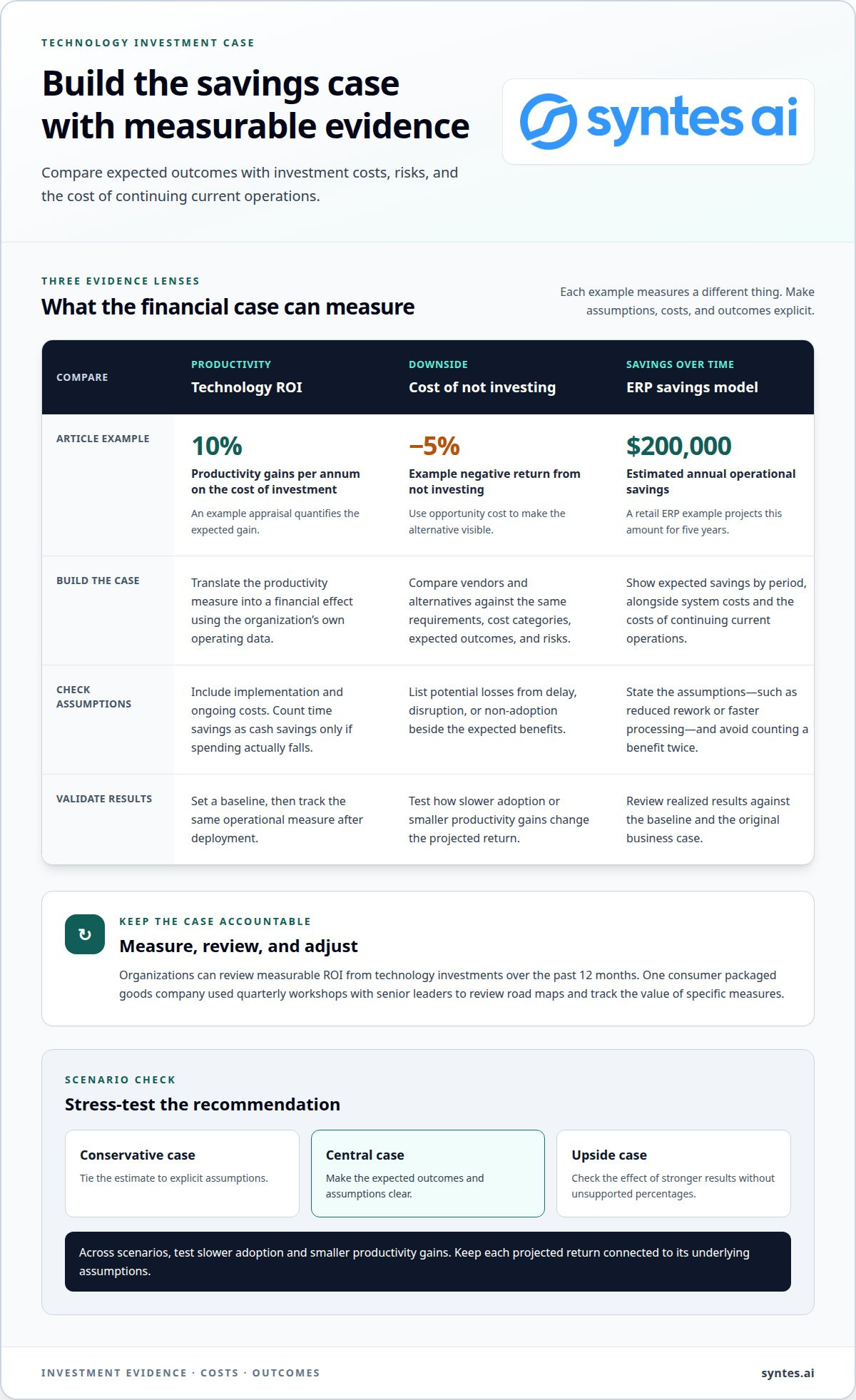
Set a baseline, then track the same operational measure after deployment. For example, an appraisal may quantify productivity gains at 10% per annum on the cost of investment. Translate that gain into a financial effect using the organization’s own operating data. Include implementation and ongoing costs, and avoid counting projected time savings as cash savings unless spending actually falls.
-
Quantify Risks and Benefits
List expected benefits beside potential losses from delay, disruption, or non-adoption. An example appraisal describes the opportunity cost of not investing as a negative return of 5%. Compare technology vendors and alternative solutions against the same requirements, cost categories, expected outcomes, and risks. This keeps the decision focused on business value rather than feature counts or presentation quality.
-
Measure and Reinforce Impact
Review realized results against the baseline and original business case. Organizations can review measurable ROI from technology investments over the past 12 months. A consumer packaged goods company held quarterly workshops with senior leaders to review road maps and track the value of specific measures. Use those reviews to identify where adoption, process changes, or spending adjustments can strengthen results.
- Build a savings model with a clear time horizon. In one retail example, a company estimates annual operational savings of $200,000 from its ERP system for five years. Present the expected savings by period, then compare them with the system’s costs and the costs of continuing current operations. State which assumptions drive the estimate, such as reduced rework or faster processing, and avoid counting the same benefit twice.
- Compare scenarios before recommending an investment. Use a conservative case, a central case, and an upside case, with each tied to specific assumptions rather than unsupported percentages. Check how slower adoption or smaller productivity gains affect the projected return. A structured assessment of operational data can also clarify which benefits depend on connected information across teams. Explore a structured investment assessment when cross-system information complicates the value case.
A financial comparison can be sharpened by making clear what the measure captures and what it leaves out. The analysis measured the companies’ earnings before interest and taxes (EBIT) growth from 2011 to 2013. When using an earnings measure, define the organizations and periods being compared, and consider whether operating changes can reasonably be connected to the technology investment. Keep the calculation consistent across the baseline and review so that shifts in scope do not make apparent gains difficult to interpret. Treat the financial result as one part of the decision, rather than as a complete account of value.
When evaluating technology investments, consider customer satisfaction and employee productivity alongside financial measures. Choose indicators that reflect the intended operational change, define how they will be observed, and review them alongside costs and realized savings. A financial benefit may be less compelling if service quality or productivity is declining; nonfinancial measures can also help explain changes in costs or returns. Record the assumptions behind each measure and use consistent definitions in later reviews. This gives decision-makers a broader view of whether the investment is delivering its intended value and where more process or adoption work may be needed.
Managing implementation milestones and budgets
Turn the approved business case into a staged implementation plan. Give each milestone an owner, a budget decision, and a way to track progress.
- Divide delivery into milestones that produce usable outcomes. Start with a focused first month, then map the work across six months of adoption rather than planning for only six days. For an enterprise system, define what teams must accomplish before each rollout stage can proceed. Connect each milestone to a business result, such as a completed workflow or usable operational data. This makes progress visible and gives leaders a basis for releasing the next portion of spending.
- Set budget gates based on delivery evidence. Separate essential implementation work from later enhancements and show which costs belong to each stage. A case-study company slowed its ERP implementation at a logical point, allowing work to resume when funding became available. This preserves a coherent delivery point instead of leaving a half-finished sequence of dependent tasks. Record the scope, completed work, outstanding dependencies, and funding needed for the next milestone.
- Build risk management, compliance, and traceability into project decisions. For each milestone, record the decision, accountable owner, supporting data, and unresolved risks. This creates a traceable path from the approved business case to implementation choices. Enterprise Security Risk Management should connect security considerations to the broader investment plan rather than treating them as an afterthought. When technology supports multiple uses, plan for security and timely results after deployment. Track both as implementation work with clear ownership.
- Plan staff buy-in as part of change management. Use the focused first month to identify affected teams, explain workflow changes, and gather operational feedback. During the six-month adoption period, give managers visible milestones for participation and process transition. If a new system changes how employees access information or complete tasks, include those changes in training and rollout planning. Adoption is an implementation requirement, not a post-launch activity to defer until the technical work ends.
- Review milestones against budget, risk, and adoption together. At each funding decision, compare completed work with the planned outcome, then record scope changes and their effect on delivery. If a dependency blocks progress, decide whether to resolve it, resequence work, or pause at a stable point. The ERP case shows why a logical pause matters when funding shifts. A documented decision trail helps executives see how spending, security, and operational readiness shape the next implementation step.
Net Present Value (NPV) and technology investment decisions
Use Net Present Value to compare expected cash flows over time and test whether an investment creates value. Base the case on realistic assumptions, shared operational benefits, and the time required to achieve results.
-
Build the Technology Business Case
Start with the business problem, expected cash inflows, costs, and decision horizon. NPV subtracts the present value of cash outflows from the present value of cash inflows over time. A positive NPV indicates that an investment is expected to generate more value than it costs. Document assumptions clearly: overly optimistic cash flows or an unrealistic discount rate can distort the result.
-
Evaluate Investment Options
-
Assess Multi-Department Value
-
Use Pilots to Assess Time to Value
Limit initial spending to a small pilot when the organization has limited experience with a technology. Define what the pilot must demonstrate, which users will test it, and what evidence will support expansion. A pilot can reveal adoption barriers and help refine cash-flow assumptions before broader implementation. Compare its results with the original case, then decide whether to scale, adjust, or stop.
- Check the final NPV against alternatives and the timing of benefits. The figures support a decision only when projected cash flows and the discount rate reflect the case’s assumptions. Use the calculation to compare options, not as a substitute for examining strategic fit, obsolescence risk, and when value is expected.
Technology investment alignment with business strategy
Technology creates strategic value when it builds capabilities the business intends to use. Connect each proposal to leadership priorities for next year and the company’s three-to-five-year direction.
- Translate business strategy into specific capabilities before assessing technology. If next year’s priority is improving customer satisfaction, identify the information or workflow needed to support that outcome. Then test whether it remains relevant to the company’s three-to-five-year direction. A practical test of how to justify technology investment is whether the proposal enables a defined capability, rather than simply adding another system to the portfolio.
- Assign a business owner and define how the operating model will use the capability. Technology investments aligned with targeted capabilities and supported by the right operating model were strongly correlated with profitable growth. Leadership should identify who will use the technology, who owns the resulting process, and which decisions it will change. Without that connection, even a technically sound purchase can sit outside the strategy it was meant to advance.
- Rate strategic alignment consistently across proposals. Organizations can assess investment alignment by rating each statement on a five-point scale. Evaluate whether the proposal advances a strategic capability, supports the operating model, and has an accountable business owner. Apply the same criteria across proposals, then examine weak areas before making funding decisions. For leadership, how to justify technology investment means making the strategic connection explicit and comparable, rather than relying on technical urgency alone.
- Measure customer and workforce outcomes alongside financial results. A manufacturing ERP system with business intelligence and analytics modules can give CFOs a real-time dashboard of financial health across plants, product lines, and customer segments. Connect each measure to the strategy it supports. Distinguish financial effects from operational indicators, such as employee productivity or customer satisfaction, so the proposal shows how value will be assessed across relevant outcomes.
- Use strategic priorities to guide increases and reductions in spending. Leadership teams can consider where to increase technology spending by 10%, then assess whether the investment strengthens a priority capability. They can also consider where to reduce technology spending by 10% without weakening strategic execution. Board technology teams are advised to begin with one or two priority improvements. This focus directs leadership attention toward investments with a clear role in business strategy.
Keep the review anchored in next year’s business strategy, while checking that each proposed capability also fits the strategy over a three-to-five-year horizon. The nearer view clarifies which priorities a proposal must support now; the longer view tests whether that support will remain relevant. Describe the intended business use before comparing proposals, so the discussion stays focused on strategic fit rather than technology in isolation.
For a consistent comparison, organizations can rate each statement on a 1-5 scale. Apply the same alignment questions to every proposal, including whether it advances a capability, supports the operating model, and has an accountable business owner. Review weak ratings to identify gaps that need clarification before a funding decision, and retain the rationale so leaders can compare choices against the same strategy.
Syntes AI
Syntes AI helps organizations connect technology decisions to operational value when fragmented enterprise data makes benefits difficult to assess. Its Enterprise Knowledge Graph, Context Engineering, Cross-System Integrations, and Syntes Agentic Platform connect information and AI capabilities across business systems. This can help leaders assess how technology spending fits strategic priorities and how connected workflows may support measurable outcomes.
Consider Syntes AI when the investment case depends on information spread across systems, or when teams need a clearer path from data to operational action. The right approach starts with the business objective, then connects the relevant capabilities to that need. To discuss how Syntes AI may fit your technology investment priorities, contact Syntes AI.
Make the next investment decision more deliberate
The strongest technology case becomes a management discipline, not a document written only for approval. Use each decision to sharpen how leadership allocates capital, learns from implementation, and responds to changing business priorities. That discipline turns how to justify technology investment into a repeatable way to connect operational needs with strategic action.
When fragmented enterprise information makes that connection difficult, Syntes AI’s Enterprise Knowledge Graph, Syntes Agentic Platform, and Cross-System Integrations can support a more connected technology environment. Consider these capabilities when evaluating how information and workflows across systems relate to the value your organization expects to create.
Move forward with a clear decision, accountable ownership, and a sharper view of the value technology can unlock.
Frequently Asked Questions
What is NPV?
Net Present Value (NPV) compares the present value of expected benefits with the present value of expected costs. It accounts for when cash flows occur, so a benefit expected later contributes less than an equivalent benefit received sooner. To apply it, map expected inflows and outflows by period, use the organization’s discount rate, and examine which assumptions most influence the result.
What cybersecurity and compliance costs should be considered in a technology business case?
Include the work needed to assess risk, manage access, monitor activity, test controls, retain audit records, and train affected teams. Also account for integration security and ongoing governance where relevant to the proposed system. Map applicable compliance requirements with the organization’s legal and compliance teams, then include the resources needed to meet them. Distinguish initial setup from recurring operating costs.