

An AI proposal earns executive support when it addresses a defined business problem, advances a strategic priority, and makes the funding decision clear. To get executive buy-in for AI, connect the use case to measurable outcomes, address risks directly, and request approval for a scoped pilot with explicit success and failure criteria. Lead with the business case, not the technology.
Executives need more than an impressive demonstration. They need to know what will change in the operation, what evidence will show value, who will own the work, and what happens if the system performs poorly. A clear proposal answers these questions without overstating returns or concealing implementation complexity.
This article explains how to align an AI initiative with strategic priorities, assess its business value and technical feasibility, and address concerns about cost, governance, workforce impact, and operational risk. You’ll also learn to define a credible pilot, establish a baseline, and set decision gates so the next investment decision is guided by evidence.
Key Takeaways
- Start with the business constraint and the workflow it affects, then connect the proposed AI use case to measurable outcomes.
- Build a credible business case by showing the assumptions behind projected returns, setting a baseline, and explaining data and technical dependencies.
- Address executive concerns directly with clear ownership, risk controls, human oversight, and fallback plans for errors or poor inputs.
- Design a bounded pilot with defined success and failure criteria, so leaders know what evidence will guide the next funding decision.
- Position AI as an operational capability that supports strategic priorities and ongoing innovation, not as a technology experiment without a business owner.
Assessing technical feasibility and business value
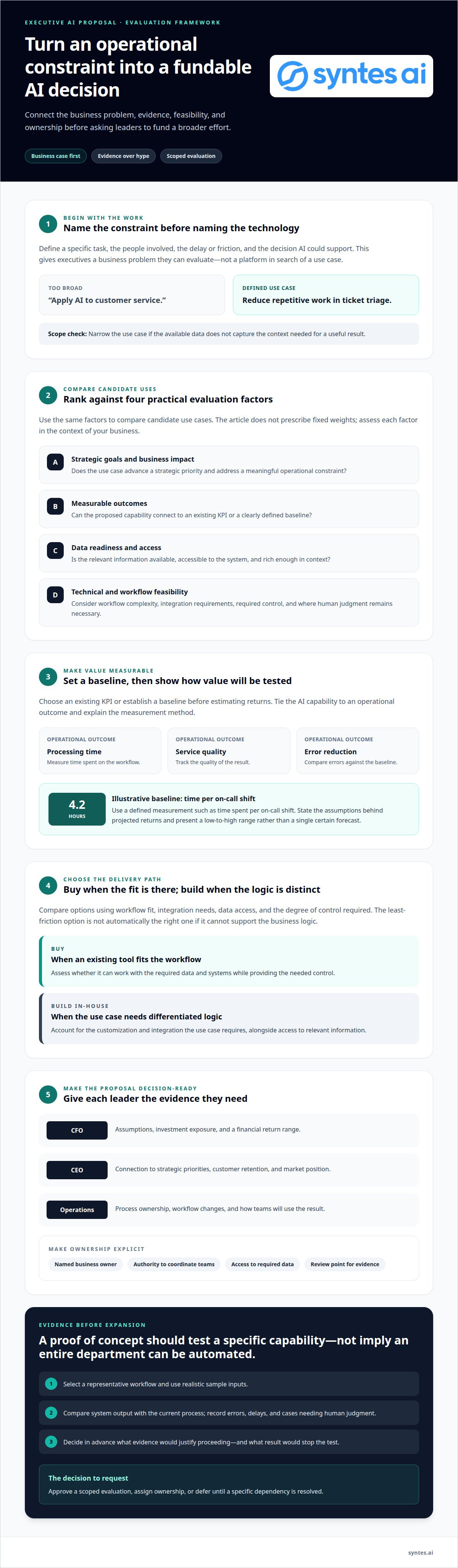
Compare buying AI tools with building in-house by assessing workflow fit, integration needs, data access, and required control. Buy when an existing tool fits; build when the use case needs differentiated logic. Identify candidate use cases by naming the task, delay, or customer friction, then rank them against strategic goals, measurable outcomes, data readiness, and technical feasibility.
-
Identify and Prioritize AI Use Cases
Start with a specific operational constraint, not a preferred model or platform. Map the task, the people involved, the delay or friction, and the decision AI could support. Then assess candidate use cases by business impact, available data, workflow complexity, and integration requirements. Avoid broad requests such as “apply AI to customer service.” A defined case, such as reducing repetitive work in ticket triage, gives executives a decision they can evaluate. Check whether the data captures the context needed for a useful result, and narrow the scope if it does not.
-
Connect Projects to KPIs and ROI
Choose an existing KPI or define a baseline before estimating returns. Link the proposed AI capability to an operational outcome, such as processing time, service quality, error reduction, or qualified demand. A workflow baseline could measure time spent per on-call shift; an illustrative example is 4.2 hours per on-call shift. State the measurement method, the assumptions behind projected returns, and a low-to-high range rather than presenting one forecast as certain.
For organic search, connect technical and content work to business metrics rather than reporting visibility alone. Track whether relevant search activity contributes to qualified pipeline and customer acquisition cost, and explain how attribution will work. SEO business results, including pipeline and acquisition cost, usually take six months or more. Set interim indicators to track progress, but distinguish them from revenue outcomes. Show how each measure supports a company KPI and what evidence would justify further investment.
-
Tailor the Business Case to Executives
Tailor the proposal to each decision-maker without changing its underlying evidence. A CFO needs the assumptions, investment exposure, and financial return range. A CEO needs the link to strategic priorities, customer retention, and market position. Operational leaders need to understand process ownership, workflow changes, and how teams will use the result. Keep every argument tied to the same use case and outcome.
Secure sponsorship as a concrete business commitment, not just a positive comment in a meeting. Request a named owner, authority to coordinate affected teams, access to required data, and a review point for evidence. Make the decision explicit: approve a scoped evaluation, assign ownership, or defer until a specific dependency is resolved. This makes the business case accountable and gives technical teams a clear basis for proceeding.
Addressing cost, ethics, compliance, workforce, and complexity concerns
Address executive concerns in the proposal before they become reasons to delay it. Use a proof of concept to test assumptions, expose operational constraints, and define safeguards before seeking broader commitment.
- Break down the full costs and sources of complexity. Identify data preparation, system integration, ongoing evaluation, governance, and workforce training as separate workstreams. For example, an AI tool may appear ready while customer records remain fragmented across systems. Show which dependencies are already in place, which need work, and how each affects delivery. Compare the cost of the full operating model, not just the initial technology decision. Tie estimates to explicit assumptions, such as data quality, integration scope, and human review.
Separate essential work from optional expansion. A proposal might request funding for a bounded proof of concept while treating data remediation as a separate decision. This keeps a narrow test from silently becoming a larger transformation commitment.
- Test the use case with a working proof of concept, not slides alone. Select a representative workflow, use realistic sample inputs, and compare the system’s output with the current process. Record errors, delays, and cases that require human judgment. For example, test how an assistant responds to incomplete records, conflicting instructions, and unusual customer requests. Decide in advance what evidence would justify proceeding and what result would stop the test.
Keep the test narrow enough to reveal technical and operational limits. A prototype should demonstrate a specific capability, not suggest that an entire department can be automated. Use the results to refine the proposal’s assumptions and identify safeguards for a larger deployment.
- Address ethics and compliance through named controls and accountable owners. The National Institute of Standards and Technology describes the NIST AI Risk Management Framework (AI RMF 1.0) as a voluntary reference for organizing AI risk management. Use it to structure a discussion of risks, while documenting the organization’s own review process and decision authority.
For each material risk, name an owner, the evidence that will show whether controls work, an escalation path, and a review schedule. Specify what data the system uses, which decisions require supervision, and the fallback when outputs are wrong. This gives leaders operational answers rather than broad assurances.
- Make workforce effects and executive concerns explicit. Identify which tasks will change, which will remain human-led, and what training or process redesign employees need. Ask finance to examine assumptions and exposure; operations to identify workflow disruption; and legal, security, and compliance leaders to assess relevant risks. Record each concern, its owner, and how the proposal addresses it.
When leaders need to see how a bounded test works in context, review an AI proof of concept as part of the evaluation.
Aligning AI investment with strategic priorities
Anchor the proposal in company priorities, then assign stakeholders and governance decisions to make that alignment actionable.
- Translate the organization’s priorities for the next 12-18 months into specific AI outcomes. Start with an approved objective, such as improving customer retention or strengthening market position, then identify the operational barrier limiting progress. Explain how the initiative addresses that barrier and what evidence would indicate strategic contribution. For example, a retention goal might support an AI use case that helps service teams resolve recurring customer issues. Avoid presenting technical novelty as a priority by itself.
Show how the proposed work supports existing plans rather than competing with them. A clear connection helps leadership compare the initiative with other demands on resources.
- Map stakeholders to the decisions and outcomes they own. Ask the CEO or strategy lead to confirm the priority, finance to assess the investment logic, and operating leaders to identify workflow dependencies. Include security, legal, and data leaders when their responsibilities affect the proposed use. Then identify potential conflicts. A service objective may call for faster responses, while a risk owner may require more review before automated actions.
Resolve these trade-offs before seeking approval. Record who owns each decision, whose support is needed for adoption, and which executive can settle competing objectives. This turns general alignment into a governance structure with clear accountability.
- Connect AI governance to enterprise risk priorities rather than treating it as a separate technical review. According to the National Institute of Standards and Technology, NIST CSF 2.0 reference GV.RM concerns risk management strategy, and executive buy-in can set security risk priorities and accountability. Explain which strategic objective depends on the proposed system and which risk decisions require leadership direction.
For example, if an AI workflow uses sensitive operational information, name the executive responsible for its risk priorities and escalation decisions. Tie oversight to the business purpose. Governance should clarify authority and accountability, not become an abstract approval layer.
- Place the initiative within the broader portfolio of strategic work. Explain what it enables, which teams must participate, and which existing process or project it complements. If proposals compete for attention, rank them by strategic contribution, operational readiness, and dependencies. A use case that supports a stated priority but lacks a process owner may need to be sequenced before broader adoption.
End the alignment discussion with a specific leadership decision: confirm the objective, assign an accountable executive, and authorize the next decision gate. This makes strategic fit clear and gives teams a consistent basis for execution.
Designing pilots with success and failure criteria
Make the pilot a bounded test of one business outcome, not a miniature enterprise-wide rollout. Define its scope, resources, evidence, and decision gates before work begins.
-
Scope and Resource the Pilot
Choose one workflow, one accountable business owner, and one measurable outcome. Define the users, inputs, systems, and decisions within scope, then state what the pilot will not test. For example, a customer-support pilot might assess whether AI can reduce the time spent categorizing incoming requests, without claiming it can resolve every customer issue.
Assign the people and access needed to run the test: a process owner, technical lead, participating users, and relevant risk reviewers. Identify dependencies such as data quality, system access, and workflow changes before launch. Keep missing-data work outside the pilot scope so its findings do not obscure whether the AI use case itself is feasible.
Include a review point and decision gate in the approval request. The pilot should produce evidence for a defined next step, such as stopping, revising the workflow, or considering a broader evaluation. Do not present a prototype as production-ready before testing it under representative operating conditions.
-
Set Pilot Success and Failure Criteria
Choose a baseline and outcome measure before the first test. Define success in operational terms, such as measurable time savings on one workflow within sixty days, a conservative example of a pilot promise. Specify the evidence source, measurement owner, and conditions that would invalidate the result, including incomplete data or low user adoption.
Describe failure as clearly as success. Set thresholds for unacceptable errors, unreliable outputs, or excessive human intervention, and name the fallback when the system cannot complete a task safely. For example, route uncertain responses to a human reviewer instead of treating model output as an approved decision.
Be explicit about the pilot’s limits. Reserve time in the pitch to explain what it is not intended to prove, such as enterprise-wide savings or readiness for unsupervised decisions. This keeps a promising, narrow result from becoming an unsupported rollout claim.
-
Use Pilots and Outside Validation
Build credibility with a pilot result another business leader can assess and defend. Ask a peer or business-unit leader familiar with the workflow to review the measures, assumptions, and conclusion. Their perspective can validate the findings and reveal operational effects the technical team may have missed.
Plan backward from the funding decision. Completing a pilot one month before an executive pitch may leave too little time for outside validation. Start building evidence before the target budget cycle, and complete smaller projects when they can demonstrate a relevant capability without overstating what they prove.
Present the design, measures, and success or failure conditions together. A clear pilot narrative gives executives a decision they can act on: continue, change scope, or stop. TeamStage reported that a lack of clear goals was the primary reason for project failure 37% of the time, underscoring why each test needs an explicit objective.
Presenting AI as evidence of ongoing innovation
Frame AI as disciplined innovation: show how the initiative advances business priorities, what evidence supports it, and what funding decision leaders need to make.
- Open with why the initiative matters now. AI has long been embedded in enterprise systems, including transportation algorithms, route optimization, and personalization. Use a relevant example to show that innovation means improving operational decisions, not adopting technology for appearances. Then connect the proposed capability to a current business priority, such as strengthening customer retention or improving service. Explain what limits progress in the existing process and what the initiative could change.
Keep claims proportional to the evidence. A bounded pilot may demonstrate improvement in a specific workflow; it does not prove enterprise-wide transformation. Make that distinction clear to protect confidence in the proposal.
- Structure the executive presentation around a decision, not a technology tour. Use two minutes to explain why the initiative is timely, then identify the business problem, affected team, and intended outcome. Present pilot or baseline evidence before discussing future potential. A concrete example, such as time saved on a defined workflow, is easier to assess than a broad productivity claim.
Make the request explicit. State whether leaders are being asked to authorize a next phase, assign ownership, or approve a review gate. Close with the decision needed and the evidence that will inform the next discussion.
- Present costs and risks together, using three minutes to make the trade-offs clear. Separate implementation needs, operational dependencies, and ongoing oversight instead of compressing them into one estimate. Explain the assumptions behind projected returns, and present a range when outcomes depend on adoption or data quality. For example, show how the forecast changes if fewer employees use the workflow than expected.
Name failure conditions, responsible owners, and fallback processes. If an AI output is unreliable, explain when a person will review it and how the workflow will continue. Specific controls make risk part of the investment decision, not a footnote.
- Show ongoing innovation through a sequence of evidence and decisions. Present what the initial test established, what remains uncertain, and which next step will address that uncertainty. Separate demonstrated outcomes from future projections. If the pilot missed its criteria, explain what the result revealed and whether changing scope is justified. This makes learning visible without disguising failure as success.
Request funding in stages tied to evidence, ownership, and review. A clear decision gate lets executives support progress while retaining oversight of the next commitment. Keep the presentation focused on the business outcome, the evidence, and the specific decision required.
Syntes AI
Syntes AI helps organizations connect an AI proposal to the data, systems, and operational context needed for execution. Its Enterprise Knowledge Graph structures complex enterprise data, while Cross-System Integrations connect AI capabilities with existing software. Context Engineering helps establish the context AI needs to support business workflows, and the Syntes Agentic Platform enables organizations to deploy and manage AI agents for operational tasks.
Consider Syntes AI when executive alignment is in place and the next challenge is turning a defined use case into a connected, governed capability. The right approach depends on the data, systems, and workflow involved.
Turn executive alignment into sustained progress
Executive support matters most when it shapes decisions after an initial AI initiative. Build on approval by keeping business owners accountable, giving leaders clear evidence at review points, and adjusting scope when operating realities change. This turns how to get executive buy-in for AI from a one-time pitch into a repeatable way to fund and govern meaningful change.
The next step is to translate executive alignment into an implementation path that fits your data, systems, and operational context. Syntes AI can connect those elements, giving an approved use case a practical foundation for execution. Bring a specific business challenge and the decision you want to enable.
Make the next decision deliberately. Clear ownership and evidence at each step help your organization move from intent to informed action.
Frequently Asked Questions
How do you build a business case for AI investment?
To get executive buy-in for AI, make the investment case answer a decision, not merely describe a technology. Define the business constraint, who experiences it, and what could change if the organization acts. Include the status quo, key assumptions, dependencies, and the consequences of delay. For example, a proposal about invoice handling can compare the current review process with a clearly scoped AI-supported workflow without assuming every invoice can be automated.
What metrics can demonstrate ROI from AI projects?
Choose metrics that connect operational change to financial or customer outcomes. Depending on the use case, track processing time, rework, error rates, service quality, adoption, and operating resources. Compare results against a consistent pre-project baseline, and separate direct outcomes from estimates. Model quality alone is not enough: a system can produce accurate outputs without improving the workflow or the business result executives funded.
How do you align an AI strategy with executive priorities?
Start with priorities leaders have already committed to, then map each proposed AI initiative to a specific contribution. For example, if customer retention is a priority, assess whether the use case improves a customer-facing process or helps teams respond to recurring issues. Identify competing goals early, such as speed and additional human review. Ask executives to resolve those trade-offs before teams turn strategy into implementation decisions.
How do successful companies get executive sponsorship for AI?
Sponsorship turns interest into an explicit commitment. A sponsor should be able to explain why the initiative matters, secure participation from affected teams, and make or escalate decisions when priorities conflict. For example, an operations executive can help a pilot team access a relevant workflow and coordinate with process owners. Sponsorship also requires follow-through: executives should review evidence at agreed decision points, not simply endorse the idea once.
How do you address executive concerns about AI risks and security?
Answer concerns with concrete scenarios tied to the proposed use. Explain what information enters the system, who can access it, how people review consequential outputs, and what happens when results are incorrect or unavailable. For a customer-facing workflow, describe how sensitive information is handled and when a case goes to a human. Assign owners for risk review and escalation so leaders know who acts if controls fail.
What AI governance and compliance rules should executives know?
Executives should distinguish voluntary risk-management references from binding legal obligations that apply to their organization. The National Institute of Standards and Technology describes the NIST AI Risk Management Framework (AI RMF 1.0) as a voluntary reference for organizing AI risk management. Use a framework to structure oversight discussions, while separately identifying the laws, contractual duties, and internal policies relevant to the specific use case.
How can you run an AI pilot that earns executive buy-in?
Make the pilot a focused test of one workflow, with a business owner and participating users. Select representative cases, including difficult inputs, and record where the system needs human intervention. For example, a team testing document classification can review ambiguous documents alongside routine ones. Share the findings with an operating leader who understands the process, and use their assessment to distinguish useful results from technical performance alone.
How should you present an AI proposal to the CEO or board?
Lead with the decision you need and why it matters strategically. Give the CEO or board a concise account of the affected business process, expected outcomes, key assumptions, material risks, and accountable owner. Use one concrete example to make the operational change clear, then state what approval enables next. Keep technical detail available for discussion, but make the requested decision clear without requiring leaders to interpret model specifications.