

Getting executive buy-in for data projects starts with the business decision, not the technology. Show which decision is difficult today, how better data could improve it, and what evidence will demonstrate progress. A platform demonstration may help, but it cannot replace a clear case for the business problem being solved.
That distinction matters. Executives need to see how a project supports priorities such as growth, productivity, cost control, or risk management, and what their teams must do to deliver the outcome. Involving them early lets them shape goals, raise concerns, and build ownership before the proposal is finalized.
For example, if teams spend time reconciling inconsistent reports, connect the project to the decisions those reports inform and the effort it could reduce. This article explains how to build that business case, define meaningful measures, and involve the right executives early. It also covers how a focused pilot and clear updates can turn initial support into sustained sponsorship.
Key Takeaways
- Anchor the business case in the decisions that need to improve, not in a technology roadmap.
- Translate technical work into clear business outcomes and measures executives already value.
- Establish a baseline before estimating value so progress can be assessed against the original problem.
- Build support by identifying the executive closest to the problem and addressing risks, costs, and resource needs openly.
- Involve leaders early to shape success criteria, surface concerns, and keep the project aligned with strategic priorities.
1. Building a business case around specific decisions
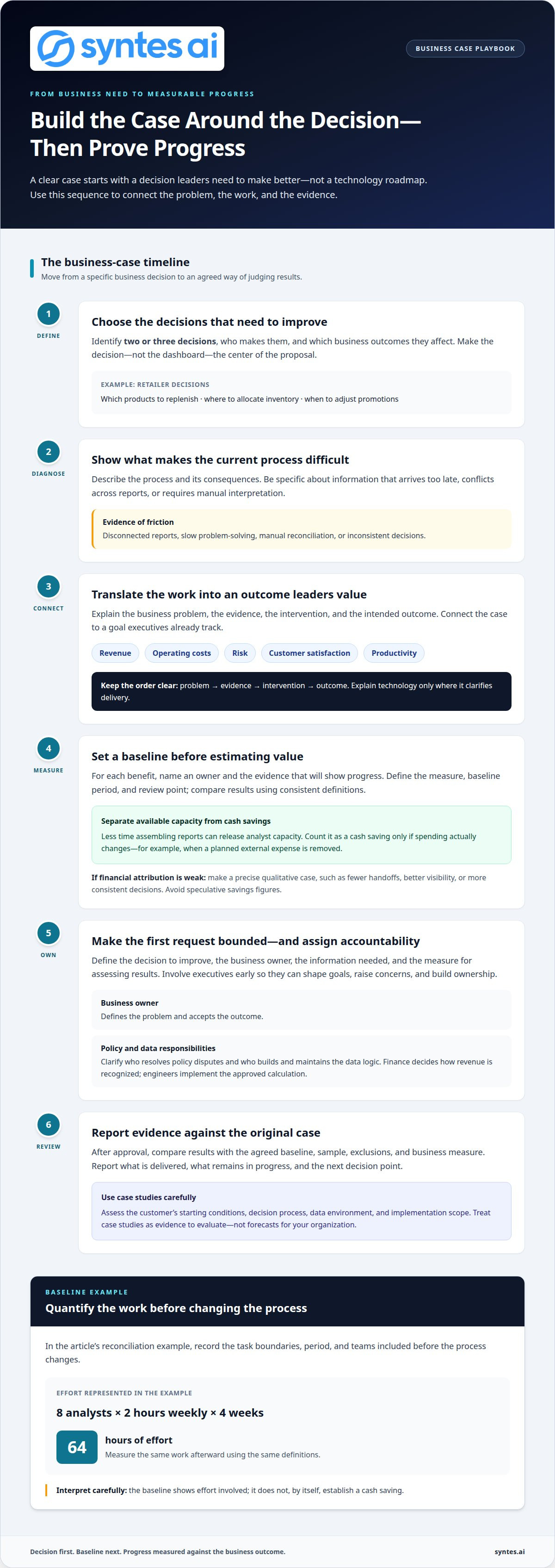
A strong business case starts with a decision leaders need to make better. Identify two or three decisions, who makes them, and which business outcomes they affect. A retailer, for example, might decide which products to replenish, where to allocate inventory, and when to adjust promotions. Show how better information could improve those choices, rather than simply promising more dashboards.
For each decision, describe the current process and its consequences. Explain which information arrives too late, conflicts across reports, or requires manual interpretation. Then connect the project to an outcome leaders already track, such as revenue, operating costs, risk, or customer satisfaction. If inventory decisions rely on disconnected reports, the case could focus on giving planners a consistent view before they commit stock.
Make expected benefits measurable, but distinguish released capacity from cash savings. If analysts spend less time assembling reports, that creates available capacity. Count it as a cash saving only if spending actually changes, such as when a planned external expense is removed. For each benefit, name an owner and specify the evidence that will demonstrate progress. If faster problem-solving is a goal, compare time to resolution over consistent periods.
Case studies and testimonials can strengthen the argument when they explain the business challenge, approach, and result. Treat vendor case studies—such as customer implementation references from Versino CZ, s.r.o.—as evidence to assess, not forecasts for your organization. Compare the customer’s starting conditions, decision process, data environment, and implementation scope with your own. A testimonial that praises a platform without explaining the original problem gives leaders little basis for judging its relevance.
Use a familiar data use case to make the proposal concrete. Choose a process executives recognize, such as sales forecasting or inventory planning, and show how better information could change a specific decision. Set out the baseline, proposed intervention, expected benefit, and review point. A useful success story makes those connections clear instead of attributing improvement to technology alone.
Keep the first request bounded. Define the decision to improve, the business owner, the information needed, and the measure for assessing results. If a broad analytics strategy cannot yet support a credible financial estimate, describe its expected benefits clearly in words. A disciplined case gives leaders a practical basis for approving the next step and evaluating the work against business priorities.
2. Explaining business problems rather than technology buzzwords
Executives fund outcomes, not labels such as “lakehouse,” “AI,” or “real-time analytics.” Start with the business problem: a sales team, for example, may struggle to explain forecast changes after leaders have committed resources. Then show how better information could improve the decision, what support the business must provide, and how progress will be assessed. Explain the technical architecture only where it clarifies delivery; it cannot replace the business rationale.
Build the explanation in a clear sequence: problem, evidence, intervention, outcome. A company facing frequent customer-service escalations might show how fragmented case histories slow resolution. Explain which information teams need together, how it could change case handling, and which existing measure reflects improvement. Connect the intended outcome to an established goal, such as customer satisfaction, productivity, revenue, cost reduction, or risk management. Avoid claiming a financial return unless the evidence supports it.
A quantitative business case is useful when the organization can measure a credible baseline and connect change to a business outcome. Define the measure, its owner, the baseline period, and the review point. If financial attribution is weak, make a qualitative case instead. Describe the operational impact clearly, such as fewer handoffs, better visibility for managers, or more consistent decisions across teams. A precise explanation is stronger than a speculative savings figure.
Translate broad goals into operational measures. If leadership wants revenue growth, explain which sales decision the initiative supports and how teams will assess its effect. If the goal is productivity, identify the process step that consumes effort and the change the project is meant to enable. Keep metrics aligned with the original business case, so progress reports answer the same question executives approved. Technical controls can support reliable data, but they do not define revenue or prove financial return.
Assign accountability before implementation. Name the business owner who defines the problem and accepts the outcome; identify who resolves policy disputes; and clarify which team builds and maintains the data logic. For example, finance should decide how revenue is recognized, while engineers implement the approved calculation. This prevents unresolved business rules from being settled accidentally in code. A focused discussion can help teams map data capabilities to business decisions and identify the operational ownership a proposal requires.
3. Can you give an example?
After approval, compare results with the agreed baseline, sample, exclusions, and business measure. Report what has been delivered, what remains in progress, and the next decision point, so leaders can judge whether the work is changing the intended outcome.
Take an illustrative reconciliation process: eight analysts each spend two hours weekly on the task for four weeks. Together, that represents 64 hours of effort. Record the period, task boundaries, and teams included before changing the process. After implementation, measure the same work using the same definitions. The comparison can demonstrate whether analyst time has been released, but it doesn’t prove cash savings unless spending changes.
Make estimates useful by connecting the baseline to a specific operational consequence. If staff spend time locating information, measure that effort before and after the relevant change. One illustrative example is half an hour per employee each day spent searching. Treat this as a measurement starting point, not a promised result. Define which employees and search tasks count, then assess whether the same activity takes less time afterward.
Data-fix effort also needs a defensible estimate. James Phare’s team estimated that some identified data problems could take one to two weeks or perhaps a month to fix. Treat that range as a planning example, not a universal delivery promise. For each issue, document what is wrong, which records or processes are affected, who must resolve it, and how the team will verify the correction. Separate investigation from remediation, since unclear definitions or ownership can change the work involved.
To estimate onboarding savings, compare training time before and after implementation. Keep the employee group, training task, and measurement approach consistent. Record whether the comparison includes preparation, instruction, or follow-up support, then connect any measured difference to the onboarding process. Do not turn saved time into a financial claim unless the organization can show how its spending changes.
Set the baseline before delivery, not after results appear. Record the measurement period, sample, and exclusions so later comparisons remain meaningful. Choose an indicator tied to the original business problem, such as resolution time or reconciliation effort. At each review, show the observed change, explain any gap from the expected outcome, and state whether the next decision is to continue, adjust, or stop. This gives leaders an evidence trail, not a success story built on shifting definitions.
4. How can I gain support from an executive for a project?
Present a data project proposal to senior leadership as a decision brief. State the business problem, affected department, intended outcome, required resources, and decision requested. Then explain the implementation scope, dependencies, delivery and ongoing operating costs, risks, and review point. Keep technical language brief, including details only when they clarify a business choice.
Separate sponsorship from budget approval. First seek sponsorship from the executive whose business problem the project addresses most directly. That sponsor can clarify priorities, convene decision-makers, and advocate for the proposal, while a finance leader or budget committee may still control funding. Build support among people who can explain distinct benefits, such as a department leader describing operational impact and a data owner explaining information needs.
Address data quality, privacy, security, and compliance concerns directly. Document the exposure, proposed controls, and remaining uncertainty with the appropriate risk or compliance owner. For example, identify source data with known quality issues, how those issues affect the intended decision, and who owns remediation. Include integration dependencies and explain how the team will manage them. Do not present hypothetical fines as assured savings.
Scope the initial budget request as a bounded, time-limited engagement with a tangible deliverable. Include business-owner time, engineering, stewardship, training, tools, and ongoing maintenance; leaving out operational work makes the estimate incomplete. Define what the team will implement, what the executive will receive, and which review point will determine whether to continue, change, or stop. A strategic roadmap can show how the initial work supports later priorities without asking leaders to approve every future phase upfront.
A pilot or proof of concept can help secure executive sponsorship by testing a defined use case, gathering user feedback, and surfacing integration or adoption issues before broader rollout. James Phare’s team used a temporary software pilot lasting about six weeks to win over sponsors. Set the scope, success criteria, participants, and decision date in advance, so the results inform a concrete next step rather than an open-ended experiment.
Use consistent business language across the proposal, pilot, and budget discussion. If the executive’s priority is productivity, describe the process change and evidence that would demonstrate it; do not switch to technical measures alone. Make a clear request for sponsorship, resources, or funding, and specify the decision each leader is being asked to make. This precision helps executives assess the commitment and understand how their involvement can reduce delivery risk.
5. Involving executives early in decision-making
Executive involvement should shape a data project before its scope hardens. Start with individual conversations with functional leaders, rather than presenting a finished strategy to a large group. Ask about strategic goals, how success is defined, and which obstacles prevent progress. Their answers reveal where priorities align and where decision rights need clarification.
Use these conversations to separate business choices from technical implementation. Executives and business owners, for example, should decide which customer category drives a sales policy; data engineers can then implement the agreed calculation. If policy disagreements emerge, document them for the responsible business leaders. Code should not become the means of settling commercial or operational disputes.
Early engagement also shapes governance. Define who owns business definitions, resolves conflicts, and approves changes to shared data. A governance operating model can distribute accountability through clear roles, a leadership committee, and working sessions. The committee can address cross-department decisions, while working sessions resolve issues close to the processes they affect.
Give stakeholders something concrete to assess. A prototype using real company data can help business users, managers, and executives decide whether a proposed view supports their decisions. Keep the discussion focused on the task: can a sales manager identify which accounts need attention, for example? When assessing complex user workflows or digital interfaces, behavioral research solutions from Ergoneers can help gather precise interaction data to inform these evaluations. Capture concerns about data meaning, access, and workflow, then document the changes the team will make before expanding the work.
Build advocacy through people with direct experience. A senior manager or director who has seen a platform’s benefits can explain its operational value to executive peers. Bring in leaders from functions affected by the project, too. A finance leader may clarify reporting needs, while an operations leader identifies process constraints. This coalition gives the proposal more than one voice without obscuring who owns the final business decision.
Before a group review, circulate a concise decision brief recording agreed goals, unresolved questions, owners, and the next decision required. Invite executives to raise concerns while the project can still change direction. Document the response and assign each issue to an accountable owner. This links executive input to project choices instead of treating consultation as a presentation followed by silence.
Use each review point to revisit strategic fit. If company priorities shift, leaders can decide whether to adapt scope, maintain the current direction, or stop work. Tie roadmap discussions to the organization’s priorities for the next 12-18 months, and make dependencies explicit. Early involvement is not a request for constant intervention; it establishes clear decision routes before delivery pressure makes alignment harder.
Syntes AI: AI Data Platform
Syntes AI’s Enterprise AI Platform can support a business case that depends on connecting complex enterprise data to operational decisions. Its AI-Generated Live Context Graph organizes structured data, documents, and relationships into a unified context layer. Bi-directional connectors link with existing systems with no rip-and-replace, while governed AI agents can act across connected workflows. The platform supports weeks, not months deployments.
Consider this approach when executives support a defined business outcome but fragmented systems make information difficult to use across processes. The next step is to map the data and integration requirements to the decisions the project aims to improve, then assess how Syntes AI’s platform fits the existing environment.
Make the Next Decision Count
The next step in getting executive buy-in for data projects is turning alignment into a working commitment. Bring the business sponsor and delivery leaders together to define the first decision checkpoint, clarify who can resolve emerging trade-offs, and agree how new evidence will shape the project. This keeps support active after approval, when competing priorities and operational realities begin to test the plan.
Choose a practical starting point, make ownership visible, and use feedback to guide execution. A data initiative earns lasting credibility when leaders can see how decisions evolve and what the organization learns along the way. Start with a focused conversation about the challenge you need to address.
With clear ownership and a defined next step, your team can move from agreement to informed action.
Frequently Asked Questions
Can you give an example?
Yes. Suppose a team must prioritize customer requests, but staff cannot see the full history in one place. Trace one request from intake to decision, showing what information was missing and how the decision changed once it became available. Include an exception, too. This helps executives understand both the operational value and the limits of the proposed approach, rather than seeing just another screen or report.
How can I gain support from an executive for a project?
Give the executive a specific role in defining the project’s decision boundaries. Ask, for example, which trade-offs the team may make independently and which require leadership review. This surfaces authority gaps before they delay delivery. Then agree on a concise update format, such as a decision log listing the issue, options, owner, and required executive input. Sponsorship becomes active and useful without asking leaders to manage daily work.
How did you win them over?
Make operational reality visible. Invite an executive to observe how a representative task moves between people and systems, then show where context is lost or decisions stall. Ask which consequence matters most. A short debrief can turn that observation into a shared problem statement and give the sponsor direct evidence to discuss with peers. Keep the demonstration focused on their actual workflow, not a polished but unrelated scenario.
What are effective ways to secure executive buy-in for a project?
A reliable method for getting executive buy-in for data projects is to tailor the case to each leader’s decision remit. A finance executive may focus on assumptions and investment controls, while an operations leader may care about disruption and adoption. Prepare one consistent proposal, then foreground the implications relevant to each audience. Close with a precise request: the decision needed, the person accountable, and the consequence of postponing it.
How do you build a business case for a data project?
Compare the current operating process with the proposed one. Describe what happens if the organization leaves it unchanged, including delays, recurring workarounds, or decisions made with incomplete context. Then explain the intervention, dependencies, and evidence needed to assess its effect. Make assumptions visible and distinguish observed facts from estimates. This lets executives challenge the reasoning without mistaking a forecast for a delivered result.
What metrics demonstrate the ROI of data projects to executives?
Pair an operational indicator with a business outcome. For example, track whether employees use a new decision workflow, then assess whether the targeted process or customer outcome changes. Adoption alone does not establish return, and a favorable business result may have several causes. Document how the measures relate, who owns them, and what else changed during evaluation. This gives leaders a clearer basis for judging the project’s contribution and deciding what to refine.
How should you align a data project with executive strategic priorities?
Translate the priority into a decision the project can support, then make the connection explicit. If leadership wants to improve customer retention, identify the decisions that shape customer experience and the information those decisions require. State what the project will not address, too. Clear boundaries help executives compare the initiative with competing work and keep a broad strategic goal from becoming an unmeasurable technology program.
Who are the key stakeholders to involve when seeking executive buy-in for a data initiative?
Involve the executive sponsor, the business owner of the affected decision, and the people responsible for data definitions, delivery, and risk oversight. Include end users who understand how work happens in practice. Clarify each person’s authority: who sets policy, approves access, resolves conflicting definitions, and manages implementation. This role map exposes missing decision-makers early and keeps technical teams from having to settle business disagreements.