

Effective enterprise generative AI security combines safeguards for data, models, applications, and the people and agents who use them. It addresses risks such as prompt injection, sensitive information exposure, and insecure connections to external services. Governance, access controls, and operational monitoring make these safeguards accountable in practice.
Generative AI can accelerate security work, but it also creates new ways for sensitive data to move and systems to act unintentionally. The answer is not to treat AI as a separate experiment, but to secure how it connects to enterprise data, software, and decision-making.
This article explains what generative AI security covers, why it matters, and how organizations can manage risks through governance, compliance, and security operations. It also looks at how generative AI can help security teams prioritize alerts, support threat response, and strengthen detection while preserving oversight and control.
Key Takeaways
- Trace how sensitive data moves through prompts, model training, and supplier systems to identify exposure points.
- Give AI agents permissions that match their tasks, and monitor their access and actions as they operate.
- Recognize prompt injection as a route to unintended actions, and build safeguards around how systems interpret instructions.
- Connect governance, compliance, and testing so AI risks are addressed across development and deployment.
- Use generative AI in security operations to support alert prioritization and response while keeping human oversight in the loop.
Data leakage, poisoning, and supply chain vulnerabilities
Generative AI can expose sensitive information, rely on manipulated data, or inherit weaknesses from its supply chain. Security teams need visibility into prompts, retrieval sources, model inputs, and external services.
Protecting Retrieval Data
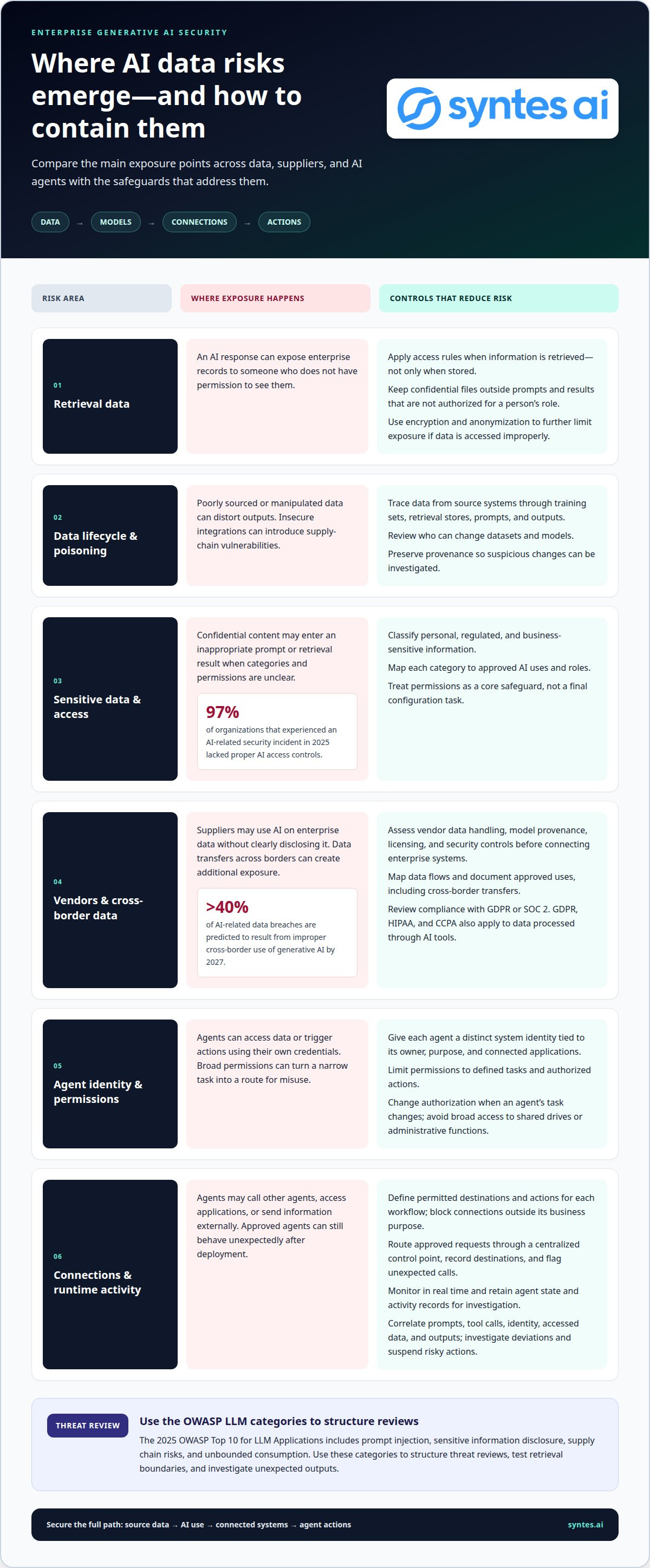
Retrieval data is enterprise information that an AI system searches to ground its responses. Protecting it matters because even a useful answer can expose records to someone without permission. Apply access rules when data is retrieved, not only when it is stored. For example, a prompt should not let an employee retrieve confidential files outside their role. Encryption and anonymization can further limit exposure if data is accessed improperly.
Securing the AI Data Lifecycle
Lifecycle security protects information as it is collected, prepared, used, stored, and removed across AI infrastructure. A control at one stage cannot prevent every later risk. Trace data from source systems into training sets, retrieval stores, prompts, and outputs. Review who can change datasets and models, and preserve provenance so teams can investigate suspicious changes. Poisoned or poorly sourced data can distort outputs, while insecure integrations can create supply-chain vulnerabilities.
Sensitive Data Classification and Access Controls
Classification labels information by sensitivity, while access controls limit who and what can use it. Together, they help prevent confidential content from entering an inappropriate prompt or retrieval result. Define categories for personal, regulated, and business-sensitive data, then map each category to approved AI uses and roles. In 2025, 97% of organizations that experienced an AI-related security incident lacked proper AI access controls. Treat permissions as a core safeguard, not a final configuration task.
Assessing Third-Party Vendor Risk
Third-party risk assessment examines a vendor’s data handling, model provenance, licensing, and security controls. It matters because suppliers may apply AI to enterprise data without clearly disclosing that use. Assess how vendors process, retain, and protect information, and review their compliance with GDPR or SOC 2. How can organizations manage this risk? Map data flows, document approved uses, and assess vendor controls before connecting enterprise systems. Include cross-border transfers in that review: more than 40% of AI-related data breaches are predicted to result from improper cross-border use of generative AI by 2027.
Existing privacy obligations remain relevant when data passes through AI tools. GDPR, HIPAA, and CCPA apply to data processed through AI tools, so classify information before use and account for jurisdiction when data moves across borders. The 2025 OWASP Top 10 for LLM Applications includes prompt injection, sensitive information disclosure, supply chain risks, and unbounded consumption. Security teams can use these categories to structure threat reviews, test retrieval boundaries, and investigate unexpected outputs.
Why is GenAI security important?
AI agents can progress from answering questions to taking actions across enterprise applications. Security depends on identifying each agent, limiting its authority, and monitoring its activity at runtime.
AI Agent Identity and Authorization
AI agent identity and authorization give each agent a distinct system identity and approved permissions. This matters because an agent can access data or trigger actions using its own credentials. Treat each agent as a separate identity, not an extension of its user. Tie its permissions to a defined task, such as drafting a report, rather than granting broad access to shared drives or administrative functions.
Map each agent to its owner, purpose, connected applications, and authorized actions. This gives security teams a basis for access reviews and incident analysis. If an agent’s task changes, its authorization should change too. For example, a report-writing agent may need to read approved records, but should not be able to alter them or create new accounts.
Managing Agent Permissions and Connections
Agent permission management limits the data, tools, and external connections an agent can use. Overly broad access can turn a narrow task into a route for misuse. In an agentic workflow, one agent may call another, access an application, or send information externally. Define permitted destinations and actions for each workflow, and block connections outside its business purpose.
Review outbound connections as part of authorization, not as a separate network concern. For example, an agent that summarizes internal tickets may need access to a ticketing application, but not unrestricted access to external services. Security teams can route approved requests through a centralized control point, record destinations, and flag unexpected calls. This creates a clearer trail when an agent acts outside its intended scope.
Monitoring Agents and Detecting Incidents
Runtime monitoring captures agent activity, access, and state while an AI system operates. An approved agent can still misuse permissions or behave unexpectedly after deployment. How should enterprises monitor use and detect incidents? Combine real-time monitoring with centralized controls, then retain agent state and activity records for investigation.
Correlate prompts, tool calls, identity, accessed data, and outputs. A request to retrieve a customer record followed by an unexpected external connection is a stronger signal when both events appear on one timeline. Security teams can compare activity with approved business purposes, investigate deviations, and suspend risky actions through a control point. Preserve enough context to determine what the agent was asked to do and what it actually did.
Operational analysis should also account for changes in agent behavior and connected applications. A new integration can expand an agent’s access even when its original task remains unchanged. Track permission changes, review outbound destinations, and capture state during investigations. Teams assessing how these controls fit their workflows can explore a demonstration of agent governance.
What Is Generative AI Security?
Generative AI security combines controls that protect AI applications, data, identities, and actions. Enterprise platforms need prompt and file inspection, access policies, activity monitoring, and restrictions on what AI agents can do.
Prompt Injection and Adversarial Threats
Prompt injection is an attack that uses instructions in a prompt or external content to steer an AI system away from its intended task. It matters because an AI application may treat hostile text as instructions, particularly when processing retrieved documents or user-supplied files.
The 2025 OWASP Top 10 for LLM Applications includes prompt injection among its risks. A document could tell an assistant to ignore its policies and disclose information. The model may not reliably distinguish that text from legitimate instructions. Security controls should therefore limit the actions available to the system, even when an attack influences its response.
Adversarial threats also include attempts to misuse an AI tool through its ordinary features. For example, a user could ask an assistant to summarize confidential material they are not authorized to access. Apply identity checks to data retrieval and tool use, then test whether the application respects those boundaries when faced with hostile prompts.
Inspecting Prompts, Responses, and Uploads
Prompt and content inspection checks inputs, generated responses, and uploaded files against an organization’s security policies. This matters because a sensitive file or deceptive instruction can enter through the same interface as a routine business request.
Inspect prompts for sensitive information and requests that conflict with approved uses. Scan uploaded files before they become model context, and treat embedded instructions as untrusted content. For example, an uploaded report might contain text intended to redirect an AI agent. Separating document content from trusted system instructions helps reduce this risk.
Review responses for sensitive disclosures and actions that exceed the user’s identity or role. Keep records of prompts, uploads, and outputs under appropriate access controls. This evidence helps security teams investigate misuse, distinguish a flawed answer from a policy breach, and refine controls based on observed behavior.
LLM Gateways and Prompt Protection
An LLM gateway is a control point between users, applications, and language models that applies security policies to AI traffic. It allows teams to manage access and observe interactions without relying on each application to implement every control independently.
Configure gateway policies to authenticate users, restrict approved models, and route requests through authorized applications. Apply input and output checks, and log relevant activity for analysis. A gateway can also enforce usage limits and block requests that violate organizational rules. These controls create a consistent enforcement layer across connected AI services.
What controls should enterprise platforms include? They should combine identity-based access, prompt and file inspection, response review, activity logging, and restrictions on agent actions. No single filter addresses every attack, so security teams should test controls against prompt injection and update policies as applications and workflows change.
Enterprise generative AI governance and compliance
A generative AI security policy should assign ownership, define approved uses, set data and access controls, and establish testing and incident procedures. Governance connects these requirements across models, applications, suppliers, and users.
AI Security Governance and Incident Readiness
AI security governance assigns responsibility for risks, controls, and incident response throughout an AI system’s lifecycle. A change to a model, application, or supplier can create risks beyond one team’s remit. Establish accountable owners across security, legal, data, and business functions. Define escalation paths, preserve evidence, and rehearse responses to incidents such as unauthorized data access or malicious model behavior.
Before deployment, require documented testing and risk reporting for each AI use case. An incident plan should identify who can restrict access, disable an integration, preserve logs, and notify affected internal teams. Include suppliers in accountability processes when their models or services handle enterprise information. These steps make response decisions operational rather than improvised during an investigation.
Governance and Compliance Frameworks
Governance frameworks organize AI risks into repeatable management, assessment, and oversight practices. They matter because consistent records help organizations connect technical controls with business objectives and compliance needs. The National Institute of Standards and Technology’s AI Risk Management Framework can help structure that work. ISO/IEC 42001 is another framework organizations can map to AI governance objectives.
Maintain an AI bill of materials that records models, datasets, components, and suppliers used in each system. This inventory supports provenance reviews and helps teams understand which systems may be affected by a newly identified vulnerability. The European Union states that the EU AI Act sets penalties for the most severe violations of up to €35 million or 7% of worldwide annual turnover. The European Union states that the EU AI Act’s transparency obligations followed in August 2026.
AI and SaaS Access Governance
AI and SaaS access governance manages which users, applications, and agents can reach AI features and enterprise data. This matters because AI may be embedded in business software outside central approval processes. Inventory LLM tools, AI assistants, embedded SaaS features, and internal models. Then compare access with approved business purposes and existing identity roles.
To create a policy, document approved tools, restricted data, permitted uses, and review responsibilities. Audit usage patterns, educate employees about approved AI tools, and define how to handle exceptions and incidents. Track supplier access and integrations alongside employee access. This gives security teams a clearer view of shadow AI and helps keep controls aligned as SaaS applications and workflows change.
Generative AI in security operations
Generative AI can help security teams prioritize alerts, support threat response, write more secure code, and deploy intelligent threat detection. Its operational value depends on connecting analysis to reliable data and controlled actions, rather than treating an AI tool as an independent decision-maker.
For alert triage, an AI system can summarize related signals and explain why an alert deserves attention. A security analyst can use that summary to identify the next investigation step while retaining responsibility for consequential decisions. This reduces friction between detection and analysis, especially when teams need to correlate activity across security applications and shared operational records.
Threat response is another practical use. Generative AI can help match an incident to an established response playbook, summarize relevant evidence, and prepare proposed actions. For example, it might assemble events associated with a suspicious login for analyst review. Organizations should evaluate available playbooks, automated actions, and tuning controls to determine whether response automation creates excessive noise.
Detection can also draw on behavioral baselines, deviations, and sensitive data access. Security teams can assess whether an AI tool identifies unusual access patterns, such as an account retrieving records outside its normal work. Analysis becomes more useful when it connects activity to identity, application, and business context. Without those links, it can be difficult to distinguish an unusual event from legitimate work.
Generative AI can support secure coding by helping developers examine code and identify potential weaknesses. Its output still needs review within existing development processes. Teams should test whether recommendations fit the application’s design and security requirements before integrating changes. This keeps AI-assisted analysis tied to accountable engineering actions, rather than allowing generated suggestions to bypass established review.
Govern adoption with clear boundaries between analysis and execution. Start with workflows where the AI system summarizes, classifies, or recommends, then define which actions require human approval. For each use case, identify the data it can access, the applications it can affect, and the evidence it must retain. This makes operational ownership visible and limits unintended effects on shared systems.
Evaluate performance against real workflows, not polished demonstrations. Test whether the tool detects meaningful deviations, handles sensitive data appropriately, and produces actionable summaries. Review response playbooks, automation settings, and tuning controls together. A useful deployment helps teams move from detection to informed action while preserving oversight, auditability, and control over changes to production systems.
Bring operational context and AI workflows into a more connected security model.
Syntes AI: Enterprise Knowledge Graph
Syntes AI’s Enterprise Knowledge Graph unifies complex data into a structured, actionable format. It is relevant when security teams need connected enterprise information to support AI workflows across systems rather than rely on isolated data sources.
Cross-System Integrations connect AI capabilities with existing enterprise software, while Context Engineering shapes the information available to AI systems. Together, these offerings support context-aware workflows grounded in organizational data. The Syntes Agentic Platform enables businesses to deploy and manage AI agents for operational tasks.
For organizations bringing security controls, data, and AI operations into a more coherent architecture, these capabilities offer a practical next step. Contact Syntes AI to discuss your enterprise AI needs.
Make security part of AI execution
The next step is to make security an operating condition for AI, not a review that happens after deployment. Assign clear ownership for each use case, connect security decisions to business workflows, and revisit controls whenever models, data sources, or integrations change.
That discipline helps organizations expand enterprise generative AI security without separating innovation from accountability. Start with a defined operational need, establish which actions require oversight, and use evidence from real workflows to refine governance. Progress comes from making decisions repeatable across the organization, not treating each new AI capability as an isolated exception.
If your organization is shaping its next phase of secure AI execution, a focused discussion can clarify the architectural priorities and operational context that matter most.
Build with intent, keep accountability visible, and move forward with confidence.
Frequently Asked Questions
Why is enterprise AI security now a priority?
AI is moving into routine business processes, where it can influence decisions and interact with sensitive information. McKinsey’s 2025 survey found that 79% of organizations worldwide reported using generative AI in at least one business function. That adoption expands the number of systems and workflows security teams need to oversee. For example, an AI feature embedded in a sales application can introduce data and access risks beyond a standalone AI service.
What does “securing AI” actually mean?
Securing AI means managing risks across the system, not just protecting the model. A practical enterprise generative AI security program considers the data, applications, identities, suppliers, and business processes connected to an AI capability. For example, a system that drafts customer responses needs controls over which records it can reference, who can review its output, and how teams investigate unexpected results.
What are the main security risks of generative AI in enterprises?
Key risks include sensitive information exposure, manipulated training or retrieval data, prompt injection, and weaknesses inherited from suppliers or connected components. Outputs may also be inaccurate or inappropriate for their intended use. Consider an AI system that summarizes an internal policy: a compromised source document could influence the summary, while an application that automatically trusts the result could carry an error into a business decision. Assess the entire workflow, not just model responses.
How can enterprises prevent sensitive data leakage to generative AI tools?
Define which information each approved AI use case can process, then enforce that boundary at input and retrieval points. For example, a finance assistant may need access to approved reporting data but not employee records. Use role-based permissions, remove unnecessary identifiers where practical, and restrict unapproved tools through organizational policies. Review prompt and file-handling practices so employees understand which information belongs in approved systems.
How do enterprises secure LLMs against prompt injection and jailbreaks?
Reduce the impact of hostile instructions by separating trusted system directions from user prompts and retrieved content. Limit the tools and actions available to the model, and require human approval for consequential operations. Test with adversarial examples, such as documents instructing an assistant to ignore its assigned task. Evaluate whether the application maintains access boundaries and refuses requests that conflict with policy, rather than relying on wording alone.
What are best practices for securing RAG systems and vector databases?
In retrieval-augmented generation systems, apply permissions when a query retrieves information, not only when documents enter the index. Preserve source and access metadata with each indexed item, and isolate records belonging to different users or organizational groups. For example, a shared search index should still prevent one department’s query from returning another department’s restricted material. Review ingestion changes and remove outdated or unauthorized content from retrieval workflows.
What compliance rules apply to enterprise generative AI in the United States?
Existing data-protection rules may apply when personal or regulated information is processed through AI tools. The GDPR, HIPAA, and CCPA apply to data processed through AI tools, according to the scope of each rule. Organizations should identify the data involved, its purpose, and the jurisdictions connected to its processing. For a customer-support assistant, that means assessing the records it receives and how its use fits existing privacy obligations.
What is the NIST AI Risk Management Framework guidance for generative AI security?
The National Institute of Standards and Technology’s AI Risk Management Framework gives organizations a structure for aligning AI risk work with governance objectives. NIST released its Generative AI Profile, NIST AI 600-1, in 2024. Organizations can use the framework to organize assessment of a generative AI use case, document its risks, and connect safeguards to accountable owners. Apply that analysis across development, deployment, and ongoing operation, rather than treating review as a one-time approval.