
Data lineage is the map behind every trusted data point. Documenting data sources and lineage means tracing data from its origin, through each transformation, to the reports, applications, or models that use it. This trace shows not only where data travels, but how it changes along the way.
Teams need that visibility when a report looks wrong or a system changes: they must know what depends on the data and where to investigate. Lineage is not one diagram or a one-time inventory. Its useful level of detail depends on the question, from a system-level view to table- or column-level detail, and it should capture both technical flows and business meaning.
This article explains what data lineage captures, how conceptual, logical, and physical models shape its level of detail, and where automated discovery needs human context. It also covers how current lineage supports troubleshooting, governance, and engineering decisions, such as assessing downstream impact before a change or planning a migration.
Key Takeaways
- Trace data from its origin through transformations to the systems and outputs that depend on it.
- Choose lineage depth according to the decision at hand, connecting business concepts to technical data structures where needed.
- Keep lineage current so teams can investigate data issues and understand downstream effects before changing systems or processes.
- Combine automated discovery with human context to capture both technical flows and the business rules behind them.
- Use lineage to make engineering work more deliberate, from troubleshooting and impact analysis to migration planning.
What is data lineage?
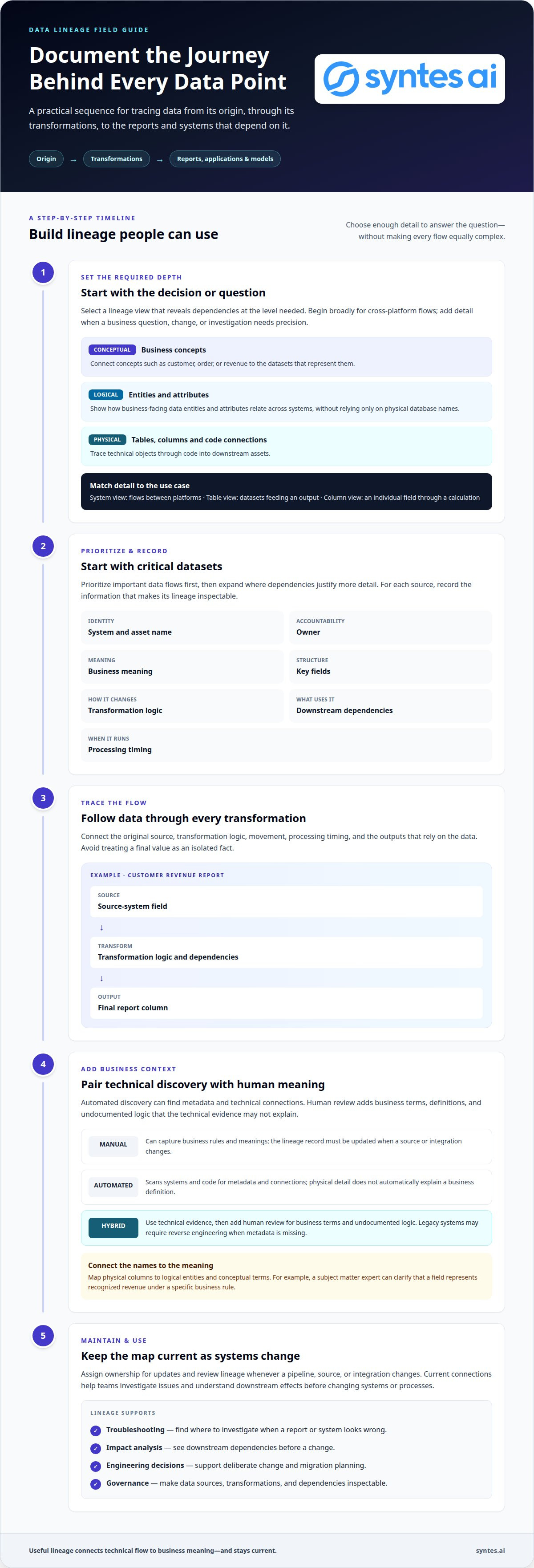
Data lineage records where data begins, how it changes, and where it is used. For a customer revenue report, for example, it can connect a source-system field to each transformation and the final report column.
Documenting data sources and lineage makes those connections inspectable. Teams can distinguish the original source, transformation logic, dependencies, movement, and processing timing instead of treating the final value as an isolated fact.
Lineage Discovery Approaches
Lineage discovery uses manual, automated, or hybrid methods to identify data flows. The choice matters because system metadata, code, and business context each reveal different parts of the transformation.
Manual discovery records flows as engineers design pipelines or trace existing processes. It can capture business rules and meanings that code alone does not explain, but teams must update the map when a source or integration changes.
Automated discovery scans systems and code for metadata and connections. A hybrid approach uses that technical evidence, then adds human review for business terms and undocumented logic. Legacy systems may require reverse engineering when metadata is missing.
Capturing Physical-Level Lineage
Automated physical-level lineage captures metadata about processing objects and their technical connections. It can show how a database table or column passes through code into a downstream asset.
That detail helps engineers identify the exact transformation or dependency behind a data value. It does not automatically explain the business definition: teams may still need to map physical columns to logical entities and conceptual terms.
For example, an automated scan may connect a source column to a transformed table, while a subject matter expert clarifies that the field represents recognized revenue under a specific business rule.
Lineage Tools and Documentation Practices
Lineage tools differ in discovery features, metadata coverage, integrations, and pricing. Costs depend on the systems covered, deployment scope, and required capabilities. Compare whether a tool captures source connections, transformations, dependencies, and usable business context.
For each source, document its system and asset name, owner, business meaning, key fields, transformation logic, downstream dependencies, and processing timing. Common tool categories include data catalogs, metadata repositories, code-scanning discovery tools, and lineage maps maintained by engineering teams.
To create and maintain documentation, identify critical datasets, map their sources and transformations, connect technical objects to business terms, and assign ownership for updates. Review the record whenever a pipeline, source, or integration changes.
For context, the U.S. Department of Health and Human Services lists 2024, 2,134,831, and 2,190,294 USD per identical violation category. These figures illustrate why teams may need traceable records, while lineage itself documents data movement rather than determining regulatory outcomes.
Choosing lineage depth across data model levels
Choose lineage depth according to the decision your data management process must support. The three levels are conceptual, logical, and physical, and each answers a different question.
System, Table, and Column Lineage
System-level lineage shows data flows between platforms; table-level lineage follows datasets, while column-level lineage tracks individual fields. The right view makes dependencies visible at the detail needed for a decision.
For example, a system view can show customer data moving from a sales platform into an analytics environment. A table view can reveal which transformed customer table feeds a dashboard. Column-level detail can trace a customer-status attribute through a calculation into that dashboard.
Start broadly when mapping an organization’s critical platforms. Add table- or column-level detail where a business question, change, or investigation requires precision. This keeps lineage useful instead of making every flow equally complex.
Logical-Level Components and Relationships
Logical-level lineage connects business-facing data entities and attributes without relying solely on physical database names. It helps teams understand how familiar concepts relate across systems.
A customer entity might include attributes such as status and account category. Logical relationships can show that a reporting customer record derives from operational customer data, while a defined transformation combines or standardizes attributes. This model gives analysts and engineers a shared view of the data flow.
Conceptual lineage sits above logical entities. It describes key business concepts, such as customer, order, or revenue, and connects them to the datasets that represent them. A revenue concept might map to sales data and finance records, clarifying which assets support a business measure.
At these two descriptive levels, link each conceptual dataset or term to its logical entities and attributes. For example, connect “customer” to a customer entity, then associate “active customer” with the relevant status attribute and business definition. These links help prevent similar terms from being mistaken for identical data.
Choose the level by starting with the use case. Executives reviewing a cross-platform flow may need system lineage; analysts investigating a metric may need table- or column-level detail. For impact analysis, connect logical definitions to physical assets so a planned database change can be assessed against its business meaning.
Organizations can make the mapping practical by prioritizing critical data flows first, then expanding where dependencies justify more detail. A lineage modeling walkthrough can help teams discuss how business concepts connect to technical assets.
Organizations can keep descriptive lineage focused on meaning by documenting it at the conceptual or logical level. Descriptive data lineage is usually documented at the conceptual or logical level. These levels let teams describe business concepts, entities, and attributes in terms that support a shared understanding of how data is represented. The choice between them can follow the question the documentation needs to clarify: broad business meaning or relationships among defined data entities and attributes.
For descriptive lineage documentation at two levels, the conceptual-level data sets or terms should be linked to logical-level data entities and attributes. Make those links explicit so a reader can follow a business term to the entities and attributes that give it meaning. This connection complements the selected lineage depth: it preserves the distinction between conceptual terms and logical structures while showing how the two descriptions relate.
Trust, troubleshooting, compliance, and impact analysis
Lineage helps teams connect a data result to its origin, processing, storage, and downstream use. That trace supports investigations, governance decisions, and assessments of how system changes affect applications.
Lineage for Trust and Compliance
Lineage supports trust by showing how information moves from its origin into a report, application, or analysis. In governance, owners can use that trace to clarify data responsibilities, business rules, and the systems that hold sensitive information.
For an audit, teams can use lineage to explain which sources contributed to a sensitive report and how data was handled. GDPR Article 30 requires records of personal data processing, while Article 17 concerns erasure rights; lineage can help locate relevant systems and storage.
The European Union states that GDPR fines for non-compliance can reach €20 million or 4% of global annual turnover. Lineage does not establish compliance by itself, but it can make evidence about data movement easier to examine.
Impact Analysis and Documentation Risks
Impact analysis follows a data element from its origin to dependent reports, applications, and analyses. Before changing a source field, teams can inspect its downstream connections and identify assets that need review.
For example, renaming a source-table column could cause 47 reports to fail if those reports are not updated. An accurate dependency map helps engineers identify affected outputs before deployment and investigate data-quality issues after a result diverges.
Incomplete lineage can hide a dependency; inaccurate lineage can point an investigation toward the wrong source. Either weakness can leave affected reports or storage locations unidentified, prolong root-cause analysis, and undermine an audit trail. Business users may also need historical processing information covering 5-7 months.
Standards and Metadata Practices
Organizations should define consistent metadata practices for source names, owners, business terms, transformation logic, dependencies, and processing history. A shared glossary and documented rules help teams interpret the same data element consistently.
No single lineage depth answers every governance question. Set requirements around critical data, record how metadata connects to each asset, and distinguish observed technical flows from business definitions confirmed by their owners.
Keep the record aligned with system changes. Assign responsibility for reviewing lineage whenever a pipeline, report, or source changes, and preserve relevant processing history for investigations. For example, a customer-data deletion request requires teams to identify the platforms and storage locations that contain the information.
Use lineage alongside data-quality checks: trace an unexpected report value to its source, inspect the transformation, and compare the result with the documented business rule. Current metadata makes this analysis more precise; stale connections can hide the dependency an audit or investigation needs.
Data lineage definition and data flow
Data lineage describes the path data takes through enterprise systems, including its origin, transformations, movement, and destination. For a sales report, it can connect a transaction in a source application to processing steps and the final reported value. It explains how that value was produced, not merely where it appears.
Define scope by the decision the lineage must support. A data governance initiative may need to explain a report’s inputs, while an engineering investigation may need to follow a field through processing logic. Start with the business driver, identify its associated datasets, then select the critical data elements within them.
Lineage can describe process design or the history of data values. Process-design lineage captures the intended flow: which source feeds a transformation, which rule changes the data, and which destination receives it. Value lineage follows how particular values change and records their processing history. This distinction matters when teams investigate a specific result rather than document a system’s planned architecture.
For example, a revenue report might combine order records with adjustment data. Process-design lineage records the sources, joining logic, and report destination. Value lineage helps trace a reported amount through the processing history that produced it. Together, these views clarify both the pipeline’s structure and the path of the value under review.
A useful lineage record describes the flow in terms readers can interpret. Include technical connections, transformation logic, dependencies, and timing, then add business context to explain why a rule exists. If an enterprise pipeline standardizes account status before sending it to a report, record both the transformation and the business meaning of each status.
- Origin: identify the first source of the data, such as an order-management application.
- Processing: describe movement and transformations, such as filtering cancelled orders.
- Destination: connect the processed data to its consumer, such as a finance report.
Provenance can be understood as the starting point of a data item, while lineage follows its broader journey. Lineage extends that view across the full flow, helping teams distinguish original records from later representations. A data catalog can provide a searchable inventory of assets, while lineage explains how those assets connect through data processing.
Keep the scope aligned with actual use. A report owner may need a clear account of sources and business rules; a pipeline engineer may need dependencies and transformation detail. Set the format to serve both audiences, and maintain the connections as systems or processes change.
Data lineage benefits for engineering workflows
Engineering teams need more than a static map. Lineage becomes operational when developers can use its metadata during development, investigation, and release planning. A database change, pipeline failure, or migration can affect assets beyond the component being edited. Tracing dependencies helps engineers identify those connections before taking action.
Consider a pipeline change that alters a shared transformation. Engineers can use lineage to identify downstream data products, then determine which teams and workflows rely on them. That visibility supports focused testing and coordination. Stakeholders can see why a change matters instead of receiving a technical notice without context.
Scale changes the work involved. Manually tracing five tables across seven data sources differs from tracing 100 tables across 50 sources used by five domain teams. At larger scale, connected metadata gives engineers a way to explore dependencies across team boundaries. It also helps focus manual investigation on flows that need business interpretation.
Lineage can also inform migration planning. When documenting data sources and lineage, engineers can trace which assets feed a destination, then identify outdated or irrelevant data that may be archived or deleted. This makes the migration scope more deliberate: teams can distinguish active dependencies from assets that no longer support a known workflow.
- Before a change: trace affected assets and identify downstream reports, applications, or analyses.
- During troubleshooting: follow a failing output back through its dependencies to locate where the data flow diverged.
- During migration: map sources and destinations, then assess which data remains relevant to current workflows.
Access matters as much as discovery. Make lineage available for users to explore themselves, and integrate it into existing engineering workflows. A developer examining a pipeline can then inspect relevant dependencies in context, rather than switching between disconnected records. This supports faster coordination between engineers and stakeholders who own downstream data products.
Keep the information useful as systems evolve. A change to a source, transformation, or destination can invalidate connected metadata, so maintenance belongs alongside the engineering change process. Teams should review affected lineage as part of the work and make updated information available to users. Otherwise, an old map can mislead the next migration or investigation.
The practical takeaway is clear: treat lineage as working engineering context, not a diagram produced once and forgotten. Use it to plan changes, investigate failures, coordinate domain teams, and understand migration dependencies. Its value comes from connecting technical metadata to the decisions engineers make in their established workflows as working infrastructure.
By leveraging Syntes AI, organizations can better plan data migrations and identify outdated or irrelevant data to archive or delete, keeping project scope precisely aligned with active needs.
Syntes AI: Enterprise Knowledge Graph
Syntes AI’s Enterprise Knowledge Graph is designed to unify complex organizational data into a structured, actionable format. For teams working across disconnected systems, it can help connect information and make relationships more useful in operational contexts.
Consider this approach when lineage needs to sit within a broader data environment rather than remain an isolated map. Syntes AI’s Cross-System Integrations connect AI capabilities across existing enterprise software stacks, while Context Engineering shapes data context for AI use. These offerings can support engineering, governance, and operational teams that need a shared foundation for complex data.
To discuss how these capabilities could fit your data environment, contact Syntes AI or visit syntes.ai.
Turn lineage into an operational capability
The next step is to make lineage part of how teams plan and execute change. Treat it as working context: connect the data relationships engineers need with the business meaning stakeholders use to make decisions. This turns documenting data sources and lineage from a record-keeping task into a foundation for informed action.
For organizations extending this foundation into AI-driven operations, Syntes AI’s Syntes Agentic Platform enables businesses to deploy and manage AI agents for operational tasks. Focus on the work itself: determine where connected data context can support execution, then build from the workflows that matter.
Build clarity into the flow, then give your teams the context to move forward with confidence.
Frequently Asked Questions
What are data sources and data lineage in data management?
Data sources are the systems or files that supply information; lineage describes the relationships connecting that information to its later uses. For example, an order-management database may supply order records, while lineage shows how selected fields become a dashboard metric. Keeping the source distinct from later copies helps teams distinguish authoritative records from derived datasets during analysis.
How do you document data lineage from source to report or dashboard?
Start with the report field that needs explaining, then work backward to its inputs. Record the report name and field, the dataset or view supplying it, each transformation, and the originating asset. Compare those connections with a sample output and ask the report owner to validate the business meaning. This field-first approach makes the map useful for a specific question rather than an inventory without a clear audience.
How can teams document lineage for ETL pipelines, APIs, and spreadsheets?
For an ETL pipeline, connect the job and its transformation logic to input and output assets. For an API, record the endpoint, returned fields, and destination that consumes them. For a spreadsheet, capture the file, relevant sheet, formulas, and linked inputs. If metadata cannot expose a connection, document it with its owner and review it when the job, interface, or workbook changes.
How does data lineage support data quality, privacy, and regulatory compliance?
Lineage helps teams scope a data-quality issue by identifying which outputs use the affected field, then tracing the problem toward its source. For privacy analysis, mapping personal-data attributes to connected applications and storage locations can clarify where information travels. Governance teams can use the documented path to explain data handling and support audit preparation, while separately validating that policies and controls are followed.