

A data lake stores structured, semi-structured, and unstructured data in its native format, without requiring a predefined schema when data is captured. This flexibility supports varied analytics and AI use cases, but the disadvantages of data lakes include slower queries, harder governance, and greater reliability and security risks when data is poorly organized. A data lake is not automatically a dependable analytics foundation; its value depends on how well data and access are managed.
The appeal is clear: teams can retain diverse data for future analysis rather than shaping it all in advance. The trade-off is equally real. Without consistent metadata, controls, and operational practices, a flexible repository can become difficult to trust, search, secure, and use.
This article explains what a data lake is, where performance, reliability, and security problems arise, and how its trade-offs compare with data warehouses and lakehouses. You’ll have a clearer basis for deciding which architecture fits your organization’s data, governance requirements, and analytical workloads.
Key Takeaways
- Assess query speed alongside flexibility: metadata quality, data organization, and partitioning can shape analytics performance at scale.
- Map reliability and security risks to how data is ingested, governed, accessed, and updated, especially when sensitive information is involved.
- Compare lakes, warehouses, and lakehouses by workload, data structure, governance needs, and operational complexity rather than by storage alone.
- Choose an architecture that matches how teams need to discover, trust, and use data, not simply how much data they need to retain.
- When disconnected systems make enterprise data harder to interpret, an Enterprise Knowledge Graph can help structure it into a more actionable format.
What is a Data Lake?
A data lake retains information in its native format rather than requiring a predefined schema when data arrives. It can hold structured records, semi-structured logs, and unstructured files together. This flexibility lets analysts preserve source details for later use, including machine learning and artificial intelligence. A retailer, for example, could store transaction tables alongside customer service messages and product images, then shape each source for a different analysis.
For business intelligence, this flexibility shifts work from data capture to analysis. Teams can load source data first, then define how to interpret it for a report or model. A sales analyst might combine order records with web activity only when a new question arises. This avoids forcing every source into one reporting structure upfront, but analysts still need reliable metadata and definitions to find the right fields and interpret them consistently.
The trade-off becomes more visible as a lake grows. It can contain millions of files and tables, so query-engine performance at scale matters. A request for monthly revenue may require locating relevant files, interpreting their structures, and scanning matching records. If the same question runs across poorly organized data, reporting can take longer than expected. Slower queries make analytics less useful when teams need timely answers.
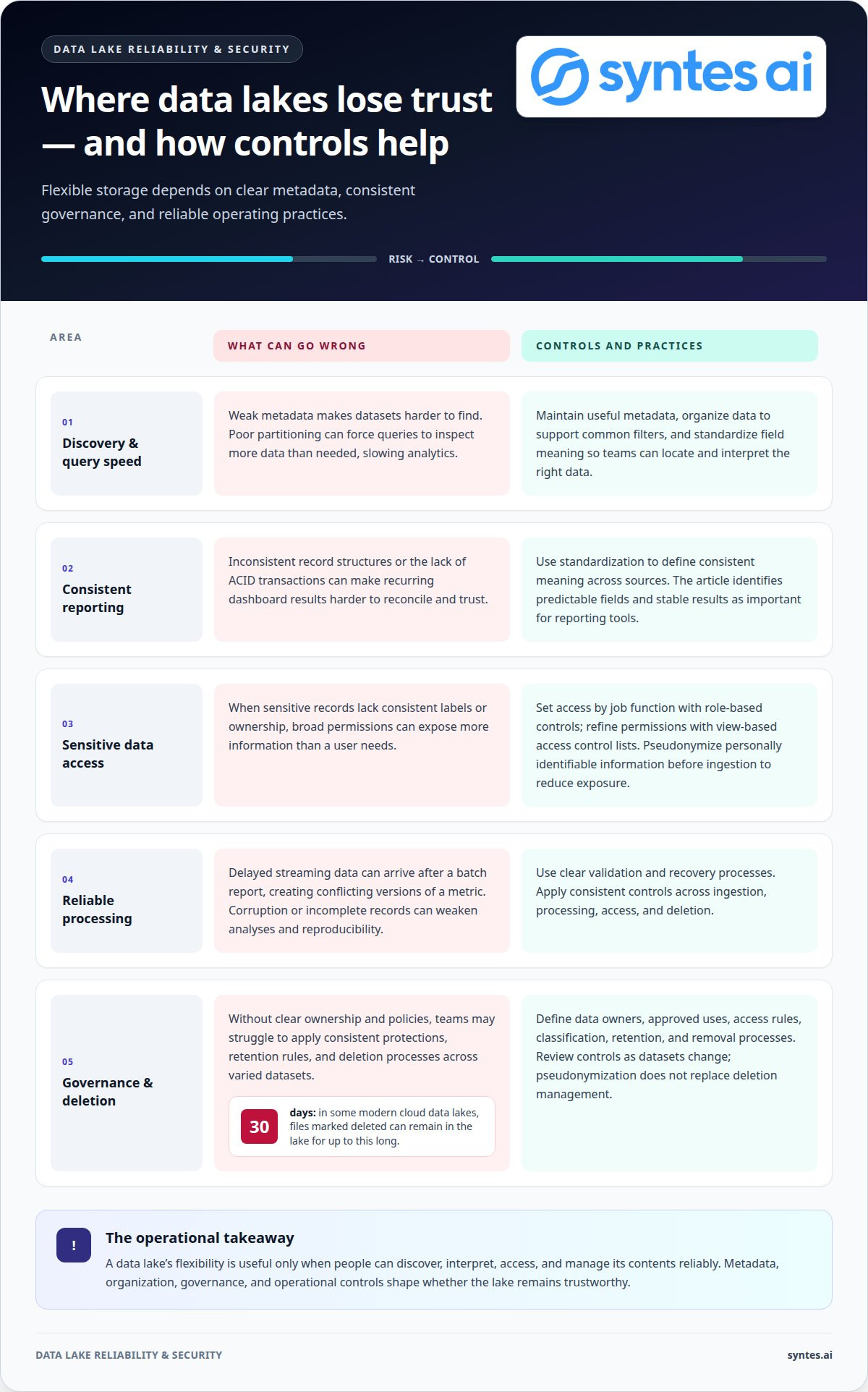
Several bottlenecks can compound. Weak metadata makes relevant datasets hard to discover, while improper data partitioning can force queries to inspect more data than necessary. For example, a report filtering orders by date may perform poorly if files aren’t organized to support that filter. These issues affect data lake query performance even when the information is present. The challenge is not simply storing more data, but making the right subset accessible to each query.
Structured-query performance can also suffer when records lack consistent structure or the lake doesn’t support ACID transactions. Reporting tools often depend on predictable fields and stable results. If one source labels a customer identifier differently from another, or records change during a query, results can be harder to reconcile. These limitations can make a lake less effective for recurring dashboards that demand consistency, even while it remains useful for exploratory analysis.
Metadata management, data partitioning, and standardization determine whether a lake can support dependable intelligence. The National Center for Biotechnology Information notes that data standardization teams need expertise in source data, data models and vocabularies, and ETL implementation. These skills help teams define meaning and prepare data for analysis. They also clarify the central trade-off: the disadvantages of data lakes emerge when ingestion flexibility outpaces the structure needed for fast, consistent reporting.
Data lake reliability and security challenges
Reliability and security depend on consistent controls across ingestion, processing, access, and deletion. When data types and operating practices vary, risks can spread throughout the lake.
Sensitive Data and Access Controls
Access controls determine who can view or change particular data, limiting exposure of sensitive records. A data scientist building a machine learning model may need a different view from an analyst preparing business insights. Role-based controls restrict access by job function, while view-based access control lists can refine permissions further. Pseudonymizing personally identifiable information before it enters a lake can also reduce exposure.
Controls are harder to enforce when sensitive records lack consistent labels or ownership. If customer identifiers sit alongside operational logs, broad permissions can expose more information than a user needs. Governance policies should define data owners, approved uses, and access rules for each dataset. Review these controls as datasets change rather than treating access as a one-time setup.
Reliability can falter when batch and streaming data are difficult to combine or processing introduces corruption. For example, a delayed stream may arrive after a batch report is produced, leaving teams with conflicting versions of an operational metric. Without clear validation and recovery processes, data scientists may build analyses on incomplete or damaged records. That weakens downstream insights and makes results difficult to reproduce.
Governance, Compliance, and Data Deletion
Governance defines how data is classified, accessed, retained, and removed. Without clear ownership and consistent policies, teams can struggle to apply the same protections across varied datasets. This affects both operational trust and regulatory obligations, particularly when records include personal information.
The European Union and California Legislature identify GDPR and CCPA as regulations requiring companies to delete a customer’s data upon request. In some modern data lakes using cloud storage, files marked deleted can remain in the lake for up to 30 days.
How do data lakes handle compliance, retention, and deletion requirements? They rely on governance policies and processes to identify affected records, apply retention rules, and manage deletion across stored data. Pseudonymizing personal information before ingestion can support GDPR compliance, but it doesn’t replace the need to manage deletion requirements.
How do data lakes become data swamps, and how can organizations prevent it? They become swamps when data accumulates without usable metadata, consistent organization, or clear ownership. Apply cataloging and governance during ingestion so teams can find, interpret, and control datasets.
Build policies around data access, retention, deletion, and storage optimization, then apply them consistently. A governance review can help identify gaps across those workflows; teams evaluating their controls can discuss data governance workflows.
Data lake versus warehouse and lakehouse trade-offs
A data lake prioritizes flexible storage; a warehouse prioritizes consistent, fast queries. A lakehouse aims to combine elements of both, but each choice shifts complexity to a different part of the data environment.
Raw-Data Storage and Schema-on-Read
Schema-on-read means data is stored before its structure is defined for a particular analysis. A lake can retain raw files in different formats, then apply the relevant schema when a team queries them. For example, analysts can interpret the same customer activity logs differently for product analysis and fraud detection. This flexibility supports new questions, but teams still need to make raw data discoverable and interpretable.
That approach contrasts with a warehouse, where data is prepared and structured before reporting. A finance team running a recurring revenue report may benefit from consistent fields and predictable query performance. The trade-off is more complex preparation before the data is ready to use. Warehouses are also generally limited to structured data, while lakes can retain a broader range of data types.
Flexible storage doesn’t guarantee easy analysis. Without clear field definitions, analysts may interpret the same source differently. For instance, product events could use inconsistent names across systems, complicating a combined customer report. A lake works best when its ability to retain varied data formats is matched by practices that make them understandable and useful.
Lakehouses as a Response to Data Lake Challenges
A lakehouse is an architecture intended to bring warehouse-style analytics capabilities closer to data lake storage. It may suit teams seeking flexible data retention alongside more structured querying. For example, an organization might want to keep varied source data while supporting consistent reporting from selected datasets. The trade-off is maturity: lakehouse technology is relatively new, and its ability to deliver on its promises remains uncertain.
That uncertainty affects architecture decisions. A lakehouse may address specific friction between raw storage and analytics, but it doesn’t remove the need to assess governance, query needs, and implementation complexity. Teams should examine how a platform handles their actual data formats and reporting workloads before committing. A warehouse remains a clearer fit for structured, repeatable reporting; a lake may better suit exploratory analysis across varied source data.
Compare the options based on the work they must support. If analysts need standardized business intelligence outputs, warehouse consistency and query optimization may matter more than ingestion flexibility. If data scientists need to explore varied raw inputs for machine learning, lake storage can preserve options. If teams need both patterns, a lakehouse may be worth evaluating, while keeping its maturity and implementation trade-offs in view.
The decision is about where the organization can manage complexity. A warehouse concentrates effort in data preparation; a lake requires strong organization and interpretation after ingestion. A lakehouse introduces another platform model to assess. Map each architecture against real workloads, such as monthly finance reporting, customer behavior analysis, and machine learning experiments, then identify which trade-off teams can manage effectively.
Data lakes compared with data warehouses
The practical difference is how organizations manage data after it arrives. A lake accepts diverse sources and can retain duplicate or poorly described records. A warehouse organizes selected data for consistent use. Each architecture creates different demands for data management, oversight, and ongoing maintenance.
In a lake, teams may store customer records, system logs, and files from separate business units. Without common ownership or cataloging, one department may not find data another team has already collected. This creates silos inside a supposedly shared repository. Missing metadata and disorganized datasets can also turn the lake into a data swamp, where users can’t identify what information means or whether it’s suitable for analysis.
Redundancy adds another management burden. If two teams ingest the same source independently, they may store overlapping records and maintain separate interpretations. Effective data management identifies authoritative sources, documents dataset meaning, and assigns ownership. These practices help users distinguish trusted records from copies and make it easier to connect stored information with analytics and business intelligence tools.
Warehouses offer a different control model. Their governance frameworks can include strict access controls, auditing mechanisms, and data lineage tracking to support security and regulatory compliance. For example, lineage can show which source records contributed to a reported business metric. This structure supports consistent data, but warehouses are limited to structured data and require complex preparation before information is ready for reporting.
Costs also need careful comparison. A lake is often presented as the less costly storage option, while a warehouse carries a higher relative cost. Yet a lake’s initial investment and ongoing maintenance can still become costly, especially as data volumes grow. Storage is only part of the equation. Organizations also need staff and processes to organize, govern, and connect datasets to the tools teams use.
What skills and ongoing maintenance do data lakes require? Teams need expertise in source data, data models, vocabularies, and ETL implementation. The National Center for Biotechnology Information identifies these capabilities as important for data standardization. Maintenance also involves preserving metadata, managing access, reducing redundancy, and keeping datasets usable as sources change.
For a monthly finance report, warehouse consistency may outweigh broad ingestion flexibility. For a project exploring varied operational sources, a lake may preserve useful detail, but teams must manage discovery and quality. Compare architectures against actual workloads, governance demands, and maintenance capacity. The right choice is the one the organization can operate properly, not simply the one that stores the most data.
Choosing a storage architecture for organizational needs
Choose an architecture by matching data types and applications to operating capacity. A customer analytics team exploring unstructured support messages has different needs from finance teams producing structured monthly reports. Start with the decisions each team must make, then identify the data and performance those decisions require.
Map the organization’s workloads before comparing platforms. List recurring reports, exploratory data analytics, machine learning experiments, and operational applications that depend on current information. Record the source systems, formats, update patterns, and users for each workload. This reveals whether the priority is retaining diverse data, producing consistent reports, or supporting both patterns.
Then assess the work required to make stored data usable. A lake can retain structured and unstructured data from multiple sources, but teams need cataloging, access controls, and clear ownership. A warehouse requires preparation to align records with defined structures before reporting. The right fit depends partly on whether the organization can sustain these different data management responsibilities.
- Favor lake storage when data scientists need to investigate varied source data, such as application logs and customer messages, for new analytical questions.
- Favor a warehouse when finance or operations needs repeatable reporting from structured records with consistent definitions.
- Evaluate a lakehouse when both patterns matter, while researching platform capabilities and implementations before purchasing.
- Reconsider the design when teams can’t locate datasets, explain their meaning, or connect them to business intelligence tools.
Operating capacity is decisive. A lake that accepts new sources faster than teams can document and govern them can become difficult to use. For instance, adding customer events from a new application creates little value if analysts can’t distinguish current fields from legacy ones. Include metadata upkeep, data quality, permissions, and deletion workflows in the architecture decision, rather than treating them as later fixes.
Also test the architecture against real analytical work. Run a representative reporting query, trace its inputs, and confirm that business teams interpret the output consistently. For a lakehouse platform, examine whether its implementation supports the organization’s actual formats and workloads. A design that performs well in a narrow demonstration may not address broader operational challenges.
Finally, compare the consequences of each choice across teams. If a warehouse’s preparation requirements delay access to unstructured data, a lake may better support discovery. If the organizational burden of a lake undermines trusted reporting, a warehouse may be more suitable for that workload. Some organizations can assign different architectures to different applications, provided ownership and data flows remain clear.
Syntes AI: Enterprise Knowledge Graph
Syntes AI’s Enterprise Knowledge Graph helps organizations unify complex data in a structured, actionable format. It can be a relevant next step when information is distributed across systems and teams need clearer context for enterprise AI and operational decisions.
Cross-System Integrations connect AI capabilities across existing enterprise software stacks, while Context Engineering structures the context those capabilities use. For organizations deploying AI agents for operational tasks, the Syntes Agentic Platform enables businesses to deploy and manage them.
These offerings address a different challenge from choosing storage alone: connecting enterprise data and making it useful in context. Visit syntes.ai to explore how Syntes AI can support your organization’s needs.
Make Your Data Architecture Work Harder
The disadvantages of data lakes matter most when architecture choices outpace an organization’s ability to connect data with decisions. Treat the next step as an operating-model decision, not simply a storage selection. Clarify which teams need trusted context, how information moves across systems, and where AI should support operational work. That focus can help turn fragmented data into a foundation for action.
Syntes AI’s Enterprise Knowledge Graph, Cross-System Integrations, and Syntes Agentic Platform support connected enterprise data and AI needs. Consider these offerings when your priorities extend beyond storing information to structuring it and applying AI across existing systems.
Define outcomes first, then align the architecture and capabilities around them. Clear decisions today create a stronger basis for what your organization builds next.
Frequently Asked Questions
What are the challenges with data lakes?
Data lakes can be difficult to organize, query, secure, and connect to analytics applications. A team might ingest records from several systems, then struggle to identify the right dataset for a report because descriptions and ownership differ. Batch and streaming data can also be hard to reconcile. The central challenge is operating the environment so teams can locate, interpret, govern, and reliably use the information it stores.
What are the main disadvantages of data lakes?
The main disadvantages of data lakes include inconsistent organization, slower queries, governance complexity, and possible data redundancy. These issues can make a repository less useful for routine reporting, even if it retains information that supports exploration or machine learning. For example, teams may spend more effort identifying and validating a dataset than answering a business question. The impact depends on how well the organization manages metadata, access, and data quality.
What data quality and governance challenges do data lakes create?
Data lakes can hold information with different definitions, formats, and levels of completeness, making consistent interpretation difficult. For example, two systems may represent customer status differently, producing conflicting results in a combined analysis. Governance must establish dataset ownership, meaning, permitted access, and retention practices. Cataloging during ingestion helps users find and interpret records, while standardization expertise helps align source data, models, and vocabularies.
What are the security and privacy risks of data lakes?
A lake can expose sensitive information if access permissions are too broad or data isn’t consistently classified. A user analyzing operational trends, for example, may not need access to identifiable customer details. Organizations can reduce unnecessary exposure through role-based controls and more precise view-based permissions. They also need processes to locate, update, or remove relevant records, since limited visibility across datasets can complicate governance and privacy work.
How do data lakes affect query performance and analytics costs?
Query performance can decline when an analytics engine must scan too many files, interpret inconsistent structures, or work around weak metadata and partitioning. Repeated scans and processing can consume more computing resources, while poorly organized storage can increase operational effort. For example, a dashboard that repeatedly filters a large history of events may perform poorly if the data layout doesn’t support that query. Cataloging and workload-aware organization help manage these demands.
What are the disadvantages of data lakes compared with data warehouses?
Compared with a warehouse, a lake places more responsibility on teams to organize and interpret data after ingestion. This can make recurring reports harder to standardize and datasets harder to discover. A warehouse typically offers structured, consistent data and query-focused design, but requires preparation and supports fewer data types. A lake better accommodates varied raw information, but its flexibility can complicate dependable business intelligence.
What are common data lake implementation failures and their causes?
Common failures include creating a repository teams can’t search, trust, or govern. For instance, an organization may ingest files without meaningful metadata or clear ownership, leaving analysts unable to distinguish authoritative data from duplicates. Other causes include weak access policies, inconsistent definitions, and inadequate plans for combining batch and streaming inputs. Establish governance and cataloging practices during ingestion, then maintain them as new sources and use cases are added.