

AI readiness isn’t measured by how many pilots an enterprise launches. An enterprise AI maturity model assesses whether governance, data architecture, workforce education, experimentation, impact measurement, and accountability can turn AI activity into sustained business capability. The MIT CISR model describes four stages, from preparing and testing to becoming AI future ready.
Organizations naturally focus on models, platforms, and high-profile use cases because they make progress visible. But experiments stall when teams lack the skills to use AI, data remains fragmented, or leaders can’t connect deployments to meaningful outcomes. Readiness depends as much on the operating foundations around the technology as on the technology itself.
This article explains how to assess maturity across the dimensions that shape responsible, effective adoption. You’ll learn how experimentation and workforce education fit into the picture, how to measure impact and assign accountability, and what maturity gaps reveal about practical next priorities. The goal isn’t to chase a label. It’s to understand what your organization can execute today and what must change to scale AI with clarity and control.
Key Takeaways
- Assess governance, data foundations, workforce capability, and experimentation together to identify what is holding AI progress back.
- Match investment to your organization’s current maturity stage, building repeatable capabilities before scaling pilots.
- Connect AI initiatives to clear business outcomes and assign accountability for measuring their impact.
- Surface barriers such as fragmented systems and opaque outputs early, so they can inform deployment decisions.
- Use a structured view of readiness to prioritize where connected data and workflows can support the next stage of AI adoption.
AI governance and responsible use
Governance makes responsibility part of AI design, approval, deployment, and monitoring. It establishes clear decision rights before a pilot becomes operational.
Embedding Governance in Operations
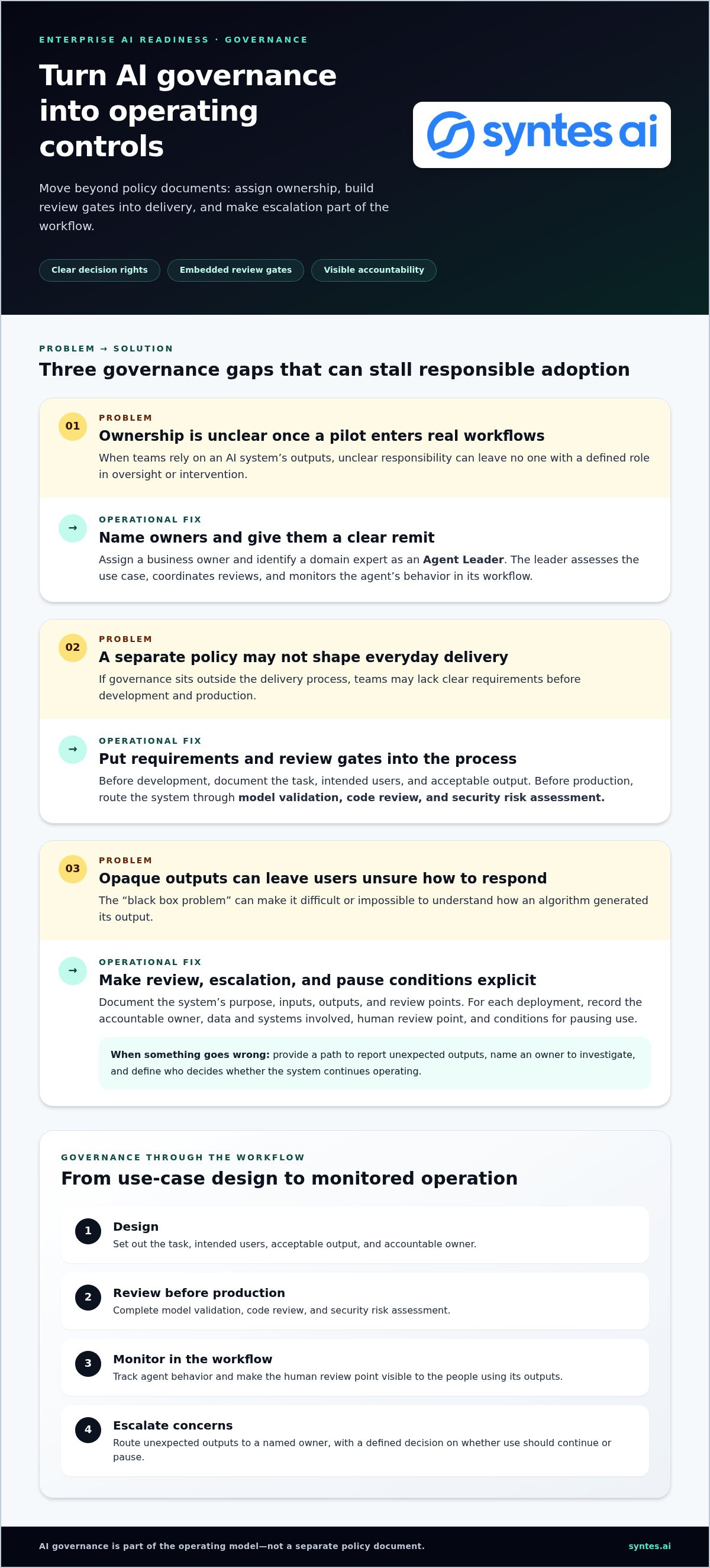
Operational governance assigns owners, review gates, and escalation paths to each AI use case. This matters because a pilot can affect real workflows once teams rely on its outputs. Identify domain experts as Agent Leaders who can design, oversee, and govern agent ecosystems at scale. Give each leader a clear remit: assess the use case, coordinate reviews, and monitor the agent’s behavior in its workflow.
Build governance into the delivery process, rather than relying on a separate policy document. For example, require a business owner to document the task, intended users, and acceptable output before development begins. Then route the system through model validation, code review, and security risk assessment. The Board of Governors of the Federal Reserve System describes technical and governance pathways that help move AI uses from pilot to production.
Define a decision record for each deployment. It can identify the accountable owner, the data and systems involved, the human review point, and the conditions for pausing use. If an agent drafts a customer response, for example, specify who approves it and how staff report an incorrect recommendation. These operating controls make oversight visible in everyday work.
Managing Adoption Risks and Barriers
Risk management identifies where an AI system can fail, mislead users, or operate without effective oversight. It matters because an unresolved issue can undermine confidence and disrupt the workflow around the model. The “black box problem” can make it difficult or impossible to understand how an algorithm generated its output, according to the University of Illinois at Urbana-Champaign.
Address that risk by documenting the system’s purpose, inputs, outputs, and review points. In a forecasting workflow, for example, users should know which recommendation requires human judgment and where to report an unexpected result. Assign a named owner to investigate reported problems and decide whether the system should continue operating. This creates a defined response instead of leaving staff to interpret risk individually.
Governance can also fail when it is detached from daily operations. A policy may assign responsibility to a department, while the workflow gives no employee authority to intervene. Map each use case from input to action, then identify who can stop or escalate it. Agent Leaders can connect domain expertise with technical oversight, helping teams resolve unclear ownership before scaling deployment.
- Document the use case, owner, workflow, and review points.
- Apply validation, code review, and security assessment before production.
- Set an escalation path for unexpected outputs and operational concerns.
Data architecture and technical readiness
AI readiness depends on whether systems can provide reliable, relevant data to models and workflows. For example, a customer-service assistant needs consistent account records, product information, and service history.
Building a usable data foundation
Start by tracing the data required for a specific AI task. For a sales forecast, identify the customer, opportunity, transaction, and time-period fields used across source systems. Then check whether those fields have consistent definitions and update practices. If “active customer” means something different in two systems, the model may combine incompatible records.
Data quality involves more than cleaning up records. Assign ownership for key data domains, document definitions, and establish how teams correct errors. Record where data originates and how transformations change it. For example, a product recommendation should use current catalog information, not an outdated export. These foundations help teams determine whether an output reflects business conditions or stale, conflicting inputs.
Access also shapes technical readiness. Map which systems contain sensitive or restricted information, then connect access rules to the AI workflow. For instance, a finance assistant should retrieve information relevant to its assigned task without exposing unrelated employee records. Clear permissions and traceable data flows make it easier to review how an output was produced.
Designing for scalable AI platforms and architecture
A scalable architecture supports more than one isolated experiment. It lets teams connect data sources, models, and business applications through repeatable patterns. Separate shared capabilities, such as identity controls and data access, from use-case logic, such as invoice review. This structure reduces duplicated work when another department adopts a similar workflow.
Plan the full path from data input to operational action. In an inventory workflow, an AI system may retrieve stock records, interpret demand signals, and present a replenishment recommendation. Define the purpose, owner, and failure path for each connection. If a source system is unavailable, staff should know whether the workflow pauses, produces a partial result, or routes the task for manual handling.
Technical readiness also means monitoring the system after deployment. Track whether source data remains current, integrations continue to function, and outputs fit the business process. A sudden change in a customer-record schema, for example, can disrupt an otherwise stable prediction workflow. Treat architecture as an ongoing operating capability, not a one-time implementation.
To assess how connected data and systems could support your AI workflows, explore enterprise data architecture in the context of your use cases.
AI impact measurement and accountability
AI impact becomes meaningful when leaders connect system performance to business outcomes. An enterprise AI maturity model therefore needs measures for value, operational effects, and ownership, not deployment activity alone. Track whether a system improves a defined process, who validates that improvement, and who acts when results change.
Measure outcomes against a clear baseline
Establish the business baseline before deployment. For a claims-review workflow, record processing time, rework, and escalation patterns before introducing AI. Compare those measures afterward using the same definitions and workflow boundaries. This helps distinguish an actual change from seasonal demand, policy shifts, or a redesigned process.
Choose a small set of indicators tied to the use case. Assess a support assistant through measures such as resolution quality, employee review time, and customer follow-up needs. Pair operational measures with business outcomes, such as completed cases or reduced manual handling. Don’t treat model accuracy alone as proof of value: an accurate prediction may still fail to improve the decision or process.
Set a review cadence and assign an owner to each measure. The operations lead can assess workflow effects, while a finance partner examines business impact. Document the measurement period, data source, and process changes that could affect comparison. If a sales model changes its recommendations after updated customer data, for example, record that change before interpreting later results.
Make accountability part of performance review
Accountability means a named person owns the interpretation and use of AI results. The owner should explain whether the system met its intended purpose, where human judgment remains necessary, and what action follows a decline in performance. A dashboard without decision rights can show deterioration without prompting a response.
Comparative evidence can help leaders understand why impact measurement matters, but it shouldn’t replace local baselines. Stage 4 enterprises had growth 17.1 percentage points above their industry average and profit 10.4 percentage points above their industry average. These figures describe a maturity-stage comparison, not a guaranteed result for an individual deployment. Use them as context, then test the value of each system against its own business objectives.
DBS Bank doubled the economic impact achieved from AI, from S$150 million in 2022 to S$370 million in 2024. For an enterprise, the practical lesson is to connect AI activity to an outcome leaders can examine. Define the business measure, document its baseline, and clarify which teams contributed to the change. That creates a stronger account of value than counting pilots or model releases.
- Record a use-case baseline before deployment.
- Assign owners to operational and business measures.
- Review outcomes alongside process changes and system performance.
- Use findings to continue, adjust, or stop an AI workflow.
What capabilities and investments are needed at each AI maturity stage?
The MIT CISR model groups enterprise AI capability into four stages, scored by Total AI Effectiveness. Each stage points to different priorities, from establishing foundations to embedding AI across organizational work.
Stage 1: Experiment and Prepare
A Total AI Effectiveness score from 0-49% places an enterprise in Stage 1. The priority is to establish direction before multiplying pilots. Select business problems with clear owners, identify suitable data, and give teams time to build practical AI literacy. For example, a department could test AI-assisted document classification while defining review responsibilities and success measures. Investment should focus on foundational skills, data quality, and a disciplined way to evaluate experiments. Resist funding disconnected prototypes that cannot inform a real operating decision.
Stage 2: Build Pilots and Capabilities
Stage 2 covers Total AI Effectiveness scores from 50-74%. Enterprises at this stage need to turn isolated experiments into repeatable pilots. Invest in shared technical patterns, model evaluation, integration expertise, and training for teams that will use the systems. A claims team, for example, can test document extraction against a defined workflow and compare results with its existing process. Capture what works, what fails, and which data or process dependencies need improvement. A pilot should produce evidence and reusable learning, not simply a demonstration.
Stage 3: Develop AI Ways of Working
Stage 3 corresponds to scores from 75-99%. The investment shifts toward organizational adoption: connect AI to established workflows, develop cross-functional delivery practices, and equip managers to redesign work. A customer-support operation might use AI to summarize case histories while employees retain responsibility for decisions. Build mechanisms to share successful patterns across departments, rather than letting each team rebuild similar capabilities. At this stage, workforce education needs to address roles and judgment in actual workflows, not only general AI concepts.
Stage 4: Become AI Future Ready
A Total AI Effectiveness score of 100% places an enterprise in Stage 4. The aim is sustained organizational readiness, with AI capabilities integrated into how teams operate and adapt. Investment can support coordinated data access, platform development, ongoing workforce learning, and evaluation across business functions. For instance, a supply-chain team might connect demand signals to planning decisions, while leaders monitor business outcomes and operational dependencies. The emphasis is not simply deploying more systems. It is developing the capacity to govern, improve, and extend valuable AI practices across the enterprise.
Use the stage descriptions as a capability map, not a spending formula. A Stage 1 organization should address its specific foundation gaps before pursuing Stage 3 practices. An enterprise already scaling AI should identify which workflows remain isolated and invest in the connections, skills, and operating routines needed to bring them into broader use.
What are common risks and barriers to enterprise AI adoption?
Enterprise AI adoption can stall when technology, data, and everyday work remain disconnected. A customer-service assistant, for example, may produce useful drafts but add little value if agents must re-enter information across separate systems. Understanding these barriers helps leaders distinguish a model problem from an operating-model problem.
Fragmented systems and inconsistent data
Fragmented data makes it difficult to give AI the context required for a dependable task. A retail company might store product details in one application, inventory in another, and customer orders elsewhere. If those records use different identifiers, an AI workflow may retrieve incomplete or mismatched information. Teams then spend time reconciling outputs instead of improving the process.
Map the information path for a specific use case, such as matching a support request with an order record. Identify each source, the fields exchanged, and the system that owns the authoritative value. This exposes gaps early and shows whether the barrier is unreliable data, an unavailable connection, or unclear business definitions.
Integration and workflow friction
A technically sound model can still fail at the point of use. For example, a procurement recommendation has limited operational value if employees must leave their purchasing system, open a separate tool, and copy the result manually. Each extra handoff adds friction and creates more opportunities for delays or transcription errors.
Trace the task from its trigger to its final action. In invoice processing, that path could include document intake, field extraction, exception handling, and approval. Identify where people need to review results and where the workflow returns information to existing systems. This helps teams design AI around actual work instead of placing a model beside it.
Skills, incentives, and adoption
Workforce readiness can suffer when employees receive a new tool without practical guidance. A claims reviewer, for instance, needs to know which extracted fields require careful verification and how to handle an incomplete result. Role-based learning connects AI concepts to real decisions, helping employees apply judgment instead of treating every output as authoritative.
Incentives also matter. If a sales team is evaluated only on speed, members may avoid an AI-supported process that initially requires extra review. Leaders can address this by aligning adoption goals with process quality and clear feedback routes. Ask frontline users to identify recurring failure points, then adjust the workflow or training in response.
Unclear use-case selection
Some initiatives struggle because the problem is poorly defined. A broad goal such as “use AI to improve operations” gives teams no clear boundary for selecting data, users, or success criteria. Narrow the scope to a specific task, such as classifying incoming service requests, and state which decision the output should support.
- Separate data gaps from integration and workflow issues.
- Design around a concrete task, such as invoice review.
- Give employees role-specific guidance for using AI outputs.
- Use frontline feedback to refine the process.
Syntes AI: Enterprise Knowledge Graph
Syntes AI helps organizations address a key maturity challenge: turning complex enterprise data into structured, actionable information. Its Enterprise Knowledge Graph connects information to support AI workflows across business systems.
When AI initiatives span disconnected applications, Syntes AI’s Cross-System Integrations embed AI capabilities across existing enterprise software stacks. Context Engineering shapes relevant information for AI use, while the Syntes Agentic Platform enables businesses to deploy and manage AI agents for operational tasks. These capabilities fit organizations that have identified valuable workflows but need stronger connections between data, systems, and execution.
Contact Syntes AI to discuss how its platform and integrations can support your enterprise AI priorities.
Turn AI readiness into sustained progress
Use an enterprise AI maturity model as a living management instrument, not a score to earn and file away. As business priorities, systems, and workforce capabilities evolve, revisit which AI-enabled decisions should change and who is prepared to make them. This shifts attention from isolated implementation milestones to the organization’s capacity to adapt.
Choose a priority that matters to the business and define what greater readiness would make possible. Then align leadership, technical teams, and operational owners around the intended change. Clear direction gives experimentation a purpose and helps teams connect emerging capabilities to work that needs to improve.
Explore how Syntes AI can support your enterprise AI priorities and next steps.
Build with intent, learn from execution, and keep progressing toward AI that works across the enterprise.
Frequently Asked Questions
What is an enterprise AI maturity model?
An enterprise AI maturity model is a structured way to evaluate how consistently an organization can put AI to work. It helps leaders distinguish isolated technical experiments from capabilities embedded in business operations. For example, a company might assess whether its procurement team can use AI with relevant supplier information, clear oversight, and measurable decision outcomes. The assessment highlights capability gaps and helps prioritize investments aligned with business needs.
What stages does the enterprise AI maturity framework include?
The MIT CISR model describes four stages: Experiment and Prepare, Build Pilots and Capabilities, Develop AI Ways of Working, and Become AI Future Ready. These stages represent evolving organizational capability, not simply a sequence of software purchases. A team moving from pilots toward established ways of working, for example, must integrate AI into roles, processes, and decisions. Use the stage descriptions to identify the next capability to strengthen, rather than assuming progression happens automatically.
What dimensions are used to assess enterprise AI maturity?
Common dimensions include strategy, leadership, governance, data, technology, workforce capability, experimentation, and business impact. Compare them through a specific use case to make their importance clearer. For a supplier-risk workflow, assess whether leaders have prioritized the task, source information is usable, staff understand the output, and accountable teams can act on it. This cross-functional view reveals dependencies a technology-only assessment can miss.
How can an organization assess its AI maturity?
Assess maturity using evidence from real workflows, not executive opinions alone. Select a business process, such as reviewing incoming supplier documents, and trace how AI is chosen, tested, used, and evaluated. Interview employees who handle exceptions, then compare their accounts with system records and operating procedures. Note where practices vary across departments. The assessment should identify specific capability gaps and the owners responsible for addressing them.
What are examples of enterprise AI maturity models and how do they compare?
The MIT CISR model offers a staged view of enterprise AI effectiveness. Organizations can also use an internal capability rubric to score areas such as data readiness, staff skills, or workflow integration separately. A governance-focused assessment examines how AI use is reviewed and controlled throughout deployment. These approaches answer different questions: stage models show broad progression, while dimension-based reviews expose specific strengths and weaknesses for targeted planning.
What is a roadmap for advancing enterprise AI maturity?
A useful roadmap links each maturity gap to a business objective, an accountable owner, and a concrete next action. An enterprise AI maturity model can help sequence priorities by showing which capabilities need attention first. For example, if document review struggles with inconsistent supplier records, resolve record definitions before expanding deployment. Then define evidence of progress, such as fewer unresolved exceptions or clearer handoffs, and revisit priorities as business needs change.
How do enterprise AI governance, security, and regulatory compliance affect maturity?
Governance, security, and applicable regulatory obligations shape which AI use cases an organization can operate responsibly. Their practical effects depend on the information involved, the decision being supported, and how outputs influence people or business operations. For a system handling employee records, identify access boundaries, review responsibilities, and relevant internal controls before deployment. Mature organizations address these considerations during use-case design, rather than leaving them until final approval.
How can organizations measure ROI and business outcomes from AI maturity initiatives?
Measure outcomes by connecting each initiative to a defined business objective and documenting the process before changes begin. An enterprise AI maturity model is most useful when progress is tied to operating results, not just deployment activity. For an AI-supported service workflow, examine whether cases are resolved appropriately, staff effort changes, and escalations shift. Include operating and maintenance resources, compare consistent process boundaries, and distinguish AI’s contribution from changes in policy, staffing, or demand.