
A report is only as defensible as the path behind its numbers. Data lineage for regulatory compliance connects source data to transformations and final reports, showing how each figure was produced and where it is used. This trace supports audit evidence and helps teams assess the impact of errors or changes.
Compliance teams already know that accurate reporting depends on trustworthy data. The harder task is making that trust visible across systems, especially when a regulator or auditor needs to follow information back to its origin. For GDPR, Article 30 requires records of processing activities, including personal-data categories and the systems that handle them, according to the European Union.
This article explains how lineage links data sources, transformations, and destinations, and why those connections matter for GDPR and the European Central Bank’s targeted review of internal models, or TRIM. You’ll learn what end-to-end traceability can reveal, how it supports reporting and investigations, and how an enterprise knowledge graph can bring fragmented data context together.
Key Takeaways
- Trace data from its source through each transformation to the reports and systems that use it, so teams can investigate errors and explain reported figures.
- Connect field-level lineage to regulatory reporting controls, making it easier to assess how a data change could affect downstream outputs.
- Apply lineage to privacy and model governance by linking data origins, usage, storage, and ownership to relevant processes and controls.
- Use GDPR and TRIM as practical contexts for identifying where data-flow visibility supports compliance work and review readiness.
- Unify fragmented data context with an enterprise knowledge graph when relationships across systems are difficult to see and maintain.
Documenting data sources, transformations, and destinations
Regulatory lineage records a data flow from its origin through each transformation to its destination. This connected view helps teams demonstrate how reported values were produced and assess whether a change could affect their accuracy.
Data Origins and Movement
Data origins and movement show where information begins, how it changes, and which systems or reports receive it. For example, a customer attribute might enter through an intake system, be standardized in a processing layer, and then feed a reporting table. Recording each handoff helps analysts trace a discrepancy to the relevant source or transformation, rather than investigating systems without a clear path.
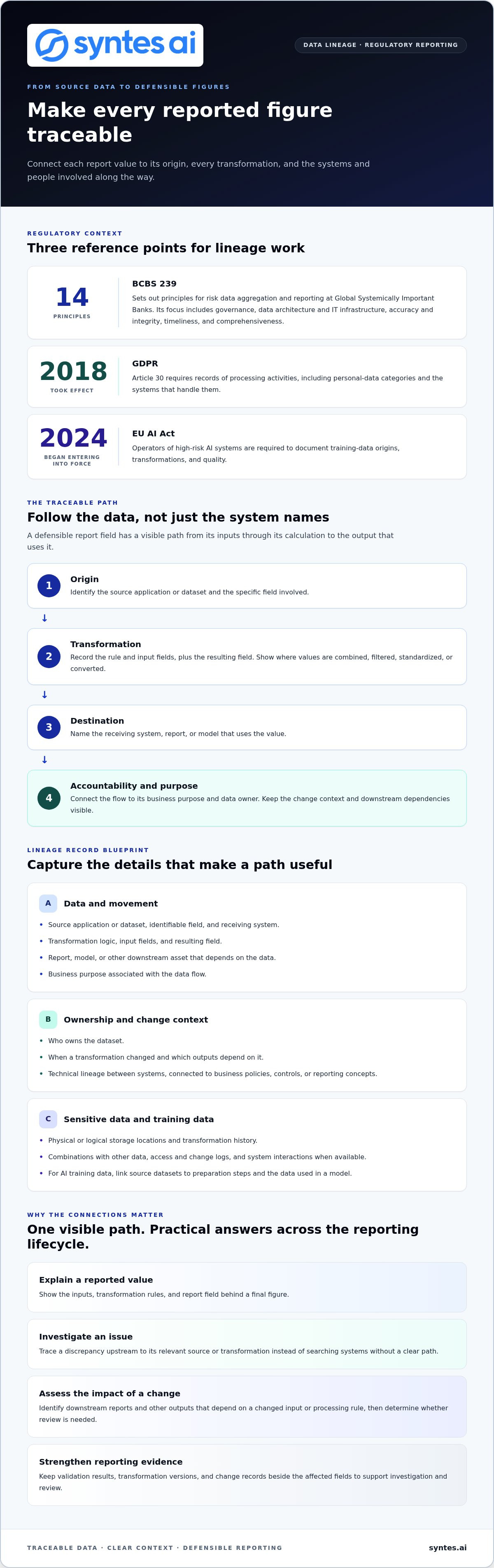
Build the record around identifiable data elements, not just broad system names. Capture the source application or dataset, the field involved, the transformation logic, the receiving system, and the business purpose. If a rule converts several source values into one reporting category, record the input fields and resulting field alongside the rule. This makes the transformation easier to interpret during an audit or incident review.
Include ownership and change context. A lineage record can show who owns a dataset, when a transformation changed, and which downstream reports depend on it. If an input definition changes, the map helps teams identify affected outputs and decide whether a report needs review. Technical lineage shows movement between systems; business lineage connects those steps to policies, controls, or reporting concepts.
The European Union’s General Data Protection Regulation (GDPR) took effect in 2018, according to the European Union. A clear record of data movement gives teams a structured way to understand how information is handled across systems. It also helps separate the source of a value from later calculations, which matters when investigating an inaccurate or incomplete result.
Sensitive Data Locations
Sensitive data location tracking identifies where protected or personal information resides and how it changes across environments. A record might show an identifying field moving from a source database into a derived table and then into a reporting system. This view helps teams locate affected data and understand which downstream assets may need attention when a source or processing rule changes.
Record physical or logical locations alongside transformation history. Include storage systems, combinations with other data, access and change logs, and system interactions when available. For example, linking a sensitive field to a derived dataset can reveal that the output still depends on the original input, even if its name or format has changed. This context is essential for impact analysis and audit documentation.
AI governance adds another dimension: training-data transparency. The EU AI Act began entering into force in 2024, and operators of high-risk AI systems are required to document training-data origins, transformations, and quality. A lineage record can connect source datasets to preparation steps and the data used in a model, helping teams examine provenance and quality rather than treating training data as an opaque input.
Across privacy and AI workflows, preserve the link between each source, processing step, and destination. This connected record helps teams explain data use, investigate errors, and identify where a change could affect sensitive information or model inputs.
End-to-end traceability for regulatory reporting
A regulatory figure needs a defensible path from source through calculation to submitted report. End-to-end traceability makes that path visible, helping organizations test data quality, explain changes, and investigate reporting issues.
For each report field, connect the final value to its inputs, transformation rules, and accountable stakeholders. Show where data entered, how it was combined or filtered, and which report or model used it. A technical record can reveal missing values, inconsistent definitions, or unauthorized changes before they undermine reporting. It also supports root-cause analysis: teams can trace a discrepancy upstream, then assess which other outputs depend on the same input.
BCBS 239 sets out 14 principles for risk data aggregation and reporting at Global Systemically Important Banks. Its focus includes governance, data architecture and IT infrastructure, accuracy and integrity, timeliness, and comprehensiveness. While the standard does not explicitly name data lineage, end-to-end traceability helps banks demonstrate how risk figures connect to raw data and transformation rules. Attribute-level visibility matters: a report-level map may show the dataset, while field-level lineage reveals how a specific risk value was calculated.
In the United States, the Federal Reserve’s Comprehensive Capital Analysis and Review, or CCAR, concerns capital planning and resilience under economic and credit stress for the largest banks. Related regulatory reporting includes FR 2052a, FRY-9C, and FRY-14 reports. Lineage can connect those outputs to source systems and processing logic, allowing teams to examine whether an input change affects a reported measure. It also clarifies which data owners and controls sit along the reporting path.
Data quality evidence is more useful when tied to specific points in the report journey. Organizations can preserve validation results, transformation versions, and change records beside the affected fields. During an incident, this evidence helps distinguish a source-data problem from a calculation error or downstream system issue. Teams can then identify affected reports and prioritize review using dependency links, rather than searching disconnected records.
A practical reporting map should make these relationships inspectable:
- Connect reported fields to their source data and responsible owners.
- Record transformation logic, validation results, and relevant changes.
- Link outputs to dependent reports, models, and downstream systems.
- Use the dependency path to scope investigations and impact analysis.
When report dependencies cross disconnected systems, a unified view can make them easier to inspect. Explore how connected data context supports reporting visibility.
Lineage use in banking, healthcare, and AI governance
Banking, healthcare, and AI governance all depend on trusted data context. Lineage connects technical records to business controls, model decisions, and reporting needs.
Business Data Governance Context
Business data lineage links information to concepts such as policies, controls, ownership, and key performance indicators. This context helps teams understand what a field means, who is responsible for it, and which decisions depend on it. For example, connecting a customer-risk attribute to its definition and control clarifies its role during reviews and audits.
In banking, a changed transaction attribute may affect customer screening, monitoring alerts, or risk reports. Lineage helps financial institutions identify affected models, filings, and outputs, then investigate issues such as mismatched customer IDs or incorrect alert categories. Forward tracing shows where an input is used; backward tracing reveals the data and rules behind a result.
In healthcare, handling sensitive information is an important governance consideration. A lineage map can show how a patient attribute moves from a source system into a reporting dataset, who owns the asset, and which transformations take place. During a case review, this context helps teams examine whether information used in a decision was correctly attributed and handled.
AI Data Governance and Traceability
AI data governance applies ownership, quality, and provenance controls to datasets used by AI systems. The EU AI Act is relevant: operators of high-risk systems must document training-data origins, transformations, and quality. A traceable record connects datasets to preparation steps and model inputs, giving governance teams evidence to review when model data or processes change.
History recall and replay add operational value. If an AI-driven decision or banking alert is challenged, teams can reconstruct which data and transformation rules informed the result. For example, retaining the applicable input versions and processing context can help distinguish a source-data issue from a later change. This supports case reviews without treating a model’s output as an isolated event.
Lineage Strategy
A lineage strategy defines which assets matter most, how ownership is assigned, and what evidence governance requires. Start with a regulatory process, such as customer screening or AI training-data preparation, then map its inputs, transformations, outputs, and accountable roles. This focus ties data governance to real controls rather than creating an inventory disconnected from audits.
Organizations can preserve traceability as systems and policies evolve by capturing metadata consistently and reviewing lineage after material process changes. Connect business terms to technical fields, record ownership, and identify dependencies that could affect reporting or decisions. This creates governance context for targeted impact analysis across banking, healthcare, and AI workflows.
Data lineage for GDPR and TRIM compliance
For GDPR and TRIM, lineage makes data dependencies visible so teams can assess how information is used and how changes affect regulated processes. Compliance platforms commonly combine automated metadata capture with catalogs, transformation maps, and reviewable records. Their value depends on system coverage, field-level detail, and auditability.
Compliance Documentation Requirements
Compliance documentation connects regulatory obligations to the data, systems, controls, and owners involved in each process. This helps teams identify the evidence relevant to a specific review instead of relying on a broad, disconnected inventory.
GDPR Article 17 establishes the right to erasure, according to the European Union. Responding to an erasure request requires organizations to identify systems holding an individual’s data, including downstream copies, transformations, and derivatives. A lineage map can reveal dependencies that a source-system list misses, helping teams locate where data has flowed and which outputs may contain derived information.
SOX focuses on controls over financial reporting, while BCBS 239 addresses risk data aggregation and reporting. CCPA is also identified as a relevant privacy law. These frameworks differ in scope, so a useful governance map ties each process to its applicable controls, evidence, and accountable roles. For a financial report, that could mean linking a calculation to its source fields and control owner; for privacy, it could mean mapping personal-data use across processing systems.
TRIM adds a model-focused lens. The European Central Bank conducts a targeted review of internal models to assess financial institutions’ compliance with specified regulations. Lineage can connect model inputs to their origins, transformations, and uses, supporting review of how data dependencies relate to model outputs. Beyond static documentation, teams can assess how a changed input or processing rule may affect model results.
Compliance Tools and Platforms
Compliance tools differ in how they capture lineage, how deeply they trace data, and how they preserve review evidence. Automated capture can collect metadata across connected systems; catalogs organize assets and ownership; lineage views map dependencies between fields, transformations, and outputs. Each capability addresses a different gap, so compare tools against the evidence a regulatory process requires.
For example, asset-level catalogs provide a broad inventory, while field-level lineage can trace a specific report attribute through transformation logic. Automated capture can improve coverage, but regulatory workflows also need a way to correct errors through audited manual edits. Access logs, change histories, and system interaction records add context for reviews.
Choose a platform framework based on the process being governed. For GDPR, test whether it can trace personal data into downstream derivatives; for TRIM, examine whether model inputs and transformations remain visible. A strong data management approach combines cross-system tracking, detailed lineage, ownership context, and controlled corrections. This comparison shows whether a tool supports actual regulatory requirements or only displays a high-level map.
Which regulations require data lineage documentation, such as GDPR, SOX, BCBS 239, and CCPA?
Regulatory frameworks do not all impose the same lineage duty. Some specify records or controls, while lineage helps demonstrate how organizations meet related requirements. Distinguish explicit documentation obligations from traceability practices that support them.
Under GDPR, Article 30 requires organizations to maintain records of processing activities, including personal-data categories and the systems that handle them, according to the European Union. Those records give teams a structured view of processing. Article 17 establishes the right to erasure, which requires organizations to delete an individual’s personal data from systems holding it, including downstream copies, transformations, and derivatives, according to the European Union. Lineage can help identify those connected locations and data products.
For a practical example, trace a personal-data field from its originating system into a reporting dataset and any derived output. Then connect each destination to the relevant processing record. If an erasure request arrives, the map helps teams identify where the information traveled and which downstream assets may need action. Distinguish source data from transformed values, so a derived field remains in scope even if its name has changed.
SOX requires controls over financial reporting. Lineage can support those controls by connecting a reported figure to its source fields, calculation logic, and responsible owners. BCBS 239 does not explicitly mention data lineage, but traceability helps address its requirements for risk-data accuracy and control over data origins and transformations. For a risk report, teams can map a reported attribute back to its inputs and processing rules, then examine whether a change affects other outputs.
CCPA is a relevant data privacy law, but specific lineage obligations depend on applicable requirements and processing context. Avoid treating every privacy framework as if it required the same technical map. Instead, connect the data assets, business processes, controls, and evidence relevant to each obligation. This gives compliance teams a defensible basis for deciding where detailed tracking matters most.
A useful assessment separates explicit rules from supporting controls:
- Map GDPR processing records to personal-data categories and systems.
- Use downstream lineage to support Article 17 erasure workflows.
- Connect SOX reporting figures to financial controls and source data.
- Apply BCBS 239 traceability to risk-data origins and transformations.
- Assess CCPA processes against the privacy obligations that apply.
This is the practical value of data lineage for regulatory compliance: match traceability to the rule, process, and evidence involved. Field-level mapping may matter for a sensitive reporting attribute, while a broader asset view may suit initial scoping. Preserve ownership, transformation history, and downstream dependencies so reviews can follow evidence rather than assumptions.
Syntes AI: Enterprise Knowledge Graph
Syntes AI’s Enterprise Knowledge Graph unifies complex data into a structured, actionable format, helping organizations connect information across systems. For compliance teams, that connected context can make relationships among data assets, transformations, and reporting processes easier to understand.
Turn to an Enterprise Knowledge Graph when lineage information is fragmented across platforms and teams need a coherent view of how data connects. Syntes AI’s Cross-System Integrations and Context Engineering connect enterprise software and structure data context for operational use. This creates a stronger foundation for examining dependencies and using data relationships across workflows.
To discuss how Syntes AI can support connected data context for your compliance needs, contact Syntes AI or visit syntes.ai.
Make Traceability Part of Operational Practice
Regulatory traceability is strongest when it informs everyday data decisions, not just audit preparation. Treat lineage as an operating capability: connect ownership, system context, and process changes so teams can understand how information supports reporting and governance as requirements evolve.
For organizations working to connect fragmented data environments, Syntes AI offers an Enterprise Knowledge Graph, the Syntes Agentic Platform, and Cross-System Integrations. These offerings structure complex data context, support operational workflows, and connect AI capabilities across existing enterprise software. They can help teams advance data lineage for regulatory compliance as part of broader data operations, with specific controls and evidence aligned to their processes.
Choose a focused next step: identify a reporting or governance workflow where disconnected data relationships create friction, then consider how connected context could improve visibility across it. A clear starting point keeps the work practical and tied to operational priorities.
Build on your teams’ existing knowledge and move toward clearer, more connected data operations.
Frequently Asked Questions
Quick Answer: Why track regulatory data lineage?
Track lineage to explain how a regulated figure or decision was produced and identify what a data change could affect. For example, if a reporting value shifts after a source field is corrected, its dependency path helps teams locate related calculations and outputs. This makes investigations more targeted and gives reviewers a clearer basis for understanding the evidence behind a result.
What role does Data Lineage play in regulatory compliance?
Data lineage connects compliance processes to the information they use, helping teams evaluate controls and explain outcomes. For example, in a financial control review, trace a reported value to its inputs, identify the calculation applied, and associate it with the relevant process owner. This context helps distinguish a data issue from a control or process issue, guiding follow-up without treating every reporting discrepancy alike.
How does data lineage support GDPR right-to-erasure?
Lineage helps locate personal data and its downstream derivatives when an erasure request must be addressed. GDPR Article 17 establishes the right to erasure and requires deletion of an individual’s personal data from systems holding it, including downstream copies, transformations, and derivatives, according to the European Union. A practical response uses the person’s relevant identifiers to trace connected data assets, then records which locations were addressed and the resulting action.
What kinds of questions do technical and business data lineage help to answer?
Technical lineage answers where data resides, which systems process it, and what transformations occur. Business lineage explains what a field represents, who owns it, and which policy, control, or reporting concept depends on it. A technical map, for instance, may show a field’s movement between applications, while business context clarifies why a risk team relies on it and who should assess a definition change.
What level of lineage detail do regulators actually require?
The necessary detail depends on the regulation, process, and evidence under review; no single level fits every case. Asset-level lineage can help scope a data environment, while column- or field-level lineage shows how a specific value was derived. For a sensitive report attribute, teams may need to trace its inputs and transformations. Match the granularity to the question the control or review must answer.
What’s the difference between data lineage for governance and for compliance?
Governance lineage helps an organization manage data ownership, meaning, quality, and permitted use across its operations. Compliance lineage applies that visibility to a defined obligation, control, or review. For example, governance may identify the owner of a customer attribute, while a compliance investigation traces it through a specific reporting process. The same lineage can support both, but governance sets broader accountability and compliance focuses on relevant evidence.
What is data lineage and why is it important for regulatory compliance?
Data lineage records how information moves and changes from its source to its uses. It matters in compliance because teams need to explain the basis of reporting and investigate whether a data change affected an outcome. For example, tracing a changed transaction field into a risk measure can help reviewers identify the affected calculation and the business process responsible for assessing its impact.
What data lineage records and evidence do regulators expect organizations to maintain?
Records should fit the applicable obligation and process. Useful lineage evidence can include source details, transformation logic, access and change logs, audit trails, system interactions, ownership, and downstream dependencies. GDPR Article 30 requires records of processing activities, including personal-data categories and the systems that handle them, according to the European Union. Linking those records to relevant lineage can help teams explain how a specific process handles information and support a focused review.