

Data creates value when people can trust it and use it to make decisions. A data as a product strategy is a roadmap for organizing and managing data products around business objectives, with clear ownership, quality standards, security, and routes to adoption. It connects reliable data to the decisions and AI workflows the organization needs to improve.
That takes more than building datasets or launching dashboards. Teams need to know who a data product serves, who maintains it, how quality is assessed, and why users can trust it. Without those foundations, data is harder to find, interpret, and apply consistently.
This article explains what a data product strategy involves and how it connects data quality, security, ownership, adoption, AI, and business decisions. You’ll learn what makes data products useful, how to align them with measurable outcomes, and how an integrated data foundation can help turn strategy into operational value.
Key Takeaways
- Anchor data products to specific business decisions and outcomes so teams can assess whether they deliver value.
- Build trust through documented definitions, lineage, quality expectations, and governed access.
- Assign clear ownership for each product, then use adoption signals and user feedback to guide its evolution.
- Design data products around how people and AI systems will find, understand, and use them across business domains.
- Connect strategy to execution by aligning data from separate systems with the context needed for operational decisions.
What is a data product strategy?
A data product strategy is a roadmap for using organizational data to meet business objectives. It treats data products as maintained resources rather than isolated analytics outputs, and links technical performance to outcomes such as better decisions and customer experiences.
Business Value and Outcomes
A data product strategy creates business value by making useful data easier to discover, trust, and apply. Data-driven organizations are stated to be 23 times more likely to acquire customers and six times as likely to retain them. Those figures describe organizational outcomes, not guaranteed results from a single data product.
The practical test is whether a product improves a decision or task. A customer analytics product, for example, might help teams tailor offers, while measures of accuracy and availability show whether its data is dependable when needed. Engagement, customer satisfaction, and system performance can help connect product use to business impact.
Alignment With Business Objectives
Alignment means selecting data products to support defined objectives, such as customer experience, product development, or decision-making. A product aimed at retention, for example, should help teams understand customer behavior and act on relevant signals. One framework example is setting a goal to improve customer retention by 10%.
To identify and prioritize data products, start with high-value business problems, then assess which data can support a measurable decision or outcome. Compare use cases by business relevance, user need, data readiness, and ownership. This prevents teams from building products simply because a dataset exists.
Business-Ready Product Characteristics
A business-ready data product is findable, understandable, accurate, and usable for a defined purpose. Clear naming, documentation, and search capabilities help users locate the right product; documented context explains what its fields mean and how they relate. Organizing products around entities such as customers, suppliers, and patients makes them easier to interpret across teams.
For example, a distributor might create foundational products for Orders, Customers, Inventory, and Product Catalog, then develop products for marketing, operations, and sales. This structure makes relationships between business entities explicit and gives users a clearer path from an analytics question to relevant data.
Strategy Steps, Risks, and Examples
Build a strategy by defining the business problem, agreeing on measurable outcomes, assessing available data, and assigning ownership before development. Then prioritize a use case, establish governance, and decide how to measure results. Common risks include siloed data, unclear accountability, poor-quality sources, and products that users cannot find or understand.
Examples show how the strategy links data to decisions: Starbucks uses transaction data to provide personalized customer offers, while Coca-Cola uses analytics to inform strategic decisions and targeted advertising. A campaign objective could be launching 50% faster, used as a measurement target rather than an assumed result. These examples demonstrate why priority, context, and user needs must shape product design.
Data quality, security, compliance, and AI integration
Reliable data products depend on governance that connects quality, security, compliance, and practical access. Those controls also determine whether analytics and AI can produce insights grounded in accurate, usable context.
Governance and Data Trust
Core data product management principles include clear definitions, accountable ownership, monitored quality, documented lineage, and governed access. Together, they help users trust the data and understand how it can be used.
Governance puts those principles into practice. A product should document its business context, definitions, source lineage, access rules, and quality standards. Teams can then trace an insight to its source and identify changes that may affect accuracy. This matters when the same information informs customer decisions, internal operations, and AI systems.
Security controls should protect sensitive information while enabling authorized use. Depending on the data and context, products may need to support regulations such as GDPR, HIPAA, and CCPA. A unified governance approach connects access decisions, cataloging, quality monitoring, and change management, rather than leaving each team to interpret data independently.
Quality and Freshness
Quality means data is fit for its intended use; freshness means it is current enough for that use. Both shape trust: an accurate record delivered too late can still mislead a time-sensitive decision.
Set quality standards according to the product’s purpose. For a customer profile used in service operations, define how to resolve conflicting records, handle missing fields, and identify stale updates. Publish those expectations and monitor whether the product meets them. A clear service-level agreement helps users decide when the data is appropriate for use.
Set freshness requirements according to the decision cycle. A daily planning report may work with scheduled updates, while an operational alert may depend on more current signals. Document update timing, known limitations, and lineage so users can interpret insights correctly. AI models also need current, relevant inputs; otherwise, automated outputs may reflect outdated business conditions.
Useful Data Product Qualities
A useful data product is discoverable, addressable, trustworthy, documented, interoperable, and secure. These qualities help users find the right asset, understand what it means, and combine it with related products without losing context.
For example, a product catalog should use consistent identifiers to connect products across sales, inventory, and service records. Shared standards make those links more reliable and support data exchange. Documentation should explain definitions and lineage, while monitoring can surface quality issues and changes that affect downstream analytics or AI.
Security should be designed into access, not added after a product reaches users. Governance should also clarify how changes are communicated and managed. For organizations connecting fragmented sources, a context graph can preserve relationships among data entities and their meaning. Explore how connected data context can support governed AI integration when inconsistent definitions or disconnected systems obstruct reliable insights.
Data product ownership and adoption
Ownership links each data product to a domain, an accountable person, and a defined business use. A domain-oriented architecture supports this model with self-service data infrastructure and shared governance standards.
Domain Ownership and Accountability
Domain ownership assigns responsibility for a data product to the business area that understands its meaning and use. A customer domain, for example, can maintain customer definitions and resolve conflicting records across its products.
Each product needs a named owner accountable for quality, updates, relevance, and usability. The owner coordinates with technical teams, while governance establishes shared expectations for access and consistency. Clear accountability helps resolve errors at the source instead of passing issues between departments.
Product Mindset and Data Ownership
A product mindset treats data as a maintained resource for users, not a one-time delivery from an analytics team. The owner defines the problem, intended users, roadmap, and measures of success.
Responsibility for cleaning and managing data is shared across the organization. For example, a sales team can flag inconsistent account details, while the product owner coordinates corrections with the source team. This keeps ownership close to business knowledge without making data quality solely the data team’s responsibility.
Data Mesh and Domain Ownership
Data mesh organizes responsibility around business domains, with domain teams producing products for other users. It combines distributed ownership with shared standards, so local accountability does not create isolated or incompatible data.
A supplier domain might publish a reusable supplier product for procurement and finance. Teams need common definitions, access controls, and interoperability to combine it with other products. Self-service infrastructure helps domains publish and maintain products, while governance keeps cross-domain use coherent.
Technology architecture supports data as a product by connecting domain-owned products through discoverable interfaces, shared standards, and governed access. This links distributed sources without requiring every decision to pass through one central team.
Adoption depends on whether a product helps users complete an important task more easily. Track these signals to see whether it is becoming part of real workflows:
- Usage by user type, such as analysts, operations teams, or product teams.
- User feedback that identifies missing fields, confusing definitions, or useful capabilities.
- Business outcomes tied to the product’s intended decision or task.
- Support requests and workarounds that reveal friction or gaps.
For example, if operations staff keep building separate customer spreadsheets, the product may be difficult to find, trust, or use. The owner can investigate these workarounds, improve documentation or access, and track whether usage changes. Make the product the easiest route to the task, then use feedback and metrics to guide its roadmap.
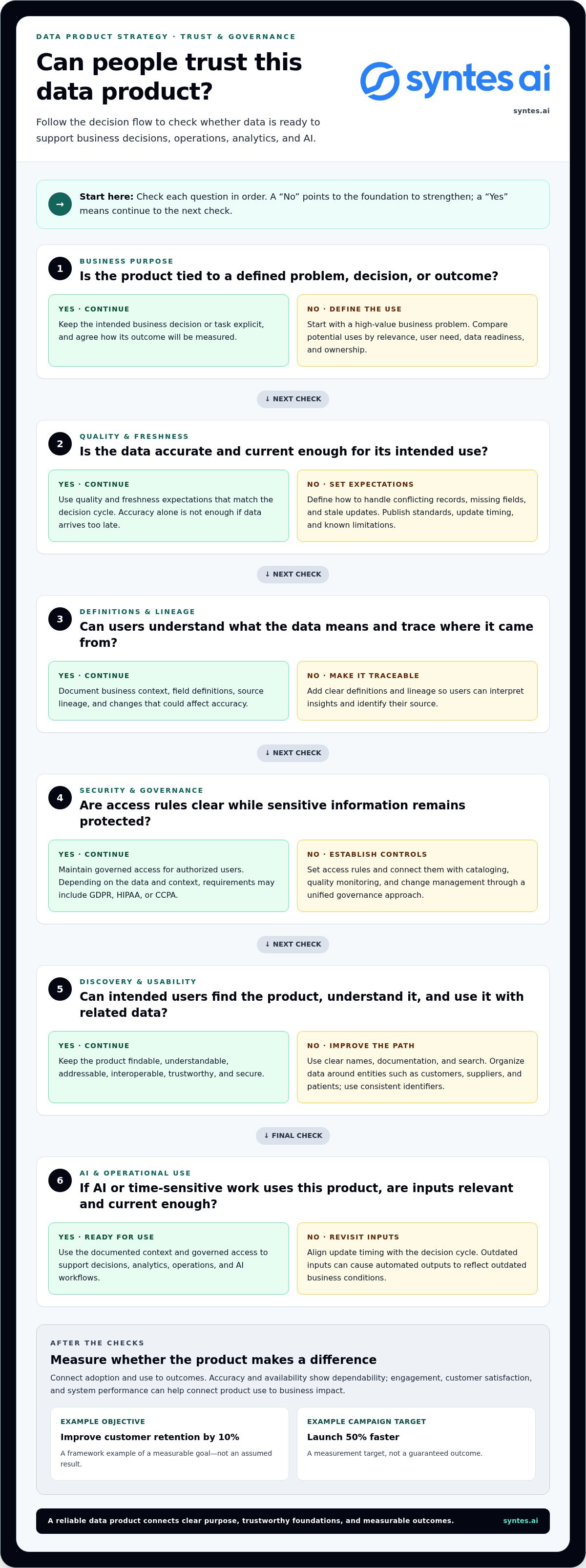
Definition and purpose of a data product strategy
A data product strategy defines how an organization turns data assets into maintained products for business purposes. Unlike a temporary data project, a product has an ongoing use and improvement path. Unlike a platform, it delivers a defined data capability to users. A platform provides shared infrastructure for building, managing, and accessing products.
Defining a Data Product
A data product is a managed data asset packaged for a specific user need, decision, or operational task. It includes data inputs, documented meaning, access methods, quality expectations, an accountable owner, and a defined purpose. A customer product, for example, might unify customer records so service teams can work from consistent information.
This definition helps leaders distinguish a useful product from a dataset that merely exists. The dataset is an asset; the product makes it usable through structure, context, and a clear route to adoption. A strategy establishes how products relate, whom they serve, and how they support business goals over time.
Purpose and Value of Data Products
Data products make reusable information available for internal decisions, AI applications, and, in some organizations, customer-facing offerings. Their value comes from repeatable use: an operations team can apply a governed product to recurring work instead of rebuilding an analysis for each request.
For example, a supplier product can support procurement decisions and provide consistent data for related operational workflows. Its purpose determines which assets belong, how users access them, and which outcomes leaders should assess. That focus keeps development tied to a real business need.
A strategy also clarifies how product development differs from traditional project delivery. A project usually targets a bounded deliverable, such as a one-time report. A data product remains accountable for ongoing relevance, maintenance, and user value after launch. The strategy defines its place in the organization’s broader portfolio.
The distinction from a platform matters too. A platform supplies shared capabilities, while products package specific data and meaning for defined users. A shared data platform, for instance, may support access and processing, while an inventory product gives operations teams structured information about stock and movement. Both matter, but they solve different problems.
Many organizations draw on decades of accumulated documentation, datasets, and digital records. A product strategy gives those assets an intentional route into current work, rather than treating each new request as a separate extraction exercise. It can also help address the reported challenge that 68% of enterprise data remains unused.
A coherent portfolio links foundational products to derived products and business uses. For example, a distributor might build products for Orders, Customers, Inventory, and Product Catalog before developing products for marketing, operations, and sales. This structure shows how shared data assets can serve distinct workflows while retaining links to their original business entities.
Data-driven product strategy and decision-making
Data should change a decision, not merely populate a dashboard. A data-driven product strategy connects each data product to a choice people must make, the evidence that informs it, and the outcome that reveals whether the choice helped. That is the critical shift from reporting activity to improving action.
Start with the decision. A customer team might need to identify which accounts require attention; operations leaders might need to respond to changing demand. In either case, define the user, the decision, and the action the data should enable. Then assess whether available sources provide relevant evidence and whether users can apply it in their workflow.
Metrics make that connection testable. Choose measures that are specific, actionable, and directly tied to decisions. For each significant upcoming feature, define a metric and the direction it should move. If a product helps service teams prioritize cases, for example, measure whether prioritization changes and whether the intended business outcome follows.
Dashboards can reveal patterns, but they don’t prove that a product improved outcomes. Track results after each launch, experiment, or update, then use what you learn to refine priorities and test assumptions. Share results across product and business teams. Successful decisions and missed expectations can both inform the next iteration.
The gap between measurement and business impact remains important. In Gartner’s 2024 Chief Data and Analytics Officer Agenda Survey, 22% of organizations had defined, tracked, and communicated business impact metrics for most data and analytics use cases. Leaders should connect product measures to business results, not stop at usage counts or technical availability.
Use a focused planning cycle: clarify the rationale, assess data, organization, and technology, then define a use case. Secure stakeholder buy-in and budget, develop a minimum viable data product, and measure its effect on the target decision. Data-driven organizations are stated to be 19 times as likely to be profitable, but a product team still needs evidence that its own work contributes to its objectives.
For every product, record the decision it supports, the user group, the expected outcome, and the evidence that will show progress. Review those measures after each release. If users engage with a product but the critical decision stays the same, revise its inputs, presentation, or place in the workflow. Adoption matters, but decision quality and business outcomes determine strategic value.
Syntes AI: Enterprise Knowledge Graph
Syntes AI’s Enterprise Knowledge Graph unifies complex data in a structured, actionable format. It can be a useful next step when disconnected systems, inconsistent definitions, or fragmented business context make trusted decisions and AI workflows harder to support.
Syntes AI’s bi-directional Cross-System Integrations connect data across existing enterprise software, with no rip-and-replace. Context Engineering organizes information around its meaning and relationships. The Syntes Agentic Platform enables businesses to deploy and manage AI agents for operational tasks, using connected data context to inform their actions.
These capabilities can help when a strategy needs to connect data products across domains and make their relationships usable in enterprise operations. Contact Syntes AI to discuss how the platform could support your data priorities.
Turn Data Strategy Into Sustained Business Value
Make your data as a product strategy part of how the organization plans, operates, and learns. Start with a business decision that matters, then connect investment, accountability, and measurement to it. This keeps the strategy grounded in real work and gives teams a clear basis for evolving products as priorities change.
When fragmented systems or disconnected business context stand in the way, Syntes AI’s Enterprise Knowledge Graph and bi-directional Cross-System Integrations, with no rip-and-replace, can help structure and connect complex data. The Syntes Agentic Platform supports the use of AI agents for operational tasks, providing a foundation for moving from strategic intent toward connected execution.
Bring your priorities, data challenges, and intended outcomes to a conversation with Syntes AI. A focused discussion can clarify how connected data capabilities fit your direction and what to address first.
Build with purpose, learn from use, and keep the business decision at the center. Start a conversation with Syntes AI to explore how your strategy can become operational progress.
Frequently Asked Questions
What is DaaP?
DaaP means data as a product: data is managed and delivered to meet a defined user need. For example, a sales team could use a customer account dataset as a product if it has clear definitions, consistent access, and ongoing maintenance. The distinction is practical: users get something they can apply to a task, rather than raw files that require repeated interpretation or rebuilding.
What is a data as a product strategy?
A data as a product strategy sets out which data products to build, whom they serve, and how they support organizational priorities. It also guides investment across the product lifecycle. For example, leaders can compare a proposed supplier data product with other initiatives by asking which business decision it supports, who will use it, and what evidence will show its value.
What roles and teams are needed to manage data products?
Most data products need a business domain owner, a product manager or product owner, and technical contributors such as data engineers and analytics specialists. Data stewards can maintain definitions and resolve disputes about meaning; security and governance teams guide access and controls. For a supplier product, procurement can define its business meaning, engineering can manage data flows, and finance users can provide usability feedback.
What metrics measure the success of a data product strategy?
Measure whether the product reaches its intended audience, supports its target decision, and contributes to a relevant business outcome. Add quality indicators, user feedback, support requests, and workarounds to identify friction. For example, if planners regularly use a forecasting product but still maintain separate spreadsheets, adoption alone is not enough. Investigate why the alternate process continues and whether the product fits the planning workflow.
How do data governance, privacy, and security apply to data products?
Governance sets rules for meaning, access, quality, change, and accountability. Privacy and security controls determine which users can access sensitive fields and for what purpose. Document data lineage, permissions, and intended uses, then review changes that affect downstream products. Regulations such as GDPR, HIPAA, and CCPA may apply depending on the data and context, so design controls around relevant obligations.