

Clean data alone doesn’t make enterprise data ready for AI. Enterprise AI data readiness means information is available, accurate, structured, governed, and aligned with the use case it must support. A dataset may pass basic quality checks yet still undermine an AI initiative if its meaning is unclear, its context is missing, or access controls don’t extend to derived information.
It’s reasonable to focus on data quality first: incomplete, outdated, or inconsistent information can undermine model outputs. But readiness also depends on whether systems can connect data to business meaning and keep it usable, secure, and accountable as it changes. This article explains what AI-ready data requires, how quality and semantic modeling contribute, and why data readiness is distinct from general data readiness and organizational AI readiness. You’ll come away with a clearer way to assess whether data can support a particular AI use case, and what gaps matter most before scaling it across the enterprise.
Key Takeaways
- Assess readiness against the specific AI use case, including data availability, quality, governance, and coverage.
- Evaluate accuracy, freshness, duplication, and drift in context: the acceptable quality threshold depends on the business consequence of an error.
- Use semantic models to connect data to shared business definitions, relationships, and context that AI systems can interpret.
- Separate data readiness from organizational AI readiness: usable data is essential, but it doesn’t replace governance, skills, or operational alignment.
- Prioritize gaps by their potential business impact, then build a remediation path that supports trustworthy AI at scale.
What is AI data readiness?
Enterprise AI data readiness assesses whether information can responsibly support a defined AI use case. Its key dimensions are availability, volume and diversity, quality and integrity, governance, and ethics and responsibility.
Governance and Compliance Controls
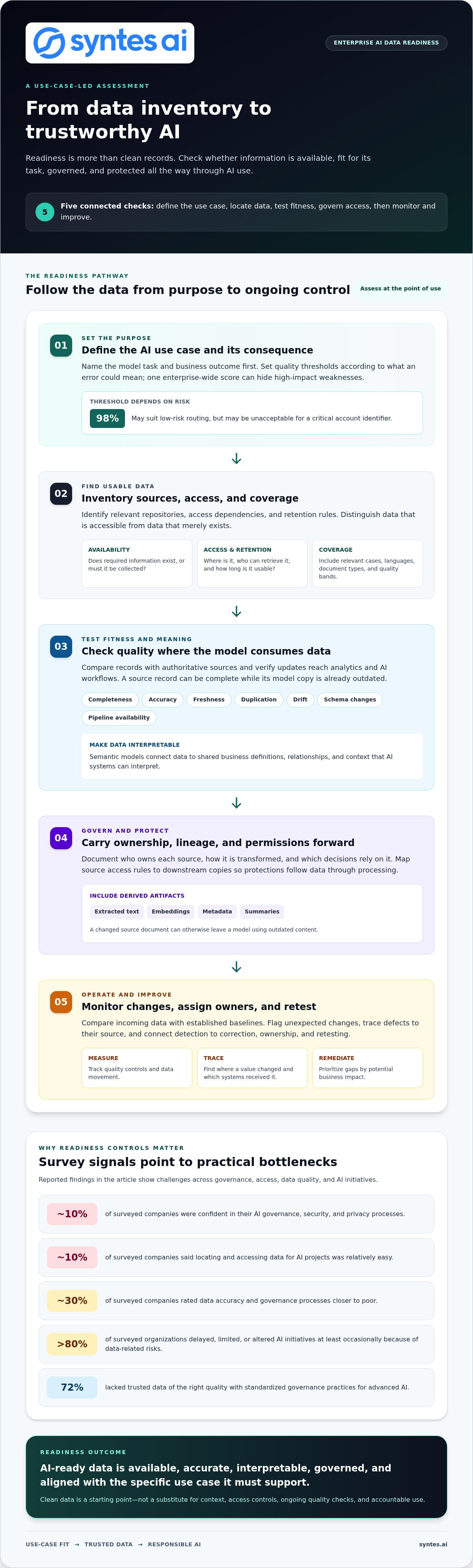
Data governance assigns ownership, tracks origin and use, and preserves evidence for auditability and regulatory compliance. For an AI use case, document who owns each source, how it is transformed, and which decisions rely on it. Governance must also cover extracted text, embeddings, and metadata, not only original files. Otherwise, a changed source document can leave a model using outdated content.
Security, Privacy, and Permissions
Security, privacy, and permissions determine whether AI systems can use data without exposing it beyond authorized purposes. Map access rules from source systems to derived artifacts, including summaries and embeddings, so protections follow data through processing. Only about 10% of surveyed companies were confident in their AI governance, security, and privacy processes. That confidence gap makes permission design a core readiness question, not a final deployment task.
Data Location, Access, and Retention
Location, access, and retention establish where data resides, who can retrieve it, and how long it remains usable. For each AI use case, identify relevant repositories, access dependencies, and retention rules, then trace those conditions into downstream copies. Only about 10% of surveyed companies said locating and accessing data for AI projects was relatively easy. A clear inventory helps teams distinguish accessible data from data that merely exists.
Accuracy and integrity determine whether information remains dependable across source systems. Assess whether records are current, consistent, and free from duplication or drift; a customer profile copied into analytics and a model pipeline can diverge if updates do not flow through. About 30% of surveyed companies rated their data accuracy and governance processes closer to poor. Readiness therefore depends on checking quality where each use case consumes data, not just at its original source.
Governance and auditability also shape regulatory readiness. The EU AI Act is one regulatory driver for stronger data controls. According to the European Union, under the EU AI Act, penalties can reach EUR 35 million, depending on the violation. According to the European Union, under the EU AI Act, penalties can reach 7% of a company’s worldwide annual turnover, depending on the violation. These figures underline why organizations need traceable ownership, permissions, and data use.
Data quality and integrity
Organizations assess AI data readiness by testing availability, accuracy, currency, duplication, drift, accessibility, and security against a defined use case. Common challenges include incomplete or inconsistent records, hard-to-access data, weak governance, and security risks that limit responsible use.
Assessing Data Quality and Fitness
Data fitness is the degree to which information reliably supports a specific model task and its business outcome. Assess records at the point of use, compare them with authoritative sources, and check whether updates reach analytics and AI workflows. For example, a customer record may be complete in a source system but outdated in a model dataset. That discrepancy can distort results even when the original record appears sound.
Quality Controls and Operational Metrics
Quality controls are repeatable checks that catch failures before poor data affects AI outputs or operational decisions. Set measures for completeness, accuracy, freshness, duplication, schema changes, and pipeline availability, then assign owners to investigate deviations. Observability links those measures to data movement, helping teams identify where a value changed and which downstream systems received it. This makes remediation an ongoing practice, not a periodic cleanup exercise.
Common Readiness Risks and Challenges
Readiness risks arise when data quality, access, and security fail together across systems. More than 80% of surveyed organizations delayed, limited, or altered AI initiatives at least occasionally because of data-related risks. Separately, 72% lacked trusted data of the right quality with standardized governance practices for advanced AI. These findings point to operational bottlenecks, not simply model limitations.
Set quality thresholds according to business consequences. A 98% result may be suitable for low-risk routing but unacceptable for a critical account identifier. Evaluate each document type, source, language, and quality band against its intended outcome. This prevents a single enterprise-wide score from concealing serious weaknesses in a high-impact use case.
Keep monitoring after launch. Compare incoming data with established baselines, flag unexpected changes, and trace defects to their source before they spread. In a sales forecast, delayed updates can make current pipeline data appear stale; in analytics, duplicated transactions can distort reported totals. A clear escalation path connects detection with correction, ownership, and retesting.
Quality remediation should follow business impact. Address data issues that could trigger model failure, poor decisions, or compliance exposure before lower-consequence defects. Teams seeking to connect quality signals with operational AI workflows can explore how enterprise data supports AI workflows.
What is AI-ready data?
AI-ready data is accessible, structured information aligned with a defined use case. Data architecture, integration, and platform tools make it usable across enterprise systems.
Enterprise Data Architecture and Infrastructure
Enterprise data architecture defines how information moves from source systems into storage, processing, and AI environments. It matters because a model can answer reliably only when its inputs retain their meaning and relationships. For example, a customer identifier must be handled consistently across a CRM, data warehouse, and analytics workflow.
Map critical data flows and dependencies before choosing infrastructure. A lineage view helps teams trace an answer to its source, while shared definitions reduce conflicting interpretations of terms such as “active account.” Architecture should connect systems without assuming every dataset belongs in one repository.
Integration and Data Fabric Architectures
Data integration connects information across systems, while a data fabric coordinates access and management across distributed environments. Both can help teams use existing sources without replacing operational applications. For example, an AI use case could combine inventory from an ERP system with service records from a support platform.
Design integrations around the use case’s data needs, update frequency, and access permissions. A fabric approach can provide a consistent view across environments, but it still depends on clear metadata and reliable connections. If a source changes its schema, downstream transformations must account for the change.
Scalable and Cloud-Ready Architecture
A scalable architecture handles changing workloads without forcing every AI application through the same data path. Cloud-ready design supports distributed storage and processing while preserving controls over identity, permissions, and data movement. This matters when teams move from a contained pilot to broader enterprise use.
Separate ingestion, transformation, and serving so each can evolve independently. A document-search use case, for example, may require text extraction and indexing, while forecasting depends on structured time-series data. Cloud infrastructure can support both patterns, provided data access and governance remain consistent across environments.
Tools and Platforms for Readiness
Readiness depends on coordinated tools, not a single platform category. Data catalogs document available sources and definitions; integration tools move or connect information; quality and observability tools detect failures; and lineage capabilities show how data was transformed. Together, these tools help teams identify which inputs operational intelligence depends on.
Select tools based on the architecture and use case, not a feature checklist. A team building retrieval over internal documents needs indexing and retrieval capabilities; a reporting model needs dependable analytical workflows. In either case, establish ownership, monitor changes, and connect outputs to the source data behind them.
AI-ready data products and semantic modeling
Reusable data products and semantic models turn disconnected enterprise information into assets AI systems can interpret and apply. They connect structured data with shared definitions, relationships, and business outcomes.
A semantic model defines business terms and how entities relate. For example, “customer,” “account,” and “active contract” need consistent definitions across finance, sales, and service systems. Without that layer, two models can interpret the same field differently and produce conflicting answers. Shared semantic definitions help leaders align model inputs with the decisions those models must support.
A data product packages information for a defined purpose, with clear ownership, documentation, quality expectations, and access conditions. An account-risk product, for instance, might connect payment history, service events, and account status through shared identifiers. Teams can reuse that trusted asset across analytics and AI use cases instead of rebuilding transformations for every project.
Reuse is a strategic capability, not just a platform feature. Data reinventors were three times as likely to intentionally engineer reusable data products; 65% did so, compared with 22% of other organizations. A reusable product can reduce duplicated preparation and make model inputs more consistent, while ownership and documentation clarify how it should be applied.
Semantic structure also helps convert expert knowledge into operational intelligence. Data reinventors were 11 times more likely to convert tacit, expert-driven knowledge into maintained, reusable, and continuously improving enterprise intelligence. A context graph can represent relationships among entities, events, and rules, helping a model interpret why a supplier delay affects a production order rather than merely matching terms.
That design has strategic relevance for productivity and return on investment. Enterprise AI is expected to boost productivity by as much as 40%, with a median expected increase of 15% across regions. These are expectations, not guaranteed outcomes. Leaders can assess value by connecting a data product to measurable workflow changes, such as fewer manual reconciliations or faster exception handling.
Program costs depend on the use case. Key cost factors include source complexity, remediation, integration, governance, and the number of reusable products. Timelines depend on those same factors, as well as stakeholder access and the throughput measured during discovery and pilot work.
To connect investment with outcomes, set a baseline before deployment. Track preparation effort, data defects, model-use frequency, and the operational result the product supports. For a claims workflow, compare manual review volume and exception-resolution performance before and after deployment. This gives leaders a grounded way to distinguish technical activity from business value.
AI data readiness versus general data readiness and organizational AI readiness
These readiness categories overlap, but answer different questions. General data readiness asks whether information is managed for dependable use; AI data readiness asks whether it supports a defined model or generative AI use case; organizational AI readiness asks whether people, governance, and operations can put that use into practice.
General data readiness often focuses on digital information for analytics, reporting, and operational decisions. A sales dashboard, for example, needs consistent customer records and dependable access. AI readiness goes further: assess whether those records provide enough relevant context, suitable metadata, and coverage for the model’s task. A dataset useful for quarterly reporting may not support an assistant answering questions about individual customer commitments.
Use-case scope matters. Organizations can assess readiness for one application, such as fraud detection, or for broader enterprise adoption. Fraud detection requires data that represents relevant transaction patterns and supports the intended decision. An internal knowledge assistant needs accessible documents whose meaning remains intact through processing. A strong result in one assessment does not establish readiness for every AI application.
Organizational readiness concerns the environment around the data: workforce skills, ownership, governance, workflow design, and decision accountability. The McKinsey State of AI Survey found 88% of companies reported using AI in at least one business function, while only about one-third had scaled AI across the enterprise. Adoption in a function, therefore, is not the same as coordinated operational capability.
Skills expose another distinction. About 20% of surveyed companies had employees proficient in AI tools and techniques; only 12% were confident they provided sufficient training opportunities. About 28% had proficiency in AI awareness. These measures describe organizational capacity, not whether a particular dataset is accurate, accessible, or suitable for a model.
Keep the assessments connected but separate. First, define the business outcome and use case. Then assess the required data, including availability, quality, governance, and metadata. Finally, evaluate whether teams can operate the resulting system through appropriate skills, controls, and workflows. Under the EU AI Act, penalties can reach 7% of a company’s worldwide annual turnover, depending on the violation.
The practical takeaway: a mature data estate is a starting point, not proof of AI readiness. Treat readiness as an ongoing process, reassessing data and organizational capabilities as use cases expand. This distinction helps leaders target remediation instead of applying broad upgrades that may not address the actual constraint.
Syntes AI: Enterprise Knowledge Graph
Syntes AI’s Enterprise Knowledge Graph unifies complex data in a structured, actionable format. It can help when disconnected systems and fragmented business context prevent AI from using information coherently. Cross-System Integrations connect AI capabilities across existing enterprise software, while Context Engineering structures the context AI systems need to interpret.
For teams moving from data foundations to operational use, the Syntes Agentic Platform enables businesses to deploy and manage AI agents for operational tasks. These offerings address different readiness gaps: connecting systems, organizing context, or applying agents to work. The right starting point depends on the use case and where data fragmentation creates friction.
Contact Syntes AI to discuss your enterprise data and AI goals.
Turn Readiness Into Your Next AI Capability
Don’t treat readiness as an abstract enterprise score. Choose a business outcome, identify the data and context it depends on, and make the gaps visible to the teams responsible for delivery. That focus turns enterprise ai data readiness into a practical investment decision: what needs to change, why it matters, and how progress will be judged.
When fragmented systems or disconnected business context block progress, Syntes AI can help connect the pieces. Its Enterprise Knowledge Graph structures complex data, Cross-System Integrations connect capabilities across enterprise software, and the Syntes Agentic Platform supports the deployment and management of AI agents for operational tasks. These offerings help move readiness priorities toward connected AI execution.
Take the next step with a focused discussion about your data and AI priorities.
Clear priorities create momentum. Start with the use case that matters most, then build toward AI that can act on enterprise context.
Frequently Asked Questions
Do legacy technology and processes influence readiness?
Yes. Legacy systems can constrain access, integration, and the freshness of information used by AI. For example, a credit-limit update held in a nightly batch may not reach a decision workflow that relies on current account data. Map dependencies between source applications, transfer processes, and AI workflows, then identify where delays or incompatible formats create bottlenecks. Modernization can focus on those specific constraints rather than replacing every system.
How can an effective AI strategy address the gaps in readiness businesses are facing?
An effective strategy connects each readiness gap to a defined business outcome and accountable owner. Start with a use case, identify the required data and workflow dependencies, then rank issues by their impact on that outcome. During discovery and pilot work, measure throughput before setting production commitments. For example, a claims team can test whether its process handles incoming cases at the required pace before expanding AI into other operations.
What is enterprise AI readiness?
Enterprise AI readiness is an organization’s ability to select, govern, deploy, and operate AI in ways that support business objectives. It involves more than data: decision ownership, employee capability, workflow design, technical integration, and risk controls all matter. For example, a model may perform well in testing, but a department still needs clear escalation procedures when its output conflicts with an established business rule.
What is the significance of the AI readiness framework’s five building blocks?
The five dimensions, data availability, volume and diversity, quality and integrity, governance, and ethics and responsibility, reveal constraints that a single score can hide. Availability asks whether relevant information exists; diversity examines whether it represents the scenarios a use case encounters. Governance and responsibility address controlled use and potential impacts. Assessing each dimension separately helps leaders target remediation instead of treating readiness as one broad technology problem.
What metrics of success should executives focus on?
Executives should connect operational results to data and system measures. Choose a business metric first, such as time to resolve an exception, then track supporting signals like data freshness, error rates, workflow throughput, and human escalation frequency. Establish a baseline during discovery or a pilot. For example, a procurement team can compare exception-resolution time before and after an AI workflow while monitoring whether data defects are increasing.
What role does responsible AI governance play in successful AI adoption?
Responsible AI governance defines who can approve, monitor, and challenge AI use, and what evidence those decisions require. For a system that summarizes internal documents, specify permitted data, review procedures for sensitive outputs, and how source changes reach downstream versions. Clear ownership and traceable decisions help teams identify accountability when model behavior changes. Governance also gives employees a defined way to escalate outputs that appear unsafe or inaccurate.
What does enterprise AI data readiness mean?
Enterprise AI data readiness means determining whether information can support a specific AI use case with appropriate access, context, quality, and controls. The assessment is use-case specific. A forecasting model, for example, may depend on aligned product, sales, and inventory records, while an internal knowledge assistant needs documents with usable metadata and clear access permissions. Readiness clarifies the data conditions to meet before a system can serve its intended purpose.
What data quality metrics and benchmarks should enterprises use for AI readiness?
Track completeness, accuracy, freshness, consistency, duplication, schema changes, and lineage for each relevant source and use case. No single threshold suits every task: the acceptable error level depends on its business consequences. Define evidence-based ratings for each readiness pillar, document the criteria, and aggregate results when an overall view helps leaders prioritize. Reassess after source changes or shifts in the use case.