
What if the answer to a costly business problem is already in your data, but scattered across systems, documents, and teams? The strongest enterprise knowledge graph use cases connect those fragments by making relationships visible, so decisions can account for how customers, transactions, suppliers, systems, and policies affect one another.
That fragmentation is familiar to enterprise leaders. Data may be available, yet analytics and AI can miss its business meaning when context is split across disconnected sources. A knowledge graph can help, but not every promising idea should be the first investment. Start with a problem where connected relationships could change a decision or operational response.
This article explores five practical use cases: customer and supplier intelligence, knowledge discovery, risk analysis, and governed AI workflows. You’ll learn how to assess each opportunity for business relevance, feasibility, and risk, and what to evaluate before choosing a solution. The goal is to move beyond assembling data and build trusted context that supports explainable reasoning and action.
Key Takeaways
- Enterprise knowledge graph use cases are strongest when relationships between business entities can change a decision or operational workflow.
- Compare candidate use cases by business impact, relationship complexity, data readiness, risk, and clear ownership before choosing a starting point.
- Match the approach to the question: connected context may call for a graph, while straightforward lookups may be better served by search or relational queries.
- Prepare for a governed pilot by defining the business question, mapping data sources and relationships, and setting evaluation criteria.
- Context Engineering connects, interprets, contextualizes, governs, and enables action on enterprise data.
Enterprise knowledge graph use cases: where connected business context matters
Systems store records, but decisions often depend on the relationships between them. A customer case may involve service history, an active contract, product ownership, and information in a document, with each held in a different system. Searching those sources one at a time can return relevant pieces without showing how they fit together.
An enterprise knowledge graph connects business entities, their relationships, and the meaning of those connections so people and applications can reason across systems. It adds context to records rather than creating just another place to store them. For a foundational overview, see this introduction to the knowledge graph.
This distinction matters when a question depends on how entities relate: which records refer to the same supplier, what systems depend on a particular asset, or how a policy applies to a business event. If the task is simply to find a document containing a phrase, conventional search may be enough. Enterprise knowledge graph use cases become compelling when isolated results leave important context unresolved.
What makes a business problem a strong knowledge graph candidate?
Start with the decision, not the volume of data. A strong candidate requires linking entities across systems, such as an account, its transactions, associated devices, and relevant cases. Look for recurring ambiguity: identifiers that differ between platforms, terms that mean different things to different teams, or relationships analysts must reconstruct manually. A large dataset alone is not a reason to use a graph. The business problem must depend on connected context.
Which business outcomes can relationship-based context support?
Relationship-aware context may help people discover connected records, analyze how entities influence one another, and trace decisions back to relevant information and rules. Treat these as outcomes to test against a defined business question, not guaranteed results. For example, compare whether a team can identify the records relevant to a case more clearly when their relationships are visible.
Separate information access from operational action. An access-focused application helps a person or AI system find and understand relevant context. An action-oriented workflow may recommend a next step or execute one, which requires clear permissions, governance, and an explanation of the context behind the action. Define the outcome before selecting a use case, then assess whether connected relationships improve the decision or workflow.
Five enterprise knowledge graph use cases across data, decisions, and operations
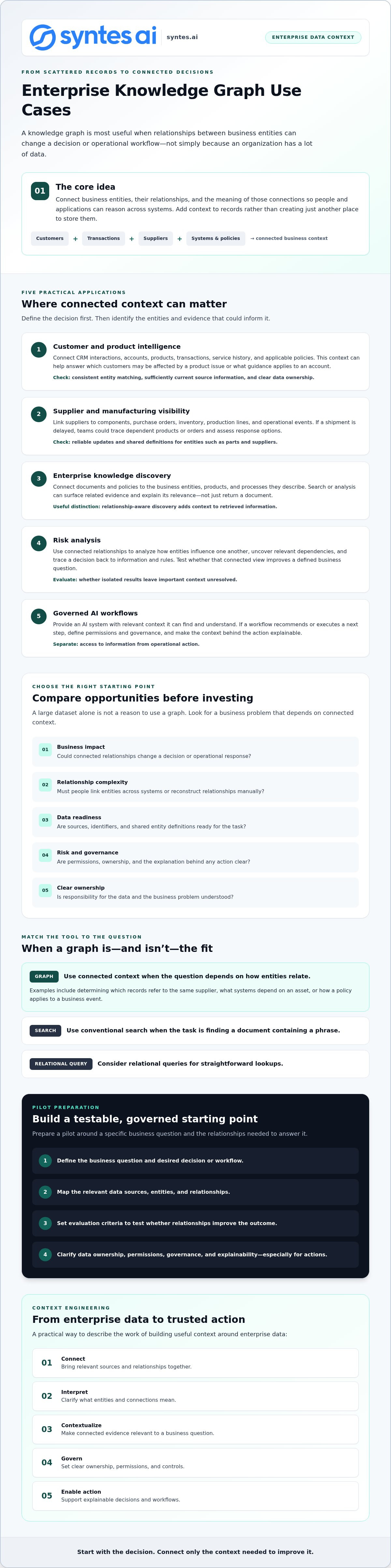
The scenarios below show how relationships can turn scattered records into operational context. They are adaptable examples, not claims of confirmed Syntes AI customer deployments. For each one, define the decision first, then identify which connected entities and evidence could inform it.
Customer, product, and supplier intelligence
- Customer and product intelligence: Connect CRM interactions, accounts, products, transactions, service history, and applicable policies to answer questions such as which customers may be affected by a product issue or what guidance applies to an account. Relationship paths can reveal dependencies that separate records obscure. Check whether entities are matched consistently, source information is current enough for the task, and data ownership is clear.
- Supplier and manufacturing visibility: Link suppliers to components, purchase orders, inventory, production lines, and operational events. If a shipment is delayed, teams could trace which products or orders depend on the affected component and assess response options. The graph’s usefulness depends on reliable updates and shared definitions for entities such as parts and suppliers.
Knowledge discovery, risk analysis, and governed workflows
- Enterprise knowledge discovery: Connect documents and policies to the business entities, products, and processes they describe. Instead of retrieving a document alone, a search or analysis workflow could surface related evidence and explain its relevance. The U.S. National Science Foundation’s Open Knowledge Network illustrates a public-data initiative focused on connecting knowledge to support AI applications.
- Risk analysis: Relate transactions, accounts, devices, policies, and investigation records to examine patterns across entities. A graph can show which connections support a potential risk signal, helping an analyst inspect the evidence before deciding what to do. The graph supports analysis, but sound data and human review still matter when assessing a finding.
- Context-aware agent workflows: An agent could use connected records, policies, and permissions to prepare a recommendation or carry out an authorized workflow step. A graph can connect evidence, entity relationships, applicable rules, and provenance to a business decision, making the reasoning easier to inspect. Keep actions within defined permissions and business rules.
These use cases require more than retrieving relevant text. They depend on current, interpretable relationships and governance suited to the decision. To explore how an enterprise knowledge graph can connect business context, consider whether a specific workflow has the data, ownership, and controls needed for a focused evaluation.
How to compare enterprise knowledge graph use cases and prioritize the first one
Not every complex data problem needs a graph. Prioritize enterprise knowledge graph use cases by testing whether connected relationships improve a specific decision. Then assess whether your organization can support those connections reliably and govern their use.
| Criterion | What to assess | Strong pilot signal |
|---|---|---|
| Business impact | Which decision or workflow is slowed or weakened by missing context? | A named decision has a clear business owner and a meaningful outcome to evaluate. |
| Relationship complexity | Does the question depend on links across entities, systems, or rules? | People repeatedly have to assemble those connections manually. |
| Data readiness | Can the team access relevant sources and resolve duplicate or inconsistent entities? | Core sources are accessible, and relationship quality can be checked. |
| Risk | What could go wrong if the context is incomplete or a recommendation is mistaken? | The initial scope supports review and limits consequential actions. |
| Ownership | Who maintains definitions, permissions, and acceptance criteria? | Business and technical owners are accountable for the pilot. |
When does a knowledge graph add value beyond search or RAG?
Conventional search finds content that matches a query. Relational databases efficiently answer structured questions within defined schemas. Retrieval-augmented generation (RAG) retrieves relevant content to provide context for a language model. A knowledge graph represents entities and their relationships, making it useful when a question requires tracing how records connect or applying business meaning across sources. These approaches can work together. GraphRAG combines graph structure with retrieval, but it is one design option, not a requirement for every application. A graph does not eliminate hallucinations or guarantee correct answers. Source quality, retrieval, permissions, and evaluation still matter.
A graph is a context layer, not an automatic replacement for operational databases or data platforms. Keep systems of record where they are, and add graph capabilities when relationship-aware questions justify them.
Which use case should an enterprise pilot first?
Start with bounded decision support before complex autonomous execution. Choose a use case with accessible sources, relationships that can be validated, manageable governance needs, and a business owner who can define acceptance criteria. Test whether users can find relevant evidence, understand its connections, and make an informed decision. Expand toward recommendations or actions only after permissions, business rules, and review paths are explicit.
For broader fundamentals, see The Executive Guide to Enterprise Knowledge Graphs: From Static Data to Agentic Intelligence. Use the comparison framework here to turn those principles into a focused, testable pilot.
What enterprise teams need to prepare for knowledge graph use cases
A useful pilot starts with a business decision, not a technology diagram. Before building a graph, determine what context the decision requires, which sources can provide it, who governs that information, and how the team will judge whether the pilot works. This preparation turns enterprise knowledge graph use cases into testable initiatives rather than open-ended data projects. For the data architects and software engineers tasked with building these systems, keeping pace with industry demands is key, and platforms like QuickApply can help tech professionals navigate career opportunities and streamline their job search.
How should teams define scope, data, and governance?
Use a readiness sequence that makes responsibilities and boundaries explicit:
- Define the question. Select one decision or workflow, identify its users, and specify what the pilot will and will not do.
- Map the sources. Inventory relevant structured data, such as system records, and unstructured material, such as documents. Record source owners, access conditions, and how often information changes.
- Agree on the meaning. Define key entities, identifiers, and relationships. Assign owners for business semantics and decide how duplicate or conflicting records will be handled.
- Set permissions and controls. Carry access policies into the context used by the graph. Establish lineage so teams can inspect where information came from, and define when uncertain or high-impact outputs require human review or escalation.
- Run a bounded pilot. Set acceptance criteria before implementation. Include whether an answer can be traced to its sources and whether the workflow completes its intended steps within defined boundaries.
Plan for change, too. Source systems evolve, business definitions shift, and permissions change. Assign owners to review these updates so the graph’s context stays aligned with current operations.
How can teams evaluate results without overstating ROI?
Establish a baseline before the pilot and compare results against measures agreed with the business owner. Depending on the workflow, track source traceability, relevance to the question, exception handling, human review needs, and completion of defined workflow steps. Document the evaluation method and its limitations. Do not present early observations as proven financial returns.
For a broader framework for assessing value, see The Business Case for Knowledge Graph Implementation. Treat the pilot as evidence for a decision to refine, expand, or stop, not as a promise that every graph use case will deliver the same outcome.
To discuss a focused evaluation, discuss a governed enterprise knowledge graph pilot.
How Syntes AI supports enterprise knowledge graph use cases
Enterprise knowledge graph use cases need more than connected records. They need a maintained layer of business context that helps people and AI systems interpret relationships, apply relevant rules, and act within defined boundaries. Syntes AI brings these capabilities together through Context Engineering and a live Context Graph. The examples below describe platform fit, not verified customer deployments or promised outcomes.
From fragmented enterprise data to a live Context Graph
Syntes AI connects structured and unstructured information across enterprise systems, then organizes relevant entities and relationships into a shared context layer. In a customer intelligence scenario, that could mean connecting accounts, products, interactions, and policies. In a supply chain scenario, the context may link suppliers, components, orders, inventory, and operational events.
The Context Graph is described as a live, continuously evolving operational model. Its purpose is to make connected business context available to applications, rather than treating knowledge as a static collection of documents. Context Engineering supports that work through five pillars:
- Connect: Bring relevant enterprise sources together.
- Understand: Interpret information and identify meaningful entities and relationships.
- Contextualize: Apply business meaning to connected information.
- Govern: Govern the context and how it is used.
- Execute: Enable governed systems and agents to use that context in workflows.
This approach is relevant when disconnected sources obscure dependencies or business meaning. For a broader discussion of fragmented systems and agentic intelligence, see Solving Enterprise Data Silos: The Strategic Shift to Agentic Intelligence.
From trusted context to governed execution
When a use case moves from finding information to recommending or taking action, context must be paired with controls. Permissions determine what an agent can access; business rules shape what it may do; explainable reasoning helps people inspect which connected information informed a recommendation. These controls matter whether a workflow supports customer operations, supplier decisions, or internal knowledge discovery.
For higher-risk workflows, human review can provide an additional decision point when evidence is uncertain or an action has greater consequences. Syntes AI connects enterprise memory with governed agents that can reason and perform actions, with governance central to execution. Assess the fit against a specific business question, its data sources, and the boundaries required for safe use.
To explore platform fit for a specific use case, book a demo to explore your enterprise knowledge graph use case.
Turn connected context into your next practical move
The strongest enterprise knowledge graph use cases are not defined by data volume. They address decisions that depend on relationships across systems and have a clear way to test whether connected context improves the work. Start with a specific business question, assess data readiness and ownership, then set criteria for traceability, governance, and workflow success before expanding.
Syntes AI combines a Context Graph with governed AI capabilities, supported by a Context Engineering Framework spanning Connect, Understand, Contextualize, Govern, and Execute. This structure is designed to help enterprises move from fragmented information toward context-aware reasoning and action, with permissions and oversight central to use. A strong first step is a focused use case with a decision owner and measurable acceptance criteria.
Choose a problem where relationships matter, define how you will evaluate the result, and keep governance in scope. Book a demo to assess your enterprise knowledge graph use case.
Frequently Asked Questions
What are the most common enterprise knowledge graph use cases?
Common enterprise knowledge graph use cases include customer intelligence, fraud and risk analysis, cybersecurity, supply chain visibility, and enterprise knowledge discovery. Each depends on connecting entities that are often held in separate systems. For example, a risk analyst could examine relationships among accounts, transactions, devices, and investigation records. A graph can surface relevant connections for review, but the use case still depends on suitable data quality, clear business definitions, and appropriate controls.
How does an enterprise knowledge graph create business value?
An enterprise knowledge graph can support business value by making relationships across data sources available for analysis and decisions. It may help teams discover relevant context, trace the evidence behind an answer, or understand dependencies that isolated records do not show. The value depends on whether this context improves a defined decision or workflow. Set a baseline and evaluate results against agreed measures rather than assuming the technology will produce a specific return.
When should a company use a knowledge graph instead of RAG?
Use a knowledge graph when a question depends on explicit relationships, entity meaning, or tracing connections across sources. RAG retrieves relevant content to provide context for a model, while a graph represents entities and how they relate. The approaches are not mutually exclusive: GraphRAG combines graph structure with retrieval when both are useful. Choose based on the task, source quality, and evaluation results. Neither approach guarantees correct answers, so retain appropriate validation and review.
Can enterprise knowledge graphs support AI agents?
Yes. An enterprise knowledge graph can provide agents with connected business context, such as relationships among records, policies, and operational events. This may help an agent interpret a request before recommending or carrying out a workflow step. For action-oriented use, define the agent’s permissions, applicable business rules, and escalation conditions. Keep human review for uncertain or higher-impact outputs where appropriate, and ensure teams can inspect the context behind recommendations and actions.
How do you choose the first enterprise knowledge graph use case?
Choose a bounded problem where a specific decision depends on relationships across accessible data sources. Identify a business owner, define the intended users and workflow, and assess whether key entities and connections can be resolved reliably. Set acceptance criteria before implementation, including how to evaluate relevance, source traceability, and completion of the intended task. A focused decision-support pilot is often easier to assess than a broad initiative or autonomous workflow.
What data is needed to build an enterprise knowledge graph?
The required data depends on the business question. Sources may include structured records from business systems and unstructured information such as documents, alongside identifiers that connect them. Teams also need definitions for entities, relationships, and business terms, plus information about source ownership, access permissions, lineage, and update frequency. Start with the minimum relevant sources, then verify whether records refer to the same entities and whether relationships remain current enough for the intended decision.
How do organizations govern enterprise knowledge graph use cases?
Governance starts with accountable owners for data sources, entity definitions, business rules, and access policies. Preserve permissions, track where information came from, and set review and escalation conditions for uncertain or consequential outputs. For agents, specify which context they can access and which actions they are authorized to perform. Evaluate source traceability, exceptions, and human-review needs during the pilot, then revisit controls as data, workflows, and business definitions change.